You already have a product that sells. Reviews are strong. Retailers know the line. The team assumes Amazon Australia is the next shelf.
That assumption is where many launch plans go wrong.
A launch brand strategy for Amazon AU isn't a listing exercise. It's a market entry decision that affects channel relationships, landed economics, compliance exposure, and how your brand will be perceived when Australian customers encounter it for the first time. For established hardware and consumer brands, a significant risk isn't a slow first month. It's entering the market in a way that weakens pricing discipline, creates operational drag, and teaches the wrong lessons about demand.
Founders usually focus first on ads, content, and catalogues. Operators start somewhere else. They ask whether the offer is compliant, margin-safe, channel-safe, and locally intelligible before they commit inventory. That's the difference between opening a new revenue stream and creating a messy exception the business has to keep fixing.
The Pre-Launch Audit Your Brand Cannot Afford to Skip
Treat Amazon AU as a validation environment, not a duplicate of your home market. If your product wins locally, that proves local traction. It doesn't prove Australian buyers will understand the proposition, accept the price, or trust the listing enough to convert.
That matters more in hardware and household categories because customers compare across more than Amazon. They look at specialist retailers, big-box alternatives, local trade suppliers, and marketplace sellers at the same time. If your offer isn't positioned for that broader market, the listing underperforms and the team often blames traffic when the underlying problem is market fit.
Audit the market outside Amazon
A serious pre-launch review starts with the shelf, but not only the Amazon shelf. Founders should compare:
- Retail positioning: Where would this sit against Bunnings-style expectations, specialist trade offers, and premium direct brands?
- Price architecture: Is your target price coherent once GST, freight, returns, and local customer service are factored in?
- Use-case clarity: Does the Australian buyer immediately understand the job the product does, or does the message rely on home-market context?
- Range logic: Should you launch the hero SKU first, or a tighter bundle that explains the system better?
If your answer to any of those is vague, the launch isn't ready.
A strong audit also tests channel conflict. If you plan to add distributors, retail partners, or other marketplaces later, Amazon AU can't be priced or packaged as an isolated experiment. It has to fit the long-term structure of the brand. That is why the best launch brand decisions are usually made by commercial, operations, and brand leadership together, not by one marketplace manager acting alone.
Compliance belongs in the first conversation
Most launch content treats compliance as paperwork to finish near go-live. In practice, it decides whether the market is viable.
Non-compliance led to 25% of import rejections in 2025, while only 12% of online brand launch guides mention cross-border product adaptation, and that gap has contributed to a 40% failure rate for AU hardware exporters due to regulatory mismatches in the last 12 months, according to US Chamber coverage of underserved market launch risks.
Practical rule: If compliance is still being clarified after inventory is booked, you're not launching. You're gambling.
For hardware brands, that means checking product claims, warnings, packaging statements, manuals, sourcing records, and any safety requirements before you make assumptions about conversion rates or ad spend. It also means testing whether your current supplier documentation can withstand customs and marketplace scrutiny.
The questions worth asking before any stock moves
The pre-launch audit should produce direct yes-or-no answers:
- Does the product solve a clear Australian use case?
- Can the price hold without eroding global brand value?
- Will the listing support future wholesale or distributor conversations?
- Can operations handle returns, replacements, and customer communication locally?
- Are compliance files complete enough to survive review without delays?
If the answer to several is no, pause. A delayed launch with clean foundations is cheaper than a rushed launch that teaches the organisation the wrong market signals.
For brands expanding through Amazon AU, a useful starting point is to review the local channel environment and requirements through Amazon Australia market entry guidance. The point isn't to launch faster. It's to launch with fewer false assumptions.
Navigating Australia's Compliance and Tax Minefield
Most failed entries don't collapse because the product is poor. They stall because finance, customs, compliance, and packaging weren't built into the launch plan early enough.
Australia is often treated as administratively simple because it's English-speaking and commercially familiar. That reading is dangerous. Hardware and household brands run into friction when they assume US, UK, or EU documentation will transfer cleanly. Often it doesn't.
Start with legal saleability, not listing readiness
Before you think about images or PPC, confirm the product can be sold into Australia in the form you're planning to ship. That means checking product safety obligations, category-specific requirements, packaging statements, and any instructions or warnings that need local adaptation.
A practical review usually covers:
- Product claims: Remove or revise statements that could trigger scrutiny if they aren't fully supportable.
- Safety documentation: Keep supplier files, test reports, and product specifications organised and easy to retrieve.
- Labelling: Check packaging, inserts, and instruction manuals for local suitability.
- Customs paperwork: Make sure descriptions, values, and classifications align across documents.
Australian compliance isn't only about avoiding seizure or rejection. It also protects the brand from messy customer experiences after launch. If the item arrives with unclear instructions, unsuitable voltage details, or claims that invite complaints, you create service cost and reputational cost at the same time.
GST changes your pricing logic
Founders often calculate target retail from ex-factory cost and freight, then add ad spend and hope the margin works. In Australia, GST has to be built into the commercial model from the start because it affects price presentation, remittance, and channel comparability.
That pushes a few decisions to the front:
| Decision area | What founders often do | What operators do |
|---|---|---|
| Retail pricing | Copy home-market price logic | Rebuild pricing with GST and local fulfilment assumptions |
| Margin review | Look at contribution after ads only | Model full landed and post-return margin |
| Promotions | Discount early to buy traction | Protect reference price and use incentives carefully |
| Channel planning | Treat Amazon as separate | Ensure Amazon pricing won't damage future partners |
If you sell a premium product, GST isn't a footnote. It's part of the perceived price on the digital shelf. If your margin only works before tax and fulfilment friction, the product isn't ready for the market.
Compliance work is often treated as dead time. In reality, it is where brands decide whether Australia will be profitable or just busy.
Build a checklist someone owns
Founders get into trouble when compliance is "shared" across too many people. Give one person ownership, even if legal, finance, and operations all contribute.
Use a checklist that covers:
- Entity and tax setup: Confirm who is selling, collecting, and reporting.
- Import documentation: Keep commercial invoices, declarations, and product records consistent.
- ACCC-related review: Check whether the product category carries specific consumer safety expectations.
- Packaging and inserts: Align labels, warnings, and instruction materials with local requirements.
- Return handling: Decide how defective, damaged, or refused goods will be processed inside Australia.
A good launch brand process treats all of this as commercial infrastructure, not bureaucracy. If the paperwork is weak, pricing confidence is weak. If pricing confidence is weak, ad strategy and sales forecasts are mostly theatre.
Your Operational Blueprint FBA vs FBM and Margin Protection
The FBA versus FBM choice gets framed as convenience versus control. For established brands, that's too shallow. The core issue is how fulfilment design affects margin, customer experience, stock risk, and your ability to preserve brand standards in a new market.
Premature multi-channel expansion is one reason margins collapse. 68% of Australian consumer goods firms report margin erosion of 15-20% from premature multi-channel launches, often because they failed to model fulfilment costs properly or use tiered distribution, as noted in this launch strategy analysis.

What FBA actually buys you
FBA can reduce operational friction fast. It usually improves marketplace-native service expectations and simplifies Prime participation. For brands entering Australia without local warehousing depth, that can be a sensible starting point.
But FBA also introduces constraints:
- Packaging control narrows: Your carefully designed presentation can be diluted by standard fulfilment handling.
- Inventory mistakes become expensive: Slow movers tie up cash and create storage exposure.
- Returns can get messy: Premium brands often discover too late that reverse logistics affects margin more than the initial outbound cost.
- Range width becomes risky: Launching too many variants before demand is proven increases stock complexity.
FBA works best when the hero SKUs are clear, pack dimensions are understood, and your team accepts that some customer experience elements will be standardised.
What FBM demands from you
FBM gives brands more authority over packaging, inserts, bundles, and service recovery. That matters if the unboxing experience reinforces premium positioning or if your products need tighter handling and better post-purchase communication.
The trade-off is operational discipline. FBM in a new market requires local service levels, reliable pick-pack performance, and return processes that don't break when order volume spikes. If your support team is offshore and your warehouse partner isn't tuned for Amazon expectations, FBM can expose the brand quickly.
A useful way to evaluate the decision is this:
| Factor | FBA | FBM |
|---|---|---|
| Speed to launch | Faster if stock is ready | Slower unless local systems already exist |
| Brand presentation | Less control | More control |
| Operational burden | Lower day to day | Higher day to day |
| Stock flexibility | Strong for proven SKUs | Better for tailored bundles or lower-volume testing |
| Margin visibility | Easier to underestimate hidden costs | Easier to underestimate labour and service costs |
The wrong question is which model is better. The right question is which model fits your brand stage, product characteristics, and risk tolerance in Australia.
For a detailed fee baseline before you commit, use an Amazon fee planning reference to pressure-test unit economics.
Margin protection starts before the first order
Launching into Australia with weak cost modelling is how premium brands accidentally train the market to expect the wrong price.
Watch the operational explainer below before finalising your path:
Protect margin by checking three things before go-live:
- Your price can absorb returns: Especially in categories with defect questions or fit uncertainty.
- Your stock plan matches demand confidence: Don't use broad catalogue depth to compensate for weak launch conviction.
- Your service model matches your promise: Premium positioning with slow responses and clumsy replacements doesn't hold.
I've seen brands choose FBA because it looked easier, then discover the easy part was only the first week. The durable decision is the one that keeps contribution margin intact after fees, returns, service, and discount pressure. That's the operational standard a launch brand plan should meet.
Localisation and Brand Defence on the Digital Shelf
Most international listings fail in subtle ways. The images are polished. The copy is grammatically correct. The title includes the right product terms from the home market. Yet the page still feels imported.
Australian customers notice that quickly. They may not articulate it, but they read for relevance and trust. If the listing sounds like it was lifted from a US catalogue or a UK trade sheet, the brand starts from a weaker position.
Translation is not localisation
For a launch brand to hold value in Australia, every listing element needs to do two jobs at once. It must stay faithful to the brand, and it must feel native enough to reduce friction.
That affects:
- Titles: Keep the important product signals, but avoid stuffing in home-market terminology that Australian customers don't use.
- Bullet points: Write for practical buying questions first. Materials, application, compatibility, and what problem the product solves.
- Descriptions: Remove assumptions that the customer already knows your category language.
- Images and A+ Content: Show use cases that make sense in Australian settings and expectations.
This isn't only about conversion. It's about price defence. If the page feels generic, buyers compare you on price alone. If the page feels precise and locally aware, they compare you on trust and fit.
Consistency protects revenue and brand equity
Brand founders sometimes separate localisation from consistency, as if one weakens the other. In practice, disciplined localisation is how consistency survives expansion.
68% of companies report that brand consistency contributes to 10-20% additional revenue growth, according to branding data from Dash. That matters on Amazon AU because your listing, A+ Content, Store, images, and support messages become the practical face of the brand.
A strong listing doesn't just describe the product. It tells the customer they can trust the brand in this market.
That is why Brand Registry should be treated as foundational, not optional. It gives you a clearer framework for protecting intellectual property, controlling brand assets, and reducing the chance that third-party noise reshapes how the market sees you. If you're mapping that protection layer, review how Amazon Brand Registry support works.
The digital shelf is where premium brands either hold the line or lose it
When I review underperforming international listings, the problem is rarely one fatal error. It's usually a series of small defensive failures:
- The copy uses search terms from another market.
- The imagery explains features but not use in local context.
- The A+ Content looks attractive but doesn't answer buying objections.
- The brand voice changes across ASINs.
- Resellers or duplicate content weaken message control.
Those are not cosmetic issues. They shape whether the customer sees a serious brand or just another imported offer.
A good localisation pass should preserve core identity while tightening the page for local search habits and local buying logic. That includes spelling, terminology, dimensions, installation language, and practical outcomes. Done well, it supports premium pricing without sounding forced. Done poorly, it creates the impression that Australia is an afterthought.
The Strategic Launch Playbook for Generating Velocity
Launch week matters, but not for the reason most founders think. A sharp first week doesn't prove you've built a durable market. It proves you've created enough relevance and enough conversion signal for Amazon to keep testing your product in front of buyers.
That means a launch brand strategy has to engineer velocity with discipline. You need enough movement to gather signal, but not so much discounting or broad targeting that you distort the market's real response.

Structure the first campaigns to learn, not just spend
A common mistake is launching with one automatic campaign, a handful of broad terms, and a large daily budget. That generates activity, but it doesn't build a clean decision framework.
A better early structure separates intent:
- Research campaigns: Useful for discovering search behaviour you didn't predict locally.
- Broad campaigns: Helpful for controlled reach when you're still testing local phrasing.
- Exact campaigns: Best for terms already showing clear conversion intent.
- Defensive brand terms: Important if customers are already searching your brand by name.
Each campaign type gives different information. When everything is mixed together, teams can't tell whether poor results come from keyword choice, listing weakness, price friction, or irrelevant traffic.
Reviews, offers, and conversion need to work together
Launch momentum isn't built by ads alone. It comes from the interaction between traffic quality, listing strength, review credibility, and pricing confidence.
In measured Australian campaigns, post-launch brand lift studies show average awareness lifts of 18-22% and purchase intent increases of 12-15%, while successful campaigns can achieve 25% higher unaided recall rates when they are measured and optimised, according to Dynata's explanation of brand lift measurement.
The lesson isn't that every launch should chase lift studies. It's that optimisation works when the team measures what the market is learning about the brand after exposure.
Use launch offers carefully:
- Coupons: Useful when they reduce hesitation without resetting the brand's long-term reference price.
- Introductory bundles: Often safer than deep discounts if they help explain the system or increase perceived value.
- Review programmes: Ethical early-review mechanisms can accelerate trust, especially for products entering a market where the brand is not yet known.
Operator advice: Discount to remove friction, not to create identity. If the market only responds when the price drops, your positioning still needs work.
Build a first-month rhythm
The first month should feel active but controlled. Teams need a cadence for checking search term quality, adjusting bids, reviewing customer questions, and tightening listing content based on real objections.
A practical first-month rhythm often includes:
- Frequent search term review: Cut waste fast and isolate terms with clean buying intent.
- Listing edits based on questions: Customer confusion is market research in plain language.
- Promotional restraint: Avoid stacking discounts and teaching buyers to wait.
- Review monitoring: Watch recurring praise and recurring friction because both reveal positioning gaps.
The brands that generate sustainable velocity aren't louder. They're cleaner. They enter the market with a sharper proposition, better controls, and a willingness to learn from signal instead of forcing the channel to validate a weak setup.
Your First 180 Days A Roadmap for Performance and Growth
A common Australian launch scenario looks healthy on the surface. Orders come in, ad spend is active, and the team starts forecasting the next SKU wave. By day 90, margin is thinner than planned, returns are exposing product expectation gaps, and too much of the revenue is still paid for. The first 180 days decide whether Australia becomes a disciplined expansion market or an expensive distraction.
That period needs operator discipline, not launch excitement. Teams that do well in Australia review performance at ASIN level, protect price architecture early, and treat customer feedback as commercial signal, not just support noise. McKinsey's launch performance benchmarks note that many launches underperform because teams expand before they have a repeatable model for demand, retention, and unit economics, while stronger launches are measured against clear commercial outcomes such as revenue traction, awareness growth, and repeat behaviour according to McKinsey's launch performance benchmarks.
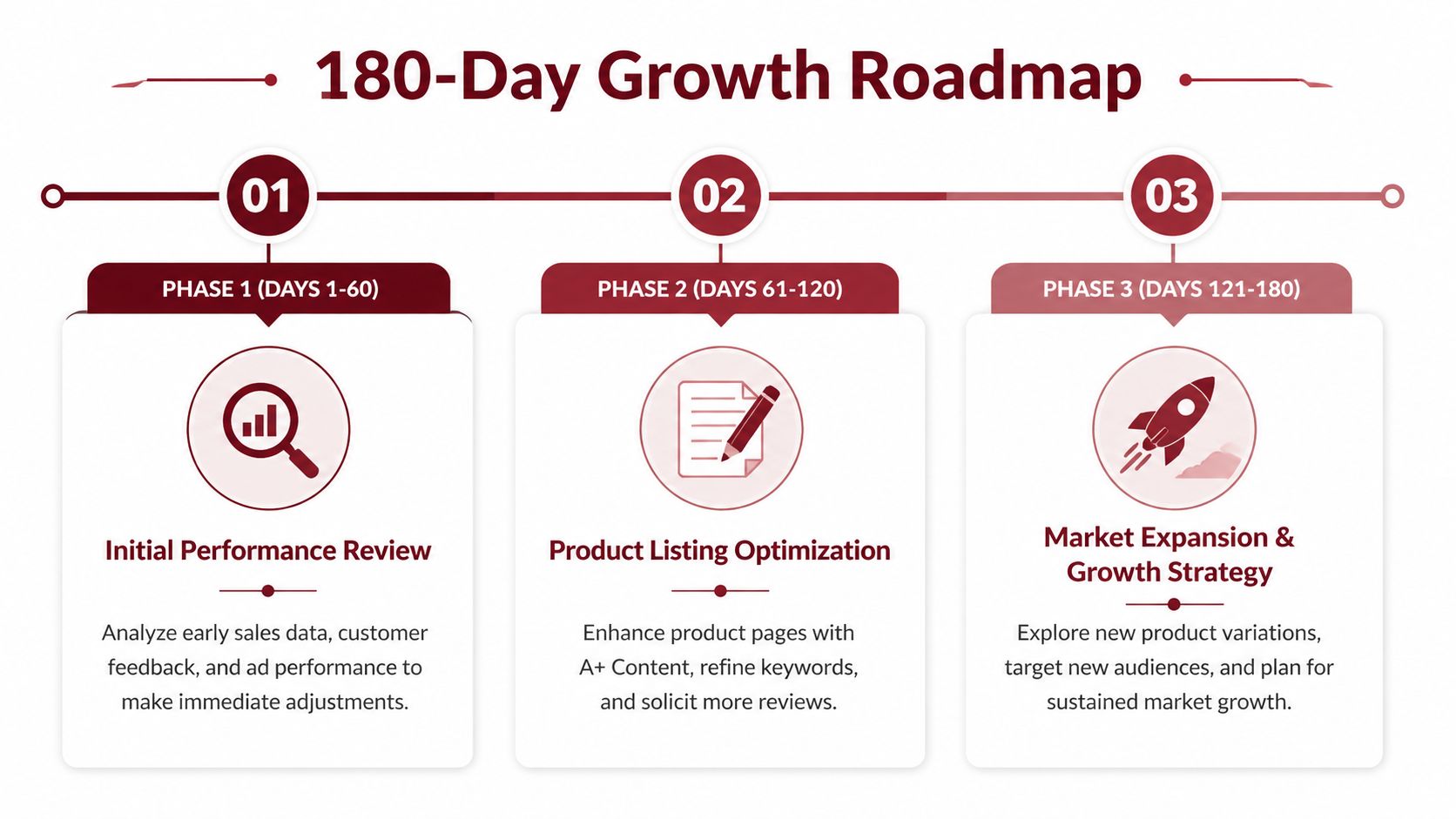
Days 1 to 60
The job here is to separate real demand from paid noise.
Early sales can hide weak fundamentals, especially in hardware categories where buyers need confidence on compatibility, durability, and support. A founder should be asking a harder question than "Are we selling?" Ask whether the right customers are buying at a price that leaves room to scale.
Focus on four areas:
- Sales velocity by ASIN: Identify which products move on their own merit and which need constant support.
- Ad efficiency trends: Track whether paid search is producing useful query data or just buying short-term revenue.
- Customer questions and returns: Repeated confusion usually points to listing gaps, packaging issues, or a mismatch between US or UK messaging and Australian expectations.
- Operational friction: Watch receiving delays, damaged stock, replacement speed, and any increase in negative seller feedback tied to fulfilment.
If signal quality is poor, simplify fast. Cut low-conviction SKUs, fix the listing, and tighten traffic sources before increasing spend. Protecting margin matters more than protecting the original launch plan.
Days 61 to 120
This is the stretch where bad decisions get rationalised as growth. Teams often add variants too early, widen campaigns before search intent is clear, or use discounting to hold volume that was never profitable.
A better approach is to improve the economics of the products already live and decide what deserves more capital.
| Checkpoint | Healthy interpretation | Warning sign |
|---|---|---|
| Organic movement | Relevant terms start contributing more sales | Paid traffic still carries the business |
| ASIN-level margin | Price holds after ad spend, fees, and returns | Margin disappears once incentives are removed |
| Review pattern | Customer language matches the listing promise | Reviews reveal confusion, misuse, or quality concerns |
| Catalogue logic | A small number of hero SKUs are emerging | Too many variants are absorbing spend without clear demand |
This is also where established brands need discipline on channel conflict. If Amazon AU pricing starts pulling against distributor, retail, or DTC expectations, the issue is no longer marketplace performance. It becomes a brand governance problem.
Days 121 to 180
By now, the business should have enough evidence to make a serious market decision. Not a hopeful one.
Three questions matter.
First, is each priority ASIN profitable on a fully loaded basis, including returns, storage, support time, and the promotional pressure needed to maintain rank?
Second, has the launch preserved brand equity? Hardware brands lose ground quickly when price becomes the only reason to convert, or when poor listing clarity creates avoidable negative reviews.
Third, can the operation scale without founder intervention in every exception case? If stock planning, customer issue handling, and listing maintenance still depend on manual fixes, the market is not ready for aggressive expansion.
A strong six-month result is control. Revenue matters, but control over pricing, service levels, and ASIN economics matters more.
If those answers are positive, expand with intent. That may mean broader keyword coverage, selected catalogue additions, better inventory positioning, or regional planning that uses Australia as a stable base rather than a speculative test.
If the answers are mixed, slow down. More spend will not repair weak economics or inconsistent execution. The better move is to narrow the range, correct the offer, and rebuild until the channel performs in a way that protects both margin and brand.
From Product to Global Brand The Strategic Mindset
A successful launch brand in Australia is not the result of one smart listing or one strong ad campaign. It comes from alignment. The product fits the market. The pricing protects margin. The operations can deliver what the brand promises. The compliance work holds up under pressure. The content feels local without losing identity.
That is why strong products often struggle when they enter new markets. Product quality carries the first conversation. It doesn't carry the whole expansion.
Founders who scale well tend to share the same mindset. They don't treat Amazon AU as a side project. They treat it as a strategic test of whether the brand can translate operationally and commercially in a new market. They also accept that growth needs constraints. Not every SKU should launch first. Not every promotion should run. Not every early signal deserves a big inventory response.
The discipline matters because marketplaces magnify whatever is already true about the business. If your positioning is muddy, Amazon makes it obvious. If your service model is weak, customers expose it quickly. If your price architecture is fragile, the market finds the gap.
The upside is equally real. A well-run Australian launch can do more than generate revenue. It can sharpen your brand architecture, improve your content systems, and create a more repeatable model for future market entry.
For established hardware and consumer brands, that is the key opportunity. Not just to open another marketplace account, but to build a stronger company through disciplined expansion decisions.
If you're evaluating whether your product is ready for a controlled Australian launch, TPR Brands works with established brands that want to expand into new channels and regions without diluting brand value or margin.