Global expansion fails earlier than most founders expect. The mistake usually happens before the first overseas shipment leaves the warehouse. A brand reads domestic demand as proof that demand will transfer.
Amazon makes that assumption look reasonable. It can create visibility fast, compress the path to first purchase, and make a new market feel easier than it is. For an established brand, Amazon management is a channel control problem. It requires clear market sequencing, disciplined inventory planning, pricing control, and strong channel governance.
That distinction matters.
A growing marketplace is not the same as a good expansion strategy. Markets such as Australia have attracted serious investment from Amazon and strong customer adoption, which is enough to draw in brands that are underprepared. The winners usually are not the first to launch. They are the ones that enter with the right margin structure, local operating model, and rules for protecting the brand once volume starts to build.
This article approaches Amazon from that angle. Not as a beginner’s route into ecommerce, but as a powerful channel that established brands can use to build international presence without giving up control. A key challenge is deciding where Amazon fits in your global expansion model, and managing it with enough discipline that growth strengthens the brand instead of distorting it.
Why Local Success Doesn’t Guarantee Global Expansion
Domestic traction creates confidence. Sometimes too much of it.
A brand wins in its home market, sees repeat orders, gets positive reviews, and assumes the next country is mostly a logistics problem. It usually isn’t. The hard part is that every new market changes the context around your product. Customer trust resets. Competitive references change. Price expectations shift. Retail habits don’t move in lockstep with your original launch market.

Demand doesn’t travel cleanly
Founders often overestimate what made the product work in the first place. Was it the product itself, the brand story, the channel mix, retailer trust, local word of mouth, or a price position that only made sense in one country? If you don’t know, international expansion turns into guesswork.
Amazon can hide this problem for a while. You can generate early sales through search demand, ads, and fulfilment convenience. But if the offer isn’t adapted to the market, the channel starts pulling the brand in the wrong direction. You discount too early. You chase broad keywords instead of qualified demand. You fix weak conversion with spend rather than positioning.
Practical rule: A product that sells well locally has earned the right to be tested abroad. It hasn’t earned the right to be scaled abroad.
Marketplace access is not market entry
Experienced Amazon management distinguishes itself from seller activity. Seller activity asks, “Can we launch?” Strategic management asks, “Should this product enter this market through this channel at this price with this service promise?”
Those are different questions, and the second set matters more.
A good international move usually comes from restraint. You choose markets where your product travels well. You protect your margin from the start. You decide in advance which parts of the brand are flexible and which aren’t. You treat Amazon as a controlled route to market, not a shortcut around strategy.
Short-term marketplace wins can still damage long-term brand value. That happens when the product enters a region without channel boundaries, without pricing logic, and without a clear plan for who owns the customer relationship.
What founders usually get wrong
The common failure pattern looks like this:
- They confuse reach with fit: Amazon gives access to buyers, but it doesn’t create cultural or category alignment.
- They enter too broadly: Multiple SKUs, multiple ad campaigns, and broad inventory commitments before the first market proves itself.
- They optimize for sales before economics: Revenue looks healthy while margin, pricing control, and operational load deteriorate.
- They treat Amazon as the brand: The marketplace becomes the strategy instead of one component inside it.
That pattern is why some great products never become great global brands. Their expansion wasn’t weak because the product lacked quality. It was weak because management lacked structure.
How to Choose the Right Market for Global Expansion
Most founders start with market size. That’s understandable and often wrong.
A large market can absorb demand, but it can also punish weak entry decisions faster. For many brands, the first international win comes from a beachhead market where product fit, logistics, compliance, and competitive pressure are easier to manage together. That’s why Australia and Canada often deserve more serious attention than they get.
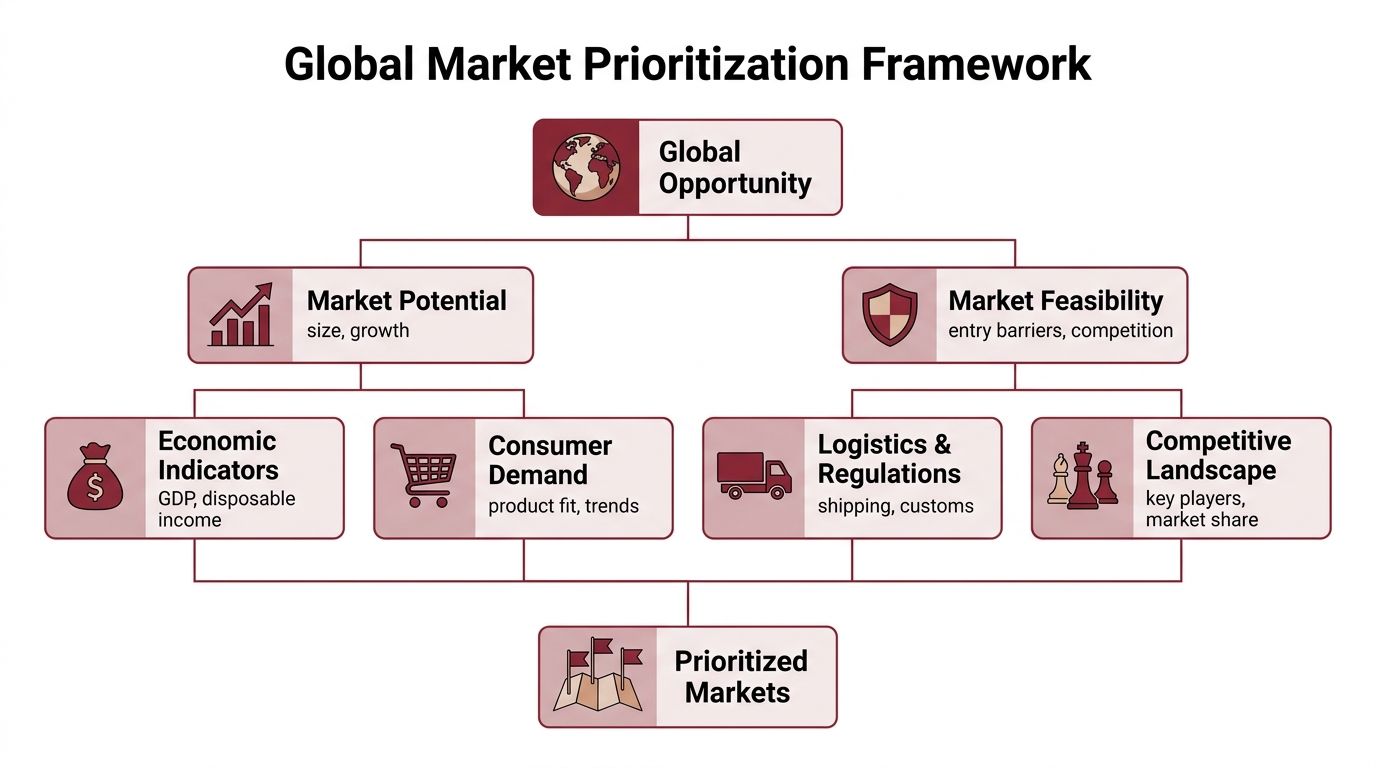
A better way to rank markets
Use a decision framework, not instinct. I look at four lenses before recommending a launch market.
| Lens | What to evaluate | What can go wrong |
|---|---|---|
| Customer fit | Product relevance, language clarity, local use case | Good product, weak local resonance |
| Margin feasibility | Landed cost, fees, ad pressure, returns profile | Revenue growth with poor contribution margin |
| Operational complexity | Freight path, local warehousing, replenishment cadence | Stockouts or trapped inventory |
| Competitive shape | Incumbent brands, private label pressure, channel fragmentation | Expensive customer acquisition with low defensibility |
This framework forces useful questions. Does your product need education? Does it rely on local retail proof? Are there market-specific compliance issues? Can your packaging and positioning survive translation into a marketplace environment?
Why Australia can work as a first move
Australia isn’t just attractive because it’s English-speaking. It can function as a disciplined test market for brands that want to prove international economics before taking on larger complexity.
The marketplace is meaningful, but still manageable enough for founders to see what the channel is teaching them. It also exposes a critical point. Amazon’s systems don’t solely reward demand. They reward operational alignment. In the last 12 months, Amazon AU introduced AI-driven predictive placement for hardware SKUs, boosting delivery speeds by 22% but stranding 18% of seller inventory in suboptimal warehouses, according to analysis discussing AU algorithmic management and ACCC concerns. That means market selection can’t be separated from operational readiness.
If you’re assessing Australia as a launchpad, it helps to review how a structured Amazon store strategy for expansion markets should be built before inventory moves.
A smart first market doesn’t just offer demand. It gives you clean signals about whether the brand can travel.
What a beachhead market should do for you
The first international market should answer strategic questions, not merely produce orders.
Look for a market that helps you validate:
- Price integrity: Can you hold the position without slipping into constant discounting?
- Message transfer: Does the value proposition make sense without heavy education?
- Operational control: Can you replenish, forecast, and support the channel without chaos?
- Channel role: Does Amazon work best as a lead channel, a support channel, or a discovery channel?
A beachhead market is useful when it teaches you how to scale the brand, not just how to ship internationally. Founders who choose markets this way usually make fewer expensive mistakes later.
Designing Your Global Channel Strategy
The biggest strategic mistake I see is treating Amazon as the expansion plan.
It isn’t. It’s a powerful route to market inside a broader commercial system. When founders forget that, Amazon starts making decisions that the brand should be making. Price position drifts. Other channels get undercut. Retailers become cautious. The team starts chasing marketplace metrics while the underlying brand becomes less coherent.

Three common models and their trade-offs
There are usually three viable channel models when entering a new market. None is universally right.
Model one is Amazon-led entry. This works when speed matters, the product converts well in search, and fulfilment reliability is central to the customer promise. It can create fast data and faster market learning. It can also compress the brand into a marketplace-first identity if you don’t control pricing, assortment, and content standards.
Model two is distributor-led entry. This works when the category relies on trade relationships, in-country compliance handling, or local ranging knowledge. The upside is market access and operational relief. The downside is distance from the customer and reduced control if the distributor sees the product as inventory rather than brand equity.
Model three is direct-to-consumer-led entry. This gives the brand maximum control over story, customer data, and margin structure. It also demands patience, localized marketing capability, and a service model that can support the customer experience.
The better answer for established brands is often a hybrid. Amazon handles discovery and fulfilment in categories where convenience matters. Distribution supports broader physical access where needed. DTC protects narrative, pricing context, and owned demand.
What works and what doesn’t
A useful way to think about global channel strategy is to separate access from control.
What works:
- Using Amazon as a demand engine: Let the marketplace surface buying intent and operationally support fast fulfilment.
- Restricting assortment intentionally: Launching every SKU at once usually muddies demand signals and complicates replenishment.
- Setting channel rules early: Define who can sell, at what price architecture, and with what content standards.
- Protecting premium cues: Packaging, imagery, copy, and review acquisition all shape whether the product feels established or opportunistic.
What doesn’t:
- Going marketplace-only by default
- Allowing channel conflict to “sort itself out”
- Using discounting to create velocity
- Treating ad spend as a substitute for positioning
Prime events show why this matters. During Prime Day 2025, Amazon generated over AUD 500 million in sales in Australia, with 2.5 million items sold and 25% growth from the prior year, according to AWS reporting on Prime Day 2025 milestones. Brands that approach events like this without a channel strategy often see a short revenue spike followed by inventory stress, margin slippage, and noisy demand signals.
A deeper look at the marketplace dynamic is useful here:
The right role for Amazon
Amazon is strongest when it does jobs that suit it. Fast discovery. Fulfilment credibility. Search-driven category access. Event-driven demand capture.
It is weaker as the sole home of the brand.
Founder lens: If Amazon disappeared from your plan tomorrow, would the brand still know how it wins in that market?
That’s a hard question, and it reveals a lot. If the answer is no, you’re not building a channel strategy. You’re outsourcing strategic thinking to a marketplace.
Strong Amazon management keeps Amazon productive without letting it become dominant. That’s the distinction mature brands need to make before they scale internationally.
Choosing the Right Partners for Global Amazon Expansion
Founders usually want control. That’s reasonable. But international expansion punishes the kind of control that comes from doing everything yourself.
The hidden problem isn’t effort. It’s instability. New markets introduce compliance friction, fulfilment exceptions, pricing disputes, retailer sensitivity, and marketplace communication gaps. Those issues don’t arrive one at a time. They stack. And once they stack, the founder ends up acting as operator, channel manager, and crisis buffer all at once.

Why external stability matters
A partner’s value isn’t only market access. It’s continuity.
That matters more on Amazon than many founders realize. In Amazon AU, internal leaks in 2025 indicated regional managers were operating under 20% attrition quotas, leading to 30% ops team turnover and disrupted vendor communications, according to reporting on Amazon manager attrition pressure. If your market entry depends on perfectly stable internal communication inside the platform, you’re building on a shaky base.
A good external partner absorbs some of that volatility. They keep replenishment moving, escalate issues properly, and stop every internal platform disruption from becoming a founder-level emergency.
What to look for in a partner
Not all partners protect brands. Some just move units. That’s a very different job.
Use a vetting standard like this:
- Brand discipline: They should care about price architecture, listing consistency, and channel boundaries.
- Operational competence: They need to handle forecasting, inbound timing, compliance detail, and exception management.
- Market fluency: They should understand what local buyers expect, not just how to open an account.
- Reporting clarity: You need visibility into performance, inventory risk, and margin, not vague summaries.
- Conflict management: They should know how to manage retailer tension, marketplace pressure, and unauthorized seller problems.
The right partner reduces entropy. The wrong one adds another layer of it.
A simple test founders can use
Ask potential partners how they respond when growth creates strain. Not when everything is working. When it isn’t.
Do they widen discounts to clear stock? Do they add marketplaces before the first one is under control? Do they chase sales events without protecting the wider channel? Their answers usually tell you whether they think like operators or traders.
For brands evaluating support options in this area, a useful reference point is the broader category of Amazon expansion partner models that combine marketplace execution with channel and brand control. The important issue isn’t the label. It’s whether the partner behaves like a custodian of value or a short-term revenue broker.
Partnership is not a loss of control
Founders often frame partnership as a compromise. In practice, the right partnership is a way to keep control over the things that matter most.
You should still own positioning, product standards, and brand direction. A partner should own execution quality in places where local complexity, platform pressure, and operational speed matter more than founder proximity.
That division of labor is what lets a product scale without the brand becoming diluted in the process.
Amazon Operations for Global Expansion: What Matters Most
Good strategy fails quickly when operations are weak.
Amazon management’s practical value is evident. Inventory placement, replenishment timing, pricing governance, and compliance detail determine whether a market entry stays controlled or starts leaking margin. Founders who ignore this layer usually discover the problem too late, when fees rise, stock availability weakens, and the channel becomes difficult to stabilize.
Inventory is not just a supply chain issue
Inventory on Amazon is a strategic lever. Too little stock and your momentum breaks. Too much stock and the platform starts charging you for poor discipline, while your capital gets trapped.
In Amazon Australia’s marketplace, an Inventory Performance Index, or IPI, needs to stay above 400 to avoid shipment restrictions, and top sellers aim for 550+ to maintain a competitive edge and access additional storage capacity, according to Pangolin’s analysis of Amazon AU inventory data. That single metric tells you a lot about how Amazon wants brands to operate. It rewards sell-through, in-stock consistency, and inventory quality, not just volume.
For brands entering a new market, this means inventory planning cannot be delegated to instinct or spreadsheet optimism.
A practical inventory discipline
The strongest operators build their launch around inventory logic before they build around ad logic.
Use a framework like this:
-
Start with a narrow SKU set
Launch the products that have the clearest use case and the cleanest margin. Early international expansion is for signal gathering, not catalogue display. -
Set replenishment around evidence
Reorder based on sales velocity, local seasonality, and lead time reality. Founders often over-order because they want to avoid stockouts. The result is aged inventory and reduced flexibility. -
Watch stock health weekly
Review stranded units, excess inventory risk, and in-stock exposure at a regular cadence. Delayed reviews create expensive surprises. -
Separate launch inventory from event inventory
Prime events, retail promotions, and seasonal peaks should not share the same assumptions. Event stock needs its own plan.
Brands that need support on this side should assess whether they have the in-country systems and warehousing relationships required for fulfilment across expansion markets. If they don’t, operational drag will show up before brand demand has a chance to mature.
Operating principle: Inventory should support the strategy. It should never become the strategy.
Margin protection needs rules, not hope
A surprising number of brands enter a new market without a proper view of what they can afford to sell at.
That’s dangerous on Amazon because the platform compresses every weakness. Advertising costs, marketplace fees, returns, foreign exchange movement, and local tax settings all eat at contribution margin. If the launch price is wrong, the team often tries to buy its way out with promotional activity. That creates top-line movement and usually weaker economics.
A better approach is to define margin boundaries before launch:
| Decision area | What to lock in early |
|---|---|
| Base sell price | A price position that survives fees and expected ad spend |
| Promotional range | Clear limits on discounting and event participation |
| Channel parity rules | How Amazon pricing interacts with retail and DTC channels |
| Currency policy | How often pricing is reviewed when costs move |
If you don’t set these rules, Amazon will pressure the weakest part of your model first.
Compliance should be built into product selection
Compliance mistakes usually begin much earlier than founders think. They often start when the wrong product gets chosen for the first market.
If a SKU needs complex local adaptation, labelling changes, or category-specific documentation, it may still be viable. It just may not be the right beachhead product. Expansion gets easier when your initial range is selected partly for operational simplicity.
A practical checklist for launch review should include:
- Labelling readiness: Packaging and claims need to fit the target market’s standards.
- Documentation control: Product files, test records, and supplier information must be accessible and current.
- Returns handling: Cross-border returns processes need to be clear before the first order ships.
- Customer support language: Instructions, troubleshooting, and listing copy should read naturally in-market.
FBA versus local support structures
Founders often ask whether they should rely fully on FBA or build around regional support structures such as local warehousing or third-party logistics. The answer depends on the product, market, and channel mix.
FBA is strong when speed and marketplace trust matter most. It can be less forgiving when the assortment is broad, replenishment is uneven, or the market needs more channel flexibility. Regional support structures can improve control, but they also require more operational maturity.
The trade-off isn’t convenience versus difficulty. It’s standardization versus flexibility.
Strong Amazon management makes that trade-off deliberately. Weak management drifts into it after problems have already appeared.
How to Launch and Measure Amazon Expansion Performance
A controlled launch protects brand value better than an aggressive one.
Established brands often enter a new Amazon market with too much confidence. They launch too many SKUs, spend too early on ads, and load inventory before the market has shown which products, price points, and messages travel. That approach can create activity fast, but activity is not proof of fit.
The better launch model is staged. Start narrow. Learn quickly. Expand after the economics and customer response hold up under real trading conditions.
What a real test phase looks like
A serious test phase is built to answer commercial questions, not to create the appearance of momentum. The goal is to reduce uncertainty before you commit more stock, more spend, and more organizational attention.
Focus on a tight group of signals:
- Assortment clarity: Which products earn conversion without dragging margin down?
- Price acceptance: Will the market buy at a price that supports the channel, after fees and fulfilment?
- Content resonance: Does the listing explain the product in a way that matches local buying behavior?
- Operational consistency: Can you stay in stock and keep the customer experience stable during the first demand spikes?
Conservative launches frustrate impatient teams. They also prevent expensive mistakes.
Sales can give you the wrong answer
Early revenue is useful, but it is one of the easiest metrics to misread. A burst of demand can come from launch discounts, novelty, temporary ad efficiency, or weak competitive response. None of that guarantees the brand has earned a durable position.
Amazon’s own seller guidance reinforces the same point from another angle. The marketplace recommends tracking business reports, conversion, traffic, and repeat purchase behavior because raw sales alone do not show whether a listing is building healthy demand or buying short-term volume through spend and discounting.
Founders need to separate market interest from market quality.
Strong early sales show attention. They do not show control.
The scorecard that matters
The right scorecard answers a harder question. Is this market getting stronger, or just busier?
I look for evidence in a few places:
- Branded search quality: Are customers starting to look for the brand by name rather than only through generic terms?
- Review pattern: Do reviews arrive steadily, and do they confirm the value proposition the brand intends to own?
- Pricing discipline: Can the brand hold its planned price architecture without constant promotions?
- Contribution margin by market: Does the country still work after Amazon fees, freight, returns, tax complexity, and support costs?
- Channel effect: Is Amazon strengthening broader market entry, or creating pricing conflict with other channels?
Here, experienced Amazon management earns its keep. It forces a brand to judge launch performance with commercial discipline, not marketplace excitement.
Some markets look promising on the dashboard and still deserve a pause. Others start smaller but show the exact signs of durable demand, cleaner economics, and better long-term channel fit.
Scale after the evidence is clear
Good scaling discipline is usually simple.
Prove one market with a focused range. Stabilize availability. Confirm that customer feedback supports the intended positioning. Then expand SKUs, ad spend, or channel reach.
That sequence feels slower than Amazon encourages. For established brands, it is usually faster in the only way that matters. It reduces rework, protects pricing, and keeps Amazon operating as a controlled part of global expansion rather than turning into the business model itself.
Turning a Great Product Into a Great Global Brand
A product doesn’t become global because it’s available globally. It becomes global when the brand can hold its value across markets, channels, and operating conditions.
That’s why Amazon management matters so much. Not as a narrow marketplace service, but as part of a larger expansion discipline. The brands that scale well usually make the same set of decisions. They choose markets carefully. They define Amazon’s role instead of letting the platform define it for them. They build partnerships that reduce instability. They treat inventory, pricing, and compliance as strategic controls.
The brands that struggle usually do the opposite. They move too broadly, measure too shallowly, and allow short-term marketplace wins to distort the long-term shape of the business.
Founders don’t need to avoid Amazon. They need to use it with intent. Done well, it can be an efficient discovery channel, a credible fulfilment engine, and a useful proving ground for international demand. Done poorly, it can compress a strong brand into a reactive marketplace operation.
That distinction is where serious growth decisions get made. Companies such as TPR Brands work with founders navigating that gap, helping proven products enter new markets with more structure, better channel judgement, and tighter control over brand value.
If you’re assessing whether your product is ready for controlled international expansion, TPR Brands provides a practical model for founders who want to open new markets without losing pricing discipline, channel control, or brand integrity.