The most popular advice on how to sell on Amazon is also the advice that gets established hardware brands into trouble. It treats US entry like admin. Set up the account, ship stock, turn on ads, wait for demand.
That’s backwards.
If you already have a proven product in Australia, the challenge isn’t whether you can upload a listing. The challenge is whether the product, economics, compliance position, and fulfilment model still work once you place them inside the US market. Amazon is not just a channel. For a hardware founder, it’s a separate operating environment with different competitive density, different product standards, different customer expectations, and very little tolerance for sloppy market entry.
Founders usually feel this too late. The listing goes live, traffic arrives, conversion drifts, support tickets increase, landed cost assumptions unravel, and the business starts subsidising “growth” that never becomes healthy margin.
Why US Market Entry Fails for Strong Product Brands
A strong product can fail in the US for reasons that have nothing to do with product quality. That’s the first mindset shift.
Many Australian brands have already learned how to compete in a comparatively mature local Amazon ecosystem. Amazon Australia has approximately 160,000 active sellers as of 2025, while the US marketplace has over 1.1 million sellers, which creates a very different competitive environment and raises the standard for positioning, launch discipline, and visibility from day one, as noted in Forceget’s 2025 Amazon seller statistics.

Good products fail when founders mistake translation for strategy
US entry often starts with false confidence. The product is selling at home. The packaging looks professional. The founder has a manufacturer, a freight path, and a few competitors already on Amazon.com. It feels close enough.
It isn’t.
A hardware product can be commercially strong in Australia and still be weak in the US for practical reasons:
- The value proposition doesn’t localise well. Features that matter in Australian retail may not be the features that drive Amazon conversion in the US.
- The certification path changes. A compliant product in one market isn’t automatically ready for another.
- The landed cost profile shifts. Freight, prep, storage, returns, and duties can subtly break the model.
- The listing enters a denser battlefield. In the US, more sellers means weaker products can still crowd the page if they’re better positioned.
The result is predictable. Founders think they have a sales problem, so they spend more on traffic. In reality, they have a market-entry design problem.
Practical rule: If your first US Amazon plan begins with “list the range and test ads”, you’re already too far downstream.
Amazon is a market, not a warehouse outlet
The brands that succeed treat Amazon US as a structured market entry. They don’t use it to dump export stock. They use it to test product-market fit under local conditions.
That changes the sequence of decisions. You don’t begin with catalogue upload. You begin with product selection, margin protection, compliance viability, and fulfilment architecture.
For hardware brands, that also means accepting a hard truth. A product that wins in trade, independent retail, or DTC may still need a different story on Amazon. The platform compresses comparison. Buyers scan images, title, proof points, review signals, fulfilment promise, and price in a matter of seconds. If your offer isn’t immediately legible, it won’t matter how good the product is.
The brands that handle this well usually narrow before they scale. They launch the right SKU set, not the full range. They build the listing around the conversion trigger, not the internal product hierarchy. They model downside before they commit inventory.
That’s the discipline required if you want to bring Australian products into the USA without turning a proven brand into an expensive experiment.
Your Strategic Checklist Before Shipping a Single Unit
Before inventory leaves your warehouse, you need a go or no-go framework. Not a launch checklist in the shallow sense. A commercial filter.
The biggest error I see is founders doing research that confirms enthusiasm rather than tests viability. They look for search demand, identify comparable products, and assume the rest is operational detail. For hardware and home improvement brands, the core work sits in the tension between demand, margin, compliance, and channel control.
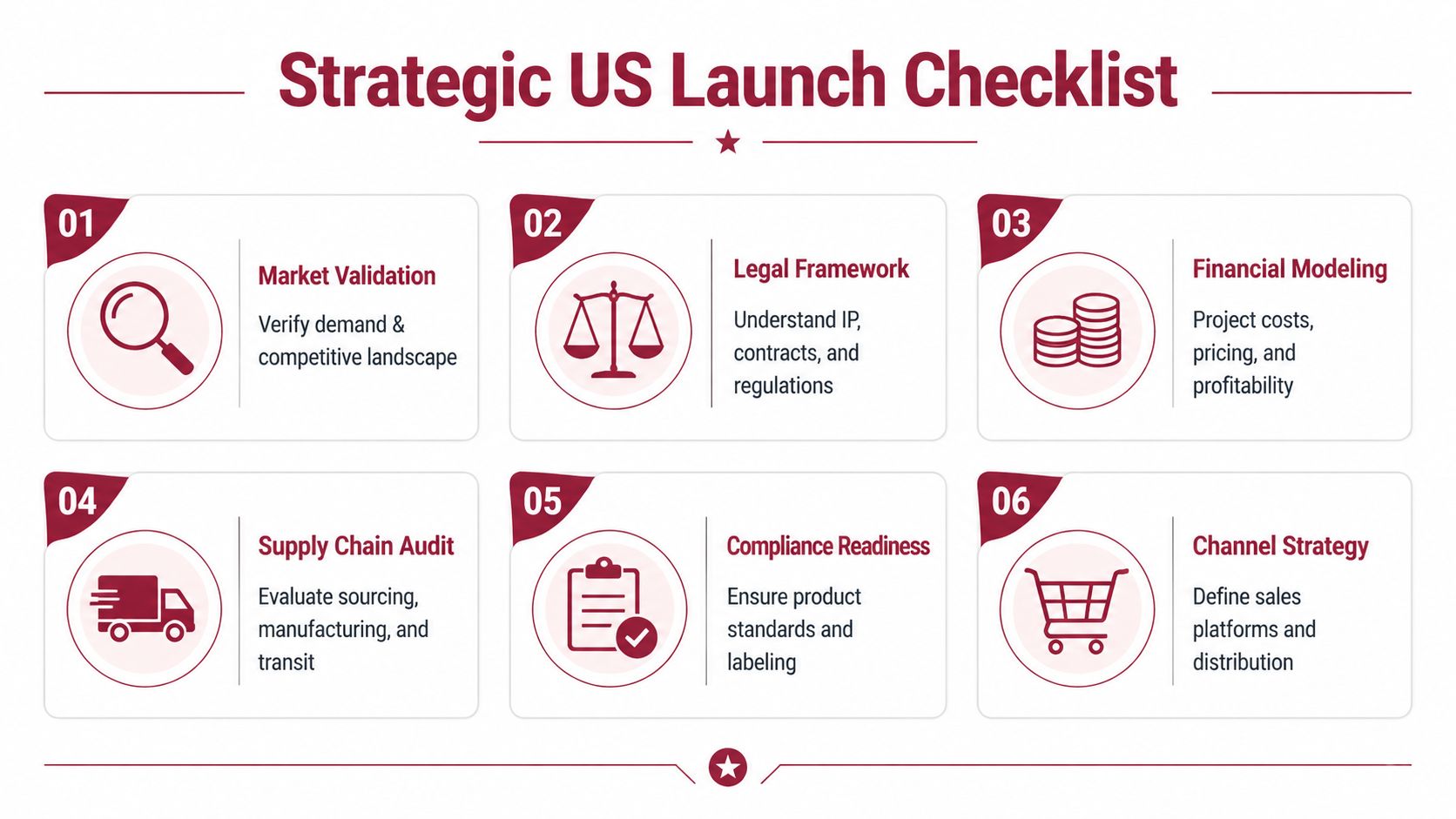
Validate the market you’re actually entering
The first question isn’t whether the category is active. It’s whether your specific offer can hold a position.
For hardware, that means reviewing the page the way a buyer would and the economics the way an operator would. Tools like Helium 10 and Jungle Scout can help surface demand patterns, but they don’t replace judgment. You’re looking for direct substitutes, low-end alternatives, premium incumbents, and imported listings that may be undercutting on price while competing poorly on quality.
Use this pre-shipment filter:
- Check whether the product solves a clear US buyer problem. Don’t rely on your Australian sales history as proof.
- Review the top listings in your search cluster. Study image quality, installation clarity, warranty framing, and whether buyers are confused about sizing, fit, voltage, or materials.
- Find the likely conversion trigger. In hardware, that may be durability, standards compliance, ease of install, compatibility, or bundled accessories.
- Decide whether your listing can present that advantage fast. If not, don’t ship yet.
Build the legal and commercial base before launch activity
Founders often leave intellectual property checks and listing control too late. That’s how a clean market entry turns into a dispute over brand assets, unauthorised listings, or packaging that can’t be defended properly on platform.
Focus on four areas first:
- Trademark readiness. If the brand name, sub-brand, or product family creates friction in the US, fix that before inventory arrives.
- ASIN ownership logic. If you’re creating new listings, define exactly how the catalogue should be structured and who controls content.
- Packaging and label review. Hardware products often need clearer origin marking, warnings, and compatibility language than founders expect.
- Channel conflict assessment. If you already have US distributors, reps, or wholesale conversations underway, don’t let Amazon create a pricing or territory dispute by accident.
A rushed account setup can be fixed. A weak legal position usually becomes expensive.
Model landed margin, not optimistic margin
A surprising number of established brands still price by currency conversion plus a rough marketplace uplift. That’s not a margin model. That’s hope.
Your model needs to reflect total landed cost in the US market, including import duties, prep, Amazon fees, storage exposure, advertising pressure, and returns handling. The exact structure varies by item, especially for heavier or awkward hardware SKUs, but the principle doesn’t.
A useful working table looks like this:
| Cost line | What to test before shipment |
|---|---|
| Product cost | Confirm current ex-factory cost and any packaging changes needed for US entry |
| Freight and inbound | Test realistic transit assumptions, not best-case assumptions |
| Duties and customs | Confirm classification and likely duty treatment before first shipment |
| Marketplace fees | Map referral, fulfilment, storage, and any prep-related costs |
| Launch spend | Include ad spend needed to establish visibility, not just maintain it |
| Returns and disposal | Decide where failed units go and what that costs |
If the model only works at perfect conversion, low return rates, and uninterrupted inventory flow, it doesn’t work.
Audit supply chain resilience, not just availability
You don’t need a huge opening order. You need a supply chain that can recover.
That means asking harder questions than “Can the factory make more?” You need to know whether lead times are stable, whether packaging changes will slow production, whether replacement parts can be shipped efficiently, and whether quality checks happen before product reaches US customers.
A structured operator provides support. Some brands manage it internally. Others use a partner that coordinates compliance, market adaptation, and downstream fulfilment. TPR Brands works in that category for established consumer product companies expanding into the US, Canada, and UK, with a focus on controlled channel growth rather than broad exposure.
Decide the first wave, not the full ambition
The final pre-shipment question is simple. Which SKUs deserve entry first?
Usually, it isn’t the broadest range. It’s the products with the cleanest compliance position, the clearest use case, the strongest margin buffer, and the lowest support complexity. Founders who start with a disciplined subset learn faster and protect more capital.
That’s how you sell on Amazon as a brand builder rather than as an exporter hoping demand will sort out the details.
Decoding US Compliance Labelling and Import Regulations
For hardware brands, compliance is where generic Amazon advice falls apart.
A lot of product research content treats viability as a demand question. But 89% of sellers used AI-driven tools for product research in 2024, and those tools still don’t account for how Australian certifications, measurements, and product requirements must be adapted for US standards, which is exactly why compliance viability has to be checked before launch, as highlighted in Nformed’s analysis of low-competition Amazon product research.

Federal compliance can affect market access
US compliance isn’t one gate. It’s a stack of gates.
For hardware and home improvement products, founders usually run into some combination of product safety, electrical conformity, chemical disclosure, packaging rules, claims substantiation, and customs documentation. The exact agencies involved depend on the item. A power accessory, connected device, workshop tool, surface treatment, or installation product each creates a different compliance pathway.
A practical way to consider this:
- CPSC-related concerns usually sit around consumer product safety and warning requirements.
- FCC-related issues matter when the product includes electronics, connectivity, or components that create radio frequency implications.
- EPA-related scrutiny can become relevant when products make environmental, chemical, or performance claims that imply regulated standards.
- Customs authorities care whether the goods are declared correctly, classified properly, and marked with country of origin in the required way.
None of that is theoretical. If the paperwork, product marking, or claims language is off, the problem doesn’t wait politely until after launch.
Australian compliance doesn’t automatically transfer
Founders often assume that because a product is already organised for the Australian market, the hard part is done. In reality, Australian standards can be useful operationally but insufficient commercially and legally for the US market.
Three friction points show up repeatedly:
| Area | Typical issue for Australian brands |
|---|---|
| Measurements | Packaging and listing copy still reflect local units or terminology buyers don’t use in the US |
| Warnings and labels | Existing warning language may be incomplete for US retail and Amazon scrutiny |
| Certification references | Packaging may highlight local compliance marks that mean little to US buyers or reviewers |
This matters on Amazon because compliance is also a conversion issue. Buyers read labels in images. They inspect packaging. They compare installation instructions, warnings, and origin details when deciding whether the product feels trustworthy.
Operator view: Compliance isn’t only about avoiding a seizure or suspension. It’s part of how the product earns belief on the page.
California can force a separate decision
Many hardware brands underestimate state-level regulation. California is the common trap because its warning regime affects packaging, listings, and legal review in ways founders don’t expect.
If your product, materials, or components raise a Proposition 65 question, the issue isn’t only whether you can sell. The issue is whether the warning requirement changes your packaging design, listing language, retailer acceptance, or broader brand presentation. For some brands, that’s manageable. For others, it weakens the category enough that the product shouldn’t be in the first launch wave.
That’s why a founder shouldn’t ask, “Can we get through customs?” The better question is, “Can we enter cleanly and still like the economics and brand consequences?”
Customs, declarations, and broker choice matter more than founders think
Most early compliance pain happens before the listing is even live. Incorrect product descriptions, weak invoice detail, wrong tariff treatment, or unclear country-of-origin marking can create friction that multiplies cost and delays.
Use a customs broker who understands consumer products and hardware, not just general freight. They should be able to review how the product is described, how packaging is marked, and what supporting paperwork is needed before cargo moves.
A simple checklist helps:
- Confirm classification logic before the first commercial shipment.
- Check country-of-origin marking on product and packaging, not just on outer cartons.
- Review instruction manuals and inserts for US-facing warnings and terminology.
- Align listing claims with packaged claims so the product page doesn’t overpromise what the physical unit doesn’t support.
Founders who treat compliance as a late-stage legal tidy-up usually pay for it in rework. Founders who build it into product selection make cleaner decisions much earlier.
Fulfilment and Logistics The FBA vs FBM vs 3PL Decision
Strong hardware brands often pick the wrong fulfilment model because they optimise for launch speed instead of operational fit. In the US, that mistake shows up fast in storage fees, damaged returns, stranded inventory, and support load.
For hardware and home improvement products, fulfilment is a commercial decision with compliance consequences. Weight affects fee structure. Packaging quality affects damage rates and returnability. Product type affects whether returned stock can go back into saleable inventory or needs inspection, testing, or disposal. If the item includes batteries, sharp components, adhesives, or regulated materials, the fulfilment path gets tighter again.

FBA works best for simple, repeatable SKUs
FBA usually makes sense when the product is compact, standardised, and easy to inspect at scale. Prime eligibility can lift conversion, and Amazon absorbs much of the customer-facing fulfilment experience.
That matters most for products such as accessories, consumable replacement parts, or boxed items with low damage risk and predictable replenishment cycles.
FBA becomes less attractive when margins are already under pressure from duties, certification costs, and inbound freight. A bulky tool, a fragile fixture, or a multi-part kit can look profitable on paper and still perform badly once storage fees, prep requirements, and return write-offs start hitting the P&L. Founders also need to accept a trade-off here. Amazon’s speed is useful, but Amazon controls more of the inventory handling and more of the return outcome.
FBA tends to fit when:
- The SKU is compact and standardised
- Packaging survives repeated warehouse handling
- Units can be resold after straightforward inspection
- Prime availability is likely to improve conversion enough to justify the fees
FBM gives better control over complicated products
FBM is often the better choice for oversized, fragile, configurable, or higher-value hardware. If a product needs careful packing, serial-number control, accessory checks, or a technician-level inspection after return, keeping fulfilment outside Amazon can protect margin.
The catch is execution. Late dispatch, weak tracking performance, and slow support responses will hurt account health and conversion. A founder should only choose FBM if the US operation can meet Amazon’s service expectations consistently, not occasionally.
For hardware brands, FBM is often strongest in a few specific cases:
| Model | Best fit | Main risk |
|---|---|---|
| FBA | Compact, repeatable, fast-moving SKUs | Fees and reduced control over handling |
| FBM | Oversized, fragile, configurable, high-value products | Service and dispatch discipline |
| 3PL-supported hybrid | Mixed catalogue with different fulfilment needs | More operational coordination |
If you need a more detailed view of the operational trade-offs, this guide to Amazon fulfilment models for growing brands is a useful reference.
A 3PL usually gives international brands the cleanest structure
For established exporters, the decision is rarely FBA versus FBM in isolation. It is whether a US-based 3PL can reduce risk across both.
A good 3PL does more than hold stock. It receives inbound containers or pallet shipments, checks for carton damage, flags labelling problems, prepares inventory for FBA, and stores reserve stock outside Amazon’s network. It can also process FBM orders for awkward SKUs and act as the first inspection point for returns. That inspection step matters for hardware. A returned drill accessory, plumbing component, or electrical fitting may not be safe to resell without checking completeness, packaging condition, and visible wear.
This is the model I recommend most often for overseas hardware brands entering Amazon USA. It costs more than sending everything straight into FBA, but it usually lowers the expensive mistakes. It also gives the brand a place in the US to solve problems before those problems hit the customer.
The hybrid structure works well because it:
- Keeps reserve inventory outside FBA storage limits
- Creates a US checkpoint for quality and labelling issues
- Supports different fulfilment methods across the catalogue
- Gives returned stock somewhere to be assessed properly
This walkthrough is worth watching if you’re comparing structures at an operational level.
Choose the model that matches product risk, not the one that looks easiest in Seller Central.
The wrong setup usually survives the first shipment and fails on the second or third. That is when duty-paid stock is already in the US, Amazon starts charging storage, returns arrive in unclear condition, and no one has built a process for inspection or rework. For hardware founders, fulfilment should protect margin, preserve product integrity, and keep control of inventory decisions inside the business.
From GTIN to Go-to-Market A Coordinated Launch Plan
Strong hardware brands often lose their first 90 days on Amazon because they treat launch work as a queue of separate tasks. Seller Central does not see it that way. Your catalogue setup, listing content, landed margin, stock availability, and traffic plan meet the market at the same time. If one fails, the launch underperforms even when the product is sound.
That matters more in hardware than in low-risk consumer categories. Buyers want fast proof of compatibility, installation fit, included parts, material quality, and any certification claims that affect purchase confidence.
Start with catalogue control, not creative assets
A clean US launch starts with product identity. Use a valid GTIN, build the right ASIN structure for the US catalogue, and decide early how the range should appear to American buyers. A parent-child variation that makes sense in your ERP can create friction on Amazon if the options mix incompatible sizes, finishes, voltage standards, or bundled accessories.
I see this mistake often with established export brands. They optimise the catalogue for internal neatness, then force customers to work too hard on the listing. That hurts conversion and creates avoidable returns.
Set these decisions before the listing goes live:
- Use correct product identifiers and brand registry assets
- Separate variants only where the buyer will reasonably compare them
- Match titles, bullets, images, and backend attributes to the exact shipped unit
- Keep packaging language, certifications, and included components consistent with the detail page
If the carton says one thing and the listing says another, Amazon traffic becomes expensive very quickly.
Build the page around buyer risk
A hardware listing earns trust by removing doubt. The buyer should be able to confirm fit, function, dimensions, materials, included parts, and installation context without hunting through the page.
That usually means fewer marketing claims and more proof. Show the product installed. Show close-ups of connectors, mounting points, finishes, and components. State what is not included. If a compliance mark, test standard, or warning label matters to the category, make it visible and accurate in both images and copy.
The operating signals are familiar. Strong launches tend to pair tight long-tail traffic with pages that convert cleanly, hold margin, and win the Buy Box consistently. As noted earlier, those metrics matter together, not in isolation. High ad cost is often a page problem, not only a keyword problem.
The launch asset set should answer the same technical objections your distributor, trade counter, or sales team already hears.
Coordinate pricing, stock, and traffic before opening the tap
Advertising should not be the first sign that a product is live. By that point, the economics and inventory logic should already be settled.
A workable launch plan does three jobs at once:
- Puts enough inventory behind the listing to support a stable in-stock position
- Starts traffic with high-intent search terms tied to actual product use and specification
- Sets price from landed cost, duty, Amazon fees, and return exposure, not from a simple FX conversion
That third point is where many overseas brands misread the US opportunity. They copy their home-market price architecture, then discover that referral fees, PPC, returns, and import costs have removed the margin needed to scale. For home improvement products, the fix is usually not more discounting. It is tighter range selection, clearer listing communication, and a launch budget tied to realistic contribution margin.
Review generation needs the same discipline. Use Amazon-approved methods only. Inserts, rebates, and any tactic that pressures the buyer for a positive review create account risk that is not worth taking on a new market entry.
If you want a more detailed operating model, this guide to an Amazon product launch covers the steps founders usually underestimate.
Treat the first weeks as a test of market fit and message fit
Early sales do not prove the launch is working. They show where the system is weak.
Watch search term quality, conversion by query, repeated pre-purchase questions, return reasons, and image-driven misunderstandings. For hardware brands, those signals usually expose one of four problems. The wrong customer is finding the listing. The right customer cannot confirm compatibility. The economics were set too loosely. Or the US version of the offer was never translated properly from the home market.
Founders who do well in Amazon USA treat launch as a controlled commercial test. They tighten the page, the range, and the traffic mix fast, before wasted spend and poor reviews harden into a pattern.
Managing Returns Compliance and Sustainable Growth
A launch is only the beginning of operational truth. The brands that scale well in the US build systems for what happens after the first wave of orders.
Returns are the clearest example. If you sell on Amazon from Australia without a US-side returns process, every defect, buyer mistake, damaged unit, or opened carton becomes harder to assess profitably. The issue isn’t only refund cost. It’s what happens to inventory quality, spare parts, repackaging, and customer trust.
Returns should feed operational learning
For hardware products, a returned item can mean several different things. It may be resaleable. It may need inspection. It may need part replacement. It may need to be written off. Without a local process, founders often lose visibility and default to outcomes that destroy margin.
A good post-launch setup usually includes:
- A local assessment point for returned stock
- A decision tree for resale, refurbishment, disposal, or parts harvest
- A feedback loop from return reason to listing improvement
- A process for recurring defects or confusion issues
That last point matters. Many “product” returns are listing failures. The wrong image, an unclear compatibility note, or poor installation guidance can create avoidable reversals.
Compliance is ongoing, not a one-time hurdle
Products evolve. Packaging changes. Suppliers substitute materials. Claims language expands. Every one of those changes can affect your compliance position.
The brands that protect themselves keep a live compliance file by SKU and review any meaningful change before it reaches Amazon inventory. They also make sure customer-facing claims remain aligned across packaging, listings, inserts, and support scripts.
Sustainable US growth comes from controlled feedback loops. Not from adding more SKUs before the first system is stable.
Growth should widen carefully
Once the initial SKUs are profitable and operationally stable, then you can widen the catalogue, test additional channel paths, or deepen your US inventory position. Not before.
That’s usually the point where founders realise the job was never “selling on Amazon”. It was building a repeatable market-entry model that protects brand value while expanding revenue. At TPR Brands, that’s the work we see serious founders focus on when they want international growth to stay controlled rather than chaotic.
Frequently Asked Questions About US Market Entry
Do I need to launch my full range to make Amazon work
No. Most established brands do better with a narrow first wave. Start with the SKUs that have the clearest use case, strongest margin protection, lowest support complexity, and cleanest compliance path. A smaller launch gives you cleaner data and lowers the cost of mistakes.
Is FBA always the right choice for hardware products
No. FBA is often useful, but not automatically correct. Compact, standardised SKUs usually fit FBA well. Oversized, fragile, premium, or configurable hardware products often need FBM or a hybrid model supported by a US 3PL.
Can I use my Australian packaging in the US
Sometimes, but don’t assume so. Country-of-origin marking, warnings, measurements, instructions, and claims language often need review. For hardware products, even a small label issue can create customs friction, platform scrutiny, or conversion problems.
Should I compete mainly on price when I sell on Amazon in the US
No. Price matters, but weak brands overuse it because they haven’t clarified their market position. In hardware, buyers often need proof around durability, fit, standards, installation, and trust. If your page communicates those clearly, you don’t have to build the whole strategy around being cheaper.
Can I manage US entry from Australia without local partners
You can, but it becomes harder once returns, compliance reviews, inbound freight issues, and replenishment timing become real. Most brands that stay organised in the US build some form of local operating support, whether through a broker, 3PL, legal counsel, or an expansion partner.
What’s the biggest mistake founders make
They assume that product success travels automatically. It doesn’t. Strong products still need localisation, margin discipline, fulfilment structure, and a launch plan built for the market they’re entering.
If you’re an established brand evaluating US expansion, TPR Brands works with companies that already have proven products and want a structured path into new markets without losing control of margin, positioning, or compliance.