A hard question sits underneath every amazon product launch for an established brand.
If your product already works in retail, distribution, or DTC, why does entering Amazon so often feel like starting over?
The answer usually has nothing to do with product quality. Strong products fail on Amazon because marketplace expansion is a separate commercial discipline. The rules that helped you win shelf space, distributor confidence, or repeat orders don’t automatically transfer to a search-driven, algorithmic channel where pricing, fulfilment, reviews, compliance, and competitive response all collide at once.
That’s the gap many founders underestimate. They assume Amazon is just another door to open. It isn’t. It’s a compressed operating environment that exposes weak positioning, thin margins, slow operations, and inconsistent channel control very quickly. A product that performs well elsewhere can still stall if the launch plan treats Amazon like a listing exercise instead of a market-entry strategy.
For a successful founder or commercial leader, that changes the conversation. The main issue isn’t whether Amazon can generate sales. It can. The issue is whether your brand can enter the platform without eroding margin, confusing channel partners, inviting price instability, or creating operational strain that damages the wider business.
That’s the lens worth using. Not “How do we get live?” but “What does an amazon product launch mean for brand equity, market access, and long-term control?”
Introduction
Most established brands don’t struggle on Amazon because they lack a good product. They struggle because they bring the wrong assumptions.
A founder sees proven demand, solid retail feedback, and a product that already earns its place in the market. From that perspective, launching on Amazon should be straightforward. Yet once the work begins, the business discovers a different reality. Search behaviour matters more than shelf presentation. Fulfilment speed affects conversion. Local compliance can suppress a listing before the market even sees it. Advertising isn’t just promotional support. It often becomes the mechanism that determines whether the product earns enough early traction to stay visible.
That’s why an amazon product launch deserves executive attention. It isn’t a junior ecommerce task to delegate and review later. It’s a channel-entry decision with implications for pricing architecture, inventory planning, regional adaptation, account health, and intellectual property protection.
Successful brands often assume Amazon will reward product strength. Amazon rewards product strength only when the operating model around that product is built correctly.
This matters even more for brands expanding internationally. A product that wins in one market can underperform in another if the listing language, certifications, pack information, voltage, sizing standards, or fulfilment method aren’t adapted to local expectations. In Australia, for example, marketplace requirements in hardware and home improvement create practical barriers that generic global launch advice often ignores.
The brands that do well tend to treat Amazon as a disciplined market expansion programme. They pressure-test the economics before launch. They decide where they will defend margin and where they will invest for velocity. They put compliance and brand control in place before the first shipment moves.
That’s the difference between getting listed and launching well.
Why Established Brands Launch on Amazon

Why do strong brands with proven demand still choose Amazon, even when they know the channel can pressure margin and brand control?
Because Amazon gives leadership teams something few expansion channels can offer at the same speed: market access, operational infrastructure, and immediate commercial feedback in one environment. For an established brand, that matters less as a shortcut to sales and more as a way to test whether the business can extend into a new market without committing upfront to full retail distribution, local warehousing, and a country-specific ecommerce stack.
That distinction matters. New sellers often approach Amazon as a listing exercise. Established brands should treat it as a strategic channel decision that affects pricing, fulfilment design, assortment, and long-term brand equity.
Amazon as a market-entry instrument
Amazon works well for brands that want evidence before they scale. A leadership team can assess whether demand exists, whether the offer translates locally, and whether the operating model can support growth without overbuilding too early.
The questions worth answering are commercial, not cosmetic:
- Will local customers convert at the price required to protect brand positioning?
- Does the product need adaptation for pack format, specifications, language, or use case?
- Can the business support Amazon service levels without distracting the wider organisation?
- Does the channel strengthen the brand in-market, or just create short-term volume at the wrong margin?
In Australia, that evaluation is increasingly relevant because ecommerce now plays a larger role in how customers discover and compare products before they buy. Amazon AU has also matured since its 2017 launch, which makes it more useful as a real expansion channel and less useful as a novelty bet. The opportunity is not just access to traffic. It is access to a market where customer intent, pricing pressure, and category competition are visible quickly.
Speed matters, but infrastructure matters more
Established brands rarely struggle to understand demand. They struggle to enter a market without creating operational drag.
Amazon reduces that burden. FBA can provide local fulfilment and service coverage before a brand commits to a broader physical footprint. Customer demand signals arrive fast through search behaviour, conversion rate, review content, and repeat purchase patterns. That shortens the time between market entry and executive-level decision making.
It also changes what a launch team needs to model upfront. Fulfilment speed affects conversion. Prime eligibility affects trust. Fee structure affects pricing flexibility. A clear view of the Amazon fee structure for Australian sellers belongs in the entry decision early, not after the catalogue is live.
A short explainer helps frame the channel mechanics:
Why strong brands still hesitate
The hesitation is justified.
Amazon can help a brand enter faster, but speed alone is not a strategy. Premium brands, multi-channel businesses, and founder-led companies with strong positioning have more to protect than revenue. They have channel relationships, price integrity, customer experience standards, and an expectation that the brand will look consistent wherever it appears.
That is why the right question is not whether Amazon is attractive. The better question is whether Amazon can be configured to support the brand you have already built.
| Strategic upside | Strategic caution |
|---|---|
| Faster validation in a new market | Constant public price comparison |
| Access to local fulfilment infrastructure | Fees and ads can compress margin |
| High-intent customer discovery | Brand presentation sits inside Amazon’s system |
| Rapid feedback on offer-market fit | A poor launch can weaken perceived brand quality |
Successful brands launch here because Amazon can reduce the cost of learning. The strongest ones do it with discipline, clear guardrails, and a view that goes well beyond first-month sales.
Understanding the Economics of Selling on Amazon
Executive teams often approve an amazon product launch with a model that looks disciplined on paper and breaks under live trading conditions.
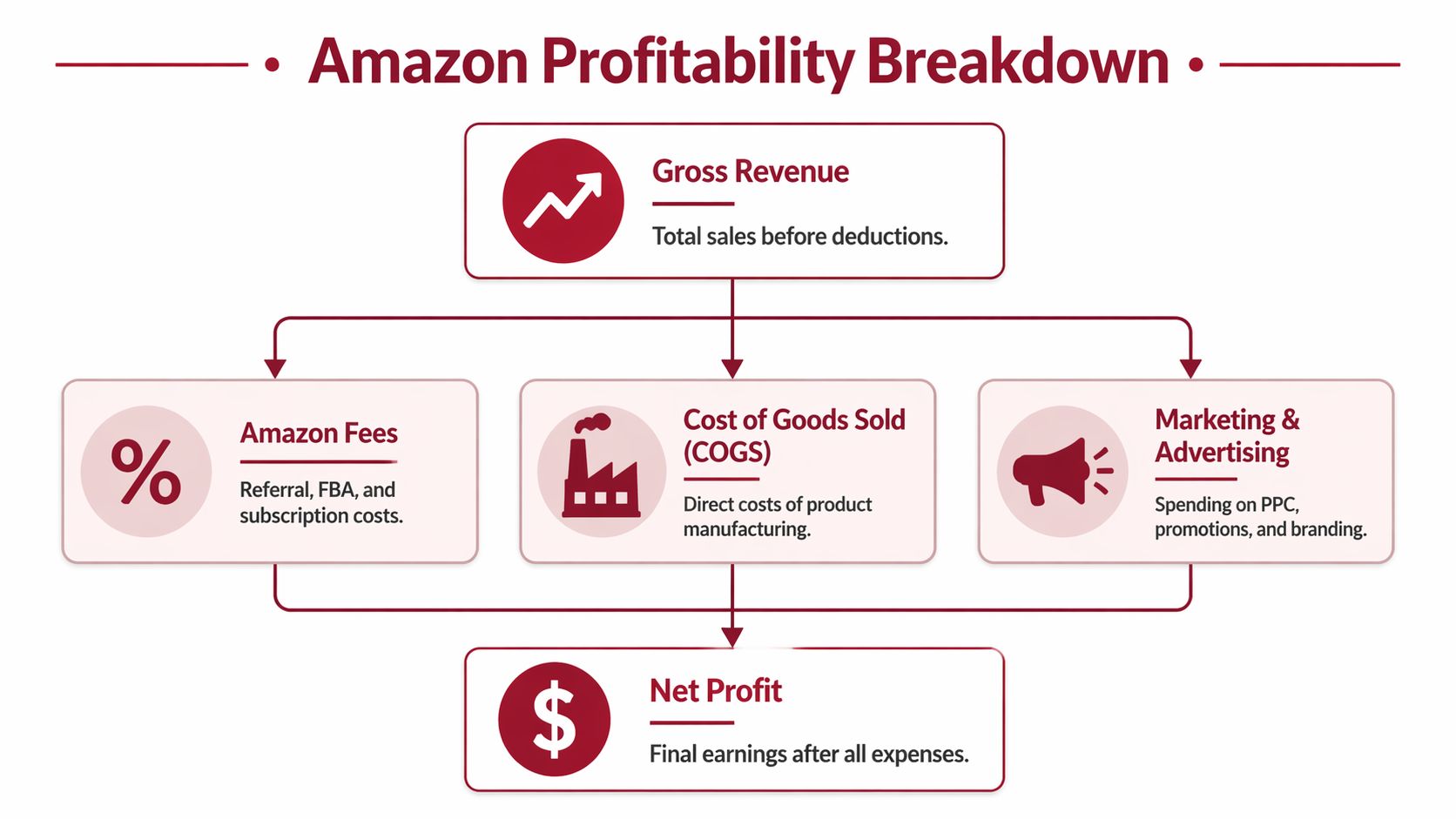
They count product cost, referral fees, and fulfilment, then assume efficiency will improve once volume arrives. For established brands, that assumption is expensive. Amazon rewards demand, but it also taxes hesitation, poor conversion, fragmented inventory planning, and weak launch support. A SKU does not need to fail to become a poor strategic choice. It only needs to absorb too much cash, too much management attention, or too much margin that the wider business could deploy better elsewhere.
Margin on Amazon is designed before it is earned
The central question is simple. Can this product support Amazon’s full cost structure without weakening the brand’s broader economics?
That requires more than a landed margin check. Leadership teams need a view on contribution after fulfilment, advertising tolerance during launch, expected return rates, stock cover, and the working capital tied up in Amazon inventory. They also need to decide what level of margin erosion is acceptable in exchange for market entry, customer acquisition, and speed of learning.
For a grounded view of baseline platform costs, review Amazon fee structures and cost considerations before setting launch targets. Fees are only the visible layer. The harder discussion is whether your category economics still work once paid traffic, operational overhead, and channel-specific stock risk are added.
I have seen strong products underperform financially for one reason. The team treated Amazon as a sales channel first and a capital allocation decision second.
TACoS is the metric leadership should watch
ACoS helps media teams manage campaigns. TACoS gives executives a cleaner view of channel health because it shows how much total revenue is being consumed to generate and maintain demand.
That distinction matters. A product can post encouraging sales while still relying on too much paid support to justify long-term expansion. If TACoS stays stubbornly high after the listing, reviews, and organic rank begin to settle, the problem usually sits deeper than ad execution. The offer may be too weak for the category, the price architecture may be too tight, or the margin structure may not support Amazon at the level the business expected.
Use TACoS to pressure-test three questions:
- Is paid traffic building repeatable demand: Or does revenue fall sharply the moment spend is reduced?
- Is the listing converting well enough: Or are content gaps and weak localisation forcing advertising to compensate?
- Is growth improving profit quality: Or is higher revenue masking an expensive model?
Practical rule: Judge launch spend by the path it creates to acceptable contribution, not by short-term revenue alone.
The first launch window has a cost profile of its own
New listings usually get a brief period in which Amazon is more willing to test their relevance in search. Leadership teams do not need a precise day count to use that fact well. They need to understand the economic consequence of wasting it.
If stock arrives late, content goes live half-finished, or the ad budget is too cautious to generate meaningful data, the brand still pays the entry cost without getting a fair read on product-market fit inside the channel. This is why cautious underinvestment can be more expensive than deliberate launch support. You end up with weak signals, slow ranking progress, and a team debating a channel that was never properly tested.
For successful brands, “start small and see” often sounds prudent but produces low-quality learning.
What disciplined Amazon economics look like
Strong operators model Amazon through four separate lenses, because one blended forecast hides too much.
| Lens | What to examine |
|---|---|
| Unit economics | Contribution after product cost, Amazon fees, fulfilment, and expected returns |
| Launch economics | Planned TACoS range, content investment, inventory depth, and early ranking support |
| Steady-state economics | Margin after the SKU stabilises and paid dependence should begin to ease |
| Portfolio economics | Whether Amazon adds incremental profit and market access, or simply shifts demand from existing channels |
This is the point many brands misread. They prove the product can sell on Amazon. They do not prove that Amazon deserves aggressive scale within the broader expansion strategy.
For a founder or executive team, that is the standard that matters. Revenue matters. Channel quality matters more.
The Hidden Risks to Your Brand and Intellectual Property
How much brand control are you prepared to give up in exchange for Amazon’s reach?
For established brands, that is the core question. Amazon can add distribution, demand capture, and category visibility at speed. It can also compress years of brand building into a listing environment you do not fully control unless protection is designed into the launch from day one.

Visibility without protection is fragile
A strong product usually gets traction on Amazon if demand already exists. The harder question is whether that traction strengthens the brand or exposes weak points in your channel control.
Amazon intensifies comparison. It places your product beside close substitutes, encourages price transparency, and gives third parties opportunities to attach themselves to demand you created. If your reseller agreements are loose, your pricing architecture is inconsistent, or your catalogue governance is unclear, growth can trigger problems faster than many executive teams expect.
Amazon itself recognises the scale of infringement risk. In its Brand Protection Report, the company outlines ongoing investment in counterfeit prevention, proactive controls, and rights-owner tools. That should not reassure brands into complacency. It should clarify the standard. If Amazon is investing heavily to police abuse, brand owners need to treat protection as a board-level launch consideration, not an admin task delegated after the listings are live.
Where brand value gets eroded
In practice, brand erosion on Amazon tends to show up in four places.
- Unauthorised sellers enter the listing: Margin pressure begins, price discipline weakens, and retail or distribution partners start asking who is representing the brand.
- Content control becomes disputed: Titles, images, bullets, and product details change through contribution conflicts, which can flatten positioning and create avoidable customer confusion.
- Imitations follow visible demand: Once a product proves there is volume in the category, copycats and lookalike offers become more likely.
- Premium positioning gets reduced to attributes: Amazon’s format favours speed and comparability. Without disciplined creative and messaging, a differentiated product can start to look interchangeable.
I have seen founders underestimate this because sales arrive before the damage is obvious. The first signal is often harmless on the surface. A reseller appears. A listing asset changes. A discounted offer undercuts your pricing logic. By the time the issue reaches the executive team, the cost is no longer only operational. It sits in channel conflict, weaker perceived value, and time spent repairing a market entry that should have been structured properly.
That is why Amazon Brand Registry support and protection planning belongs in the launch plan before revenue targets, not after infringement appears. Registry does not solve every problem, but it gives the brand a stronger position on ownership, reporting, and enforcement.
The trade-off established brands need to make
The choice is not speed versus caution. It is unmanaged exposure versus controlled expansion.
A delayed launch carries opportunity cost. An under-protected launch carries equity risk. For smaller sellers, that may be a tactical gamble. For an established brand, it is a strategic decision with wider consequences across distributors, existing channels, and future market entries.
| Approach | Likely outcome |
|---|---|
| Launch before governance is set | Early sales may arrive, but pricing conflict, content inconsistency, and seller disputes become harder to contain |
| Set protection rules before scale | Preparation takes longer, but the brand enters with clearer control over representation, enforcement, and channel standards |
Strong brands do not win on Amazon by appearing quickly. They win by entering with clear ownership, clear rules, and enough discipline to protect long-term brand equity while the channel scales.
Operational Readiness The Non-Negotiable Requirements
A marketplace launch becomes fragile when operations are treated as back-office detail.
That’s especially true in hardware, home improvement, and household categories, where packaging, identifiers, inbound preparation, local standards, and fulfilment setup can all influence whether the product is even allowed to compete. The commercial team may see the amazon product launch as a market opportunity. Operations sees the practicalities: every weak handoff increases the odds of suppression, delay, or wasted ad spend.

Compliance comes before conversion
For imported products entering Australia, compliance is not a refinement step. It is the gate.
According to Australian Seller Central launch compliance guidance, new hardware product launches in the Australian marketplace must use GS1 Australia barcodes and comply with AS/NZS standards. If those requirements are missed, listings can be suppressed immediately, and 40-60% of initial AU launches for imported goods face delistings within the first week.
That changes the launch sequence. Many teams obsess over images and PPC while leaving identifier validation, local labelling, electrical standards, or pack information too late. In practice, that means marketing starts spending against a product that operations has not fully cleared for sale.
For brands using Fulfilment by Amazon, FBA planning and fulfilment structure should be tied into compliance planning from the start, not after the product file is created.
Inventory planning is a strategic decision
Stock depth and stock timing shape visibility. If a product runs out during its launch phase, the damage is not only lost revenue. Ranking momentum slows, ad efficiency deteriorates, and the team starts making reactive decisions under pressure.
Operational readiness usually comes down to disciplined answers to a few questions:
-
Is the inventory available before traffic is pushed?
Launching ads against unavailable or delayed stock wastes the best period to gather signal. -
Are supplier timelines reliable enough for replenishment?
A good launch can create its own problem if production and inbound lead times were modelled too optimistically. -
Is packaging built for the target market?
AU voltage, metric measurements, and required warnings are not cosmetic changes in many categories. -
Has the product been prepared for Amazon’s handling environment?
Carton logic, labels, and FNSKU workflow affect receiving speed and avoidable errors.
FBA versus FBM is not a beginner decision
The FBA versus FBM debate is often oversimplified. FBA can improve customer trust and operational consistency, while FBM can give a brand more direct control over inventory and fulfilment workflows. The right answer depends on product dimensions, complexity, service expectations, and internal capacity.
For established brands, the question usually isn’t ideological. It’s practical.
| Consideration | FBA may fit when | FBM may fit when |
|---|---|---|
| Speed expectations | Prime-style delivery matters | Delivery windows are manageable without Prime |
| Operational capacity | Internal warehouse resources are limited | Existing fulfilment systems are already strong |
| Control requirements | Standardised fulfilment is acceptable | Special handling or bundling needs direct control |
| Scalability | The team wants Amazon infrastructure | The team already has reliable in-house scale |
Operational weakness doesn’t stay in operations. On Amazon, it shows up in conversion, visibility, account health, and customer trust.
The brands that handle launch well usually bring operations into channel planning early. They don’t ask ops to “support ecommerce.” They ask ops to co-design the launch.
A Strategic Framework for Your Amazon Launch
Not every strong product should launch on Amazon in the same way. Some should move quickly. Some should enter narrowly with one hero SKU. Some should wait until pricing, compliance, or reseller structure are tightened. A few should avoid the channel altogether unless the business is willing to change how it operates.
The right framework starts with product fit, then tests channel fit.
First decide whether the product belongs on Amazon
A founder usually begins with confidence in the product. That’s fair. The harder question is whether the product is suitable for Amazon’s mechanics.
Use this as an executive filter:
- Margin resilience: Can the SKU absorb launch advertising, marketplace fees, and fulfilment costs without turning into a vanity revenue line?
- Search-led demand: Do customers already look for this kind of solution in Amazon language, or does the product require education that the marketplace format struggles to deliver?
- Operational simplicity: Can the team handle packaging, stock flow, account management, and customer expectations without stretching core operations?
- Brand defensibility: If the product succeeds, can the business protect pricing, listing quality, and authorised distribution?
If one of those answers is weak, the product may still launch. It just shouldn’t launch as if conditions are favourable.
Then look for unserved demand, not just available demand
A common mistake is entering an obvious category because demand is visible. Mature brands do better when they identify gaps that reward preparation.
Australian marketplace data points to a strong example. According to research on unserved demand in Amazon Australia, underserved sub-niches such as climate-resilient home improvement products saw 35% search growth in 2026 data, while 70% of imports fail to meet local testing standards. That is a strategic opening. It shows how compliance capability can become a competitive advantage, not just a legal requirement.
That matters for established brands because it changes the launch thesis. Instead of asking, “Can we compete in a broad category?”, ask, “Where does our product meet a local need that weaker imports can’t satisfy well?”
Good Amazon launches don’t just target volume. They target categories where the brand has a reason to win.
A practical decision matrix
This is a useful way to pressure-test launch readiness at leadership level.
| Question | If the answer is yes | If the answer is no |
|---|---|---|
| Can this SKU protect margin during launch? | Proceed to category and competitor review | Rework pricing or assortment first |
| Does the product solve a market-specific need? | Build localised positioning | Avoid generic “copy-paste” entry |
| Can operations support early momentum? | Plan inventory and fulfilment with confidence | Delay until supply chain risk is reduced |
| Can the brand defend itself on-platform? | Launch with controls in place | Solve protection and seller policy first |
Launch sequencing matters more than launch enthusiasm
A disciplined launch sequence for an established brand usually looks like this:
- Validate local fit through competitor review, search behaviour, and compliance requirements.
- Select the right SKU set rather than pushing the whole catalogue live.
- Prepare the operating model for fulfilment, stock continuity, and account health.
- Build a controlled visibility plan that uses advertising and content to create signal, not noise.
- Monitor the right signals early such as conversion quality, pricing stability, and review quality, not just sales volume.
This approach is less exciting than “go live everywhere.” It is also how brands avoid turning Amazon into a drain on management attention.
When to Partner for Global Expansion
There is a point where internal capability stops being the issue and structural advantage becomes the issue.
A talented in-house team can manage a lot. It can build listings, launch campaigns, coordinate stock, and respond to marketplace problems. But once a brand starts moving across regions, adapting to local standards, protecting pricing across channels, and coordinating fulfilment with compliance, the workload changes shape. It stops being a pure ecommerce function and becomes a market expansion function.
That’s the inflection point founders often feel before they can describe it. The business is no longer asking, “Can we sell on Amazon?” It’s asking, “Can we scale across markets without damaging the brand, the margins, or the rest of the operation?”
The cost of doing it halfway
Many otherwise capable brands often lose efficiency. They localise the listing but not the product. They fund PPC but not compliance validation. They enter a region based on category demand but underestimate the adaptation work needed to convert that demand profitably.
Australian-specific data captures the cost of that gap. According to analysis of AU launch localisation and compliance mistakes, skipping pre-launch validation of AU compliance and market adaptation can waste 20-30% more ad budget, while ACoS averages 65% higher for non-localised products because conversion is weaker.
Those aren’t just campaign problems. They’re strategic planning problems. The money gets wasted in advertising, but the root cause usually sits upstream in market preparation.
Partnership is often a maturity move
Experienced founders don’t outsource because they’re incapable. They partner because some forms of growth require specialised coverage.
That can mean local compliance expertise. It can mean on-the-ground distribution knowledge. It can mean strategic oversight that keeps Amazon aligned with broader brand positioning rather than letting the platform dictate the brand’s behaviour.
A good partner becomes valuable when the business needs any combination of the following:
- Regional adaptation: The product is strong, but local market fit requires technical or commercial adjustment.
- Cross-market coordination: Launch decisions in Australia affect pricing, stock, and positioning elsewhere.
- Brand protection discipline: Marketplace growth needs tighter control than the internal team can maintain alone.
- Leadership bandwidth: Senior operators shouldn’t spend disproportionate time firefighting platform complexity.
The strongest brands treat this the same way they treat legal, finance, or major supply chain decisions. They don’t see partnership as a fallback. They see it as a way to increase precision while reducing avoidable risk.
For brands expanding into new channels and new regions, that mindset usually produces better outcomes than trying to force every capability in-house at once.
TPR Brands helps established product companies expand into Amazon across Australia, the US, Canada, and the UK with strategies designed to protect pricing, maintain brand control, and support long-term growth. If you’re evaluating an Amazon product launch as part of a broader expansion strategy, the right structure matters before the first listing goes live.