You’ve probably hit the point where the Australian market still works, but it no longer stretches your ambition. Your product sells. Retailers know the line. Amazon AU is established enough to prove the concept. Now the US looks like the obvious next move.
That’s exactly where a lot of strong founders make a bad decision.
They assume US expansion is a bigger version of what already worked in Australia. Same product. Same listing logic. Same ad playbook. Same packaging. Same positioning. Then they hire an amazon agency and expect the agency to “do the US launch”.
That’s not a strategy. That’s outsourcing uncertainty.
A good amazon agency can help. But if your market entry logic is weak, your agency won’t save you. It will just make the failure more efficient. The brands that win in America treat Amazon as one execution layer inside a wider market-entry system that covers demand validation, pricing structure, compliance, channel selection, inventory flow, and local consumer trust.
Your Australian Brand is Winning Is America Next
The common story goes like this. An Australian founder has built a solid hardware, household, or home improvement brand. The product has real traction. Reviews are good. Operations are organized. The local market starts to feel familiar, maybe too familiar. Growth becomes harder to squeeze out of the same channels, so the founder turns to the US.
That instinct is right. The next move often is international. The mistake is assuming the next market will reward the same playbook.

Most founders don’t fail in the US because the product is bad. They fail because they carry over Australian assumptions into a very different commercial environment. American buyers search differently. Competitors position more aggressively. Category density is higher. Margin pressure shows up faster. Logistics mistakes get punished harder.
If you’re evaluating an amazon agency partner for expansion, ask a blunt question first. Are you looking for ad management, or are you trying to build a durable US market presence? Those are not the same thing.
Lift and shift usually fails
A lift-and-shift launch looks efficient on paper. Reuse the same creative. Translate the same listing structure. Push traffic. Watch sales. That approach breaks quickly in categories where trust, use case clarity, and product comparison drive conversion.
American customers don’t buy your backstory first. They buy relevance. If your listing sounds imported, unclear, or slightly off in language and framing, they move to the next option. In hardware and household categories, small friction points kill momentum.
Practical rule: If your US launch plan starts with ads before it starts with positioning, the plan is upside down.
The real decision is bigger than Amazon
You’re not deciding whether to simply “sell in the US”. You’re deciding whether your brand can operate in the US with enough local fit to defend margin and build repeat demand.
Amazon can accelerate feedback and visibility, but it can also hide weak fundamentals temporarily by giving products access to traffic before true market fit exists.
Many founders mistake early sales activity for validation. In reality, sustainable expansion comes from operational strength, positioning clarity, and customer trust.
The brands that scale successfully treat America as a different commercial system, not just a larger version of Australia.
Gauging True US Demand Beyond Surface-Level Data
“The US market is huge” is not demand validation. It’s a slogan.
You need to know whether there’s a profitable pocket of demand for your product, at your likely landed cost, with your realistic conversion rate, against the competitors you’ll face. That’s a narrower question, and it’s the one that matters.
A lot of Australian founders skip this discipline because they’ve already proven the product at home. That proof matters, but it doesn’t travel cleanly. Category language changes. Purchase triggers change. Even the search terms that look similar can carry different intent.
Start with commercial reality, not marketplace optimism
Don’t begin inside Amazon ads software. Begin with the market itself.
Review the brands that dominate your category in the US, not just on Amazon but across their own sites, specialist retailers, trade suppliers, and big-box environments. You’re looking for patterns:
- Positioning language: How do they frame the problem they solve?
- Assortment logic: Do they sell single hero products, kits, refills, accessories, or professional bundles?
- Price architecture: Are they competing on premium trust, contractor-grade reliability, or entry-level convenience?
- Review friction: What do buyers consistently complain about?
This work sounds basic. It isn’t. Most founders rush to keyword volume and miss the more important issue, which is whether their product fits a clear purchase narrative in the US.
Watch for false confidence from familiar tools
Many expansion plans often go awry. Founders see a tool, a dashboard, or a new ad feature doing well elsewhere and assume it will transfer cleanly into America or from global benchmarks into Australia and back again.
That assumption is dangerous. Amazon’s 2025 generative AI ad tools showed a 22% efficiency boost globally, but early adoption in Australia was only 12% and some early adopters in competitive categories saw an 18% ROAS drop, according to Amazon Ads agency guidance. The lesson isn’t that AI is bad. The lesson is that market context matters more than platform hype.
If a founder blindly trusts “what worked” in another region, they end up validating the tool instead of validating demand.
Don’t confuse platform capability with market readiness. They’re different decisions.
Build a small proof system before a full launch
You do not need a full US rollout to test whether the market is viable. You need disciplined signals.
A smart validation process usually includes a mix of the following:
-
Search language testing
Compare how Americans describe the problem your product solves. Australian wording can be technically correct and still commercially weak. -
Competitor listing teardown
Pull apart top listings and identify the decisive competitive factors. It may be warranty confidence, installation simplicity, materials, finish, compatibility, or speed of use. -
Landing page tests
Run a simple US-facing page with direct response messaging. If the product can’t get interest when clearly explained, your Amazon listing won’t magically fix that. -
Controlled paid traffic
Use small campaigns to test click quality and messaging resonance. The purpose isn’t scale. The purpose is to see which claims earn attention and which ones don’t. -
Customer language review
Read reviews on competing products and sort them by desired outcome, disappointment, and situational use. That language often matters more than your current copy deck.
What founders should actually be asking
Most founders ask whether the US market is “big enough”. That’s the wrong question.
| Question | Why it matters |
|---|---|
| Is the product easy to understand in one glance? | US marketplace competition punishes ambiguity fast. |
| Does the offer solve a clear, valuable problem? | Broad usefulness is weaker than specific relevance. |
| Can the margin survive paid acquisition and fulfilment? | Revenue without contribution margin is not expansion. |
| Is there room to differentiate beyond price? | If not, Amazon will turn into a race you don’t want. |
The founder mistake I see most
They treat demand as binary. Interested or not interested. Big market or small market.
Real demand work is about fit, economics, and defensibility. A product can have obvious interest and still be a terrible US expansion move. Another product can look niche and become your strongest international channel because the positioning is cleaner, the margin is healthier, and the buyer intent is stronger.
That’s why “hire an amazon agency and launch” is too shallow a plan. Demand has to be tested at the market level first. Otherwise you’re not entering the US. You’re gambling in it.
Adapting Your Product and Brand for the American Consumer
Most Australian brands don’t need a new identity for the US. They need a sharper commercial translation.
That translation usually lives in three places. Positioning, pricing, and compliance. Founders often spend too much time on the first and not nearly enough on the third. Then they wonder why the launch drags, costs more than expected, or gets stuck in avoidable friction.

Positioning for trust, not for familiarity
Founders like to preserve what made the brand work in Australia. That instinct is understandable. It can also hurt conversion.
American buyers won’t reward you for sounding Australian unless that origin adds value in the category. In many hardware and household niches, they care more about installation ease, durability, compatibility, warranty confidence, and whether the product feels immediately understandable.
That means rewriting your offer around the buyer’s decision trigger.
A few examples:
- Technical wording may need simplification: If your product copy reads like a spec sheet, the US customer may not get to the actual benefit.
- Humor often travels badly: What sounds clever in Australia can sound vague or distracting in the US.
- Proof points need hierarchy: Lead with what reduces purchase anxiety first. Materials, fit, use case, and outcome often matter more than brand personality at the initial click.
If the buyer has to interpret your message, you’ve already made the sale harder than it needs to be.
Price the product as a US business, not an export experiment
Many founders underprice because they anchor to Australian economics. They convert the local price into USD, add a margin buffer, and assume the market will absorb the rest.
That approach usually creates pressure later through advertising costs, fulfilment fees, returns, and retailer deductions.
Your US pricing model needs to reflect the full commercial structure of operating in America, including freight, customs, warehousing, marketplace fees, customer acquisition costs, and support obligations.
Healthy pricing gives the business room to scale without depending on perfect conditions.
- Landed cost reality: What does the product cost once it’s physically available for US sale?
- Channel-specific deductions: Amazon, DTC, wholesale, and retail do not support the same gross margin profile.
- Promotional tolerance: Can you survive launch offers, trade discounts, or marketplace promotions without damaging the business?
- Replacement and returns: Categories with installation, compatibility, or breakage risk need room for mistakes.
If the numbers only work when everything goes perfectly, the pricing is wrong.
Compliance is not a back-office problem
Many founders treat compliance as something to fix after launch. That mindset creates avoidable delays and marketplace risk.
Even in Australia, this is already a major issue. A 2025 Australian Border Force report found that 28% of imported consumer goods fail local compliance checks, contributing to 15% higher suspension rates for non-localized Amazon AU listings, as referenced in Hinge Commerce’s discussion of full-service agency requirements. If brands get caught out in their home region, they are even more exposed when entering a more layered market.
The US adds more moving parts. Depending on the product, you may be dealing with federal standards, state-level requirements, labelling expectations, packaging warnings, electrical requirements, materials restrictions, or retailer-specific compliance documentation. Hardware and household brands can’t afford to treat that as admin.
What to localize before launch
Here’s the short list I’d insist on before taking a product live:
- Packaging review: Make sure product claims, warnings, measurements, and usage instructions make sense in the US context.
- Listing language rewrite: Don’t just convert spelling. Rebuild the copy around US search and buying logic.
- Support documents: Manuals, inserts, warranty wording, and product detail sheets need consistency.
- Evidence file: Keep test reports, certifications, material details, and supplier records organized and easy to produce.
- Claims audit: If the product says “safe”, “heavy-duty”, “non-toxic”, “commercial”, or similar, verify that your evidence supports those claims.
The strategic view founders miss
Compliance doesn’t just reduce legal risk. It changes channel access.
A retailer, distributor, or marketplace operator is more likely to back a brand that looks organized. Clean documentation signals competence. It tells partners you won’t create cleanup work later. That matters more than most founders realize.
And this is why a narrow amazon agency model often falls short. If the agency only handles ads and listings, it can’t solve the upstream issues that drive conversion, approval, and long-term margin. The product has to be translated operationally, not just marketed digitally.
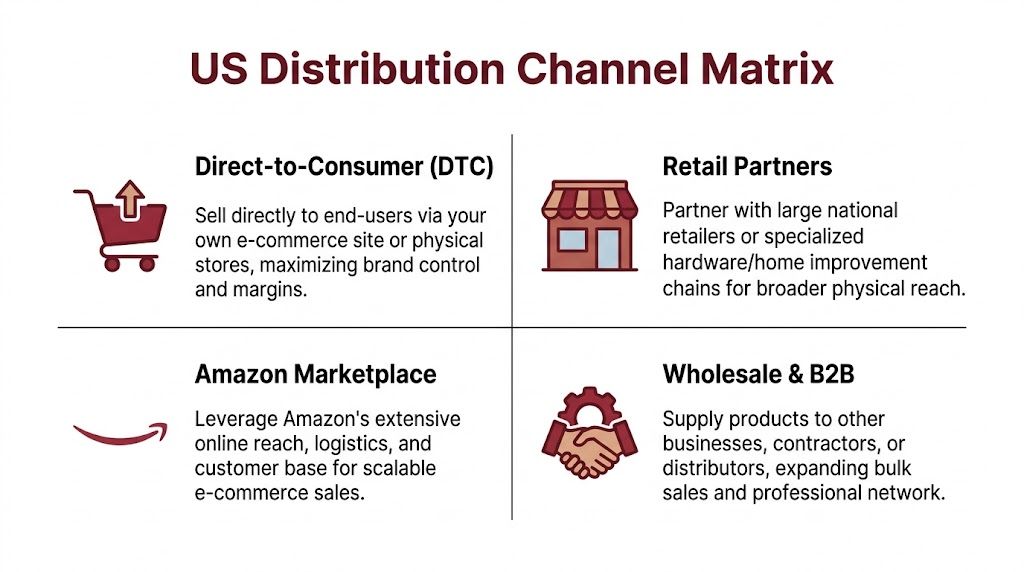
Your US Distribution Channel Matrix
If your entire US expansion plan is “launch on Amazon”, your plan is incomplete.
Amazon matters. For some brands, it should be the first live channel. But it should almost never be the only channel in your thinking. Serious expansion requires a channel matrix, not a platform obsession.
Amazon is a channel, not the strategy
Amazon gives you reach, demand capture, and a relatively fast route to market feedback. It also compresses brand control, invites direct comparison, and can train your business to chase volume that doesn’t translate into strong profit.
That’s why the quality of the amazon agency matters. Basic ad management isn’t enough. High-performing brand partners integrate backend search term optimization, FBA inventory reconciliation, and fee auditing into their PPC strategy because brands lose significant revenue when those pieces aren’t coordinated, as outlined by Canopy Management’s review of advanced Amazon agency services.
If your agency reports clicks, impressions, and ACOS but can’t explain inventory flow, listing conversion, and margin leakage, you hired a campaign manager, not a growth operator.
Compare the four core US channels
| Channel | Primary Advantage | Main Risk | Best Use Case |
|---|---|---|---|
| Amazon Marketplace | Fast demand capture | Margin compression and direct comparison | Search-driven consumer products |
| Direct-to-Consumer (DTC) | Brand control and customer ownership | Higher acquisition costs | Products requiring education or storytelling |
| Retail Partners | Credibility and physical visibility | Slower onboarding and lower flexibility | Established consumer brands |
| Wholesale / B2B | Stable recurring orders | Longer sales cycles | Trade, installer, or contractor-focused products |
When Amazon should lead
Amazon should often lead when your product is easy to understand, highly searchable, operationally stable, and suited to marketplace buying behavior. It’s especially useful when the customer already knows the problem and is comparing options.
It’s less effective when your product needs education, installation context, or a more layered sales argument. In those cases, Amazon can still work, but it shouldn’t carry the whole market-entry burden.
For brands shipping from Australia or using a US partner stack, your US fulfilment model also shapes this decision. Channel choice and fulfilment choice are tied together. If they’re planned separately, costs drift and service quality suffers.
The channel that gives you the fastest sales is not always the channel that builds the strongest business.
DTC does a different job
Some founders dismiss DTC because Amazon converts faster. That misses the point.
DTC is where you control the narrative. You can explain the product properly, build bundles, show demonstrations, collect customer feedback directly, and protect the brand from marketplace simplification. If your product has nuance, DTC matters even if Amazon remains your biggest short-term revenue source.
What DTC won’t do is solve weak product-market fit. It amplifies whatever clarity you already have.
Retail and B2B are not “later” by default
Australian founders often assume retail and B2B come after marketplace success. Sometimes they do. Sometimes that sequencing is wrong.
If your product suits trade buyers, installers, maintenance teams, or professional users, B2B may create cleaner economics than consumer acquisition. If the product wins through physical demonstration, credibility, or store adjacency, retail may do more for the brand than months of paid traffic.
That’s why channel planning should answer these questions:
- Where does the buyer expect to discover this product?
- What channel best explains the value quickly?
- Which route preserves margin after support, shipping, and returns?
- What channel creates an advantage for the next one?
The practical channel mix
For many established Australian brands, the sensible mix looks something like this in principle:
- Amazon for demand capture and data
- DTC for brand control and customer understanding
- Selective retail for credibility and reach
- Wholesale or trade for account stability
Not every brand needs all four immediately. But every founder should at least model them. If you let an amazon agency define the whole expansion strategy, you’ll end up optimizing one lane while missing the bigger route to US scale.
The Operational Playbook for Your US Launch
Good strategy still fails if operations are improvised.
Founders progress from ambition to actual market entry. Freight, customs handling, warehousing, returns, stock planning, account setup, and launch timing all need to line up. If one piece lags, the rest get expensive fast.
The best operational plans are boring. That’s a compliment. They remove drama before the product lands.
Build the flow before you build the campaign
Founders often focus on launch assets first. Images, copy, ads, maybe influencer outreach. None of that matters if your replenishment cycle is weak or your first shipment gets delayed because the paperwork chain was sloppy.
Your launch flow needs clear ownership across:
- Freight forwarding: Who moves the product from origin to US destination?
- Customs brokerage: Who handles import process accuracy and document integrity?
- US storage and fulfilment: Will inventory sit in FBA, a third-party warehouse, or both?
- Returns handling: Where do customer returns go, and who checks them?
- Inventory triggers: What prompts reorders and transfers before stockouts happen?
A founder who can’t answer those questions cleanly is not launch-ready yet.
Use phased execution instead of one big push
The most expensive launches usually come from trying to do everything at once. It’s better to phase the move so each stage reduces uncertainty for the next.
Here’s a practical planning template.
| Phase | Timeline | Key Activities | Estimated Cost (USD) |
|---|---|---|---|
| Foundation | Months 1 to 3 | Entity and tax review, product documentation, compliance review, packaging updates, channel strategy | Varies by product, structure, and advisory scope |
| Setup | Months 4 to 6 | Freight partner selection, customs process, warehouse or FBA setup, listing build, content preparation | Varies by shipment size, storage model, and launch complexity |
| Initial Launch | Months 7 to 9 | First inventory placement, channel activation, ad testing, customer service workflows, returns process | Varies by inventory commitment and media budget |
| Stabilisation | Months 10 to 12 | Replenishment planning, channel refinement, margin review, operational fixes, expansion decisions | Varies by sales velocity and channel mix |
The point of this table is not to promise a universal budget. There isn’t one. The point is to force sequencing. Every phase has different risks, and each one should earn the next capital commitment.
Your pre-launch checklist should be ruthless
Use a short checklist and treat every unchecked item as a warning sign.
-
Documentation complete
Product files, manuals, certifications, supplier records, and claims support are organized and accessible. -
Landed cost understood
You know what the product costs when it is available for sale in the US, not what it cost to manufacture. -
Fulfilment path chosen
There is a clear operating model for storage, dispatch, returns, and replenishment. -
Channel sequence decided
Amazon, DTC, retail, and B2B are prioritized for reasons, not because one sounded easiest. -
Launch inventory logic set
You’re not guessing opening quantities based on optimism. -
Owner assigned to each function
Strategy without names next to tasks becomes delay.
A US launch usually breaks where responsibility is vague, not where ambition is lacking.
Don’t outsource judgement
You can and should use external partners. Freight specialists, marketplace operators, legal advisers, fulfilment providers, and local channel experts all have a role. But founders still need to own the operating logic.
If you’re planning to sell on Amazon USA from Australia, don’t think in terms of “getting listed”. Think in terms of building a repeatable system that can handle stock movement, customer expectations, and channel expansion without constant firefighting.
That’s the difference between a launch and an entry.
From Great Australian Product to Global Brand
A strong product gives you the right to expand. It doesn’t guarantee you’ll expand well.
The founders who win in the US don’t treat market entry as a marketing exercise. They treat it as a leadership decision. They validate demand properly, adapt the offer for the local buyer, choose channels deliberately, and build operations that can support the promise the brand is making.
That’s also why an amazon agency should sit in the right place in your thinking. Important, yes. Central, sometimes. Sufficient, no.
If your US plan depends on ads carrying weak positioning, poor channel logic, or messy operations, the product won’t become a brand. It will become a listing. That’s a much smaller outcome than most founders are aiming for.
The shift happens when you stop asking, “How do we start selling in America?” and start asking, “What structure does this brand need to win there without losing control?”
From Great Australian Product to Global Brand
A strong product gives you the right to expand. It doesn’t guarantee you’ll expand well.
The founders who succeed in the US treat market entry as a strategic business decision, not simply a marketplace launch. They validate demand carefully, adapt positioning for American buyers, build operational stability, and choose channels that support long-term growth.
That’s why an amazon agency should support the strategy, not define it.
If your expansion plan relies entirely on advertising to compensate for weak positioning, poor channel structure, or operational gaps, the result is rarely a durable brand. It becomes another listing competing on attention.
TPR Brands helps established Australian product brands enter the US market through structured Amazon strategy, operational planning, compliance support, and multi-channel growth systems designed for long-term control rather than short-term marketplace spikes.
If you’re evaluating US expansion, the first step is understanding whether your product, pricing, operations, and positioning are genuinely ready for the market you want to enter.