Most advice on Amazon expansion focuses too heavily on marketplace mechanics. Set up the listings, move inventory into fulfilment centres, launch ads, and scale into new regions as quickly as possible.
That approach often creates activity before it creates a durable business.
International Amazon growth works differently for established brands. The challenge is not simply getting products live in another marketplace. The real challenge is expanding without weakening pricing control, operational stability, margin structure, or long-term brand positioning.
Amazon can be an exceptional international growth channel when used strategically. It can accelerate market validation, improve regional reach, and expose operational weaknesses early enough to fix them. But it can also compress strong brands into pure price competition if expansion decisions are made too quickly.
The strongest founders approach Amazon expansion as a broader commercial strategy, not just a marketplace launch. They evaluate market sequencing, SKU discipline, localisation, fulfilment resilience, and channel structure before scaling aggressively.
This guide explains how established brands use Amazon expansion more strategically, from market selection and product adaptation through to supply chain design, launch execution, and long-term operational control.
Beyond the Marketplace: Reframing Amazon Expansion
Amazon is often sold as a shortcut to global sales. That framing is one of the biggest reasons strong products stall once they leave their home market.
A marketplace can give you access to traffic. It doesn’t give you market fit, brand trust, or repeatable profitability. Those have to be built deliberately. When founders miss that distinction, they expand as operators. They focus on account setup, freight movement, and listing uploads. The stronger operators still end up disappointed because the strategic layer was thin from the start.

Amazon is a test of brand transferability
The key question in amazon expansion isn’t whether your product sells at home. It’s whether your proposition survives translation into a different buying culture, fulfilment expectation, and competitive environment.
That’s where many good products get exposed. A product that wins through retailer relationships, founder story, or category familiarity in one country may arrive in a new Amazon marketplace stripped down to price, reviews, and delivery promise. If the brand hasn’t built enough meaning into the offer, Amazon makes that weakness obvious.
Practical rule: Treat every new marketplace as a compressed audit of your brand. If buyers can’t understand the value fast, compare it easily, and trust the delivery promise, expansion gets expensive very quickly.
Top-line growth can hide weak expansion logic
Founders sometimes mistake launch momentum for proof of strategy. Early orders can come from novelty, ad spend, or underpriced inventory. None of those tell you whether the market is structurally attractive.
A more useful lens is whether Amazon helps you build assets that matter outside the platform. Those assets include better localisation, stronger packaging discipline, clearer pricing architecture, cleaner SKU rationalisation, and a more resilient supply chain. If your expansion effort improves those capabilities, Amazon is doing strategic work. If it only produces marketplace turnover, you’re renting growth.
Here’s the split that matters:
| Focus | Weak expansion posture | Strong expansion posture |
|---|---|---|
| Primary goal | Add another sales channel | Build a viable market position |
| Decision driver | Revenue urgency | Margin, fit, and control |
| Listings | Direct copy from home market | Adapted to local buying context |
| Supply chain | Ship and react | Planned around service expectations |
| Brand outcome | Volume without defensibility | Market entry with long-term options |
The Founder Mindset is Different
Operators can launch marketplaces. Founders have to decide what kind of company they’re building.
If the ambition is a real global brand, amazon expansion has to be judged by harder questions. Does this move strengthen pricing power? Does it increase dependency on one platform? Does it force useful discipline into compliance and inventory planning? Does it open adjacent channels later, such as DTC, wholesale, or regional distribution?
Those trade-offs matter more than launch speed. Fast expansion with weak structure usually creates a clean-looking dashboard and a messy business underneath.
Phase One Market Selection and Strategic Prioritisation
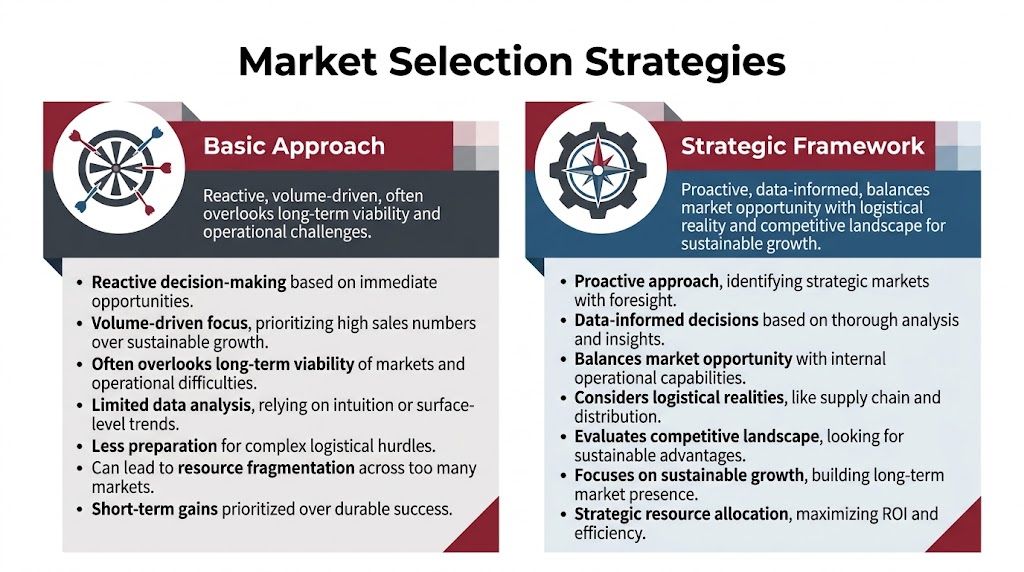
The usual advice is to enter the biggest market first. That sounds sensible until you look at what creates durable returns.
Large markets attract founders because the upside is obvious. The downside is less obvious until capital is committed. More competition, heavier advertising pressure, tougher compliance, and more complex fulfilment can turn a promising launch into a margin leak. A smaller or better-matched market can be the smarter first move because it lets the brand build operating competence before it scales complexity.
The four lenses that matter
A serious market decision should be filtered through four lenses, not one.
Commercial opportunity comes first, but it can’t stand alone. You’re looking for evidence that the category can support your price point, your fulfilment model, and your product story.
Competitive environment matters just as much. Some markets look attractive until you realise the search results are dominated by entrenched sellers with local review depth and aggressive pricing behaviour.
Operational feasibility is where many expansion plans start to unravel. The right market on paper can still be the wrong market if service expectations, returns friction, freight realities, or local technical requirements don’t fit your current business.
Strategic fit is the final filter. A market may offer revenue but still be a poor brand-building choice if it pushes you into discounting, fragmented SKUs, or unnecessary complexity too early.
What localisation reveals about market quality
Amazon’s expansion into Australia is a useful example because it highlights what founders often underestimate about local buying behaviour. Deep market analysis showed that Australian consumers prioritise delivery speed and local payment options. The same pattern also showed that brands adapting listings for AU-specific details such as sizing and voltage saw a 290% sales uplift in their first year, which is a sharp reminder that localisation beats a standardised global template in practice, not just in theory, according to Omnia Retail’s analysis of Amazon’s Australia strategy.
That insight matters beyond Australia. It shows that the “best” market isn’t always the biggest one. It may be the one where your product can be localised clearly, your fulfilment promise can be met, and your category can establish credibility without extreme spend.
For brands assessing marketplace pathways, Amazon marketplace expansion support often becomes relevant only after this selection work is done. Doing it in reverse usually creates expensive rework.
A profitable beachhead is worth more than a broad but unstable launch.
A practical scoring matrix
Use a scoring matrix before you choose a market. It forces discipline when internal enthusiasm starts outrunning evidence.
| Pillar | What to assess | Warning sign |
|---|---|---|
| Commercial opportunity | Demand quality, price tolerance, category relevance | Interest exists, but only at compressed pricing |
| Competitive landscape | Incumbent strength, review barriers, private label pressure | Search results reward volume over differentiation |
| Operational feasibility | Delivery expectations, returns complexity, local requirements | Service promise can’t be met consistently |
| Strategic fit | Brand alignment, channel future, SKU clarity | Market adds revenue but weakens positioning |
What works and what usually doesn’t
The pattern is consistent.
Brands that chase the US first because it feels like the “real” opportunity often underestimate what the market demands operationally. They launch too many SKUs, bid too broadly, and discover late that local service expectations punish weak execution.
Brands that start with a more deliberate first market usually do three things better:
- They choose a manageable lead SKU group: They don’t export the whole catalogue.
- They build local relevance early: Listing content, packaging, and technical details are adapted before launch.
- They protect optionality: The first market becomes a system for learning, not a vanity milestone.
Market selection isn’t about bravery. It’s about sequence. The founder who gets sequence right usually scales faster later because fewer strategic mistakes need to be undone.
Phase Two Product Positioning and SKU Adaptation
A product can perform well domestically and still fail abroad for reasons that have nothing to do with quality. In most cases, the issue is positioning friction. The product arrives in a new market carrying assumptions from the old one.
That’s why SKU adaptation should be treated as a commercial exercise, not a compliance afterthought.

Start with a portfolio audit, not a catalogue export
Founders often ask which marketplace to enter, then immediately assume the answer is to take their best domestic sellers into that market unchanged. That can work occasionally. It isn’t a strategy.
A better process is to audit the catalogue through the lens of transferability. Some SKUs are naturally portable. Others depend on local standards, local terminology, retailer education, or a support structure that Amazon won’t provide.
Use this shortlist to audit each SKU before launch:
- Technical fit: Check voltage, sizing conventions, plug types, materials declarations, and any market-specific performance expectations.
- Packaging fit: Review label content, warnings, claims language, and whether the pack communicates clearly without a sales rep present.
- Margin fit: Remove SKUs that only work if freight, returns, or ads stay unrealistically low.
- Brand fit: Keep products that express the brand clearly and are easy for a new customer to understand in seconds.
- Operational fit: Prioritise SKUs that are easier to forecast, replenish, and support in-market.
Localise meaning, not just words
Translation is mechanical. Localisation is commercial.
A translated listing can still fail because it uses the wrong buying cues, the wrong hierarchy of benefits, or references that mean little in the target market. This is common in home improvement, household, and consumer product categories. The founder assumes the product story is universal. The buyer sees a confusing offer with unclear standards and unfamiliar terminology.
The strongest marketplace listings in new regions usually do three things well. They clarify practical use fast, remove technical ambiguity, and align the product story with how that market shops. That may require changing imagery, rewriting bullets, adjusting pack copy, or simplifying your feature narrative.
If your listing needs the customer to “figure it out”, it’s not localised enough.
The adaptation decision is often SKU by SKU
Not every product deserves adaptation. Some should be held back.
That’s a difficult discipline for founders because adaptation work creates momentum. Once the team starts localising packaging and rebuilding listings, it’s tempting to push more SKUs through the pipeline than the market has earned. In practice, the highest-quality expansion work usually begins with the products that are easiest to explain, easiest to support, and least likely to trigger avoidable technical friction.
A simple way to classify the range is:
| SKU type | Expansion decision |
|---|---|
| Direct-fit SKU | Launch quickly with localised listing and packaging review |
| Adaptable SKU | Launch only after technical or message changes are complete |
| High-friction SKU | Hold until market demand and local support justify the effort |
The video below gives a useful external perspective on how marketplace expansion decisions often play out in execution.
What a founder should ask before approving a SKU
Good adaptation work usually comes from better questions, not better templates.
Ask the team:
- Would a first-time buyer in this market understand the use case immediately?
- Does the product require technical interpretation that the listing doesn’t currently solve?
- Will customer expectations around installation, compatibility, or care differ from the home market?
- Does the pack create trust locally, or just compliance?
- If this SKU wins, can we replenish it smoothly without distorting the rest of the business?
A great product doesn’t need to remain unchanged to remain great. In international expansion, the brands that win are usually the ones willing to adapt the offer without diluting the core proposition.
Phase Three Channel Strategy and Supply Chain
Amazon-first isn’t always wrong. It’s often efficient. But efficiency and resilience aren’t the same thing.
Founders usually face a channel decision long before they admit it. Are you using Amazon as the market entry vehicle, or are you allowing it to become the market itself? That distinction affects pricing power, inventory planning, customer data access, and how much negotiating power you retain later.

Three channel models and their trade-offs
Most international launches fall into one of three models.
| Model | Strength | Limitation | Best fit |
|---|---|---|---|
| Amazon-exclusive | Fast market access and operational simplicity | High platform dependency and weaker brand control | Brands testing demand with limited channel infrastructure |
| Hybrid | Better balance between visibility and control | More moving parts across inventory and marketing | Brands that can support DTC alongside Amazon |
| Partner-led distribution | Local execution and market knowledge | Less direct control over day-to-day channel activity | Brands entering markets with heavier operational friction |
The wrong choice usually comes from confusing what’s easiest to start with what’s easiest to sustain.
Amazon-exclusive can work, but only under strict conditions
An Amazon-only entry model can be useful when the product has straightforward compliance, predictable replenishment, and clear marketplace fit. It works best when the founder is deliberately using Amazon to validate local pricing and message-market fit before investing further.
It works poorly when the brand needs education, service nuance, or channel insulation. In those cases, Amazon compresses the proposition too aggressively. The listing has to do all the work, and the business becomes vulnerable to fee pressure, ad dependency, and review asymmetry.
Hybrid models protect more long-term value
A hybrid model usually creates better strategic optionality. Amazon handles discovery and convenience. DTC or owned channels support richer brand communication, retention, and pricing architecture.
This model requires more discipline than founders expect. Inventory can’t be allocated casually. Packaging and fulfilment standards need consistency. Channel conflict needs to be managed before it becomes visible. But if the brand has enough organisational maturity, hybrid is often the point where marketplace growth starts contributing to brand equity rather than merely extracting margin.
The goal isn’t to avoid Amazon dependence entirely. The goal is to prevent Amazon from becoming your only explanation for growth.
Partner-led expansion is often underestimated
In operationally demanding categories, a partner-led model can be the smartest route because local execution matters more than theoretical control. Distribution, compliance interpretation, regional freight decisions, and account management often determine whether the launch behaves like a business or a project.
That’s where operators look for established local infrastructure. In practical terms, options can include local 3PLs, specialist compliance consultants, in-market distributors, or a structured expansion partner such as TPR Brands’ logistics capability, depending on category, geography, and internal resourcing.
Supply chain design should match channel design
A weak supply chain can sabotage even a sensible channel strategy. Founders often choose FBA, FBM, or a blended model based on convenience, then discover later that the replenishment rhythm doesn’t suit the product.
Use these questions to pressure-test the supply chain before launch:
- Replenishment stability: Can your suppliers support a consistent cadence, or will stockouts become normal?
- Freight flexibility: Do you have alternate routing options if lead times move against you?
- Inventory segmentation: Can you hold stock differently for Amazon, DTC, and distribution without confusion?
- Sourcing resilience: If policy or cost conditions change, do you have room to adjust?
A smart amazon expansion plan doesn’t start with “Which fulfilment model should we use?” It starts with “Which channel structure lets us keep control while still serving the market properly?” Supply chain decisions become clearer after that.
Phase Four The Go-To-Market Launch Plan
A marketplace launch shouldn’t be treated like a switch being flipped. It’s closer to a controlled release. The brands that hold margin and learn quickly are the ones that enter with a tight sequence, a constrained SKU set, and a clear definition of what success looks like beyond revenue.
The first mistake is overloading the market on day one. The second is measuring the wrong things after launch. If your dashboard is dominated by gross sales and ad visibility, you can miss operational weaknesses until they become expensive.
The pre-launch work that changes the launch outcome
Good launches are won before inventory is fully live.
That means the catalogue is already rationalised. Packaging and listing content have gone through local review. Forecasting has been stress-tested against realistic replenishment windows. Freight assumptions have been challenged, not accepted. Above all, the business knows which SKUs are being launched to learn and which are being launched to scale.
A practical pre-launch checklist looks like this:
- Narrow the opening range: Launch the smallest SKU set that can still express the brand properly.
- Map the unit economics: Build the market-level P&L before stock leaves origin.
- Review listing logic: Make sure copy, imagery, technical details, and pack hierarchy match local buying behaviour.
- Set inventory guardrails: Decide the minimum stock position you’re willing to tolerate before pausing growth efforts.
- Define launch thresholds: Know in advance what would trigger more spend, less spend, or SKU withdrawal.
A simple 90-day operating rhythm
Most launches need a weekly decision rhythm, not a one-off campaign plan.
Days 1 to 30
The opening period is about signal quality. You’re checking whether the market is responding to the value proposition you intended, not merely whether traffic is arriving.
Focus on:
- Listing clarity
- Conversion behaviour
- Early review patterns
- Inventory movement by SKU
- Ad spend discipline
This is not the stage to broaden aggressively. If one SKU is absorbing disproportionate ad pressure just to hold sales, that’s information. If returns or customer questions cluster around one technical issue, that’s information too. Launches go wrong when teams explain away these signals instead of acting on them.
Days 31 to 60
By this stage, the team should know whether the core offer is landing. If it is, the work becomes optimisation. If it isn’t, the business should still be operating from enough restraint to adapt without panic.
Use this period to decide:
- whether the hero SKU set is correct
- whether pricing architecture is sustainable
- whether the creative assets are doing enough explanatory work
- whether replenishment assumptions need tightening
- whether adjacent owned channels should begin supporting the launch
A common founder error here is trying to solve a positioning problem with more advertising. If the product isn’t communicating clearly, spend rarely fixes it.
Early advertising can buy attention. It can’t repair a weak market proposition.
Days 61 to 90
Now the business should be shifting from launch mechanics to operating model. At this stage, scale decisions start carrying consequences.
You’re no longer just asking whether customers will buy. You’re asking whether the market can be served profitably and consistently. If yes, then the next decisions may involve range expansion, stronger replenishment commitments, and more formal channel layering. If not, the brand should tighten, not sprawl.
The KPIs that matter more than vanity metrics
A founder needs a smaller, sharper dashboard than most marketplace teams produce.
Use launch reporting to answer five questions:
| KPI lens | What you’re really asking |
|---|---|
| Contribution margin | Are sales creating profit after marketplace reality is accounted for? |
| Repeat purchase pattern | Is the product earning retention, not just launch curiosity? |
| Inventory health | Can growth continue without service degradation? |
| Returns and support issues | Is the offer understood and performing as promised? |
| SKU concentration | Do we have a scalable hero range, or scattered demand? |
Revenue belongs on the dashboard, but it shouldn’t dominate the decision-making. Revenue is often the noisiest signal during launch.
Build the launch team around decisions, not tasks
Founders often assign launch work functionally. Operations handles freight. Marketing handles ads. Creative handles listings. Finance checks the numbers. Each workstream is reasonable on its own, yet the launch still underperforms because no one is integrating the decisions.
The better model is cross-functional and narrow. One person owns commercial judgement. One owns inventory and fulfilment readiness. One owns listing quality and marketplace execution. Finance remains involved from the start, not after spend has already gone out the door.
That structure matters because launch problems usually sit between functions. A stock issue gets blamed on demand, when the actual problem was a bad inbound assumption. A conversion issue gets blamed on ads, when the actual problem was technical ambiguity in the listing. A margin issue gets blamed on Amazon, when the launch range was never economically coherent to begin with.
A disciplined launch beats an exciting one
A founder doesn’t need a dramatic launch. They need one that produces clear evidence.
That usually means fewer SKUs, cleaner assumptions, tighter thresholds, and a willingness to delay market scale until the operating model is proving itself. In amazon expansion, restraint is often what creates speed later. Teams that rush usually spend the next quarter correcting avoidable mistakes.
Managing Risk Margins Compliance and Logistics
Most international marketplace plans look profitable until the full cost stack shows up. That’s where founders learn whether they built a launch model or a business model.
The hidden problem in amazon expansion isn’t usually one giant error. It’s the accumulation of smaller assumptions. Freight comes in heavier than expected. Returns behave differently in-market. compliance work takes longer. Platform fees are accepted as fixed while other costs drift upward. The margin that looked healthy in the planning sheet starts narrowing from several directions at once.
Margin erosion usually starts before launch
A disciplined market P&L needs to model landed cost reality, not ideal conditions.
That means founders should pressure-test every market with uncomfortable questions. What happens if inventory sits longer than forecast? What if the highest-volume SKU also becomes the highest-support SKU? What if a compliance issue delays replenishment? What if your freight route remains available but no longer makes commercial sense?
For Australian brands entering rural US demand pockets, that pressure-testing matters even more. The challenge isn’t just distance. According to reporting on Amazon’s rural US delivery expansion, rural US represents a $1.3 trillion consumer segment, yet Australian exporters can face 15 to 20% higher logistics costs without on-ground adaptation, alongside compliance friction such as differing US EPA standards.
That’s exactly the sort of opportunity that tempts founders into expansion before the operating model is ready.
A practical way to stress-test profitability
Before approving a market, build a simple decision sheet around four layers:
-
Base product economics
Unit cost, packaging cost, and expected gross margin before market entry costs. -
Market entry costs
International freight, customs handling, compliance work, storage assumptions, and returns exposure. -
Marketplace costs
Advertising tolerance, platform fees, and the operational cost of maintaining account health. -
Failure costs
Slow-moving inventory, listing suppression risk, disposal risk, and working capital strain.
If the economics only work under favourable assumptions, the launch isn’t ready.
Strong founders don’t ask whether a market is attractive. They ask whether the downside is survivable if the first plan is only partly right.
Compliance isn’t an admin step
Founders often treat compliance as a box-ticking exercise delegated late in the process. That’s dangerous because compliance affects packaging, claims, materials, shipping, and channel eligibility. It can change whether a SKU is viable at all.
The right approach is to pull compliance forward into the market-selection and SKU-selection stages. That creates cleaner packaging decisions, fewer inbound surprises, and less rework across listings and logistics. For brands that need marketplace execution support in parallel with operational discipline, Amazon selling support for international expansion is one route to structure that work.
Logistics should be designed for exceptions
A supply chain that works only when everything goes smoothly isn’t resilient enough for cross-border marketplace growth.
Founders need backup thinking. Alternate replenishment paths. Clear rules for inventory prioritisation. Defined thresholds for pausing ads when stock risk rises. A process for handling compliance holds without contaminating the wider range. Margin protection usually comes from these operating decisions, not from finding a cleverer spreadsheet.
International expansion becomes much easier once the business accepts a simple truth. Profitability isn’t found later in optimisation. It’s built into the launch design from the start.
Common Amazon Expansion Mistakes
Many international Amazon launches fail for predictable reasons. The issue is rarely the marketplace itself. The problem is usually weak expansion structure underneath the launch.
One common mistake is entering large markets too early without proving operational stability in smaller regions first. Founders often underestimate the advertising pressure, review competition, and fulfilment expectations inside major marketplaces.
Another issue is poor localisation. Translating listings without adapting positioning, imagery, technical details, or packaging for local buying behaviour creates confusion instead of trust.
Many brands also launch too many SKUs at once. This increases inventory complexity, weakens forecasting accuracy, and spreads advertising spend too thinly across the catalogue.
Margin erosion is another major problem. Businesses frequently underestimate returns exposure, storage costs, advertising dependency, and replenishment delays. Revenue may grow while profitability quietly deteriorates underneath.
The strongest operators avoid these mistakes by treating Amazon expansion as a controlled commercial system rather than a rapid marketplace rollout.
Final Thoughts on Amazon Expansion
The biggest mistake founders make in Amazon expansion is treating international marketplaces like simple sales channels instead of long-term brand infrastructure.
Strong international growth usually comes from disciplined execution rather than aggressive rollout speed. The brands that scale successfully are typically the ones that pressure-test market selection, SKU strategy, localisation, fulfilment systems, pricing structure, and operational resilience before expanding aggressively.
Amazon can become a powerful international growth engine when it strengthens broader commercial capability. It can improve market validation, sharpen inventory discipline, accelerate regional learning, and create future pathways into wholesale, distribution, and direct-to-consumer growth.
But expansion only becomes sustainable when the operating model underneath it is stable.
At TPR Brands, we work with established product businesses navigating international Amazon growth across multiple regions and marketplace environments. Our focus is helping brands evaluate market readiness, channel strategy, localisation requirements, supply chain structure, and scalable expansion planning before growth becomes unnecessarily expensive.
If your business is evaluating Amazon expansion, the quality of the launch structure will usually matter far more than the speed of entry.
If you’re evaluating amazon expansion and want a clearer view of market readiness, channel structure, and international execution risk, TPR Brands works with established product businesses scaling into new regions with tighter control over positioning, compliance, logistics, and margin.