A successful global expansion strategy is not about entering the most markets. It’s about entering the right markets with the right operating model, positioning, and channel structure. Many product brands expand too early, overextend resources, and mistake short-term sales activity for scalable international growth.
Your product is working. Customers reorder, reviews are strong, and the home market no longer feels like the main constraint. That’s usually when expansion starts to look obvious.
It also becomes dangerous.
Founders often treat expansion as a series of tactical moves. Open an Amazon account in another country. Say yes to an inbound distributor. Ship a test container because a buyer sounded interested. None of that is a strategy. It’s activity. Sometimes it creates short-term sales, but it rarely creates a stable second market.
A real expansion strategy answers a harder question. Not “where can we sell next?” but “where can we win without breaking the brand, the margin, or the operation?”
The Foundation for a Real Expansion Strategy
Many brands begin global expansion from the wrong starting point. They assume domestic traction is proof of international readiness. It isn’t. A product can be strong and still fail abroad because the company entered the wrong market, used the wrong channel, or underestimated localization and compliance.
That gap between product quality and market-entry discipline is where a lot of good brands get hurt. A 2025 Austrade finding highlighted by Luth Research says 40% of Australian SMEs that attempt international expansion fail, largely because of inadequate localization and flawed market entry strategy.

That number matters because it changes the founder’s job. Expansion isn’t a reward for growth. It’s a separate operating discipline.
Why opportunistic selling usually backfires
The most common pattern looks sensible at first:
- A retailer reaches out: The founder sees inbound interest and assumes demand is validated.
- A marketplace looks accessible: The team lists the catalogue quickly because setup feels faster than wholesale or distribution.
- A neighbouring market feels familiar: English-speaking buyers, similar packaging, and comparable product use create false confidence.
The problem is that each move is disconnected from the others. Pricing wasn’t built for the new channel. Inventory planning wasn’t built for longer lead times. Brand language wasn’t adapted for local buying logic. Customer support wasn’t prepared for a new market’s expectations.
You can still get orders. You just can’t build repeatable growth that way.
Practical rule: If your expansion plan starts with a sales channel instead of a market thesis, you’re reacting, not expanding.
What a real foundation looks like
A disciplined expansion strategy rests on four decisions made early.
| Decision | What founders need to settle |
|---|---|
| Market choice | Which country or region has the strongest fit for the current product set |
| Positioning | Why local buyers should care, and how that message changes by market |
| Operating model | How product will move, who will hold stock, and who owns the customer relationship |
| Risk boundary | What you won’t compromise on, usually margin, brand control, compliance, or service quality |
Most founders spend too much time on the first line and not enough on the last three.
Movement is not progress
A rushed launch can create flattering signals. Early Amazon sales. A few wholesale accounts. Positive responses from one trade show. Those signals can hide structural weakness for months.
What matters is whether the business can repeat the result without constant founder intervention. If every order needs manual exceptions, every shipment creates a customs issue, and every reseller wants a different version of your marketing, you haven’t built expansion. You’ve built dependency.
The strongest operators treat market entry like capital allocation. They assume every new region will test the brand in three ways: local relevance, channel discipline, and execution capacity. If one fails, the whole market can stall.
That’s why the first stage of a serious expansion strategy isn’t shipping product. It’s narrowing choices before you commit to them.
Phase One Pinpointing Your Next Market with Precision
Most founders start with a shortlist that’s too emotional. They choose markets they know, markets they like visiting, or markets where one buyer showed interest. A better approach is to filter broadly, then cut hard.
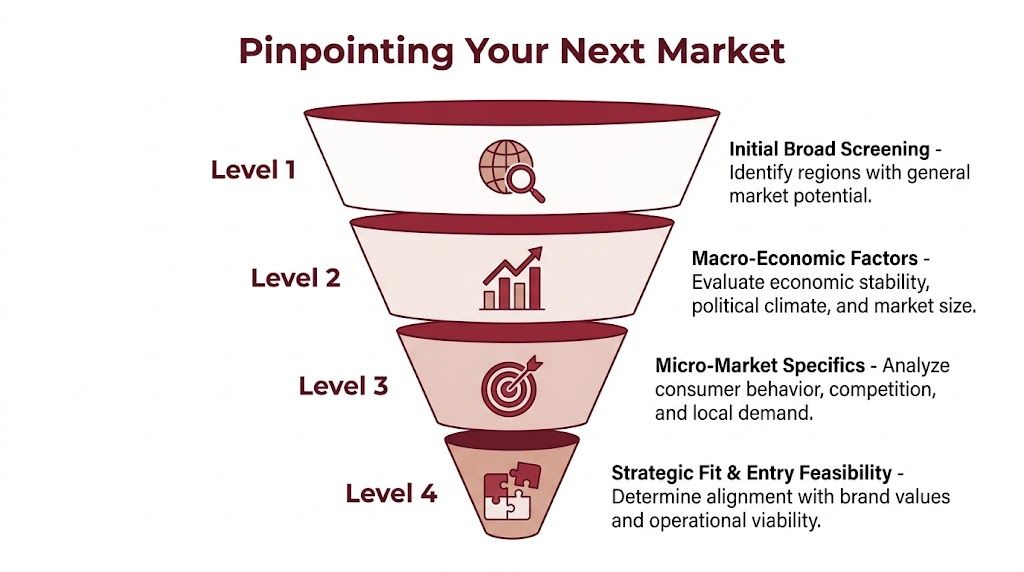
Start broad, but not vague
The first pass is not about commitment. It’s about eliminating bad fits quickly. Build a candidate list of markets, then assess each one against a small set of filters.
I’d use three layers.
- Macro attractiveness
- Product-market fit
- Entry feasibility
That sequence matters. Founders often jump straight to product enthusiasm and ignore market structure.
Filter one through macro attractiveness
A market can be interesting and still be wrong for your next move. What you want first is stability and enough commercial depth to justify management attention.
Look at:
- Economic reliability: You don’t need the biggest market. You need one where planning assumptions are less likely to break.
- Retail and channel maturity: Some markets support clean multi-channel growth. Others force you into fragmented execution.
- Consumer spending logic: Premium products, utility products, and replacement products all behave differently across markets.
A region can pass the “big opportunity” test and still fail the “right next move” test.
Filter two through actual market fit
Once the field narrows, shift from geography to buyer behaviour. At this stage, many expansion plans improve or die.
A useful example comes from Asia-Pacific. Chalifour Consulting’s business expansion guide notes that Australian hardware exports to Japan and the Asia-Pacific region surged 28% during 2020 to 2022, reaching AUD 4.2 billion, driven in part by understanding market-specific demand such as Japan’s ageing population seeking easy-to-install home products.
That isn’t just a trade statistic. It’s an operating lesson. Categories don’t travel because they exist. They travel because they fit local use cases.
The right market is rarely the one with the loudest demand signal. It’s the one where your product solves a local problem without needing a full reinvention of the business.
Ask sharper questions here:
- Does the customer use the product the same way?
- Does your core value proposition still make sense when translated into local buying priorities?
- Are you entering a crowded category where the winner is decided by discounting, not differentiation?
If your product needs heavy education, your market-entry cost rises fast. If your product already maps to existing local demand, the launch gets simpler.
A founder exploring marketplace-led growth should also think carefully about how local platforms shape discovery, pricing and review velocity. That becomes even more important when assessing Amazon store expansion options as part of the shortlist.
Filter three through cost of entry
This is the final cut, and it’s the one founders skip when they’re excited. The question isn’t “can we enter?” It’s “can we enter without damaging the business?”
Use a simple decision table.
Narrow to one primary market, not five
The strongest first expansion strategy is usually narrower than the founder wants. A single market with a clear thesis beats a scattered push across multiple regions.
Your shortlist should end with:
- One priority market
- One backup market
- One market you deliberately reject for now
That last choice matters. It proves you’re allocating focus, not collecting possibilities.
Phase Two Adapting Your Brand and Channel Mix
A lot of brands translate packaging, swap currencies, and call that localisation. Buyers notice the difference immediately. They can tell when a brand has entered a market versus when it has arrived there.
Brand adaptation isn’t cosmetic. It affects conversion, retailer confidence, pricing power, and how much support the product needs after launch.

Position the product for the local buyer
Founders usually know their product story too well. That’s the problem. They start speaking from internal logic instead of local relevance.
In one market, a household product may sell because it saves time. In another, the better angle is reliability, safety, or space efficiency. The product hasn’t changed. The buying motive has.
That means reviewing:
- Value proposition: What matters most to the local buyer
- Claim hierarchy: Which proof points should lead, and which should move down
- Visual cues: Whether your packaging and listing assets signal quality in the local retail context
- Language choices: Not just translation, but terminology buyers use
If the message doesn’t fit the market, the channel won’t save it.
Don’t let the channel define the brand
Marketplace growth is useful, but it can also train a founder into bad habits. When Amazon becomes the whole go-to-market plan, pricing, content, support, and stock decisions start revolving around platform convenience rather than brand strength.
That’s backwards.
Your channel mix should follow your positioning. If your product needs education, specialist retail or a strong distributor may outperform a pure marketplace launch. If your product already has high search intent and simple comparison logic, Amazon can be a strong acquisition channel. If the brand depends on trust and repeat purchase, direct relationships may matter more than early marketplace velocity.
Here’s the trade-off in plain terms:
| Channel | Best used when | Main risk |
|---|---|---|
| Amazon and marketplaces | Product is searchable, review-led, and operationally ready | Margin pressure and weaker brand control |
| Distributors | Local relationships and field execution matter | Less direct visibility into customer feedback |
| Speciality retail | Product benefits from category context and staff explanation | Slower rollout and more account management |
| Direct-to-consumer | Brand story and retention economics are strong | Higher local marketing and service burden |
A well-built mix usually combines channels instead of worshipping one.
Your Approvd’s 2025 summary of eMarketer AU data notes that brands that strategically diversify channels, such as combining Amazon Australia with strategic partnerships, see a benchmark revenue uplift of 28% compared with relying on a single channel. That doesn’t mean “be everywhere.” It means channel diversification works when it’s intentional.
A short discussion on channel balance is useful here:
What adaptation looks like in practice
The strongest market entries usually make a few visible changes and a lot of invisible ones.
- They adjust message order: The first three selling points change to match local priorities.
- They reshape the assortment: Hero SKUs lead. Edge variants wait.
- They set channel rules early: Pricing, promotional windows, and account boundaries are clear before launch.
- They rewrite support assets: FAQs, instructions, and listing content reflect local objections, not home-market assumptions.
Founder test: If your product page, reseller pitch, and packaging could be dropped unchanged into any market, you probably haven’t localised enough.
The key insight is simple. Brand adaptation and channel strategy are one decision, not two. The market tells you what the brand should emphasise. That positioning tells you which channels can carry it without distorting it.
Phase Three Building Your Operational Blueprint
This is the part founders delay because it feels less exciting than product, channel, or revenue planning. It’s also the part that determines whether expansion becomes a repeatable capability or an expensive distraction.
Execution breaks most international launches. Not because the product is weak, but because the operation wasn’t built for the market being entered.
Compliance is not an admin task
Too many teams treat compliance as paperwork to handle late in the process. That mindset is expensive. Testing requirements, labelling rules, import documentation, safety standards, and category-specific approvals can all affect product design, packaging, cost, and launch timing.
The failure rate here is high. Techsalerator’s summary of IBISWorld’s Q1 2026 Australian Hardware Report says 65% of SMEs fail their initial compliance checks when entering new international markets.
That should change how you sequence work.
A disciplined team handles compliance in this order:
- Confirm market-specific product requirements
- Map any packaging or documentation changes
- Check whether testing must be refreshed or localised
- Model the cost and timing impact before launch approval
If you wait until stock is in motion, you’ve left strategy and entered damage control.
Build the supply chain around the market, not your current habit
A founder’s existing fulfilment model often becomes a default. That’s another mistake. The right inventory architecture depends on the market, the channel mix, and how much control you need over customer experience.
Three common models appear in most launches.
Marketplace-led fulfilment
This suits products with strong platform demand and relatively standard handling requirements. It can improve speed and reduce operating complexity inside the platform.
The downside is dependence. Stock planning becomes tightly linked to one ecosystem, and channel flexibility can shrink.
Regional 3PL
A good 3PL gives you more control across multiple channels. This often makes sense when you’re serving Amazon, wholesale, and direct orders from the same market.
It requires tighter forecasting and stronger operating oversight. But you keep more optionality.
Full-service distributor
This works when local relationships, field sales, and account access matter more than direct operating control. It can be the fastest route into a market where credibility and execution sit with local players.
The trade-off is visibility. You must define reporting, brand standards, and inventory expectations early.
Here’s the decision lens:
| Model | Best for | Watch-out |
|---|---|---|
| Marketplace fulfilment | Speed inside a single platform | Channel dependence |
| Regional 3PL | Multi-channel flexibility | More planning complexity |
| Distributor stock model | Local market access and account reach | Lower day-to-day control |
Operationally, teams also need a realistic view of freight volatility, packaging durability, replenishment timing, and returns handling. Those decisions are not secondary. They shape margin and retailer confidence.
A practical example is international logistics planning for expanding brands, where the issue isn’t only moving cartons. It’s choosing who owns stock risk, who manages exceptions, and how quickly a problem can be corrected inside the market.
Strong operators don’t ask, “How do we ship product there?” They ask, “What operating model still works when demand spikes, a shipment is delayed, or one account underperforms?”
Turn operations into a moat
Most competitors will talk loudly about growth and improvise the backend. That creates an opening for the founder who builds discipline early.
An operational blueprint should cover:
- Compliance ownership: One person or function must own approvals and documentation
- Inventory logic: Reorder points, buffer stock, and account allocation must be defined before launch
- Exception handling: Customs holds, damage claims, stockouts, and listing issues need an owner
- Data flow: Sales, returns, and inventory data must come back fast enough to support decisions
Founders often want certainty before they invest in operations. In practice, the opposite works better. You build the operating spine first, then scale into it.
Phase Four Launch Partnership and Scalable Growth
A first market entry rarely fails because the founder lacked ambition. It fails because the company tried to control everything from too far away. New markets punish distance. They expose every weak assumption about channels, retail dynamics, logistics, and buyer behaviour.
That’s why partnership matters.
The right local partner is not just a sales outlet. They’re your compression layer between strategy and reality. They shorten feedback loops, flag issues early, and stop small mistakes from becoming structural ones. Without that, the founder ends up making delayed decisions on partial information.
What a good partner actually does
A useful partner does more than place orders. They help execute the market in a way that protects the brand.
Look for operators who can:
- Interpret local demand: They can tell you whether poor sell-through is a positioning issue, a pricing issue, or even bad account selection.
- Manage channel nuance: They understand which retailers matter, which marketplaces distort pricing, and where your product should not be pushed.
- Protect standards: They won’t shortcut compliance, packaging, or account discipline just to create early volume.
- Provide real feedback: Not vague optimism. Clear signals on what’s landing and what’s not.
That last point matters more than founders expect. Expansion gets expensive when everyone is “positive” and nobody is specific.
Go alone versus launch with structure
Founders often frame this as control versus cost. Instead, the trade-off is apparent control versus informed execution.
A go-it-alone approach may preserve decision rights on paper, but it often slows learning and increases avoidable mistakes. A structured partner model can feel less direct, yet it usually gives better visibility into what the market is saying.
A useful way to compare the two:
| Approach | What it gives you | What it tends to cost you |
|---|---|---|
| Direct solo entry | Maximum formal control | Slower local learning and more execution drag |
| Partner-led entry | Faster market interpretation and local reach | Need for tighter governance and clearer agreements |
For founders assessing whether outside support belongs in the model, the more relevant question is whether your team can currently cover local compliance, channel relationships, inventory problem-solving, and brand governance from a distance. If not, you don’t have a control advantage. You have a capability gap.
A useful lens on this is the role of an Amazon expansion partner for international growth, particularly when marketplace execution needs to sit inside a broader channel strategy instead of becoming the entire plan.
The best partnerships don’t reduce standards. They make standards executable in-market.
Measure the launch properly
Founders sometimes judge a launch too early by top-line revenue alone. That creates bad decisions. A weak launch can be dressed up by discounting and overstocking. A strong launch can look modest while the foundations are being built correctly.
Better launch metrics are operational and commercial at the same time.
Focus on questions like:
- How quickly did the market get to a clean, compliant live state?
- Did margin hold by channel, or did early promotions train the market badly?
- Are the first accounts reordering for the right reasons?
- Are customer complaints pointing to product-market mismatch or simple onboarding friction?
- Can the current model scale without adding founder-level intervention to every problem?
Those signals tell you whether to increase commitment, slow down, or redesign the entry model.
Scalable growth doesn’t come from pushing harder on a weak launch. It comes from learning fast enough to reinforce what’s working and stop what isn’t.
Scaling Internationally Without Losing Control
From Great Product to Global Brand
A strong product gives you permission to explore expansion. It doesn’t guarantee success once you get there.
The brands that scale well internationally usually make the same shift. They stop treating expansion as a sales event and start treating it as a system. Market choice becomes narrower. Positioning becomes more deliberate. Channel selection becomes a brand decision, not a convenience decision. Operations become part of strategy, not something left to fix later.
That discipline matters because global growth amplifies everything. It magnifies weak pricing logic, loose channel rules, poor compliance habits, and fragile supply chains. It also amplifies good decisions. A clear market thesis, adapted positioning, reliable execution, and strong in-market partners can turn one successful launch into a repeatable model.
For founders, that’s the primary goal. Not just entering another country, but building a business that can expand again without reinventing itself every time.
Great products don’t automatically become great brands. They become great brands when the company around them learns how to scale with control.
Frequently Asked Questions for Founders
When is the right time to start a global expansion strategy?
The right time isn’t when the founder gets restless. It’s when the home market has produced repeatable success and the business can explain why that success happened.
You want to see a few things in place:
- Stable demand: The product isn’t surviving on novelty alone.
- Clear unit economics: You know where margin comes from and what pressures it can absorb.
- Operational consistency: Forecasting, fulfilment, and customer support work without constant escalation.
- A defined brand position: You can explain why customers choose you over alternatives.
If domestic growth is still messy, expansion usually multiplies that mess. If domestic performance is organized, expansion becomes a more manageable extension of what already works.
Should I use my own team or find a partner
That depends on where your current capability sits, not where you’d like it to sit.
If your internal team already understands international compliance, local channel development, inventory planning, and in-market execution, a direct model can work. But most first-time expansions expose blind spots. The issue isn’t intelligence. It’s distance and unfamiliarity.
A partner usually makes sense when:
- You need local channel access quickly
- The market has meaningful compliance or operational complexity
- Your team can manage strategy but not daily in-market friction
- You want to limit avoidable mistakes in the first launch
Running everything yourself can feel cleaner. In reality, it often means slower learning and more expensive errors. Partnerships work best when roles are explicit, reporting is disciplined, and brand rules are documented from the start.
How much capital should I budget for an expansion
Budget more than your launch model tells you.
Founders often build a number around the visible costs. Freight, inventory, listing setup, packaging edits, and local marketing. That’s only part of the picture. Expansion also carries slower-moving costs: compliance revisions, delayed account decisions, rework on content, extra support load, stock imbalances, and the time needed for the market to settle.
The right budgeting mindset is:
- Fund the launch
- Fund the correction cycle
- Fund the learning period
If your plan only works when the first shipment lands cleanly, every account converts on time, and no documentation changes are needed, the budget is too tight.
A better plan assumes friction. It gives the team room to adjust without panicking, discounting, or pulling out before the market has had a fair chance to prove itself.
What should I look for in my first target market
Look for the market where your current product can travel with the fewest forced compromises.
That usually means:
- Demand that already makes sense for your category
- Buyer behavior you can understand quickly
- Compliance complexity your team can realistically manage
- Channel options that won’t crush margin or brand control
- A path to local support, whether through internal capability or partnership
The best first market often isn’t the largest. It’s the one that gives you the cleanest learning loop.
What’s the biggest expansion mistake founders make
Confusing access with fit.
A market can be reachable and still be wrong. A retailer can be interested and still be the wrong account. A marketplace can be open and still damage your pricing architecture if used badly.
The biggest mistake is entering because you can, without proving you should.
That usually shows up as:
- chasing inbound opportunities without a broader market thesis
- launching too many SKUs too early
- using one channel as a substitute for strategy
- underestimating compliance and post-launch operations
The fix is simple, but not easy. Slow the decision down before you speed the launch up.
If you’re evaluating your next expansion move and want a more structured path, TPR Brands works with established product companies that are ready to scale into new channels and markets with tighter positioning, stronger operational planning, and on-the-ground expansion support.