Amazon creates a difficult tension for established Australian brands.
On one side, the platform offers enormous reach, strong search demand, and faster access to international customers than most traditional retail expansion models can provide. On the other, experienced operators understand the risks just as clearly. Price compression, channel conflict, reseller issues, inconsistent listings, and the possibility of weakening a carefully built brand position.
That tension is exactly why Amazon Brand Registry matters.
Not because it is simply another Amazon feature, and not because enrolment is a box-ticking exercise. It matters because established brands should not evaluate Amazon only as a sales channel. The more important question is whether the platform can support broader brand strategy without damaging pricing discipline, operational control, or existing retail relationships.
For Australian hardware, home improvement, and consumer product brands with proven traction, Brand Registry is often the first layer of structure that makes controlled Amazon expansion possible.
This guide explains how established brands use Amazon Brand Registry strategically, including marketplace control, operational readiness, risk management, channel governance, and phased expansion planning.
Amazon Is a Tool, Not a Strategy
A lot of established brands stay off Amazon for understandable reasons.
They’ve spent years building retailer relationships, maintaining price integrity and earning trust through product quality. From that vantage point, Amazon can look like a fast route to brand dilution. In many cases, that instinct is correct.
Why scepticism is rational
Amazon rewards visibility, availability and operational discipline. It doesn’t automatically reward premium positioning, nuanced product education or channel harmony. If you treat it as a default growth channel, you usually hand control to the marketplace instead of using the marketplace to advance your own objectives.
That’s where brands get into trouble.
A rushed launch often creates a familiar pattern:
- Listings go live before governance does. Product pages appear, but there’s no clear control over titles, imagery, pricing logic or reseller participation.
- Retail partners notice first. They see online price movement and start asking whether the brand is changing channel priorities.
- The team reacts tactically. More ad spend, more promotions, more catalogue added too early.
- The brand loses definition. What was once a differentiated product becomes one more search result.
None of that means Amazon is the wrong channel. It means unmanaged Amazon is the wrong operating model.
Amazon can be useful for an established brand, but only when the business decides what the channel is for before the channel starts shaping the business.
The right question senior teams ask
The brands that manage Amazon effectively usually have a narrow reason for entering.
Sometimes they want to protect existing demand because unauthorised sellers are already there. Sometimes they want to test a market before committing to larger distribution. Sometimes they want search data from the US or UK to validate product translation before wider expansion.
Those are strategic uses of Amazon.
A weaker reason is, “Our competitors are there.” That logic pulls brands into the marketplace without a plan for margin, pricing, operations or partner conflict. It treats Amazon as strategy rather than infrastructure.
What control looks like in practice
For a mature Australian brand, Amazon should usually be judged against a short decision lens:
| Question | Strategic implication |
|---|---|
| What role will Amazon play? | Protection, market entry, revenue diversification or data gathering all require different setups. |
| What must remain controlled? | Price architecture, brand presentation, authorised seller rules and SKU selection need to be defined early. |
| What are you not willing to trade away? | Premium positioning, retailer trust and product quality standards can’t be afterthoughts. |
If those answers aren’t clear, launching faster won’t help.
The point isn’t to avoid Amazon on principle. It’s to avoid entering a powerful channel without a clear operating thesis. That’s why brand registry sits near the beginning of the conversation, not the end.
Understanding Amazon Brand Registry Beyond IP Protection
Brand registry is often described as an anti-counterfeit tool. That’s true, but it’s incomplete.
For an established brand, Amazon Brand Registry is the base layer of control. Without it, you’re trying to build a branded business on land you don’t really control.

Why it matters before growth even starts
Amazon Brand Registry has enrolled over 350,000 brands globally and delivers a reported 99% reduction in suspected infringements for registered brands, according to Power Digital’s guide to Amazon Brand Registry. For Australian brands expanding internationally, that’s less a nice-to-have than a threshold issue.
If your product already has traction, someone will eventually test your listing control, brand presentation or pricing discipline. Brand registry gives you a framework to push back.
That includes control over core brand assets on product pages, access to reporting tools and the ability to manage your presence with more authority than an unregistered seller can. It also opens up elements like A+ Content, which matters because good products often need context, comparison and clear explanation to convert properly in hardware and household categories.
A serious brand should think of registry the way it thinks about trade marks, packaging standards or channel terms. It’s operational infrastructure.
For brands already planning marketplace execution, this is also where broader channel support becomes relevant. Teams evaluating the day-to-day demands of the platform often need to assess Amazon management support at the same time as brand protection requirements.
Registry is both shield and operating system
A narrow view says brand registry protects IP.
A more useful view says it does three jobs at once:
- Protects brand assets so you can challenge infringements and monitor misuse.
- Improves page control so the customer sees the brand the way you intend it to be seen.
- Provides access to tools that make Amazon viable as a managed brand channel instead of a generic catalogue feed.
That last point gets missed.
If you’re selling technical or considered-purchase products, listing control isn’t cosmetic. It affects conversion quality, return risk and customer trust. Poor images, generic descriptions and fragmented content can damage a good product faster on Amazon than in almost any other channel.
What changes after enrolment
Once registry is in place, the conversation shifts from “Can we protect the name?” to “Can we manage the channel properly?”
That means using Amazon as a branded environment rather than a dumping ground for SKUs.
A few of the practical levers matter more than founders first expect:
- A+ Content helps explain product differences that a standard listing often can’t communicate well.
- Brand Stores give shoppers a cleaner path across the range instead of forcing every buying decision onto a single detail page.
- Sponsored Brands support visibility at the brand level, not just the product level.
This walkthrough gives a useful visual overview of how the program works in practice.
Practical rule: If you wouldn’t hand a distributor the right to rewrite your packaging, alter your product explanation and compete on your own listing, you shouldn’t approach Amazon without brand registry.
Registry doesn’t solve every marketplace problem. It won’t make bad pricing strategy good. It won’t stop all reseller activity. It won’t substitute for channel governance.
But it does answer a basic commercial question. If you’re going to operate on Amazon at all, do you want to participate as a brand owner or as a passenger?
Evaluating the Commercial Opportunity on Amazon
The case for Amazon isn’t just access to demand. For many established brands, the stronger case is access to information.
That matters when you’re entering unfamiliar markets. A hardware brand that performs well in Australia doesn’t automatically translate into the US or UK with the same product emphasis, language, bundling logic or adjacent category opportunity.
Brand Analytics changes the quality of the decision
Brand Registry provides Brand Analytics, which offers region-specific data including top search terms, repeat purchase behaviour, customer demographics and market basket analysis, according to Seller Labs’ overview of Amazon Brand Registry.sellerlabs.com/blog/amazon-brand-registry-2025/).
That’s strategically useful because it gives senior teams a direct view into how shoppers behave inside the marketplace, not just how they say they behave in survey data.

For a CEO or commercial lead, this shifts Amazon from being only a sales channel to being a live intelligence environment.
The data is useful beyond Amazon
Most brands underuse this.
They look at Amazon data only through the lens of ad performance or listing tweaks. The better use is broader. Brand Analytics can inform product line decisions, merchandising logic and even what should or shouldn’t be taken into a new market.
A few examples of how operators use this well:
- Search term review can show whether customers describe the product the way your brand does, or whether the market uses different language.
- Market basket analysis can reveal adjacent products shoppers naturally pair with yours, which is useful for bundle planning and future range expansion.
- Repeat purchase behaviour can help determine whether a product should be treated as a one-off purchase, a replenishment item or a gateway into a broader product family.
- Demographic insight can guide positioning, imagery and commercial focus by region.
That’s part of why Amazon deserves a more serious boardroom discussion than “we should probably list there.”
A practical lens for opportunity
When brands assess the commercial upside properly, they usually look at three layers.
| Layer | What to examine | Why it matters |
|---|---|---|
| Demand visibility | Search behaviour and product discovery patterns | Shows whether the market is already looking for your type of solution |
| Category fit | Basket behaviour, adjacent purchases, repeat dynamics | Helps judge whether the product belongs in a broader ecosystem |
| Market translation | Differences by region, terminology and shopper profile | Reduces the risk of assuming Australian traction will map cleanly overseas |
This is also where the economics need scrutiny. Amazon can be commercially attractive while still being margin-sensitive once fulfilment, advertising and operational overhead are considered. Any serious channel review should sit alongside a clear understanding of Amazon fees, because poor unit economics can make promising demand look better than it is.
The brands that learn fastest on Amazon don’t just study sales. They study customer behaviour, keyword intent and product adjacency, then use those signals outside the marketplace as well.
Amazon as a de-risking tool
There’s a useful mindset shift here.
For a proven Australian brand, Amazon doesn’t have to begin as a full-scale expansion bet. It can function as a structured test environment. You can learn which products gain traction, which messages resonate and which markets show the cleanest fit before committing to heavier retail or distribution investment.
That doesn’t eliminate risk. It does make expansion less speculative.
Done well, brand registry turns Amazon into more than an ecommerce endpoint. It turns it into a channel where brand control and commercial intelligence can coexist.
Navigating the Strategic Risks for Established Brands
Most Amazon articles underplay the part experienced operators care about most.
The biggest risk usually isn’t that someone copies your listing. It’s that you enter a high-velocity marketplace in a way that weakens the rest of your business.

The risk isn’t just external
Counterfeits and bad actors are obvious threats. Internal strategic errors are often more expensive.
An established Australian hardware brand usually has existing channel architecture. There may be trade distributors, independents, national retailers or export relationships already in place. Amazon affects all of them once price visibility increases and shoppers start comparing offers side by side.
That creates tension in several areas at once.
Channel conflict
Retail partners may tolerate Amazon if the role of the channel is defined clearly. They react badly when the marketplace looks like a discount outlet or when the online assortment undermines in-store value.
If your Amazon offer mirrors retail packs, undercuts the market and adds uncontrolled promotional behaviour, conflict becomes likely. The issue isn’t ideology. It’s simple economics for your partners.
Price erosion
Amazon makes pricing behaviour highly visible.
If one seller drops price, the brand often feels pressure to respond, then the rest of the channel follows. Once that cycle starts, restoring premium position gets harder. A marketplace launch that boosts top-line revenue can still damage brand equity if the customer begins to treat the product as interchangeable.
Loss of direct customer context
Brands with strong DTC or trade relationships often underestimate this shift. On Amazon, the customer interaction sits inside Amazon’s environment. You can still learn a great deal, but you don’t own the relationship the same way you do on your own site or through direct trade programs.
That means the channel should be used for a purpose, not allowed to become the default centre of your customer strategy.
AU-specific compliance can block expansion before it starts
There’s also a category of risk that looks administrative until it delays a launch.
For Australian brands expanding to the US or UK, unresolved brand abuse flags from the AU store can lead to brand registry rejections, affecting 20-30% of multi-marketplace applicants, according to Seller Engine’s Amazon Brand Registry guide.
That matters because many leadership teams assume marketplace expansion is mainly a front-end commercial decision. In reality, Amazon often treats account health, policy history and marketplace compliance as part of one connected system.
A brand can have a strong product, a valid international growth case and still get slowed down by unresolved marketplace hygiene in its home region.
What brand registry does not solve
Founders need a blunt view here.
Brand registry improves control. It does not create perfect control.
It won’t automatically stop every unauthorised reseller. It won’t guarantee that every ASIN issue is resolved quickly. It won’t fix weak packaging proof, inconsistent product branding or poor internal governance.
That’s why the most common failure pattern for established brands isn’t refusing Amazon. It’s entering with partial commitment.
A few warning signs usually show up early:
- Too many SKUs at launch. The team expands range before it has operational proof on the channel.
- No authorised seller policy. Reseller ambiguity creates avoidable listing and pricing problems.
- Retail parity ignored. Amazon assortment is copied from other channels without strategic adaptation.
- Registry treated as the endpoint. Enrolment happens, but governance, monitoring and content discipline don’t follow.
The real strategic trade-off
Staying off Amazon doesn’t guarantee protection. Entering badly doesn’t guarantee growth.
That’s the trade-off.
If customers are already searching there, if resellers are likely to appear there, or if overseas buyers use Amazon as a first discovery layer, avoidance can become a passive decision to let the channel form around you without your input. But if your team enters without operating discipline, Amazon can distort pricing, messaging and partner relationships very quickly.
Established brands need to be honest about both sides. The danger isn’t Amazon itself. The danger is entering one of the world’s most demanding retail environments without deciding what must stay controlled.
Assessing Your Brand’s Operational Readiness for Amazon
Most Amazon problems that look commercial are operational at the root.
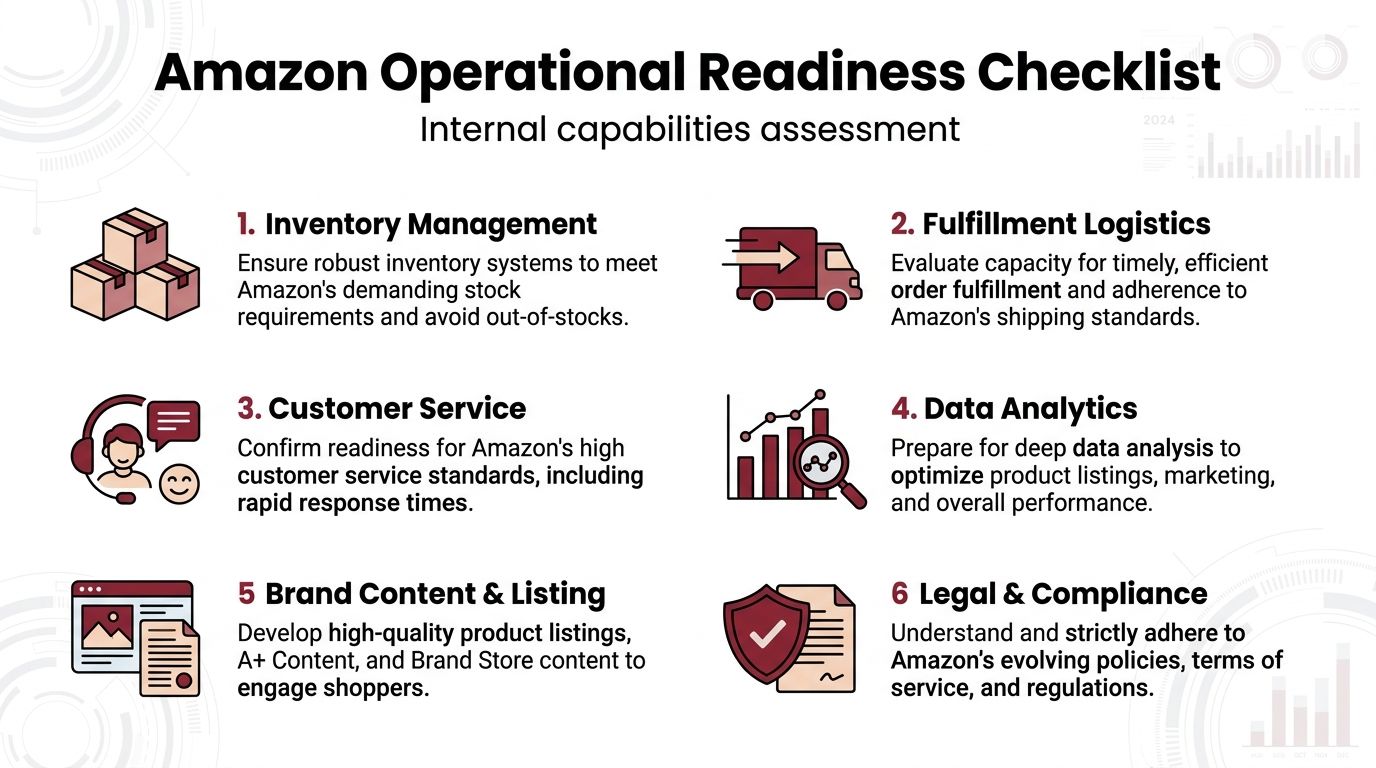
A listing dispute, delayed enrolment, poor customer experience or channel mess often starts much earlier with trade mark setup, packaging execution, inventory discipline or internal ownership gaps. That’s why readiness needs to be audited before launch, not during cleanup.
Start with legal and product proof
Amazon’s requirements aren’t especially forgiving here.
Brand Registry enrolment in Australia mandates a text-based or image-based trade mark from IP Australia, and the product images submitted must show the brand name permanently affixed. Stickers or temporary labels are a common cause for rejection, as outlined in Amazon’s Brand Registry requirements.
That sounds straightforward until teams realise their production reality doesn’t match their legal paperwork.
A practical audit should ask:
- Does the trade mark match the brand presentation? If your registered mark and on-product branding differ, friction starts early.
- Is the branding permanent? Printing, engraving or other production-applied branding is treated differently from removable labels.
- Do your images prove that clearly? Internal assumptions about what “looks fine” often don’t survive platform review.
Readiness is cross-functional
Amazon isn’t owned by marketing alone. It touches legal, operations, supply chain, customer service and commercial leadership.
That’s why a serious pre-launch review should include the systems around the listing, not just the listing itself. Teams working through regional fulfilment and service expectations usually need to pressure-test their Amazon logistics setup before they worry about scaling the catalogue.
A practical readiness scorecard
Use this as an internal working checklist.
Legal and brand control
- Trade mark status is clean. The IP Australia record aligns with the brand you plan to use on Amazon.
- Ownership and access are clear. The right people can act on registry, claims and account decisions.
- GTIN ownership is documented. Product identifiers are controlled, not loosely inherited through third parties.
Product and packaging
- Packaging and product branding match the registered brand presentation.
- Product photography is compliant and operationally usable.
- The range selected for Amazon has clean, consistent product data.
Supply chain and fulfilment
- Inventory accuracy is reliable. Amazon punishes stock instability quickly.
- Fulfilment choice is deliberate. Whether you use FBA, FBM or a mixed model, the decision is based on service level and economics, not habit.
- Returns and replacements are understood. Fragile or technical products need tighter handling logic.
Commercial governance
- Authorised seller rules exist. If nobody knows who can sell where, control won’t hold.
- Pricing policy is written down. Not as a wish, as an operating rule.
- SKU selection is strategic. Amazon doesn’t need your whole catalogue on day one.
Operational reality: If your packaging, identifiers and ownership records are messy offline, Amazon won’t tidy them up for you. It will expose the mess faster.
The key question readiness should answer
Don’t ask whether your team can get products listed.
Ask whether your business can support Amazon without creating downstream problems in retail, service, compliance or stock flow. Those are very different standards.
A strong product with weak operational preparation often struggles on Amazon for reasons that have little to do with demand. By contrast, a disciplined operator can use the marketplace carefully, because the foundations already exist before the first SKU goes live.
Phased Entry Models for Controlled Amazon Expansion
Amazon entry isn’t a yes-or-no decision. It’s a design choice.
That matters because many established brands assume the only real decision is whether to participate. In practice, the smarter question is how much control, operational burden and commercial exposure you want in the first stage.
Seller Central versus Vendor Central
The two most common models create very different outcomes.
| Model | What it usually gives you | What it usually costs you |
|---|---|---|
| Seller Central (3P) | More control over pricing, listings, assortment and inventory decisions | More operational responsibility and more direct channel management |
| Vendor Central (1P) | Simpler wholesale-style relationship with Amazon as the buyer | Less control over pricing, presentation and purchasing behaviour |
| Hybrid | Flexibility across markets, product types or channel objectives | More complexity, more governance and more room for internal confusion |
There isn’t a universally superior option. There is only fit.
When Seller Central makes more sense
For established Australian brands protecting premium positioning, Seller Central is often the cleaner starting point.
It gives the brand more direct influence over assortment, listing quality and price discipline. That matters when the objective is controlled market entry rather than moving units. It also tends to suit brands that want Amazon to complement existing distribution rather than replace it.
Seller Central can work well when:
- you want to launch a narrow SKU range first
- product education matters
- price architecture needs to be held carefully
- the business wants clearer feedback loops on demand and conversion
The trade-off is workload. More control means more active management.
When Vendor Central may fit
Vendor Central can appeal to teams that prefer a wholesale-style relationship and want less day-to-day seller administration.
That can be useful in certain circumstances, but established brands should understand the compromise. Amazon’s priorities as a retail buyer won’t always match your priorities as a brand owner. If your category is sensitive to price integrity or curated assortment, that matters.
The issue isn’t that 1P is wrong. It’s that some brands choose it for simplicity, then discover they’ve given away more control than they intended.
Why phased entry is usually the better move
The strongest Amazon launches from mature brands are rarely the loudest. They are the most deliberate.
A phased model lets the business learn before it scales. That can mean starting with a limited product set, one marketplace, tighter pricing rules and a clear distinction between Amazon-only SKUs and broader retail assortments.
A sensible progression often looks like this:
-
Protect first
Clean up trade mark, identifiers, product branding and channel rules. -
Launch a controlled subset
Start with the products most likely to translate well, not the entire catalogue. -
Measure operational strain
Watch service issues, stock flow, content quality and partner response. -
Expand only where the model holds
Add range, regions or fulfilment complexity once the first stage is stable.
The best first Amazon launch often looks smaller than the leadership team expected. That’s usually a strength, not a weakness.
What works better than “going all in”
For premium or established brands, controlled expansion tends to outperform broad expansion.
That can mean Amazon-exclusive bundles, region-specific tests or a restricted assortment designed to minimise direct conflict with retail partners. It can also mean delaying certain product lines until operations, compliance and pricing discipline are proven.
The common mistake is treating Amazon like a shelf extension. It isn’t.
It’s a separate commercial environment with its own rules, incentives and failure modes. A phased model respects that reality. It gives the brand room to learn, contain risk and scale from evidence rather than urgency.
Common Amazon Brand Registry Mistakes
Many established brands enrol in Amazon Brand Registry expecting the tool itself to solve broader marketplace problems. In practice, Brand Registry is only effective when supported by strong operational discipline and channel strategy.
One common mistake is treating enrolment as the finish line instead of the starting point. Registry improves control, but it does not replace pricing governance, reseller policies, or content management.
Another issue is launching too many SKUs too early. Brands often expand catalogue size before operational systems, fulfilment stability, and listing quality are fully under control.
Some businesses also underestimate the importance of packaging consistency and identifier ownership. Weak GTIN management, inconsistent product branding, and unclear ownership records can create avoidable friction across multiple marketplaces.
Channel conflict is another frequent problem. If Amazon pricing, promotions, or assortment strategy directly undermine retail partners, marketplace growth can weaken broader brand relationships instead of supporting them.
The strongest operators use Brand Registry as part of a larger commercial system. They combine marketplace protection with disciplined channel management, operational readiness, and controlled expansion planning.
The Decision Framework for Amazon Channel Management
Once the strategic case is clear, the final decision is organisational.
Who is going to run this channel well enough that it helps the brand instead of distracting it?
That question matters more than many leadership teams expect. Amazon rewards detail, speed, compliance discipline and constant monitoring. A business can have excellent products and still struggle because nobody internally owns the channel with enough depth.
Build internally or use a partner
There are good reasons to build an in-house Amazon capability.
If Amazon is going to become a major long-term channel, if your business already has strong marketplace operators, and if leadership is prepared to fund the function properly, internal ownership can work well. It keeps knowledge close to the brand and can align tightly with broader commercial strategy.
But there are also good reasons not to force it.
For AU brands, skipping initial registry in favour of a partnership can reduce risks, as enrolment doesn’t block all unauthorised resellers. The same source also notes that recent 2026 updates mandating GTIN ownership via GS1 Australia are benefiting brands but exposing non-users to new hijacking risks, according to Ecombrainly’s Amazon brand protection guide.com/amazon-brand-protection/).
That’s important because it highlights a larger truth. Brand registry is valuable, but it is not a complete operating model. If the business lacks marketplace expertise, legal coordination, identifier control, listing governance and cross-border execution capability, enrolment alone won’t solve the problem.
A simple leadership test
Senior teams can usually make the build-versus-partner decision by answering four questions.
Do we have the internal attention for this?
Amazon isn’t just another sales account. It demands regular intervention across content, compliance, inventory, pricing and issue resolution.
Are we set up for international complexity?
Cross-border expansion introduces local trade mark coordination, marketplace policy variation, fulfilment decisions and account health exposure across regions.
What is management focus worth?
Every hour the leadership team spends untangling Amazon issues is an hour not spent on product, sourcing, retail relationships or broader market expansion.
Are we trying to learn, or trying to scale?
If the business is still validating channel fit, a partner-led model can contain risk. If the model is already proven and strategically central, internal capability may make more sense.
Final Thoughts on Amazon Brand Registry
Amazon Brand Registry is most valuable when it is treated as operational infrastructure rather than a simple marketplace feature.
For established Australian brands, the real objective is not just gaining access to Amazon. It is building enough control around listings, pricing, fulfilment, and channel governance that the marketplace strengthens the business instead of weakening it.
The brands that perform best on Amazon are usually the ones that enter deliberately. They launch narrower product ranges, protect retail relationships carefully, maintain tighter operational standards, and treat marketplace expansion as a long-term commercial system rather than a short-term sales opportunity.
Brand Registry supports that structure, but it does not replace strategic judgement.
At TPR Brands, we work with established product companies evaluating Amazon as part of broader international growth and channel expansion. Our focus is helping brands assess marketplace fit, operational readiness, channel control, and scalable expansion structure before growth becomes unnecessarily expensive.
If your business is evaluating Amazon Brand Registry, the quality of the operating model behind the launch will usually matter far more than the speed of entry.