For US brands looking to expand into Amazon Australia, the most common advice is also the most expensive mistake: copy your US listings, send inventory to FBA, and expect the market to adapt.
At TPR Brands, we work with established US manufacturers and consumer brands to structure proper Amazon Australia expansion strategies—covering export readiness, compliance, fulfilment modelling, and marketplace positioning.
Amazon Australia is not a smaller version of the US market. It is a distinct retail environment where freight structure, compliance requirements, and pricing sensitivity can significantly impact profitability from day one.
Success depends less on listing products—and more on how the Amazon Australia market entry is structured.
Through our experience working with international brands entering Australia, we consistently see the same outcome: success is determined before launch. The brands that scale are not the ones with the best products, but the ones with the best market-entry structure.
Why US Success Doesn’t Guarantee Australian Growth
US success creates confidence. It also creates blind spots.
This is where structured Amazon Australia expansion support becomes critical. Without a clear export model, pricing architecture, and fulfilment strategy, US brands often enter the market with strong products but weak economics.
Founders of established hardware and home brands often assume Australia is a straightforward extension of the Amazon.com playbook. In practice, the market punishes that assumption fast. The products may still be right. The operating model often is not.
The gap usually shows up in unit economics before it shows up in revenue. A SKU that works in the US can lose money in Australia once bulky freight, GST, local returns handling, storage constraints, and marketplace fees are applied together. That problem is sharper in home and hardware, where carton dimensions, breakage risk, and slower stock turns can distort margin more than the top-line sales forecast suggests.
The second failure point is offer fit. US listings are built around US search behaviour, US value cues, and US delivery expectations. Australian shoppers do not need a radically different brand story, but they often need a different commercial proposition. Pack configuration, landed price tolerance, warranty clarity, and delivery promise all carry more weight than many US teams expect.
I see the same pattern repeatedly. A founder imports the US catalogue logic, keeps the same ASIN priorities, sends oversized inventory into FBA, and assumes early traction confirms product-market fit. What happens is simpler:
- Sales come in, but contribution margin erodes because the freight and fulfilment model was wrong.
- Traffic arrives, but conversion stays weak because the listing and price architecture were never adapted for local buying conditions.
- The team spends months fixing compliance, inventory, and channel conflicts that should have been addressed before launch.
For bulky categories, these are not small execution errors. They are market-entry errors. Electrical standards, product labelling, import documentation, damage rates in transit, and warehouse handling rules can affect whether Amazon Australia expansion becomes a profitable growth channel or a distraction that absorbs management attention.
Treating Amazon Australia expansion as a deliberate expansion channel is the correct approach. Start with market mechanics, then the economics of fulfilment, then the channel model. Brands that want a clearer operating view usually begin with a structured look at Amazon Australia expansion planning before they commit inventory and internal resources.
For many established US brands, that also points to a practical conclusion. A partnership model often outperforms a solo DIY launch because local operators can pressure-test compliance risk, freight assumptions, and margin protection before those mistakes become expensive.
Key takeaway: US traction supports the case for expansion. It does not prove Australian market readiness.
What US Brands Need Before Expanding to Amazon Australia
Before entering Amazon Australia, successful US brands typically validate:
- Landed margin after freight, GST, and fulfilment costs
- Product compliance and import readiness
- SKU selection for market fit (not full catalogue migration)
- Local pricing tolerance and competitor structure
- Fulfilment model (FBA vs hybrid vs local 3PL)
At TPR Brands, these factors are evaluated before launch to prevent margin loss and operational disruption.
Assessing the Amazon Australia Expansion Opportunity
Amazon Australia expansion is large enough to tempt almost any US brand. Size alone is a poor reason to enter.

For established US hardware and home brands, the better question is narrower. Can your landed product, after local compliance, freight, storage, returns, and marketplace fees, still support the margin standard your business needs?
That test rules out more brands than market-growth headlines suggest.
What to evaluate before you commit inventory
Amazon Australia expansion has moved beyond early-adopter status. Shoppers use it as a routine retail channel, which gives credible brands a path to demand. The strategic mistake is assuming marketplace maturity makes your category attractive by default.
For bulky and higher-ticket home products, demand quality matters more than topline audience size. A large shopper base helps only if your offer sits in a category where buyers will accept the landed price, trust the product specs, and convert without excessive discounting.
Three questions usually clarify the opportunity fast.
| Market question | Why it matters for a US hardware or home brand |
|---|---|
| Is the category already trained to buy on Amazon Australia? | Some categories convert cleanly on-platform. Others still rely more heavily on specialist retailers or offline comparison. |
| Can your price architecture survive local costs? | Bulky freight, GST treatment, storage fees, and returns can erase margin even when sales volume looks healthy. |
| Does the range scale beyond one SKU? | Australia is a smaller market. Customer acquisition works better when adjacent products, accessories, or replenishment lines lift account-level economics. |
This is why I rarely advise founders to assess Australia SKU by SKU in isolation. The right unit of analysis is the range, the operating model, and the cost to stay in stock without losing pricing discipline.
Read demand signals with caution
Sales events can make the market look cleaner than it is. Event-led demand can distort founder judgement.
A strong Prime Day result may reflect discount elasticity, not durable brand pull. A weak launch month may reflect poor stock positioning or an unworkable fulfilment setup, not a lack of demand. Founders need to separate true product-market fit from temporary marketplace noise.
For established brands, that means looking past gross revenue and pressure-testing four operating signals:
- Contribution margin after all landed costs. This is the first filter, especially for heavy, fragile, or oversized products.
- Conversion at a price you can defend. If the listing only works under aggressive discounting, the market may be less attractive than it appears.
- Return and damage exposure. Home and hardware products often absorb hidden costs here, especially when packaging was designed for domestic US parcel networks rather than longer inbound routes.
- Range expansion potential. One winning SKU is useful. A cluster of compatible SKUs is what usually justifies the management effort.
Where opportunity sits
Founders often overestimate the upside in broad catalogue launches. In practice, Amazon Australia expansion usually rewards selective entry.
The stronger play is often a narrower range built around products with cleaner freight economics, lower compliance friction, and a clear local use case. That is especially true for US brands selling storage, tools, fixtures, kitchen equipment, home organisation products, or other categories where cubic weight and handling complexity can punish weak planning.
A practical screen looks like this:
-
Start with landed-margin realism
Model the item after freight, marketplace fees, tax treatment, local handling, and likely returns. If the economics are thin before marketing, they usually worsen after launch. -
Assess whether the SKU earns its space
Bulky products consume more working capital and warehouse capacity. Each SKU needs a clear role in the account, not just a place in the catalogue. -
Prioritise products that support channel control
Lines with MAP vulnerability, reseller leakage, or easy price comparison can become margin traps in a smaller market. -
Check whether local execution requires specialist help
If compliance, packaging adjustments, or bulky-goods freight need local coordination, a partnership model often protects margin better than a solo launch.
The upside is real. The margin for error is not.
A disciplined founder should treat Amazon Australia expansion as a strategic expansion decision, not a light-touch export test. For established US home and hardware brands, the winners are usually the ones that enter with selectivity, protect pricing from day one, and use local operating support before complexity starts consuming margin.
Practical rule: Market demand can justify entry. It does not excuse weak economics.
Adapting Your Brand for the Australian Consumer
Most US brands overestimate how much of their positioning can be reused unchanged.
This is not mainly about changing “color” to “colour”. It is about whether the promise, the price, and the product hierarchy still make sense once landed in Australia.

For hardware and home products, margin pressure arrives early. Verified data notes that profitability on Amazon Australia expansion is challenged by FBA fees of 15-20% for bulky items and import duties of 5-10% on tools, while successful brands tend to focus on underserved niches with 25-40% margins rather than fight in oversaturated categories (Arktic Fox on standing out in Amazon Australia).
Position for the market you are entering
A US listing often leans on familiarity. Australian buyers do not always share that familiarity.
If your listing wins in the US because buyers already recognise the category language, a direct transfer can underperform in australia. The issue is not necessarily the product. The issue is that the listing assumes context the buyer does not have.
I would pressure-test adaptation in three layers.
The value proposition
Ask a blunt question. Why should an Australian buyer choose this over a local substitute, a cheaper import, or a known retail chain option?
That usually leads to one of three viable positions:
- Problem-solver
The product clearly fixes a common household or job-site issue. - Quality upgrade
The offer is for buyers tired of cheap, disposable alternatives. - Specialist niche fit
The product serves a use case broad retailers handle poorly.
If your answer is “because it sells well in the US”, you do not have a local position yet.
The range architecture
Do not launch every variation.
For many established brands, a narrower Australian range performs better because it removes dead weight. Exporting low-velocity variants creates extra compliance work, heavier inventory exposure, and more pricing confusion without improving brand strength.
A practical shortlist often includes:
- One core hero SKU
- One premium or expanded version
- One accessory or replenishment line that supports repeat purchase
Price for margin protection, not vanity volume
Founders often chase an attractive front-end price and only later discover they built a structurally weak offer.
Your Australian price has to absorb more than the landed product cost. It has to hold up against GST treatment, duties where relevant, fulfilment, customer service, returns friction, and channel conflict with any existing wholesale or export arrangements.
Tip: If the only way your product looks competitive is by stripping out margin buffers, the product is not ready for Amazon Australia expansion at that price point.
A useful decision framework is below.
| Question | Healthy answer | Warning sign |
|---|---|---|
| Why will buyers choose this product? | Clear local relevance | “It already works in the US” |
| Which SKUs should launch first? | Narrow, intentional set | Full catalogue upload |
| What supports the price? | Feature, durability, niche fit | Discounting alone |
| What protects margin? | Built-in buffer for fees and freight | Optimistic assumptions |
Local language matters, but local context matters more
Australian spelling should be corrected. That is the easy part.
The harder part is translating the product into local usage cues, search terms, and buyer anxieties. A home maintenance product, for example, may need stronger emphasis on durability, installation simplicity, or suitability for local conditions. A generic US listing structure often buries the reason a buyer would choose the product.
Many brands stall at this point, thinking adaptation is cosmetic. It is commercial.
If your category is crowded, the best move is often not louder branding. It is sharper positioning into a less congested niche where your offer is easier to understand and defend. That is how stronger brands preserve margin instead of entering a race to the bottom.
Navigating Australian Regulatory and Compliance Hurdles
Most founders dislike compliance work because it feels administrative. In Australia, it is strategic.
Compliance decides whether your launch can scale cleanly or whether it becomes a series of avoidable interruptions. For hardware, household, and electrical-adjacent products, those interruptions can include listing delays, customs issues, packaging revisions, and margin leaks from tax mistakes.
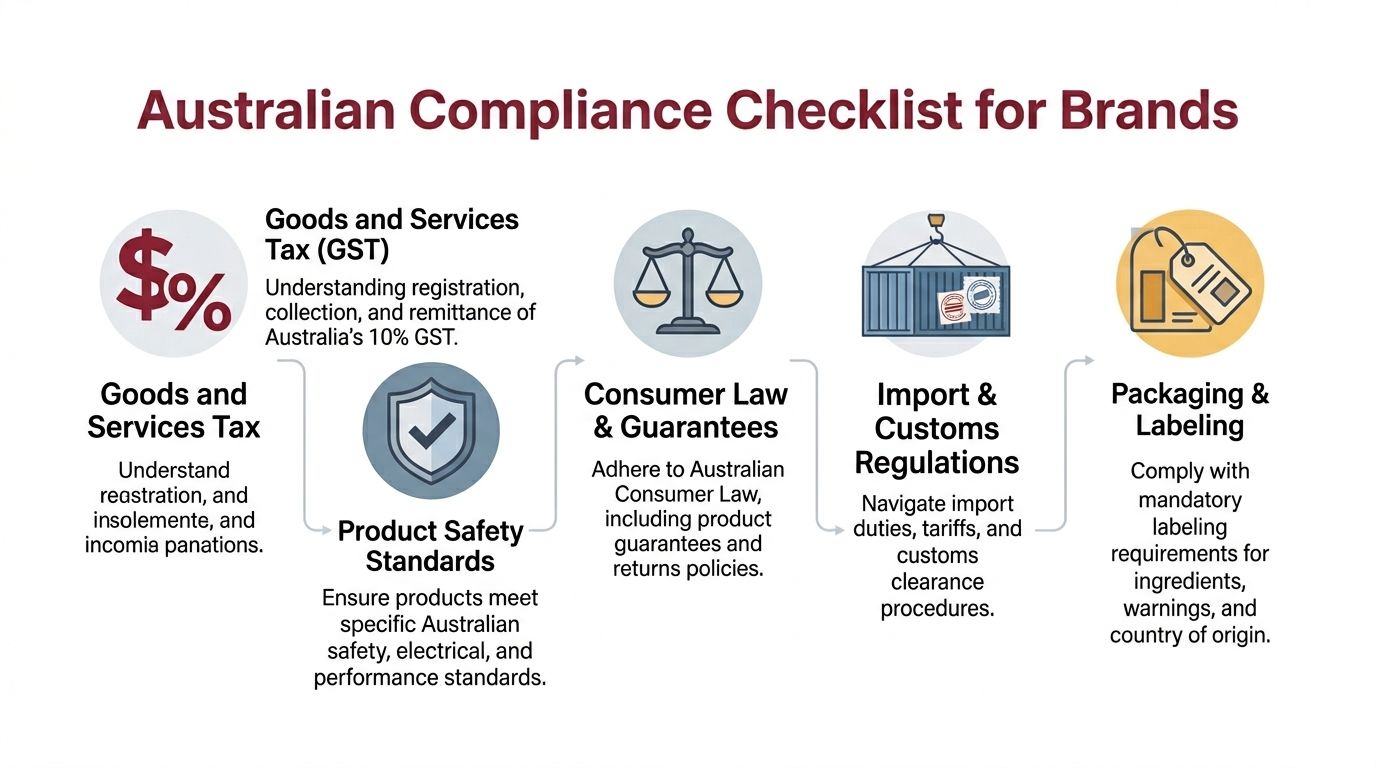
Verified guidance for international sellers is straightforward on GST. You must register once annual turnover reaches or is likely to exceed A$75,000, file quarterly BAS, and price products on a GST-inclusive basis, with 1/11th of the sale price representing GST (Dolman Bateman’s guide for international sellers on Amazon Australia).
The tax threshold founders should not ignore
A common mistake is treating the A$75,000 threshold as a future problem.
It is not just a registration trigger. It is the point at which your back office needs to behave like a real Australian operation. If you hit that threshold without clean reconciliation between sales, supplier invoices, freight, packaging, and Amazon fees, BAS filing becomes harder than it needs to be.
The practical issue is cash flow timing. GST collected on sales and GST paid on business expenses do not always line up neatly with your purchasing cycle. A fast-growing account can look healthy at the top line while creating short-term pressure underneath.
Compliance is broader than GST
For hardware and consumer products, tax is only one part of the picture. Founders also need a product-level checklist that reflects how the goods will be imported, labelled, sold, and supported after purchase.
Use a working checklist like this:
-
Tax setup
Confirm whether you are approaching the GST threshold, how BAS will be prepared, and who owns reconciliation. -
Product standards
Check whether the product falls into any Australian safety, electrical, or performance standard requirements. -
Labelling and packaging
Review warning language, country-of-origin treatment, and any category-specific information required at sale. -
Consumer law readiness
Make sure warranty, returns handling, and product claims align with Australian expectations. -
Import documentation
Clean paperwork prevents expensive slowdowns at the border.
Operator note: Compliance is not a legal appendix to the launch plan. It is part of unit economics because every late correction costs money.
Who should own this work
Founders often split this badly. The accountant handles tax. A freight partner handles shipping. Someone in-house edits labels. Amazon gets treated as the system holding it all together.
That fragmentation creates blind spots.
A better approach is to assign one commercial owner to the market-entry process, even if multiple specialists support the work. That owner should know what has been checked, what is still provisional, and what assumptions are sitting inside pricing.
For brands that do not want to build that capability alone, there are several operating paths. One is using an expansion partner with marketplace and channel experience. Another is engaging specialist compliance and freight advisers separately. Some brands also explore a structured marketplace route through Amazon selling support for overseas brands, which can reduce the number of disconnected decisions being made in parallel.
What works and what usually does not
What works
- Compliance review before inventory ships
- GST process designed before threshold pressure arrives
- Product claims checked against local standards
- One accountable operator overseeing the launch
What usually does not
- Fixing labelling after goods are in motion
- Delegating each task to a different external party without a commercial lead
- Assuming Amazon’s systems will resolve tax and compliance complexity for you
- Treating Australia as a minor export market not worth dedicated process
Founders who handle compliance early usually preserve optionality later. They can expand range, add channels, or scale ad spend without rebuilding the operating base underneath.
Building a Resilient Australian Supply Chain
If you sell compact, durable, easy-to-ship products, the standard Amazon playbook can work reasonably well.
If you sell bulky tools, heavy household products, awkward home-improvement items, or anything with fragile packaging, a pure FBA mindset can damage margin quickly in Australia.
Verified data on Australian fulfilment challenges makes the issue plain. Australia’s geography and infrastructure can lift last-mile delivery costs for bulky items by 20-30% in regional areas, and standard FBA models often fail to account for that, making a hybrid FBA-local warehouse model important for margin protection (TGL on Amazon fulfilment challenges in Australia).
Why FBA-only is often the wrong answer
FBA solves some problems well. It gives access to Prime-aligned fulfilment and a simpler customer proposition in metro areas.
It does not automatically solve the economics of serving a country with concentrated urban demand and large regional distances. For hardware and home brands, the challenge is not merely shipping parcels. It is doing so without allowing freight variability to eat the gross margin your product should have protected.
The weak pattern looks like this:
| Model | Strength | Risk for bulky products |
|---|---|---|
| FBA only | Fast launch, Prime visibility | Regional freight and storage pressure |
| FBM from overseas | More inventory control | Slow delivery and weak customer experience |
| Hybrid model | Better routing by SKU and region | More planning required upfront |
A more resilient operating model
For many established brands, the sensible model is hybrid.
Use Amazon fulfilment where it improves conversion and service levels. Route oversized, awkward, or regionally expensive orders through a local 3PL or warehouse arrangement that gives you more control over freight and handling. That structure is less elegant on paper than “everything through FBA”, but it is usually more durable in practice.
A resilient model typically includes:
-
Metro-friendly FBA SKUs
Faster-moving lines that convert well with Prime visibility. -
Local handling for oversized items
Products that create fee or freight pressure if forced into a standard Amazon fulfilment structure. -
Inventory buffers for disruption
Australia deals with weather-related disruption that can interrupt normal logistics patterns. -
Landed cost modelling by region
Not just by product. By region.
Tip: If your margin model assumes Sydney economics apply equally across the country, the model is too simple.
What founders should model before launch
Do not model fulfilment as one blended national cost. That hides the problem.
Instead, test your economics across a few realities:
- Metro demand where service expectations are high and delivery competition is stronger
- Regional delivery where oversized products become more expensive to move
- Returns handling for items that are difficult or costly to reverse-logistics
- Peak event periods when promotional demand can expose warehouse and replenishment weaknesses
Brands that enter australia with heavy or awkward products often discover the biggest issue is not demand. It is that the order profile is different from what the original freight assumptions expected.
This is also where local operating support matters. A founder in the US cannot easily troubleshoot warehouse exceptions, damaged inbound stock, packaging failures, or regional routing problems from a distance. Brands that want tighter control over this part of the equation often build around a local fulfilment network or work with a partner already managing fulfilment and channel operations in Australia.
The point is not to avoid Amazon’s logistics. The point is to stop treating them as universal. In australia, the right fulfilment model depends on SKU shape, freight reality, and where the customer sits.
Designing Your Go-To-Market and Channel Strategy
Channel strategy decides whether Amazon Australia expansion becomes a profitable entry point or an expensive distraction.
US founders often reduce the choice to fulfilment mechanics. FBA or FBM is part of the decision, but it is not the decision. The key question is who controls execution while the brand is still learning local demand patterns, price tolerance, service expectations, and retailer spillover.
That matters even more for established hardware and home brands. Bulky products, accessory attach rates, replacement-part expectations, and freight-sensitive margins create a narrower margin for error than many US teams expect. A weak launch structure can still produce early sales. It just does it while training the market to expect the wrong price, the wrong assortment, or the wrong service level.
Comparing the main entry paths
The best model depends on the catalogue, the team, and how much operational strain the business can absorb in year one.
| Entry path | Best fit | Main advantage | Main trade-off |
|---|---|---|---|
| Direct FBA | Smaller ranges, simpler products, strong internal marketplace ownership | Faster Prime participation and simpler customer promise | Fees and storage settings can punish bulky or slower-turning SKUs |
| Direct FBM | Brands with local fulfilment capability and tighter service control | More control over stock flow and fulfilment rules | Harder to maintain marketplace speed and consistency from offshore |
| Local distributor or marketplace partner | Established overseas brands entering a new market with limited local bandwidth | Local execution, faster problem-solving, and better channel control | Success depends on partner quality, incentives, and account structure |
| Hybrid channel model | Mixed catalogue where some SKUs suit FBA and others do not | Better fit by SKU, rather than forcing one model across the range | More complexity in planning, reporting, and accountability |
A partnership model is often stronger than founders want to admit.
Not because Australia is impossible to manage directly. It is because the cost of getting the first 12 months wrong is higher for established brands than for small marketplace-native sellers. If a premium home brand enters with poor listing control, loose pricing, and a catalogue that does not travel well, the market remembers.
What should be set before launch
The first decision is not SKU count. It is control.
Set channel guardrails before inventory lands. Founders should know who has authority over price floors, promotional approval, listing content, review response, replenishment calls, and marketplace issue resolution. If those rules stay vague, Amazon usually becomes a reactive sales channel instead of a managed market-entry channel.
Four decisions carry the most weight:
-
Price integrity
Can this structure prevent short-term discounting from becoming the default market position? -
Assortment discipline
Which SKUs are meant to win on Amazon, and which are better held back until service and demand are proven? -
Content ownership
Who controls the local brand story, technical claims, imagery, and copy standards? -
Operating accountability
Who is responsible when stock runs out, listings break, compliance flags appear, or customer feedback exposes a product issue?
These are not admin questions. They shape margin, brand perception, and channel conflict.
The launch mistake that looks like progress
The wrong channel structure rarely fails on day one. It usually looks acceptable for a quarter or two.
Orders come in. Revenue appears. The founder sees proof of demand and assumes the model is sound. Then the structural problems show up. Promotions become too frequent. Marketplace pricing starts to pressure other accounts. High-friction SKUs absorb too much support time. The team keeps feeding Amazon range that should never have been there in the first place.
For hardware and home brands, this usually shows up in three places first. The oversized hero product gets all the attention but carries weak economics. The accessory range is listed without a clear bundling or attach strategy. Customer expectations around delivery speed and item condition rise faster than the operating model can support.
A stronger go-to-market approach
Treat Amazon Australia as a selective channel, not a full catalogue release.
That means answering a tougher set of questions before launch:
- Which products can hold margin after local fees, freight, returns, and promotional pressure?
- Which products help establish the brand without creating service headaches?
- Which SKUs need local proof of demand before they deserve inventory commitment?
- Which decisions should stay with the US team, and which should sit with a local operator or partner?
In practice, the strongest entries are usually narrower than the founder first planned. They launch a tighter assortment, protect pricing early, and build around a local operating structure that can solve problems fast. For many established US brands, especially in hardware and home, that is the better trade-off than trying to run Australia as a remote extension of the US marketplace team.
Key takeaway: The first channel model should protect margin and brand position while the business learns the market. Growth comes after that, not before.
The Founder’s Dilemma When to Partner for Growth
At some point, every founder reaches the same decision.
Do we build the Australian operation ourselves, or do we enter through a structure that already has local capability?
That is not a philosophical question. It is a resource allocation question.
If your team already has marketplace expertise, freight discipline, compliance oversight, local content capability, and enough management bandwidth to handle a new region properly, direct entry can make sense. Some brands should absolutely own the build.
Many should not.
The friction points are cumulative. Product adaptation needs local judgement. GST and BAS need process. Heavy or awkward products need better fulfilment logic than a default FBA setup. Channel strategy needs someone protecting pricing and brand presentation while the market is still learning your offer.
None of those issues is impossible alone. The problem is stack-load. Founders underestimate how many of them arrive at once.
The trade-off
Doing it yourself can preserve direct control.
It can also slow decision-making, increase rework, and force senior people to solve market-entry problems they have not solved before. That is expensive even when it does not show up neatly in the P&L.
Partnership is not about handing off the brand. In the best cases, it is about compressing the learning curve and avoiding structural mistakes. A good partner helps the brand enter the market with a tighter SKU plan, a cleaner compliance path, and a fulfilment model that matches the product.
When partnership usually makes sense
The case becomes stronger when several of these are true:
- Your products are bulky, regulated, or margin-sensitive
- You are entering Australia from overseas without local staff
- You need channel control, not just order volume
- You want the market to become part of a broader international strategy, not a side experiment
Selective partnership can outperform an internal DIY launch. Not because the founder lacks capability, but because international expansion rewards local execution more than remote confidence.
The strongest brands rarely confuse product quality with market readiness. They know that entering Amazon Australia expansion properly requires the same discipline they applied when building the product in the first place.
For founders weighing that decision, TPR Brands works with established consumer product companies that want structured expansion into markets like Australia without treating marketplace entry as a shortcut. The fit is usually strongest for proven brands that care about pricing integrity, channel control, and sustainable growth across regions.
How TPR Brands Supports US Brands Expanding to Australia
We help established US brands expand into Amazon Australia by managing:
- Export and compliance readiness
- Marketplace listing and positioning strategy
- Fulfilment and logistics structure design
- Pricing architecture for margin protection
- Controlled launch and scaling strategy
Our focus is not just entering the market—but entering it profitably and sustainably.