Many strong products fail in international markets not because demand is weak, but because their logistics strategy is not built for scale.
Founders often assume that if a product performs well domestically, it will naturally succeed in new markets. In reality, international expansion exposes weaknesses in fulfilment, compliance, and cost structure very quickly.
Logistics is not an operational detail. It is the system that determines whether your brand can actually scale across borders without margin erosion or customer experience breakdown.
When entering markets like Australia, the US, or the UK, your product is immediately tested against new conditions: import duties, last-mile delivery complexity, packaging durability, and fulfilment efficiency. If these are not designed into your model early, growth stalls even when demand exists.
Why Logistics Defines Global Expansion Success

For a founder consumed by product, marketing, and sales, logistics often feels like a background task—a commodity to be managed for the lowest cost. This perspective is a strategic blind spot. A robust logistics strategy is what allows you to deliver on your brand promise, literally and figuratively, to a customer on the other side of the world. It dictates your speed to market, your cost structure, and your ability to scale profitably.
When you push into new territories like Australia, the UK, or the US, your product is up against a whole new set of marketplace dynamics. Will your packaging survive a month-long sea voyage and rough handling at port? What will happen to your profit margins after you factor in currency conversion, import duties, and last-mile delivery fees? These aren’t operational details; they are fundamental questions of brand strategy.
The Pattern: Early Growth Followed by International Stagnation
A common pattern appears when brands expand internationally.
They achieve early traction in their home market, assume the model is repeatable, and then launch into a new country expecting similar performance.
Instead, growth slows or stalls.
This is rarely a demand problem. It is a logistics and structure problem.
Here’s what happens when logistics is treated as an afterthought:
- Eroded Margins: Unexpected tariffs, storage fees, and carrier surcharges quietly eat away at profitability until the new market becomes a financial black hole.
- Poor Customer Experience: Shipments get delayed, products arrive damaged, and surprise customs fees create frustrated customers who won’t make a second purchase. This is death for a new brand.
- Stalled Growth: Founder attention, which should be focused on brand building and market penetration, is instead consumed by fixing a broken supply chain.
A product sitting in a container delayed at customs isn’t just losing sales. It’s actively damaging your brand’s momentum and reputation in a market where you have none to spare.
Take the Australian market, a popular target for international brands. The logistics sector is a massive part of the national economy, contributing over 8.6% to GDP. While the opportunity is huge—third-party logistics (3PL) partners report average cost savings of 13% for their clients—the challenges are equally significant.
During recent supply chain disruptions, import delays stretched up to 30 days. For a new brand launch, that’s a crippling blow. It highlights the absolute necessity of a compliant, resilient distribution network. You can explore the data on logistics’ economic role to understand the scale.
The strategic lesson is that a product’s potential is directly tied to the foresight of its logistics strategy. It is a core pillar of brand building.
Assessing Logistical Readiness Before You Expand
Before shipping internationally, founders often focus on marketing readiness.
But the real constraint is operational readiness — whether the supply chain can survive cross-border conditions.
This includes packaging durability, compliance, inventory planning, and fulfilment structure.
Deconstructing Your Physical Product Path
The journey from your factory to an international customer’s doorstep is lined with potential points of failure. Consider a brand with an innovative kitchen gadget that was a runaway success in its home market. When they tried to enter the humid Asia-Pacific (APAC) region, their standard cardboard packaging, which worked perfectly in a dry climate, began to fail during the long sea transit.
Boxes arrived at the fulfilment centre misshapen and damp. The brand’s premium perception was destroyed before the first sale. This one oversight triggered a cascade of expensive problems:
- Repackaging costs: A significant portion of the shipment had to be repacked on-site, incurring unplanned labor and material costs.
- Lost inventory: Damaged products were a complete write-off, hitting their bottom line directly.
- Delayed launch: The time required to fix the packaging mess killed their launch momentum and cost them crucial initial sales.
This is why a granular assessment is non-negotiable. It’s not just about packaging; it’s about anticipating the unique environmental and physical stressors of each new shipping corridor. Can your product formulation handle the heat of an Australian warehouse in summer? Will the vibrations from a long-haul truck journey in the US damage sensitive electronics? You must answer these questions with confidence.
International Logistics Readiness Scorecard
| Logistics Area | Key Questions for Founders | Ideal State for Expansion |
|---|---|---|
| Packaging & Durability | Has your packaging been tested for long-haul sea freight, high humidity, or extreme temperatures? Do your products have specific fragility concerns? | Packaging is stress-tested for the target environment. Product can withstand a 6-8 week transit time with multiple handling points without damage. |
| Product Compliance | Does your product formulation or its components comply with the destination country’s regulations (e.g., chemical restrictions, material safety)? | All product formulations and materials are pre-cleared for the target market. All necessary Safety Data Sheets (SDS) are ready. |
| Labelling | Are your product labels compliant with local laws, including language, weight/measurement units (metric vs. imperial), and warning symbols? | Labels are designed to be multi-market compliant or a process is in place for market-specific labelling before shipping. |
| Inventory & Shelf Life | Does your product have a shelf life? Can it withstand being held in a container or warehouse for several months before reaching the final customer? | Product has at least 18 months of shelf life upon leaving the factory. Inventory planning accounts for a 3-4 month lead time for international stock. |
| Unit Economics | Do you know your product’s precise weight and dimensions (in its shippable packaging)? Are these numbers optimised for shipping costs? | All product weights and dimensions are accurately recorded and used to model landed cost. Packaging has been optimised to reduce dimensional weight. |
This scorecard covers the core areas where founders get into trouble. If you find yourself unable to answer these questions, it’s a clear signal you have more foundational work to do.
Your landed cost is not just a number on a spreadsheet; it’s the ultimate test of your new market’s viability. Underestimate it, and you risk building a business that sells products at a loss.
Calculating True Landed Cost (Where Most Brands Miscalculate)
Landed cost is often underestimated, but it defines whether expansion is viable.
A real landed cost model includes:
- Product manufacturing cost
- Freight and shipping
- Customs duties and tariffs
- Import taxes (GST, VAT, etc.)
- Port and handling fees
- Inland transport
- Last-mile delivery
Even small miscalculations here can completely distort pricing strategy and destroy margins at scale.
Choosing the Right Fulfilment Model (FBA vs 3PL vs Hybrid)
The choice between Fulfilment by Amazon (FBA), a third-party logistics (3PL) partner, or a hybrid model is one of the biggest strategic forks in the road a founder will face. This isn’t just an operational detail; it’s a decision that defines your brand’s customer experience, profitability, and long-term control.
Many brands default to FBA for its apparent simplicity, but this convenience often masks significant hidden costs and strategic dead ends. It can get your product in front of Amazon’s massive audience, but at what cost to your brand?
The Real Cost of FBA: Trading Brand for Access
Relying purely on FBA puts a ceiling on your growth. You lose control over the unboxing experience—a critical touchpoint for building brand loyalty. More importantly, you lose direct access to your customer data, making it nearly impossible to build lasting relationships or remarket effectively. You are building Amazon’s customer base, not your own.
Beyond the loss of brand control, the financial model of FBA deserves a hard look. The fees are far more complex than they first appear.
- Long-Term Storage Fees: FBA penalises slow-moving inventory. Punitive monthly storage fees can destroy your margins, especially for larger items.
- Removal and Disposal Fees: Getting unsold or returned inventory out of an Amazon warehouse is another expense. You either pay to ship it back or pay for Amazon to dispose of it—a total loss.
- Multi-Channel Fulfilment (MCF) Costs: Want to use FBA inventory to fulfil orders from your own website? You’ll pay a premium for Amazon’s MCF service, locking you further into their ecosystem at a higher cost.
The real cost of FBA isn’t the fee schedule; it’s the strategic opportunity you surrender. You trade long-term brand equity and customer ownership for short-term marketplace access.
We see this scenario often: a brand finds initial success on Amazon, only to hit a wall. Growth stalls because they can’t expand to other channels without creating a logistical nightmare. Margins get squeezed by FBA’s rising costs, and they have no real connection to the people buying their products. They’ve built a successful product on Amazon, but they haven’t built a sustainable, independent brand.
The Strategic Power of a Specialised 3PL Partner
This is where a strategic 3PL partner changes the game. Unlike FBA’s one-size-fits-all solution, a specialised 3PL acts as an extension of your team, adapting to your brand’s specific needs with a focus on efficiency and brand preservation.
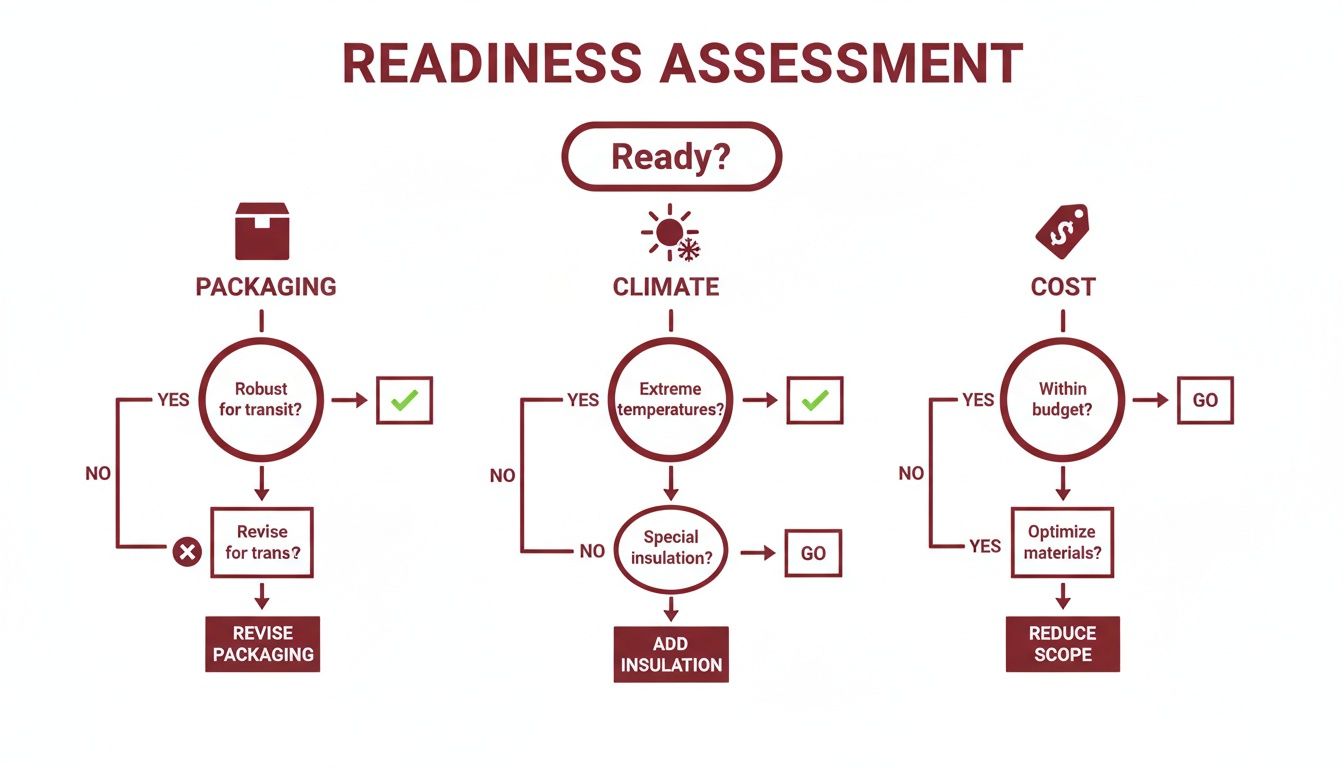
This decision tree can help you visualise which factors should be guiding your choice.
A partnership with a capable 3PL opens up strategic advantages that FBA simply can’t offer. In Australia, for instance, the logistics industry has made huge leaps. Digital integration reached 75% by 2023, boosting on-time deliveries by 25%. Automated warehouses with robotic picking are increasing throughput by 50% to manage the 15% annual growth in consumer goods logistics.
Given that 68% of Australian distributors in relevant sectors already use 3PLs for an average 18% margin improvement, the data shows that partnership is the key to controlled, profitable growth.
One founder we worked with was trapped in the FBA ecosystem. By transitioning to a strategic 3PL partner, they reclaimed their brand. They introduced custom-branded packaging, slashed their storage costs by 40%, and started fulfilling orders across their own DTC site and other marketplaces from a single inventory pool. This move didn’t just protect their margins; it unlocked new growth channels and allowed them to finally build the direct customer relationships they needed to scale. Our approach to strategic fulfilment outlines how this works. The right model isn’t about short-term convenience; it’s about long-term brand building.
Navigating Cross-Border Compliance
International expansion is where many otherwise successful brands stumble. It’s almost never a lack of demand that trips them up; it’s the hidden maze of cross-border regulations. For founders focused on product and marketing, this complex world of compliance often comes as a harsh, and expensive, surprise.
Suddenly, you’re not just a brand owner. You’re also trying to decode product labelling laws in the UK, navigate strict customs declarations in Australia, and enforce your pricing online across multiple time zones. It’s a minefield where one misstep can get your entire shipment seized and damage your brand’s reputation before you’ve made a single sale. Getting compliance right is non-negotiable for building a sustainable international business.
The Upstream Battle of Product and Labelling Compliance
The costliest mistakes happen long before a product ever leaves the factory. You simply cannot ship your domestic product overseas and hope for the best. Every market has its own rulebook for everything from the materials you use to the exact wording on your labels.
For instance, a wellness brand entering the UK might find that an ingredient perfectly legal in North America is restricted under European REACH regulations. We’ve also seen brands discover that Australia’s strict biosecurity laws require specific treatment for all wooden components in their product.
These aren’t rare edge cases; they are the standard hurdles of international logistics. Ignoring them leads to predictable and painful outcomes:
- Seized Shipments: Your inventory can be impounded at the port of entry, racking up daily storage fees until the issue is resolved—or worse, the goods are destroyed.
- Forced Reworking: You could be forced to relabel or even repackage your entire shipment in a foreign trade zone, an incredibly expensive and slow process that kills launch momentum.
- Fines and Penalties: Government agencies won’t hesitate to impose significant fines for non-compliance, turning a promising market entry into a financial loss.
The strategic lesson is simple: compliance must be handled upstream, at the product and production stage. Trying to fix a non-compliant product is always more expensive and stressful than designing for global compliance from the start.
This means doing your homework. You have to verify that every component, material, and chemical in your product is allowed in your target country. You must also ensure your labelling meets all local requirements for language, measurement units, and mandatory warning symbols.
Protecting Brand Value with MAP Policy Enforcement
Once your product is compliant and in-market, a new challenge emerges: protecting your brand’s value. In the age of online marketplaces, a Minimum Advertised Price (MAP) policy is your most important tool for maintaining consistent pricing and brand integrity.
Without it, you open the door to channel conflict. One rogue Amazon seller can slash prices, forcing your other retail partners to either follow them in a race to the bottom or drop your brand completely. Either way, your product’s perceived value is damaged and your profit margins evaporate.
A MAP policy is useless without enforcement. This is a heavy operational lift, especially across different marketplaces and time zones. It demands constant monitoring to catch violators and a systematic process for issuing warnings and taking action. This is another area where a strategic partner provides enormous value. They aren’t just moving boxes; they are your eyes and ears on the ground, acting as a critical line of defence for your brand’s integrity.
Building a Resilient Supply Chain Through Partnership
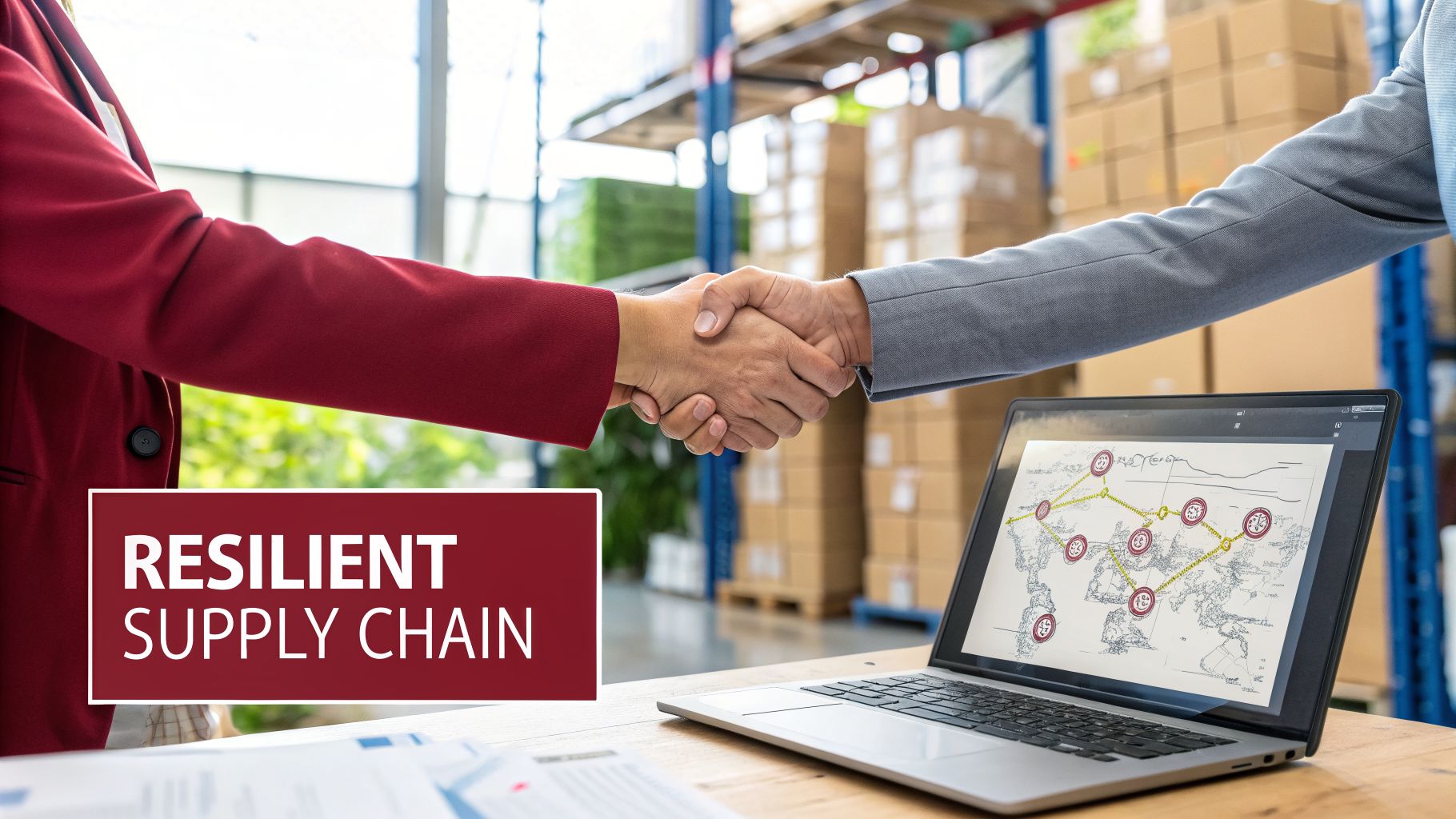
There’s a dangerous myth that a brand should go it alone when expanding internationally. We’ve covered the tactical readiness steps, but the high-level strategy that holds it all together is the necessity of strategic partnerships. Many great products fail to become great brands because their founders try to do everything themselves.
Trying to build a global logistics network from scratch isn’t just inefficient; it’s a huge and avoidable risk. Your genius is in creating great products and building a brand, not in mastering freight forwarding, customs brokerage, and warehouse management across a dozen countries.
The Founder’s Dilemma: Building vs. Partnering
The entrepreneurial instinct is to build, own, and control every piece of the business. It’s an admirable trait, but it becomes a serious liability when applied to global logistics. The capital spend, operational overhead, and regulatory headaches are immense.
Smart founders realize that true control doesn’t come from owning warehouses and trucks. It comes from having a supply chain that’s resilient, flexible, and can react to market shifts instantly. You don’t get that by building it yourself. You get it by integrating with strategic partners who have already done the heavy lifting. A genuine expansion partner acts as an extension of your team, bringing deep, on-the-ground knowledge you could never replicate.
Leverage Existing Infrastructure and Expertise
Consider Australia again. The country’s freight task hit 1,047 billion tonne-kilometres in 2021-22, a 45% jump in just over a decade. After recent global disruptions, a staggering 82% of Australian businesses reported supply chain vulnerabilities. This has forced 70% of companies to adopt advanced digital tracking—a move that cuts errors by 40%.
For a brand founder, those numbers paint a clear picture. You can either spend years and millions trying to figure this landscape out on your own, or you can plug into a local expert who already knows how to optimize routing to cut transport costs by 15-20%.
Building a resilient supply chain isn’t about owning the assets; it’s about having access to the right capabilities at the right time. A strategic partnership gives you that access instantly.
The value here goes far beyond just saving money. It’s about speed and mitigating risk. A partner who understands local compliance protects you from expensive mistakes. A partner with established warehouse space lets you scale up or down without getting locked into long-term leases. This agility is a massive competitive advantage.
Navigating this complexity is exactly where a strategic partner proves their worth. Their job is to handle the operational chaos so you can stay focused on building your brand, connecting with customers, and designing the next great product. It’s about expanding intelligently, a topic we explore in our guide to Amazon logistics and beyond.
Frequently Asked Logistics Questions from Founders
When founders plan their global expansion, logistics questions surface quickly. These are the most common ones I hear—and the ones that can derail a launch if not addressed strategically.
How Do I Calculate the True Landed Cost for My Products in a New Country?
Calculating your true landed cost is more than adding product cost and shipping. It requires accounting for every expense from factory to customer.
A proper landed cost model includes:
- The factory cost (COGS)
- Freight forwarding from the manufacturer
- Transit insurance
- Customs duties and tariffs (based on HS code and country)
- Import taxes (e.g., GST in Australia, VAT in the UK)
- Port and handling fees
- Inland transport from the port to the fulfilment center
- And the last-mile delivery cost to the customer
I’ve seen founders get caught out by duties and taxes, which can easily add 15-30% to product costs. Work with a customs broker or a logistics partner to build a detailed cost model for each market before you ship. It’s the only way to ensure your pricing is viable.
Failing to model landed cost accurately is one of the fastest ways to turn a promising new market into a financial drain. It’s the difference between scaling profitably and selling at a loss without even realising it.
What Are the Biggest Logistics Mistakes Brands Make When Expanding to Australia?
The most common mistake is underestimating Australia’s sheer size and its impact on last-mile delivery. Brands treat it like a single European country, leading to high costs and slow deliveries. A single national shipping price is rarely viable.
Smart brands use a distributed inventory model, splitting stock between an east coast fulfilment center (Sydney/Melbourne) and a west coast one (Perth). This simple move dramatically cuts shipping times and costs nationwide.
The other major pitfall is compliance. Australia has some of the strictest biosecurity laws in the world. Without the right paperwork for materials like wood or plant-based components, you risk having your entire shipment quarantined or destroyed. This is an incredibly expensive mistake that a local partner can help you avoid.
Should I Use FBA in a New Country to Test the Market?
Using Fulfilment by Amazon (FBA) to “test” a new market is a common tactic, but it comes with serious strategic risks that founders must weigh.
First, you are immediately commoditized on Amazon’s platform. It’s incredibly difficult to create a unique brand experience when your product arrives in a generic Amazon box. You lose control over that crucial first impression.
Second, you surrender the customer relationship and all associated data. You don’t own the customer list, which makes off-Amazon marketing or direct communication nearly impossible.
Third, an FBA-only strategy creates huge channel conflict if you later decide to enter traditional retail or launch your own direct-to-consumer (DTC) site. You become locked into Amazon’s fee structure and ecosystem.
A smarter approach is to partner with a local 3PL. This lets you manage a small batch of inventory and sell across multiple channels simultaneously—such as your own localized website and Amazon. It provides far more control, data, and flexibility from day one, setting you up for sustainable brand growth, not just short-term sales on someone else’s platform.
Global expansion does not fail because of demand.
It fails because logistics, compliance, fulfilment, and pricing are not designed as a system before launch.
The brands that scale successfully treat logistics as a strategic foundation, not an operational afterthought.
When logistics is structured correctly, expansion becomes repeatable. When it is not, every new market feels like starting over.
The difference is not product quality.
It is system design.
Find out how we turn strong products into scalable global brands.