Most brands looking to sell on Amazon Australia think international expansion is a checklist. Upload products, run ads, and wait for sales.
In reality, selling on Amazon Australia successfully requires a structured approach — and when done properly, it becomes a powerful launchpad for global expansion.
Who This Guide Is For
This guide is designed for:
- Established brands with proven products
- Companies preparing to expand internationally
- Businesses considering Amazon Australia as a launchpad
- Founders who want structured growth — not trial-and-error
If you are just starting out or still validating your product, this is not the stage for international expansion yet.
I’ve seen this play out more times than I can count. Good products. Strong demand. Wrong entry… and everything slows down.
We’re working with brands right now using Amazon Australia exactly this way — and the difference in outcomes is significant.
The Hidden Opportunity: Amazon Australia as a Strategic Proving Ground
For ambitious brand founders, viewing Amazon Australia as merely a local sales platform is a strategic misstep. The reality is far more powerful. This isn’t a fledgling marketplace; it’s a dynamic and rapidly growing ecosystem that offers the perfect environment for controlled, data-driven product testing and brand positioning.
Smart brands don’t just sell on Amazon.au. They use it as a strategic launchpad to de-risk and fine-tune their global expansion playbook before entering hyper-competitive arenas like the US or Europe. The ones that do treat it like a testing ground usually miss the bigger play.

Deconstructing the Market Dynamics
The growth of Amazon Australia has been explosive. Amazon Australia is growing fast. Millions of Australians are now shopping there regularly, and that number keeps climbing.
This brought the total to 7.9 million Australians now shopping on the platform annually. This surge is particularly telling as traditional retailers navigate a tough economy. While others fight for retention, Amazon is fundamentally reshaping the Australian retail landscape. You can explore more on these customer growth trends to grasp the market’s momentum.
These aren’t one-off buyers. They purchase, on average, six times a year, and nearly three in ten are high-frequency shoppers. Their buying habits span diverse categories, including:
- Books
- Small electrical goods
- Clothing
- Computers & accessories
This cross-category purchasing—with 31% of customers buying from two or more categories—points to a key strategic advantage. For brands with great products, this signals a receptive audience comfortable with online purchasing across a wide spectrum.
The core insight for founders is this: Amazon.au’s growth represents a mature, scalable infrastructure perfect for testing product-market fit, pricing strategies, and marketing messages in a controlled environment before committing to the hyper-competitive US and UK markets. We’re seeing brands use this exact approach right now, and it changes how they scale globally.
Why Australia is a Strategic Proving Ground
Launching directly into a massive market like the United States comes with immense risk. The advertising landscape is ferocious, and a flawed strategy can burn through capital with little to show for it. This is where most brands burn money.
Australia offers a distinct advantage. The consumer culture shares similarities with the US and UK, but the marketplace itself is far less saturated. This unique combination allows your brand to:
- Establish a Beachhead: Build sales history, gather reviews, and earn “Choice” or “Best Seller” badges with a lower marketing spend.
- Refine Positioning: Test different messaging, imagery, and price points to see what truly connects with a Western audience before scaling internationally.
- Gather Actionable Data: Analyze sales velocity, customer feedback, and return rates to make informed decisions about which SKUs have the strongest global potential.
Success here provides the proof points and operational learnings needed to approach larger markets with a validated strategy. It’s not about making sales today; it’s about building a resilient, scalable brand for tomorrow.
How to Sell on Amazon Australia the Right Way
Most brands approach Amazon Australia like a simple marketplace. Upload listings, run ads, and expect results.
That approach is exactly why many launches fail.
Selling on Amazon Australia successfully requires structure from the start:
- Choosing the right initial SKUs (not your full catalogue)
- Building listings for conversion, not just keywords
- Setting pricing that protects margin after fees and GST
- Controlling inventory to avoid overstock or stockouts
- Using early data to refine your global expansion strategy
Amazon Australia works best when it is treated as a controlled testing environment — not a volume channel.
The brands that succeed here are not the ones chasing quick sales.
They are the ones building a system they can scale into larger markets.
Preparing Your Brand for International Scale
Global success isn’t built on a blind leap of faith. Too many founders with excellent products assume that what worked in their home market will automatically succeed overseas. This costly assumption derails countless expansion efforts.
Real preparation involves moving beyond generic advice to make tough strategic decisions. It requires scrutinizing your brand, products, and target markets with an analytical, unsentimental eye. The goal is to make calculated choices that de-risk your expansion from day one.
Choosing Your Battlegrounds Wisely
The first strategic decision is market selection. Many brands default to the largest markets—the US, UK, or Europe—driven by Total Addressable Market (TAM) figures alone. This is a common mistake. A better approach prioritizes product-market fit, competitive density, and regulatory alignment over sheer size.
Let’s look at the key international markets through a strategic lens:
- The United States: The largest consumer market, but also the most competitive and expensive. A flawed launch here can burn capital with alarming speed. Breaking into the US demands a highly refined strategy and serious marketing investment.
- Canada: Often seen as “US-lite,” Canada offers a similar consumer culture with less competition, making it a strong next step for brands that have validated their approach on Amazon Australia.
- The United Kingdom: A sophisticated e-commerce market that shares cultural DNA with Australia. Post-Brexit, however, it comes with unique compliance (like UKCA marking) and logistical hurdles that must be addressed beforehand.
- Japan: A large, affluent market with high appreciation for quality. Success in Japan demands deep cultural localization of product, packaging, and marketing, making it a more complex but potentially rewarding venture.
The most important question isn’t “How big is the market?” It’s “Where does our product have the strongest right to win?” A smaller market where your product solves a clear need with less competition is a far better starting point than a huge market where you are just another voice in the crowd.
Conducting a Strategic SKU Analysis
Not every product in your domestic portfolio is destined for global success. One of the most common paths to failure is launching an entire catalogue internationally, which leads to split focus, bloated inventory costs, and diluted marketing. A ruthless SKU analysis is essential.
This isn’t just about picking local bestsellers. It means evaluating each product against international viability criteria:
- Universal Appeal: Does the product solve a globally relevant problem, or is its success tied to a specific local context?
- Compliance and Certification: Can the product easily meet regulatory standards (e.g., UL, CE, FDA)? The cost and time to certify can make some products unviable from the start.
- Shipping Profile and Margins: How will international logistics impact your margins? Bulky, heavy, or low-cost items often become unprofitable after shipping, tariffs, and marketplace fees. You can learn more about calculating these expenses in our guide to Amazon fees in Australia.
- Competitive Landscape: How does your product stack up against established players in the target market? If the niche is dominated by low-cost competitors, you’ll need a hero product with a clear point of difference.
This disciplined process helps you identify a “lead-off” roster of products with the highest probability of success. A focused launch with just a handful of SKUs allows for concentrated marketing, simpler inventory management, and faster data collection on platforms like Amazon Australia. This isn’t about limiting ambition; it’s about sequencing it for intelligent, sustainable growth.
Now comes the hard part: building the operational structure to support your international launch. This is where strategy and execution collide, and where many ambitious brands stumble. They underestimate the sheer complexity of global retail.
Get this wrong, and even a brilliant product can be dead on arrival, tangled in compliance nightmares, channel conflict, or customs issues that bleed cash and momentum.
The Compliance Minefield You Can’t Ignore
Every country plays by its own rules. For brands in hardware, home improvement, or consumer electronics, this is one of the biggest hurdles. Trying to sell non-compliant products is a massive gamble that can end with seized inventory, crippling fines, and even a permanent ban from major marketplaces. I’ve seen this kill launches before they even get moving.
As a founder, you must plan for these standards from day one:
- United States: Key retail channels look for UL (Underwriters Laboratories) certification, a powerful signal of safety and quality.
- United Kingdom & Europe: You’ll need to navigate CE marking (for the EU) and the post-Brexit UKCA marking (for Great Britain) to show your product meets health, safety, and environmental standards.
- Australia: Electrical goods must carry the RCM (Regulatory Compliance Mark), managed by the Electrical Regulatory Authorities Council (ERAC).
These are not just boxes to tick; they are fundamental to market access. The certification process can be long and expensive, so it must be built into your launch timeline and budget.
Choosing Your Channels and Partners
A common mistake is treating a platform like Amazon as the entire strategy. It’s a powerful channel, but it should be part of a wider approach that might include a direct-to-consumer (DTC) site and traditional retail. The goal is to make these channels support each other.
You might, for instance, use Amazon’s reach for initial market penetration and customer acquisition, while your DTC website becomes the hub for your most loyal fans. The rise of Amazon Australia shows how effective this can be. After its launch on December 4, 2017, it quickly became the company’s fastest-growing marketplace, with revenue exploding by 1500% in its first year. That velocity proves its power for establishing a strong beachhead.
Deciding on the right entry model is a critical strategic choice, involving different levels of investment, control, and speed.
International Market Entry Model Comparison
| Entry Model | Level of Control | Initial Investment | Speed to Market | Best For |
|---|---|---|---|---|
| Marketplace-Led (e.g., Amazon) | Moderate | Low to Moderate | Fast | Brands wanting to test a market, gain rapid customer access, and leverage existing logistics. |
| Direct to Consumer (DTC) | High | Moderate to High | Moderate | Brands with strong digital marketing skills who want to own the customer relationship and data. |
| Local Distributor | Low | Low | Fast | Brands entering complex markets who need deep local knowledge and retail relationships. |
| Licensing / Partnership | Low to Moderate | Very Low | Variable | Brands with strong IP who prefer a royalty-based model with minimal operational involvement. |
Choosing the right model depends on your brand’s resources, risk appetite, and long-term ambition.
This decision tree can help you visualize the process when thinking about a new market.
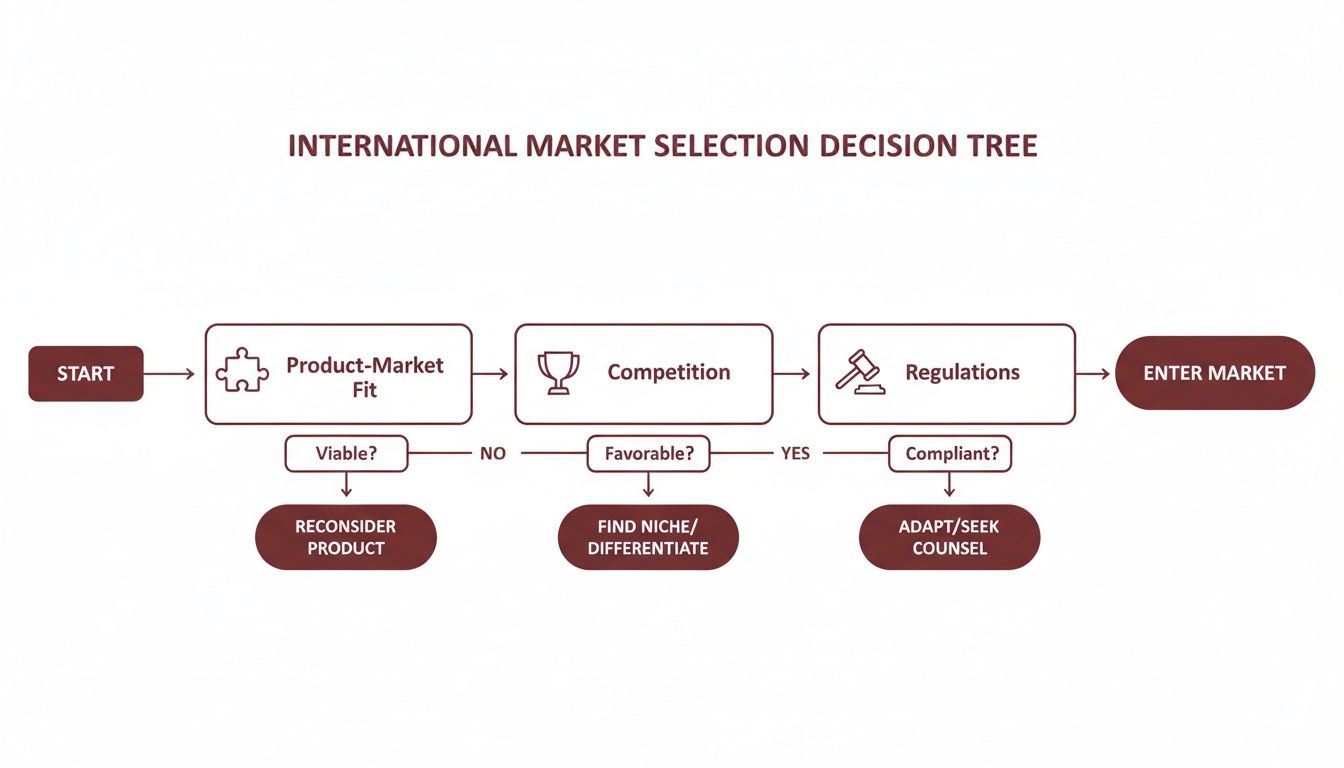
As the flowchart shows, after nailing product fit and sizing up the competition, the regulatory and compliance gate determines if you can proceed.
Your single most important decision will be choosing your on-the-ground partners. A distributor or 3PL provider isn’t just a vendor; they are a core strategic asset.
The right partner becomes your local expert, navigating customs, ensuring compliance, and preventing the expensive mistakes that can kill a launch. When vetting partners, look past the price tag. Dig into their expertise with your product category. A great partner doesn’t just move boxes—they help you grow smarter. Before committing to a region, check out our guide on how Amazon selling works to understand the core mechanics. Getting this foundation right is non-negotiable.
Launching and Scaling with Deliberate Control
A successful international launch isn’t a ‘big bang’ event. Sustainable growth comes from a series of calculated steps that build a strong market beachhead over time.
This is about establishing that beachhead with pragmatic launch planning, then scaling with intelligence and control.

Pragmatic Launch Planning
Your first move isn’t about capturing the entire market. It’s about securing your initial position and gathering real-world data. Start with inventory: ship just enough of your validated lead-off SKUs to cover sales for the first 90-120 days. This minimizes initial risk and capital exposure. Trying to do too much too early is where things usually go sideways.
From there, focus on genuinely localized marketing. This is not simply translating ads. It’s adapting your message, creative, and keyword strategy to connect with a new consumer culture. The goal is to build relevance and trust quickly.
The rise of Amazon Australia shows how critical a localized approach is. Its slice of the Australian online sales pie is climbing steadily, projected to capture an increasingly significant portion by 2026. With over 10 million monthly visitors, it’s a channel where you must compete on local relevance to win. You can discover more insights about its projected market share on Statista.com.
Protecting Margins and Pricing Strategically
For founders, protecting margins is paramount. An international launch introduces new costs that can quickly destroy profitability if not properly accounted for. Your pricing strategy must be built from the ground up for each new market.
This means a meticulous calculation of your true landed cost:
- International Shipping & Freight: The cost to get your product to the destination country’s port or fulfilment centre.
- Tariffs & Duties: Taxes imposed by the destination country, which vary by product category.
- Currency Fluctuation: The risk that exchange rate shifts can eat into profits. It’s smart to build in a 3-5% buffer to guard against this.
- Marketplace & Fulfilment Fees: Commissions and logistics costs charged by platforms like Amazon.
Only after accounting for every cost can you set a retail price that delivers a profit. Guesswork isn’t a strategy. You have to know your numbers cold. For a deeper look at operational costs, our article on Amazon logistics and fulfilment is a valuable starting point.
Founders often fall into the trap of matching competitor pricing without first understanding their own cost structure. This is a race to the bottom. Your price must reflect your product’s value and your business’s financial health, not just react to the market. This is where margins quietly disappear.
Measuring What Truly Matters
Revenue looks good. It doesn’t tell you much. Real market traction is measured by founder-focused KPIs that provide a clear dashboard of your brand’s health and scalability. These are the numbers that reveal if your strategy is actually working.
Smart founders obsess over:
- Sell-Through Rate: How quickly your inventory is selling compared to the amount in stock. High sell-through means strong demand and efficient inventory management.
- Customer Acquisition Cost (CAC) by Channel: How much it costs to acquire a new customer on Amazon versus your DTC site? This data directs marketing budget for the best return.
- Contribution Margin: The actual profit made on each unit sold after all variable costs are deducted. This is the ultimate measure of your product’s profitability.
Tracking these metrics provides the clarity to make informed decisions. They tell you when to increase inventory, when to double down on a marketing channel, and when you have built a foundation strong enough to scale.
Why Smart Brands Partner for Global Growth

There’s a painful lesson many ambitious founders learn: going it alone in global expansion is almost always the slowest, most expensive path. The assumption that you can simply copy and paste a domestic strategy into a new country is a dangerous one, even with a fantastic product.
This solo approach is tempting. It promises total control. The reality, however, is a string of costly mistakes played out in real-time, often with the brand’s reputation on the line. It almost always costs more than expected.
The Familiar Pattern of Solo Expansion
When strong brands try to enter new markets on their own, a predictable pattern often unfolds. It starts with excitement but quickly hits a wall of complexity.
First, stalled growth kicks in. After an initial sales bump, momentum flatlines. The brand realizes the marketing tactics that worked at home don’t connect in a new consumer culture. They burn through their launch budget trying to find a message that works, but the sales needle barely moves.
Next, they get hit with margin erosion. Unexpected costs appear from everywhere: a customs hold-up, a warehousing error, a fine for not meeting an obscure regulation. Each problem carves another slice out of profitability.
Finally, brand dilution begins. In a move to spark sales, the brand might turn to heavy discounting, cheapening the product. Or, they struggle with logistics, leading to poor customer experiences and negative reviews that damage their reputation.
A great product does not automatically become a great global brand. Marketplace success requires deep market understanding, operational excellence, and flawless execution—capabilities that are incredibly difficult and expensive to build from scratch in every new country.
A Strategic Partner as Your Accelerator
This is where the mindset must shift. Smart founders realize a strategic partnership isn’t about losing control; it’s about gaining speed and leverage. It’s about focusing your team on what they do best—product innovation and brand building—while plugging into an existing framework of on-the-ground expertise.
The right partner isn’t just another distributor. They become an extension of your team, a strategic asset bringing critical capabilities from day one.
- Real Market Intelligence: A good partner understands local market nuances. They know which channels matter, how consumers shop, and how to position your product against local competitors. This insight prevents wasting months on flawed ideas.
- Operational Infrastructure: They have warehouses, logistics networks, and carrier relationships already running. This lets you bypass the brutal learning curve of setting up your own supply chain.
- Compliance and Risk Management: A strategic partner navigates the maze of local regulations, from import duties to product safety standards, shielding your business from catastrophic risks.
Think of it like this: building a full-scale international operation is like constructing a house from scratch in a country where you don’t speak the language. A partner provides a move-in-ready home with a local guide who knows the neighborhood.
For brands using Amazon Australia as a launchpad, this model is even more powerful. Once you’ve proven your product in a controlled marketplace, you can plug into a partner’s established network in the US or UK to scale with speed and confidence.
At TPR Brands, we work with founders navigating precisely these challenges as they expand into international markets.
Your Questions on Global Expansion, Answered
As founders plan their move into international markets, a lot of the same questions come up. Most centre on using Amazon Australia as a strategic first step. Here are the direct answers we give brands every day.
Is Amazon Australia Too Competitive for a New International Brand?
This is a common worry, but the short answer is no—if you have the right strategy. Yes, there’s competition, but the marketplace on Amazon.com.au is nowhere near as saturated as its US or UK counterparts. The cost to acquire customers and the ad spend needed to get noticed are still much lower here.
This creates a brilliant opportunity. It allows a new brand to get a solid foothold, build some initial sales velocity, and collect those crucial first reviews without the crushing financial pressure you’d face in a bigger, more cutthroat market.
Think of it as the perfect testing ground. You can sharpen your product listings, experiment with pricing, and figure out what messaging actually connects with customers before you commit to the high-stakes game of the larger global marketplaces.
What Are the Biggest Mistakes Brands Make When Launching on Amazon Australia?
From our experience, the most damaging mistakes all come from one flawed idea: thinking Amazon Australia is just another sales channel you can tick off a list. This mindset always leads to critical, and often costly, errors.
- A “Copy-and-Paste” Strategy: Too often, brands just lift their listings, keywords, and creative straight from another country. This completely misses Australian consumer habits, slang, and cultural differences, making the brand feel alien and disconnected.
- Underestimating the True Cost: Founders consistently miscalculate the landed cost of their products. They forget to factor in GST, import duties, and local fulfilment fees, which can destroy margins and make a product unprofitable from day one.
- Ignoring Local Compliance: Assuming a product that’s compliant in the US or Europe is automatically good to go in Australia is a huge risk. Many categories, especially electronics and consumer goods, require specific Australian standards and certifications (like the RCM mark). These are not optional.
A successful launch on Amazon.au demands a dedicated, localised strategy. It’s not just an item on a checklist; it’s a deliberate market entry that requires its own planning and execution.
Can I Manage an Amazon Australia Launch from Another Country?
Technically, yes. With Fulfilment by Amazon (FBA), it’s possible to manage your inventory and sales from overseas. In reality, a purely remote approach is packed with hidden risks.
To pull it off, you need a deep, current understanding of Australian tax obligations (like the Goods and Services Tax), import regulations, consumer law, and advertising standards. Without that on-the-ground knowledge, you’re essentially flying blind.
This is precisely why so many successful international brands partner with a local expert. An in-market partner handles the operational and compliance headaches, deals with the logistical curveballs, and provides the local intelligence you need for a much smoother entry and faster, sustainable growth.
How Long Does It Take to See Results on Amazon Australia?
With a well-executed plan—including optimised listings, a targeted PPC campaign, and enough initial stock—a brand can start seeing real traction and data within 3-6 months. This period is all about gathering those early sales, customer reviews, and performance metrics.
But the real goal isn’t just a few quick sales. It’s about building a profitable, scalable channel that proves the model for your wider global expansion. Building that kind of sustainable momentum, where you have consistent sales, strong unit economics, and a clear picture of your customer, is typically a 12 to 18-month journey. The focus has to be on controlled, intelligent growth and data, not just immediate revenue.
If you’re an established brand looking to sell on Amazon Australia as part of a broader international expansion strategy, execution is what determines whether this works or fails.
At TPR Brands, we work directly with product-based companies to launch and scale on Amazon Australia in a way that protects margin and builds toward global growth — not just short-term sales.
That includes:
-
Market entry strategy
-
Amazon launch and optimisation
-
Pricing and margin control
-
Expansion into the US, Canada, and UK once validated
This is not about “trying Amazon.”
It’s about building a repeatable system for international growth.
If you’re serious about expanding, the next step is getting your Amazon strategy right from day one.
Learn more about our partnership model.
How do you sell on Amazon Australia successfully?
Selling on Amazon Australia requires more than listing products. Brands need the right SKU strategy, pricing structure, compliance alignment, and a clear plan to use Amazon as a testing ground for global expansion.