Many great products struggle internationally, not because demand is weak, but because the expansion strategy is flawed. You've built a fantastic product and seen initial success in your home market. For many founders, this early traction feels like the ultimate validation, but it can create a dangerous illusion. The truth is, a great product and those initial marketplace wins are often not enough for sustained global success.
The Difference Between a Product and a Global Brand
The journey from a successful local product to a resilient global brand is filled with traps that early wins often hide. Founders often believe their amazing product is the only asset they need, assuming that what worked in one country will automatically work in another. This is precisely where so many promising expansion plans go wrong.
Marketplace success demands strategic positioning, not just a good product listing. The drivers of your domestic success—brand recognition, consumer trust, and established distribution—simply do not carry over to new territories automatically.
Why an Amazon Warehouse Is Not a Strategy
For many founders, the term "Amazon warehouse" represents their entire international logistics plan. They believe that if they can just get their inventory to a fulfilment centre, sales will naturally follow. This oversimplification is a critical strategic mistake.
An Amazon warehouse is an entry point into a complex global ecosystem. It's a powerful tool, but it is not a strategy.
True international expansion means navigating a maze of challenges that go far beyond basic fulfilment:
- Market-Specific Compliance: Every country has its own jungle of rules for product safety, labelling, and taxes. One misstep can lead to your inventory being seized and significant financial penalties.
- Building Consumer Trust: Shoppers in a new market have no relationship with your brand. Building that trust from scratch requires a localized approach to marketing, customer service, and brand storytelling.
- Distribution Dynamics: Relying on a single warehouse can mean slow delivery times and high shipping costs for customers outside that immediate area, completely destroying your competitive edge.
- Brand Protection: Launching in a new market without a solid plan to combat counterfeiters and unauthorized sellers can devalue your brand and destroy pricing integrity almost overnight.
Great products do not automatically become great brands. The transition requires a deliberate shift from simply selling a product to strategically building a brand presence in each new market.
The Real-World Pattern of Stalled Growth
It’s a pattern we see constantly. A brand achieves incredible initial growth in its home market, driven by a quality product and the power of Amazon's local logistics. Buoyed by these results, the founder decides to go global.
They ship a container of inventory to an Amazon warehouse in a new country, expecting the same magic to happen. Instead, they hit a wall. Sales are flat, customer acquisition costs are unsustainable, and managing the operational side becomes a nightmare.
This is the exact moment many brand founders realize that product success doesn't just copy-and-paste across borders. The strategies that built a winning domestic business are often no match for the complexities of international trade.
At TPR Brands, we work with founders navigating these very challenges as they expand into international markets. We help them build the strategic framework that turns a strong product into a truly scalable global brand. If you're one of the many successful Amazon sellers looking to take that next big step, understanding this distinction is your first critical move.
Decoding Amazon's Global Logistics Network
For founders evaluating international expansion, it's easy to see an Amazon warehouse as just a place to store boxes. This view fundamentally misunderstands the strategic opportunity. These facilities are the operational heart of Amazon's global dominance—a powerful infrastructure that smart brands can leverage for capital-efficient growth.
Understanding this network isn't just about logistics; it's about marketplace economics and strategic leverage.
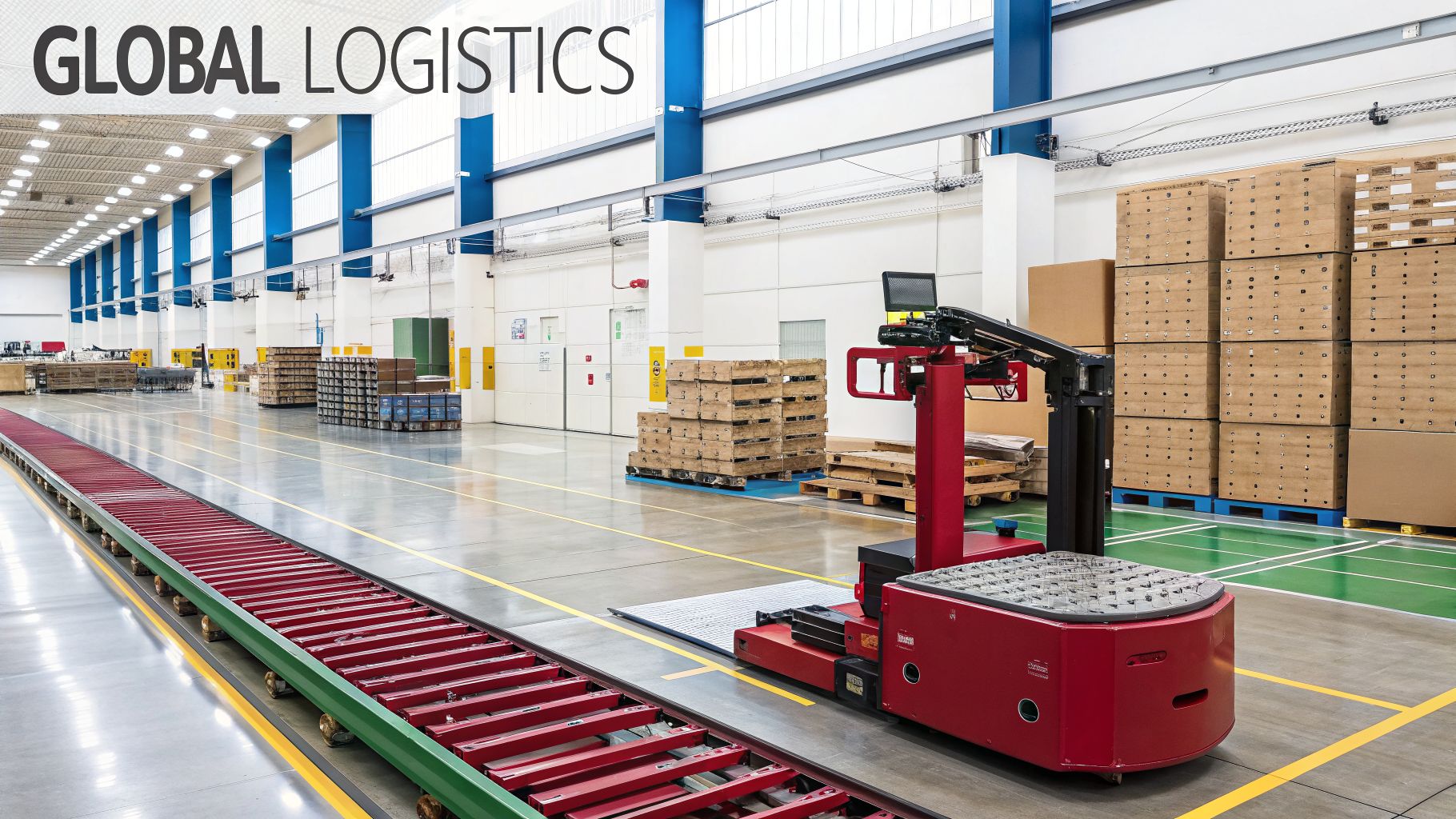
Simply sending your inventory to an Amazon fulfilment centre is a transactional relationship. You send stock, they pick and pack. A strategic approach, however, treats Amazon's network as a shared asset, using its power to drive brand growth—not just move units.
The real opportunity isn't just in using an Amazon warehouse—it's in understanding how to make its entire logistics engine work for your brand's specific expansion goals. This is the difference between being a user of the system and a strategic beneficiary.
Infrastructure as a Strategic Signal
When Amazon invests billions in its logistics, it's sending a clear signal about where it sees future growth. These aren't just construction projects; they are calculated moves based on deep data analysis of consumer demand, economic trends, and future e-commerce potential.
For a founder evaluating a new territory, Amazon's own capital expenditure is one of the most reliable leading indicators available.
A perfect example is unfolding in Australia. Amazon has poured AU$750 million into a new robotics fulfilment centre in Brisbane, a massive vote of confidence in the region. You can get the details on Amazon's Australian robotics facility from their news site, but the scale is what matters. This isn't just another shed.
To give you a sense of what this means for brands, let's look at the numbers and what they signal.
Amazon AU Infrastructure Investment At A Glance
| Investment Metric | Figure or Target | Strategic Implication for Brands |
|---|---|---|
| Total Investment (Brisbane FC) | AU$750 million | A strong signal of Amazon's long-term commitment to the Australian market. |
| Facility Size | 150,000 square metres | Massive increase in local storage capacity, reducing the need for brands' own warehousing. |
| Item Capacity | 15 million smaller items | More room for diverse product catalogues, especially in consumer goods and hardware. |
| Annual Processing Capacity | 125 million packages | Supercharges delivery speeds nationwide, making Prime a more compelling offer for customers. |
This kind of investment fundamentally changes the calculus for market entry. It means faster, more reliable nationwide delivery is becoming a reality, allowing your products to compete on service and availability—without you needing to build a single distribution centre.
Beyond Fulfilment By Amazon
A basic FBA setup is a one-size-fits-all solution. It's effective, but it's not strategic. Working with an expansion partner transforms this relationship, unlocking a more sophisticated level of control and efficiency.
Instead of just tactical fulfilment, the focus shifts to:
- Optimised Inventory Placement: A partner can analyse sales data and demand patterns to strategically distribute your stock across multiple Amazon warehouse locations. This isn't about just sending inventory; it's about placing it closer to the end customer to minimise shipping times and costs, which directly improves your margins and customer experience.
- Compliance and Inbound Logistics: We have seen brands get completely stalled by the complexities of import regulations, customs duties, and country-specific labelling. A partner manages all of this, ensuring your products arrive at the Amazon warehouse shelf-ready and fully compliant, avoiding costly delays.
- Integrated Supply Chain Management: Your international shipments stop being a siloed operation. A partner integrates them into a cohesive supply chain, giving you better visibility, forecasting, and control over your stock from the factory floor all the way to the final customer.
This strategic layer is what separates the brands that struggle with international logistics from those that thrive. It turns the Amazon warehouse from a simple storage unit into a dynamic, capital-efficient engine for global expansion.
The goal is to compete on a global scale without the immense upfront cost and risk of building your own international logistics from the ground up. You gain the power of a multi-billion-dollar infrastructure while staying lean and focused on your core business: creating great products. Exploring Amazon logistics in-depth reveals how this powerful network can be configured to protect brand value while driving scalable growth.
The Modern Playbook for International Market Entry
For founders eyeing international expansion, the old playbook is broken. We’ve seen it time and again: a brand lists its products on a new Amazon domain, crosses its fingers, and hopes for the best. This isn't a strategy; it's a recipe for stalled growth and wasted capital.
A modern, intelligent approach is needed—one that treats market entry as a deliberate campaign, not a hopeful experiment. This new playbook starts long before your inventory ever hits an Amazon warehouse. It begins with a deep, honest analysis of your product-market fit in the target region. So many promising brands derail because they misread local demand or fail to realize their marketing message just doesn't land with a new culture.
Reading the Strategic Signals
One of the most reliable ways to gauge a market’s potential is to watch where Amazon itself is placing its bets. The company's massive infrastructure investments aren't random. They are data-driven decisions that signal where future e-commerce growth is headed. When you see Amazon announcing new warehouse capacity, robotics centres, or faster Prime delivery promises, you’re getting a clear signal of market readiness.
A perfect example of this just unfolded in Australia. Amazon Australia's logistics expansion was a massive undertaking, with a completed AU$15 billion investment in infrastructure by 2025. This included two new Sydney warehouses that became operational in Q2 2025 and a major Melbourne hub expansion designed to slash average delivery times from 3.2 days to just 2.1 days.
This investment, coinciding with Australia's e-commerce boom where sales were forecasted to hit AU$70 billion in 2025, has created an unprecedented opportunity for brands in categories like hardware and home improvement. The groundwork for structured, efficient distribution has been laid for you. You can read more about this logistics surge and its impact on the FreightAmigo website.
This isn't just about faster shipping. It’s about a robust supply chain that can handle rising demand, manage local compliance, and overcome the last-mile challenges that can sink a launch.
Founders who learn to interpret these infrastructure investments as strategic signals can align their expansion plans with markets that are primed for growth, effectively de-risking their entry.
A Framework for Intelligent Market Testing
Instead of betting the farm on a full-scale launch, smart brands test new markets intelligently. This is where the right partnership becomes a force multiplier. A distribution partner provides the on-the-ground expertise that is nearly impossible to replicate from afar.
This partnership-led model looks like this:
- Initial Market Validation: Use a partner’s established presence to conduct small-batch tests. This lets you gather real-world sales data without committing to a full container of inventory.
- Compliance and Localisation: You rely on your partner to navigate the maze of local regulations—from product labelling to tax obligations—ensuring a smooth, legal entry.
- Brand Control: From day one, you establish clear protocols to manage pricing, control third-party sellers, and maintain brand integrity in a new, unfamiliar marketplace.
This methodical approach transforms market entry from a high-stakes gamble into a calculated business decision. It allows you to validate demand, refine your strategy, and scale with confidence. Ultimately, the partner handles the operational complexity, freeing you to focus on building your product and growing your brand.
Why a Strategic Partner Is Your Greatest Growth Asset
For founders with a winning product, the instinct is almost always to "go it alone" when expanding into new countries. It’s the same entrepreneurial drive that built the business from the ground up. But the skills that deliver success at home are entirely different from what’s needed to scale a brand globally.
That admirable DIY approach often leads to a series of predictable and expensive mistakes. The smartest move isn't trying to do everything yourself. It’s about finding a partner with established expertise, infrastructure, and local market knowledge to fast-track your growth and de-risk the entire venture. This is the difference between simply selling more units and building a sustainable global brand.
The Hidden Complexities Founders Overlook
Even the most experienced entrepreneurs get blindsided by the sheer operational drag of international expansion. What looks straightforward on a spreadsheet quickly unravels into a complex web of problems that pull focus and drain resources. The reality of managing a global business from the other side of the world is far more demanding than most founders anticipate.
Without a dedicated partner on the ground, your team is suddenly on the hook for:
- Multi-Region Inventory Management: Juggling stock levels across an Amazon warehouse in Sydney, another in London, and a third in Toronto isn't just about shipping boxes. It demands sophisticated forecasting, understanding seasonal demand shifts between hemispheres, and navigating wildly fluctuating shipping times and costs.
- The Labyrinth of Cross-Border Tax Laws: Every country has its own jungle of rules for GST, VAT, import duties, and sales tax. One simple error in a product classification can get your entire shipment stuck at customs, triggering fines and stockouts that kill your sales momentum right at launch.
- Cultural and Marketing Nuances: A marketing message that works perfectly for Australian consumers can easily fall flat—or worse, be unintentionally offensive—in the UK or Canada. Adapting product listings, ad copy, and brand voice for each market is a full-time job that requires deep local insight.
A strategic partner doesn’t just execute a list of tasks; they absorb this complexity for you. This frees up your core team to focus on product innovation and brand vision—which is always the highest-value use of a founder's time.
The Partnership Model for Accelerated Growth
Let's look at a common scenario. A successful Australian brand in the household goods space decides to enter the US market alone. The founder takes the "go-it-alone" path, shipping a container directly to an Amazon warehouse in California.
Almost immediately, they're hit with unexpected customs delays from incorrect paperwork. When the product finally goes live, sales are sluggish because the listings haven't been optimised for American search terms and buying habits. To make matters worse, a handful of unauthorised resellers pop up, undercutting their price and damaging the brand's premium positioning. The founder and their small team spend the next six months just putting out fires instead of proactively growing the business.
Now, picture the same brand choosing a partnership model. They engage a US-based expansion partner who handles the entire import process, making sure the product is compliant and sails through customs. The partner, who lives and breathes the US market, rewrites the product listings with locally relevant keywords and imagery. They also have a system ready to monitor and shut down unauthorised sellers from day one, protecting the brand's integrity and price points.
The product launches successfully and gains traction fast because all the foundational work was done correctly. Back in Australia, the founder receives clear, consolidated reports, allowing them to make strategic decisions without getting tangled in the daily operational chaos.
This is the real power of partnership. It isn't about losing control; it's about gaining strategic leverage. It lets you grow faster, more sustainably, and with significantly less risk. By plugging into an existing network of expertise and infrastructure, you bypass the painful and expensive learning curve, dramatically accelerating your journey from a strong local product to a recognised global brand.
Deciding you need an international Amazon partner is an important first step. The real work begins now: picking the right one.
This is a critical moment for any founder. Make the wrong choice, and you’ll create more headaches and expense than you would have by yourself. But the right partner? They become a force multiplier, accelerating your growth while fiercely protecting the brand you’ve worked so hard to build.
It’s a huge mindset shift. You’re not hiring a simple service provider. You’re choosing a strategic ally who needs to be just as invested in your long-term vision as you are.
The market is flooded with agencies promising the world. But most are just focused on sales volume. A true expansion partner understands that controlled, sustainable growth is what matters. They know that preserving your brand’s integrity and pricing is every bit as important as shipping units from an Amazon warehouse.
Beyond the Sales Pitch
When you start meeting potential partners, you have to learn to see past the flashy presentations and dig into how their business actually operates. Frankly, anyone can promise to boost your Amazon sales. That’s easy.
A real strategic partner, however, can show you exactly how they’ll protect your brand while they do it. Their value isn't just in their sales chops; it's in their ability to manage the immense complexity of global marketplaces and head off problems before they start.
Your goal is to find someone whose entire business model aligns with the long-term health of your brand, not a group chasing short-term transactional wins. This means getting comfortable asking direct, sometimes tough, questions that reveal their true philosophy.
This decision tree really highlights the crossroads founders find themselves at. Do you risk going it alone and making the same common mistakes so many others have, or do you find a partner to navigate that path with you?
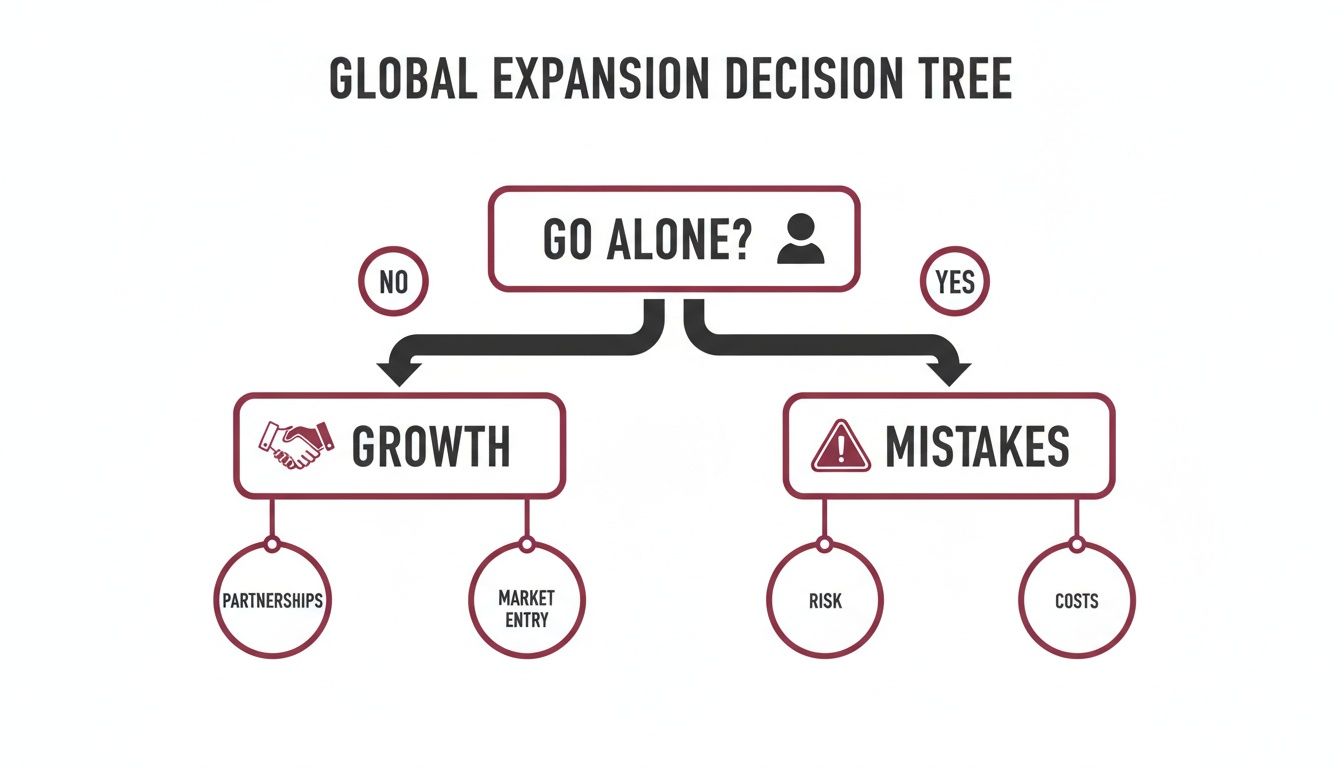
What this visual makes clear is a pattern we see all the time. The desire for founders to "do it all" is strong, but it often leads directly to predictable and very expensive errors—the exact kind of errors a good partnership is designed to prevent.
A Founder's Due Diligence Checklist
To separate the real operators from the glorified sales reps, you need a solid evaluation framework. Before you even think about signing an agreement, you need to probe these critical areas:
- Proven Market Expertise: Don't just ask if they work in your target market (like Australia, the UK, or the US). Ask for specific case studies from brands similar to yours. How did they manage the market entry? What were the exact results, and what challenges did they hit along the way?
- Brand Protection Protocols: This is completely non-negotiable. Get them to walk you through their step-by-step process for finding and stamping out unauthorised sellers. How, specifically, do they enforce MAP (Minimum Advertised Price) policies? If you get a vague answer here, it's a massive red flag.
- Operational Depth: How deep does their Amazon knowledge go? Quiz them on their process for managing inventory across multiple regions, handling inbound customs and compliance, and optimising logistics all the way from the factory floor to the final Amazon warehouse.
- Reporting and KPIs: What does success actually look like to them? Ask to see their sample performance reports. Look for metrics that go beyond just top-line sales. You want to see things like inventory health, Buy Box ownership percentage, and advertising return on spend.
A true partner will not only welcome this level of scrutiny, they'll expect it. They’ll have clear, documented processes for everything from brand protection to performance measurement because that's the core of what they do.
Commercial Terms and Integration
Finally, the structure of the deal itself tells you a lot about a potential partner's philosophy. Be very cautious of models that are purely commission-based on gross sales. This can create a perverse incentive for them to chase volume at any cost, even if it means eroding your prices and damaging your brand's long-term health.
A much healthier model often involves a structure that ties the partner's success directly to your profitability and brand integrity. This might look like a retainer, performance bonuses linked to specific brand-health KPIs, or some kind of hybrid approach.
The integration process is just as important. Ask for a clear, documented plan for the first 90 days. Who will be your main point of contact? How often will you have strategic review calls?
Making the right call here requires thorough due diligence. For a deeper look at what to look for, you might find our guide on finding the right Amazon expansion partner useful. Choosing correctly is one of the most significant strategic decisions a founder can make. It’s a move that will set the course for your brand’s global journey for years to come.
In the world of global retail, a fantastic product isn't the finish line. It's just the price of entry. I’ve seen countless brands with incredible products assume that their local success will automatically translate to international markets, only to see their growth stall.
The journey from a strong domestic product to a resilient global brand is paved with a series of deliberate, strategic choices. It's never left to chance.
When a brand’s international expansion falters, it’s rarely a sign of a weak product. More often, it’s a symptom of a flawed strategy. Relying on a basic Amazon warehouse setup and hoping for the best is a high-risk gamble that overlooks the market-specific compliance, brand protection, and cultural nuances that truly determine success.
The path forward isn’t about working harder; it’s about working smarter. It involves leaning on the established expertise of a strategic partner to navigate the complexity, freeing you up to focus on what you do best: building your brand and creating great products.
A great product gives you the right to compete. A great strategy is what allows you to win. The smartest founders I work with recognise they don't need to build every piece of the puzzle themselves. They see partnership not as a loss of control, but as a way to gain strategic leverage. It's how they turn the immense potential of Amazon's global infrastructure into a predictable engine for growth.
At TPR Brands, we work with founders navigating these challenges as they expand into international markets.
Common Questions From Founders
We work with founders navigating these exact challenges every day. Here are some of the most common questions that come up when we discuss building a strategic bridge from a strong local product to a scalable global brand.
Isn't Amazon FBA Enough for International Expansion?
While Amazon’s FBA program is a powerful logistics tool, it's not a complete international strategy. Think of it as the delivery truck, not the entire distribution plan.
True expansion requires a partner who can manage market-specific compliance, protect your brand from local counterfeiters, and build a marketing strategy that actually works in that country. Relying solely on FBA often leads to unexpected costs and brand dilution because it doesn't address the critical strategic layer needed to win in a new market.
How Do I Protect My Brand and Pricing With a Partner?
This is a critical point, and one where many brands get burned. A true strategic partner operates on a controlled growth model, not one that chases volume at all costs.
Your partnership agreement should explicitly detail how your brand's integrity and pricing will be upheld. A good partner will have proven, documented processes for this.
You should look for partners who establish clear brand control protocols from day one. This includes enforcing MAP (Minimum Advertised Price) policies and actively monitoring the marketplace to remove unauthorised sellers who are eroding your pricing.
When Is the Right Time to Bring on an International Partner?
The ideal time is when you have a proven product with strong, consistent traction in your home market. This is for brands moving from being a successful product to becoming a scalable international brand.
You should have stable manufacturing, a clear brand identity, and the operational capacity to support increased volume before you take this step. Waiting until you have this foundation in place significantly increases your chances of a successful international launch.
At TPR Brands, we work with founders navigating these exact challenges, building the strategic bridges that turn strong products into scalable global brands. Find out how we can help you expand.