Many great products fail when expanding internationally — not because demand is weak, but because the expansion strategy is flawed.
At TPR Brands, we work directly with established companies expanding into Amazon Australia, managing everything from logistics and compliance to full-scale Amazon growth. What we see consistently is this: success in the US or UK does not translate without a localized, strategic approach.
Who This Is For
This guide is written for:
– Established brands expanding into new markets
– Manufacturers adding Amazon as a revenue channel
– Companies looking for a managed Amazon growth partnerIf you’re looking to expand into Amazon Australia without building everything in-house, TPR Brands manages the entire process.
Understanding the Amazon Marketplace Australia
The Amazon Marketplace Australia operates differently from other global regions. Success here depends on local logistics, pricing structures, and buyer expectations — not just product quality. At TPR Brands, this is exactly where we support our clients — building localized strategies across logistics, pricing, and marketplace positioning to ensure successful entry.
Brands we work with often struggle when they initially apply overseas strategies without adapting to how Amazon Australia actually operates.
In our experience managing Amazon expansion, a copy-paste strategy consistently underperforms in the Australian market.
Why the Amazon Marketplace Australia Is a Strategic Market
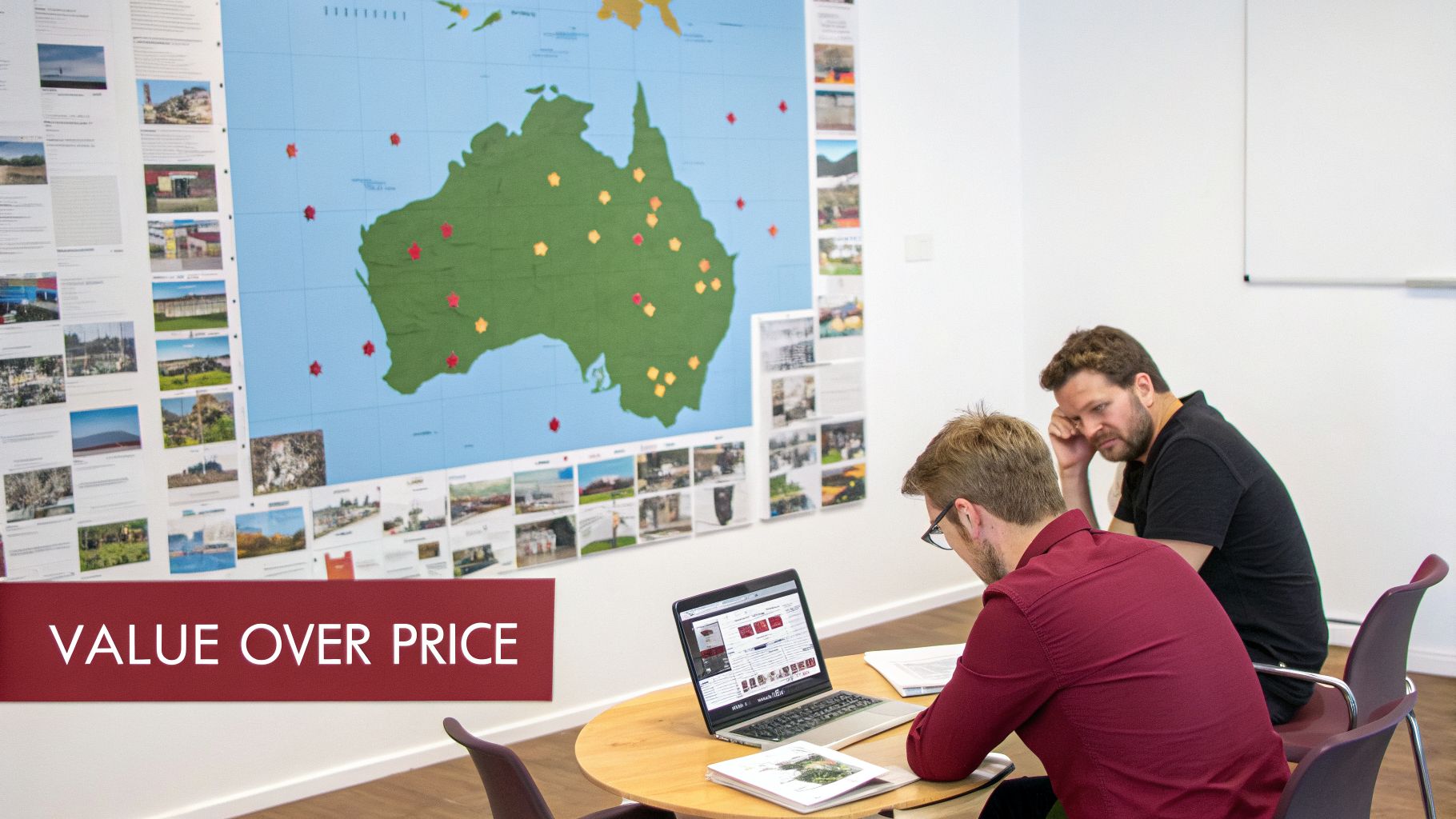
In its early days, the Australian marketplace was a price-driven battleground. The cheapest listing usually won. This created a false sense of opportunity for international sellers who could land products cheaply, but that era is over. The market has matured, and the drivers of consumer behavior have fundamentally shifted.
The New Economics of Brand Trust on Amazon Australia
By 2026, Amazon is reaching 60% of Australian shoppers, a significant jump from 52% in 2023. However, the most critical insight for brand builders is why they buy. Price is no longer the dominant factor; service, speed, and trust now dictate purchasing decisions.
This shift reveals a marketplace where operational excellence and brand credibility have overshadowed raw price competition.
This is why Amazon Australia expansion now requires a structured, locally executed strategy — not just product availability.
Australian Consumer Driver Shift on Amazon 2023 vs 2026
| Purchasing Driver | Importance in 2023 | Importance in 2026 | Strategic Implication for Brands |
|---|---|---|---|
| Price | High | Low | Competing on price alone is a losing strategy. Focus on value and brand. |
| Delivery Speed | Low | High | Fast, local fulfilment is a non-negotiable for consumer trust. |
| Prime Benefits | Medium | High | The Prime badge signals reliability and is a key conversion driver. |
| Brand Trust | Medium | High | Reviews and localized brand reputation are critical for success. |
The data shows Australian consumers prioritize:
- Speed of delivery (35%): Local logistics are essential.
- Prime benefits (31%): The Prime ecosystem drives immense loyalty.
- Overall platform preference (28%): Shoppers are committed to the Amazon experience.
- Product reviews (24%): Social proof is a powerful trust signal.
For founders, this means the real barrier to entry is no longer just capital—it’s strategic sophistication. Your logistics, customer service, and brand story must be built for the Australian consumer, who has become far less tolerant of long shipping times and generic marketing.
From Price War to Brand Positioning
This evolution demands a new playbook. Brands competing solely on price will find themselves in a race to the bottom. The winning strategy is about building a durable value proposition through intelligent positioning.
This requires a deep understanding of local market economics, consumer trust signals, and Australian distribution dynamics. We’ve seen US bestsellers fail in Australia because their value wasn’t communicated in a culturally relevant way or their delivery promise couldn’t meet local expectations.
Smart brands recognize that entering the Amazon marketplace Australia isn’t just about finding a new sales channel. It’s about building a new, localized business—a challenge that often grows brands faster through strategic partnerships rather than attempting it alone. For more on this, explore our insights on succeeding in the Amazon Marketplace Australia.
Common Mistakes Brands Make When Expanding to Amazon Australia
– Relying on global pricing instead of local market positioning
– Underestimating logistics and delivery expectations
– Ignoring Australian compliance requirements
– Copy-pasting listings without localization
These are the exact areas TPR Brands manages for clients to prevent failed launches and wasted investment.
Navigating the Hidden Risks of Australian Compliance
For founders focused on product and brand growth, the intricacies of international compliance can seem like a distraction. However, treating Australian regulatory and tax hurdles as an afterthought is one of the most significant strategic errors a brand can make.
The real-world patterns are clear: the primary friction points for global brands are rarely marketing or product-market fit. They are the non-negotiable rules that can halt shipments at the border, erode margins, and damage a brand before its first sale.
A successful Amazon Australia launch requires a proactive compliance strategy. At TPR Brands, we build this into the foundation of every client expansion to prevent costly delays and disruptions.
The Strategic Implications of the Goods and Services Tax (GST)
Australia’s Goods and Services Tax (GST) is a 10% value-added tax on most goods and services. Understanding its impact is critical for any international brand.
For consignments valued at or below AUD $1,000, Amazon automatically collects and remits GST. While seemingly helpful, this automation can create a false sense of security. You must account for GST in your pricing strategy from day one. Simply adding 10% to your US or UK price will likely render your product uncompetitive.
Smart brand builders construct a ‘landed cost model’ from the outset. This involves calculating the final Australian price by working backwards from a target profit margin, incorporating the cost of goods, shipping, import duties, Amazon fees, and the 10% GST. Neglecting this analytical step is the fastest way to see your margins evaporate.
The Unseen Barrier: Australian Import Regulations
Getting products into Australia involves more than just logistics. The Australian Border Force (ABF) enforces some of the world’s strictest regulations. An error can result in your entire shipment being seized, returned, or destroyed—all at your expense.
Key areas demanding strategic attention include:
- Biosecurity Laws: The Department of Agriculture, Fisheries and Forestry (DAFF) has stringent rules to protect Australia’s unique ecosystem. This is a critical consideration for brands in pet supplies, health, outdoor goods, and even homewares. Products containing wood, plant materials, or certain food-derived ingredients require specific declarations and sometimes an import permit.
- Electrical Safety Standards: Any product that plugs into a wall socket must meet Australian electrical safety standards and carry the Regulatory Compliance Mark (RCM). Selling non-compliant electronics is illegal and poses a significant liability risk.
- Product Labelling: Australia has its own specific labelling requirements for ingredients, safety warnings, and country of origin. Packaging that is compliant in another market may not be here.
We have observed founders making seemingly minor mistakes with devastating consequences. For example, a US brand selling wooden kitchen utensils had its first shipment held indefinitely by biosecurity for lacking the correct timber treatment certificate. This single oversight derailed their launch and cost thousands in lost inventory.
Getting compliance right isn’t just about avoiding penalties; it’s about building a resilient supply chain. It’s the essential groundwork that enables marketing and sales efforts to succeed. For a deeper dive into these common pitfalls, we’ve shared more founder-focused insights on selling successfully on Amazon.
Designing Your Australian Distribution and Fulfilment Strategy
A great product is only as good as your ability to deliver it — which is why logistics is one of the core areas we manage for brands expanding into Amazon Australia. For brands expanding into the Amazon marketplace Australia, this is a fundamental business reality. Australia’s vast geography and dispersed population centres mean that logistics can—and will—make or break your brand’s entry into the market.
A flawed fulfilment strategy is the fastest way to burn capital, accumulate negative reviews, and cede the market before gaining a foothold. This isn’t just about moving boxes; it’s about building a distribution network that protects your margins and delivers a consistent brand experience.
The Core Fulfilment Models: A Strategic Analysis
For international brands, the decision comes down to three paths: Fulfilment by Amazon (FBA), Fulfilled by Merchant (FBM), or a local third-party logistics (3PL) provider. Each has strategic benefits and significant limitations.
Fulfilment by Amazon (FBA) is often the default choice. You ship stock in bulk to Amazon’s Australian fulfilment centres, and they handle storage, picking, packing, shipping, and customer service. The Prime badge is a powerful conversion driver, as Australian shoppers expect fast, free shipping.
However, FBA is not a universal solution. Its fee structure can be punitive for certain product types, especially:
- Oversized or Heavy Items: For hardware, outdoor gear, or furniture, FBA fees can decimate margins.
- Slow-Moving Inventory: Amazon’s long-term storage fees become a serious financial drain if your entire catalogue doesn’t sell through quickly.
- Lack of Brand Control: With FBA, you cede control over your branding, packaging, and the final delivery experience.
Before logistics, however, comes compliance—a non-negotiable step.
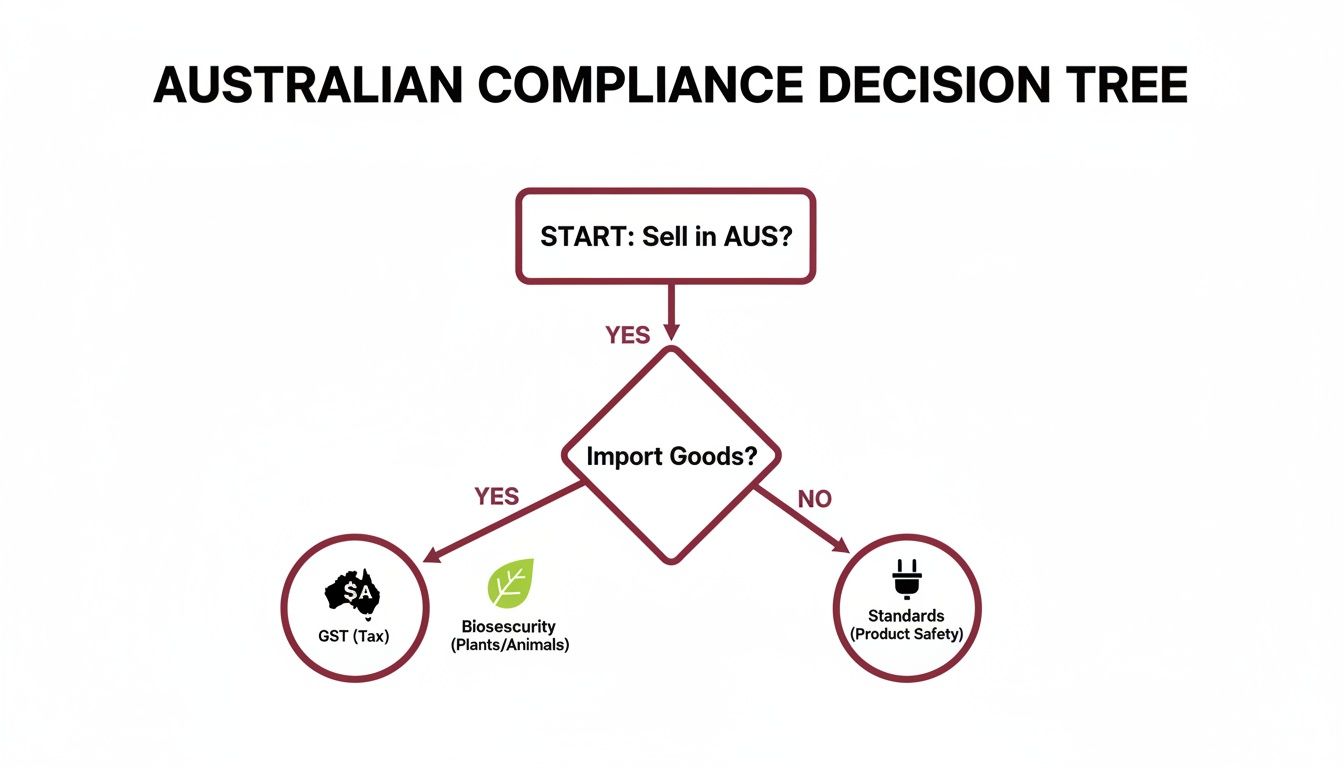
This illustrates that before you can decide how to ship, you must ensure your products are cleared for GST, biosecurity, and local safety standards. A strategic partner with deep market knowledge is crucial for navigating this complex path.
Strategic Alternatives: FBM and the 3PL Hybrid Model
Fulfilled by Merchant (FBM) gives you complete control over inventory and fulfilment. While this protects margins and brand experience, it is operationally intensive and often impractical for international brands. The primary drawback is failing to meet the delivery expectations of Prime-conditioned shoppers, a significant competitive disadvantage.
This brings us to the Third-Party Logistics (3PL) Hybrid Model, often the most intelligent choice for serious brands. Partnering with a local Australian 3PL allows you to store inventory closer to customers and achieve fast, nationwide shipping without the punitive overhead of FBA for every product. A strong 3PL partner provides control over branded packaging and enables multi-channel fulfilment from a single inventory pool.
This table breaks down the strategic differences between the models in the Australian context.
Fulfilment Model Comparison for the Australian Market
| Fulfilment Model | Best For | Control Level | Margin Impact | Scalability Factor |
|---|---|---|---|---|
| Fulfilment by Amazon (FBA) | Fast-moving, standard-sized items where the Prime badge is critical for conversion. | Low | Can be high due to storage and fulfilment fees, especially for non-standard items. | High, leveraging Amazon’s established network for rapid growth. |
| Fulfilled by Merchant (FBM) | Niche, high-margin products with low sales velocity or for brands testing the market. | High | Potentially highest margins, but offset by high shipping costs and operational overhead. | Low, difficult to scale internationally without significant investment. |
| Third-Party Logistics (3PL) | Brands with mixed catalogues (standard and oversized) or those with a multi-channel strategy. | Medium | Generally lower fees than FBA for non-standard items, preserving margins on a wider range. | Medium to High, depending on the 3PL’s network and capabilities. |
The optimal strategy for many founders is a blended approach: use FBA for fast-moving “hero” products to secure the Prime badge, and rely on a cost-effective 3PL for oversized items, the rest of the catalogue, and multi-channel orders. This balances speed, cost, and brand control.
This hybrid model is the approach we implement for many TPR Brands clients, balancing Prime visibility with cost control and brand experience.
Choosing the right fulfilment model is a strategic decision that directly impacts profitability and scalability. For a more granular analysis, our guide on Amazon logistics solutions in Australia explores these trade-offs. This isn’t just an operational choice; it’s a strategic one that will define your success in the Australian market.
From Product to Brand: Your Australian Launch Strategy

One of the most common mistakes founders make when entering the Amazon marketplace Australia is treating their product catalogue as a simple copy-paste exercise. The assumption that listings, creative, and pricing from a home market will translate directly almost always fails.
It ignores a fundamental truth: you are not just entering a new marketplace; you are launching your brand to an entirely new audience. Great products do not automatically become great brands, especially in a new country.
Success requires a ground-up rethink of your value proposition. This is not about minor tweaks; it is a strategic repositioning for a market with its own culture, expectations, and competitive landscape.
Localizing Your Brand, Not Just Your Listings
True localization goes far beyond swapping “color” for “color.” We regularly see brands invest heavily in expansion but underinvest in localization, which directly impacts conversion and customer trust.
Genuine localization ensures every element of your product page resonates with an Australian shopper.
This starts with a full audit of your listings. Language must be adapted for local terminology, measurements must be metric, and cultural references require review.
Imagery is just as critical. Lifestyle photos depicting a North American suburb can feel alienating. Smart brands invest in creative that reflects the local environment—an outdoor product at a recognizable Australian beach, or a kitchen gadget in a home that feels familiar.
A brand’s success on Amazon Australia is often decided long before the first sale. It’s won or lost in the strategic decisions made during the catalogue planning phase. Founders who treat this as an administrative task are positioning themselves for failure.
Architecting a Defensible Australian Pricing Structure
Pricing is where many international brands falter. A simple currency conversion of your domestic price is a recipe for disaster. It ignores the multiple cost layers of selling in Australia and will destroy your margins.
At TPR Brands, we build detailed landed cost models for every client before launch to ensure profitability from day one.
A robust pricing model must include:
- Landed Costs: The total cost to get your product into an Australian fulfilment centre.
- Import Duties: Tariffs specific to your product category.
- Goods and Services Tax (GST): The 10% tax that must be factored into your final price.
- Amazon Fees: Referral fees, plus any FBA charges.
- Local Overheads: Marketing budget, returns allowance, and any partner fees.
Only after modelling these costs can you set a retail price that protects your profit. This is non-negotiable for building a viable business in Australia.
A Phased Launch for Sustainable Momentum
Another frequent error is launching an entire catalogue at once. This “all-in” approach spreads your launch budget too thin and dilutes your ability to build momentum.
A far more intelligent strategy is a phased launch, starting with a curated selection of “hero” products.
First, select 2-4 of your proven winners—products with a strong sales history and broad appeal. These will be your market-testing vehicles.
Next, focus all launch energy on generating reviews for these few products. Concentrate your initial ad spend to drive sales velocity and build crucial social proof.
This initial phase allows you to gather data and refine your approach, validating your pricing, stress-testing your logistics, and gaining direct feedback from Australian customers.
Once your hero products have traction, you can methodically introduce the next tier of your catalogue from a position of strength. This controlled entry is how smart founders de-risk expansion into the Amazon marketplace Australia and build sustainable growth.
Protecting Your Brand in a New Marketplace
Expanding onto the Amazon marketplace Australia is a huge win for founders. But as your sales and visibility climb, a new, high-stakes problem emerges. Unauthorised sellers appear, and tension can build with existing retail partners or your own direct-to-consumer (DTC) channel.
This is a pattern we actively manage for brands scaling on Amazon Australia. The very platform fuelling your growth can become a source of brand dilution, price wars, and channel conflict. Protecting your brand’s integrity isn’t just a good idea; it’s a fundamental part of a sustainable growth strategy. This is the critical governance layer we help founders implement from day one.
Amazon Brand Registry: Your First Line of Defence
For every brand we onboard at TPR Brands Amazon Brand Registry is a non-negotiable first step when entering the Australian market.
While it requires a registered trademark in Australia—an investment in itself—the control it provides is immediate and substantial.
With Brand Registry, you gain the authority to:
- Control Your Product Listings: Lock down the content on your product detail pages, preventing unauthorised sellers from changing titles, descriptions, or images.
- Fight Counterfeiters: Access powerful tools to find and remove listings for fake products.
- Manage Unauthorised Sellers: Gain a clear process for reporting sellers who misrepresent your product or violate your intellectual property.
Brand Registry is more than a defensive tool; it’s the key that unlocks A+ Content, Brand Stores, and Sponsored Brands advertising. These are the tools you need to tell your brand story and turn a product listing into a rich brand experience.
Think of Brand Registry as the digital title deed to your real estate on Amazon. Without it, you are merely a tenant.
Architecting a Go-to-Market Governance Strategy
While Brand Registry protects you on Amazon, a broader governance strategy is needed to manage your brand across all channels. A primary concern for founders is that success on Amazon will cannibalize established retail relationships or devalue their own DTC business.
This is a valid concern, but it is entirely manageable with the right structure.
The goal is to build a controlled ecosystem where Amazon serves as a complementary growth engine, not a disruptive force. A classic mistake is allowing a free-for-all where multiple distributors—or even internal teams—compete on the same listings, sparking a race to the bottom on price that only benefits Amazon.
A smarter approach is to establish clear ‘rules of engagement’. For many brands, this means appointing a single, exclusive partner to manage the entire Amazon channel. This structure delivers immediate control.
- Price Consistency: It eliminates rogue discounting that erodes your brand’s perceived value.
- Brand Integrity: A single partner ensures a consistent brand voice, premium content, and responsive customer service.
- Channel Harmony: It reassures traditional retail partners that they won’t be constantly undercut by a chaotic online marketplace.
Designing and implementing these governance models is a core part of building a scalable and defensible brand presence. By establishing this control from the start, you ensure the Amazon marketplace Australia becomes a strategic asset for growth—not a source of conflict that unravels the brand you’ve worked so hard to build.
Amazon Marketplace Australia: Key Questions for Brand Founders
Expanding a successful brand into the Amazon marketplace Australia is a major strategic decision. It requires founders to move beyond daily tactics and engage with the high-level questions that define long-term success.
We often see founders get bogged down in the ‘how-to’ before they’ve grappled with the ‘why’ and ‘if’. The real risk isn’t choosing the wrong ad type; it’s committing to a market without a clear-eyed view of what success requires.
These are the strategic questions every brand founder should ask before investing in an Australian expansion.
Is It Better to Enter Amazon Australia Alone or with a Partner?
While going it alone is an option, it creates significant operational and strategic hurdles for international brands. You become solely responsible for navigating Australia’s complex tax laws, stringent import regulations, and local fulfilment challenges. The learning curve is steep, and the potential for costly mistakes is high.
A strategic partner brings existing infrastructure and on-the-ground expertise, reducing risk and accelerating the path to profitability. For founders whose time is best spent on product and brand vision, a partnership model allows for faster, more controlled growth.
The question isn’t just about capability—it’s about opportunity cost. Every hour you spend troubleshooting a customs issue is an hour you’re not spending on building your brand. A partnership lets you focus on your strengths.
How Do I Price My Products Profitably for the Australian Market?
Profitable pricing on Amazon Australia demands a ‘landed cost’ calculation, not a simple currency conversion. This common mistake quickly erodes margins.
To price for profit, you must model all expenses:
- Product Cost: Your basic cost of goods sold.
- International Shipping & Duties: The cost to get inventory into an Australian warehouse.
- Goods and Services Tax (GST): The 10% tax applied to most goods sold in Australia.
- Amazon Fees: Referral fees and any FBA charges for storage and handling.
- Local Overheads: Budget for marketing, returns, and partner costs.
Only by starting with your desired profit margin and working backwards can you set a sustainable retail price. This analytical process must be completed before you launch.
What Is the Biggest Mistake International Brands Make in Australia?
The single biggest mistake is underestimating logistics and overestimating brand recognition. We’ve seen successful international brands assume their reputation will carry them, only to be undermined by slow shipping, poor inventory management, or non-compliance at the border.
The Australian consumer has high expectations for delivery and service. Failing to have a solid, localized fulfilment strategy from day one is the fastest way to kill your conversion rate with bad reviews and stall growth. Your brand name won’t save you from a two-week delivery window.
How Can I Test the Australian Market Without a Full-Scale Launch?
A phased approach is the smartest way to de-risk market entry. Instead of launching your entire catalogue, select two or three of your proven ‘hero’ products and start there.
This focused strategy lets you:
- Test Demand: Validate appetite for your products with Australian shoppers.
- Prove Your Model: Confirm your pricing and logistics are viable on a small scale.
- Gather Crucial Data: Collect sales data, customer feedback, and reviews with a limited inventory investment.
Using a partner with existing market entry capabilities makes this ‘test phase’ highly efficient. It provides a low-risk, data-driven way to gauge viability before a full-scale launch. The real-world data you gain is infinitely more valuable than any market research report.
At TPR Brands, we work with founders navigating these exact challenges within the Amazon Marketplace Australia and beyond. We’ve seen firsthand how the right strategy turns stalled products into scalable brands. https://tprbrandsau.com.
This is why many brands choose to work with a partner like TPR Brands to accelerate expansion while reducing risk.