For many ecommerce brands, expanding into Amazon USA looks like the natural next step after achieving success in domestic or regional markets. The opportunity is massive, but so is the level of competition.
Many strong products fail in the US market not because demand is weak, but because the expansion strategy is incomplete. What works in Australia, Europe, or Canada often breaks down under the scale, pricing pressure, and operational complexity of Amazon USA.
Success in the US requires far more than listing products and running ads. Brands must build a strategy around market positioning, fulfilment infrastructure, compliance, pricing, localisation, and inventory management.
Amazon USA operates at a completely different level of consumer expectation. Delivery speed, listing quality, review velocity, and advertising efficiency all influence whether a product gains traction or disappears into a highly competitive marketplace.
This guide breaks down the real operational and strategic challenges brands face when expanding into Amazon USA, and what separates scalable market entry from expensive trial-and-error expansion.
Why Amazon USA Represents a Massive Growth Opportunity
So many great products struggle internationally. It’s rarely because of weak demand. It’s almost always because their expansion strategy is flawed. Founders often look at the US market and see it as just a bigger version of their current operation. This is the first critical mistake.
The US market operates on a different economic scale entirely. Consumer expectations are higher, the competition is brutal, and the logistical challenges are immense. Simply translating your listings and shipping over a container of inventory isn’t a strategy—it’s a gamble. A successful entry into Amazon USA requires a deliberate, analytical approach that treats the US as its own unique, complex beast.
Understanding Amazon’s US Market Dominance
The numbers alone paint a clear picture of marketplace economics in the US. In e-commerce, Amazon isn’t just a big player; it’s the entire stadium.
For brand founders, ignoring Amazon USA is like building a ship and refusing to put it in the ocean. The scale is so significant that it has its own gravitational pull, shaping consumer behaviour and competitor strategy alike.
To put this in perspective, Amazon’s dominance is almost hard to comprehend. Projections show it will command a 37.6% market share by 2026, leaving giants like Walmart and Apple fighting for the scraps.
This is precisely why we see so many established Australian hardware and home improvement brands targeting the US. As the market surges, there’s a massive $71 billion opportunity for agile brands that can navigate the ecosystem effectively. You can dig deeper into this market forecast on eMarketer.
What Amazon USA Means for Expanding Brands
This level of market control presents both a massive opportunity and a significant risk. The opportunity is obvious: direct access to the world’s largest and most active consumer base. The risk? Becoming another forgotten product on a crowded digital shelf, burning through capital with nothing to show for it. This is a common pattern for brands who achieve early success on Amazon in their home market, only to see growth stall when they attempt international expansion.
Smart brands do things differently. Their success on Amazon USA boils down to two core principles:
- Strategic Positioning: Your product must solve a clear problem for a specific American consumer. What makes you different from the thousands of domestic and international competitors already fighting for that same customer? A great product doesn’t automatically become a great brand.
- Operational Excellence: Your supply chain, compliance, and fulfilment must be rock-solid. You need to be able to meet the demands of a continent-sized market. One major logistical failure can shatter consumer trust and stall your momentum for good.
This guide moves beyond generic advice. We’re providing a tactical playbook designed for established brands and founders. We will break down the real-world dynamics of expanding into Amazon USA, focusing on the practical decisions that separate the brands that thrive from those that merely survive.
Building an Amazon USA Market Entry Strategy
Expanding into the Amazon USA marketplace is far more than just listing a product. It’s a complex sequence of strategic decisions, and I’ve seen too many founders underestimate the sheer scale of the American market. A flawed entry strategy is one of the biggest reasons great products fail in new markets.
Thinking of the US as one single, uniform market is a fast track to burning through capital with little to show for it. A successful launch demands a tactical, phased approach. You have to think less about a “national launch” and more about securing a strategic beachhead in a specific region or with a target demographic first.
The diagram below shows the high-level flow we use, moving from a brand’s home market to a strategic launch on Amazon USA. Notice the critical strategy phase that sits right in the middle.
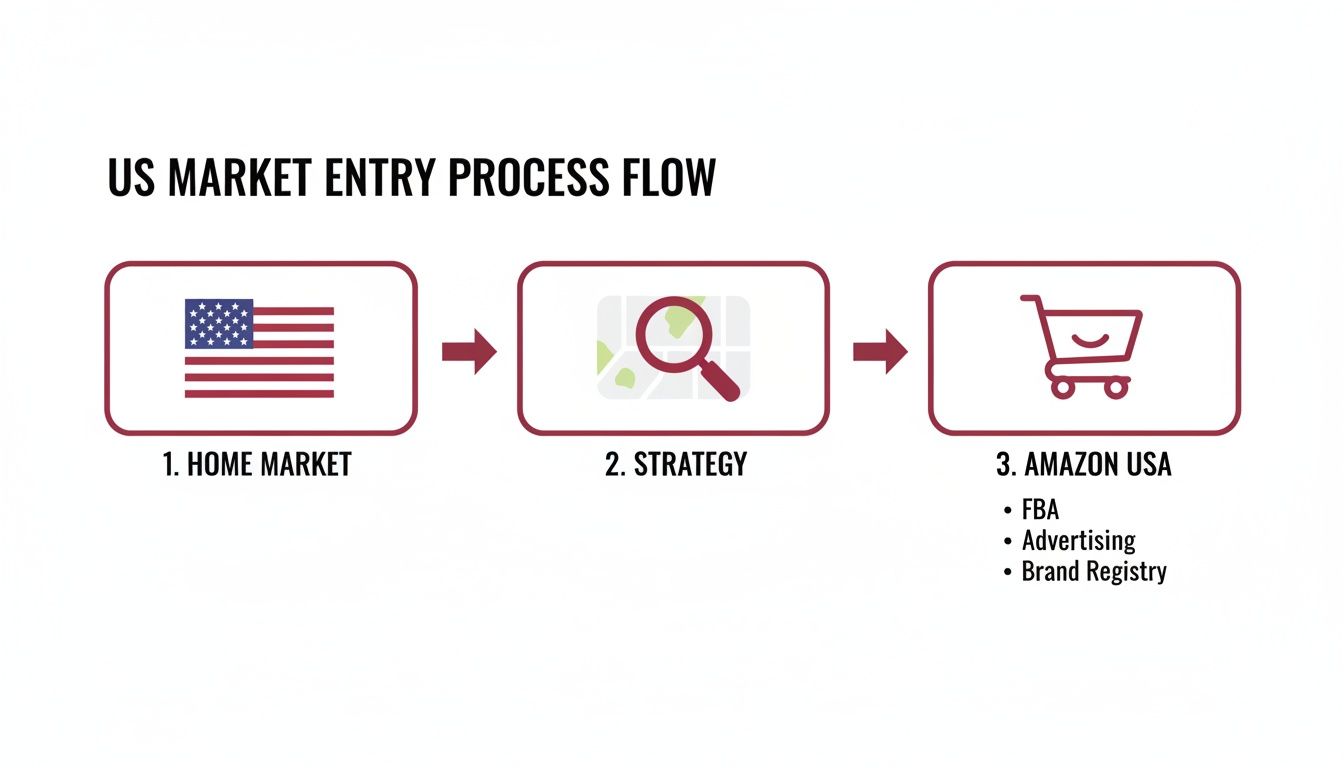
Trying to jump straight from your home market to the US without that dedicated strategy phase is a recipe for failure. It’s a step that simply cannot be skipped.
Understanding US Compliance Requirements
Before you even think about shipping your first unit, you must get your head around the dense web of US legal and compliance requirements. This is precisely where many international brands stumble.
Federal regulations from bodies like the FDA (Food and Drug Administration) and the CPSC (Consumer Product Safety Commission) are only the beginning. The real landmines are often buried in state-specific rules.
California’s Proposition 65, for instance, requires warnings for products containing certain chemicals. Failing to comply can lead to massive fines and legal action that can derail your launch before it even starts. We have personally seen brands forced to pull thousands of units from FBA warehouses just because their packaging was missing a tiny, state-mandated warning label.
For founders, compliance is not a box-ticking exercise; it is a foundational pillar of your US brand strategy. Overlooking it is like building a skyscraper on sand—the collapse is inevitable, and the fallout is costly.
Here are some of the most common compliance hurdles we see:
- Product Testing & Certification: This means ensuring your products meet standards like UL (Underwriters Laboratories) for electronics or specific safety tests for children’s products.
- Labelling & Packaging: You must adhere to the Fair Packaging and Labelling Act (FPLA), which governs how you display quantity, product identity, and business information.
- Customs & Import Documentation: Incorrectly classifying your goods or having incomplete paperwork can get your entire shipment stuck at port, racking up huge delays and storage fees. For brands just starting to plan, our detailed guide on how to sell on Amazon USA from Australia is a great place to begin.
Building a Profitable US Pricing Structure
Once your compliance is sorted, your focus has to shift to the numbers. A common and fatal mistake is simply converting your home market price to USD and subtracting Amazon’s fees. This is a formula for losing money.
A sustainable US pricing model must account for every single cost from the factory floor to the customer’s front door. This is your true “landed cost,” and it’s non-negotiable.
This calculation includes far more than just the product cost and Amazon’s referral fee. It must cover:
- International Freight and Insurance
- US Customs Duties and Tariffs
- Port and Drayage Fees
- FBA Inbound Placement and Fulfilment Fees
- Monthly and Long-Term Storage Fees
- Customer Return and Disposal Costs
- Advertising Spend (PPC)
Modelling these costs properly reveals your actual profit margin and dictates your final retail price. It stops you from falling into the classic trap of generating high sales volume while operating at a net loss. This isn’t just about setting a price; it’s about building the financial framework for long-term success on Amazon USA.
Building a Scalable US Fulfilment Strategy
A great product with a broken supply chain is just a missed opportunity. I’ve seen countless founders fixate on marketing and listing optimisation, only to discover their US fulfilment strategy can’t handle the pressure of the American market. It’s a classic mistake.
For any founder looking at Amazon USA, the operational backbone of your expansion will determine whether you scale successfully or get crushed by the sheer volume. Your choice of fulfilment model isn’t just a logistical box to tick; it’s a strategic decision that directly impacts your brand’s reputation, profitability, and customer experience.
Getting this right means fast delivery, happy customers, and healthy margins. Getting it wrong leads to stockouts, punishing storage fees, and a brand that feels unreliable to US shoppers.
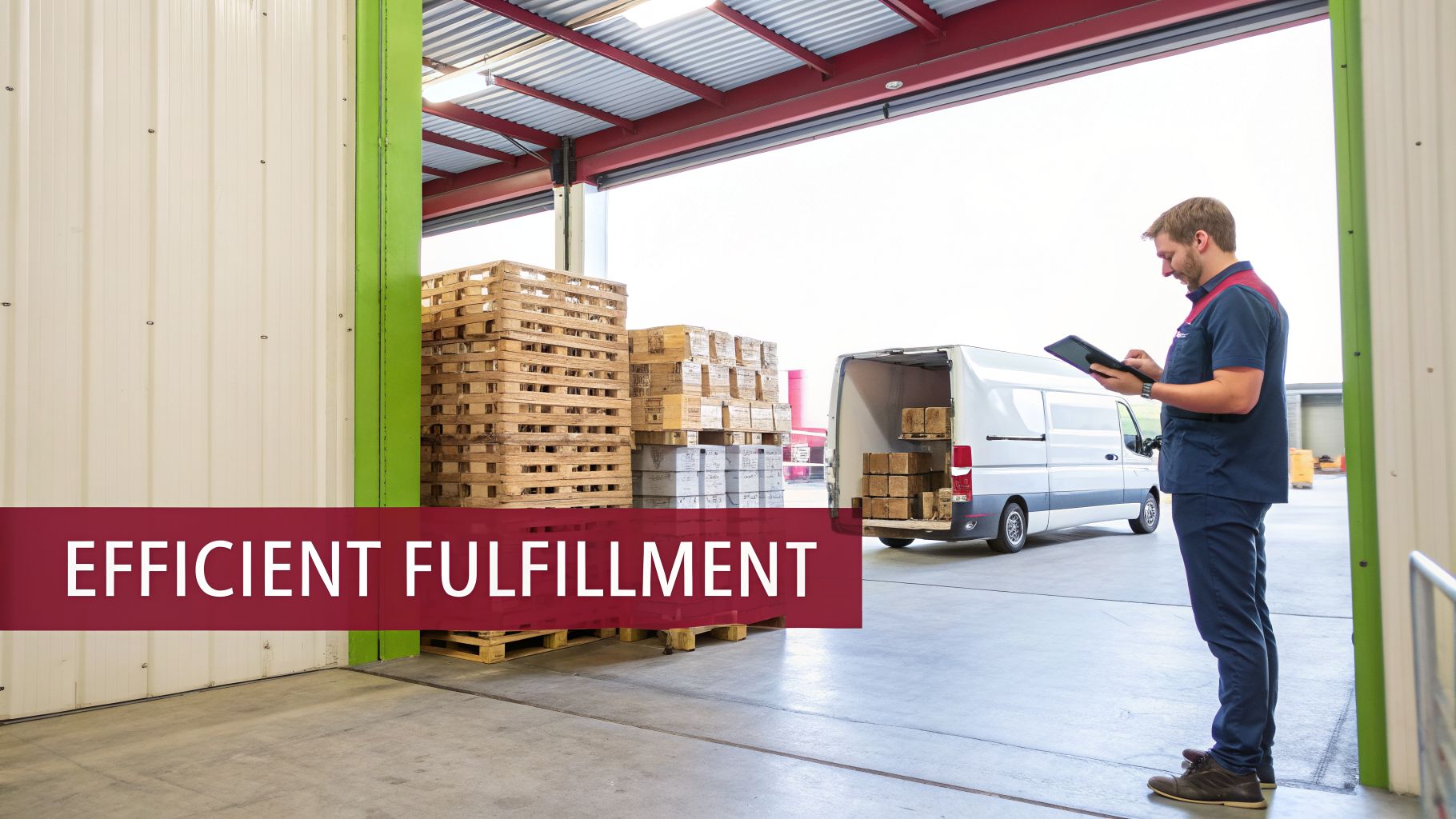
This operational readiness is where we see a clear divide between brands that methodically grow and those that stumble into inventory chaos.
Choosing Your Fulfilment Model
For international brands entering the US, you really have three primary paths for fulfilment: Fulfilment by Amazon (FBA), Fulfilment by Merchant (FBM), or using a third-party logistics (3PL) partner.
Each has distinct advantages and serious strategic challenges that you have to weigh against your brand’s specific needs, capital, and long-term goals.
-
Fulfilment by Amazon (FBA): This is the most common route for a reason. You ship your inventory to Amazon’s fulfilment centres, and they handle everything else—storage, picking, packing, shipping, and customer service. The non-negotiable advantage here is instant access to the Amazon Prime badge, a massive driver of consumer trust and conversions. You can get a deeper understanding of this model by exploring our comprehensive breakdown of Amazon FBA services.
-
Fulfilment by Merchant (FBM): With FBM, you’re on the hook for storing your inventory and shipping orders yourself. While it gives you more control over your packaging and inventory access, it’s incredibly intensive from an operational standpoint and makes it almost impossible to compete with the 2-day shipping promise of Prime.
-
Third-Party Logistics (3PL): This is a hybrid model where you outsource your US logistics to a specialised company. A 3PL can handle warehousing and order fulfilment for all your channels—Amazon, your own website, other marketplaces—not just one. This provides flexibility but adds another layer of cost and management complexity.
To make this decision clearer, here’s how these models stack up for brands new to the US market.
US Fulfillment Model Comparison for International Brands
| Fulfillment Model | Best For | Key Advantages | Strategic Challenges |
|---|---|---|---|
| Fulfillment by Amazon (FBA) | Brands prioritising rapid scaling and leveraging the Prime badge for maximum visibility and conversion. | • Automatic Prime eligibility • Access to Amazon’s world-class logistics network • Simplified customer service and returns | • Less control over inventory and branding • Strict packaging and prep requirements • Risk of high storage fees for slow-moving stock |
| Fulfillment by Merchant (FBM) | Brands with bulky/heavy items, smaller catalogues, or existing US logistics capabilities. | • Complete control over inventory and packaging • Potentially lower fulfilment fees on certain items • Direct management of customer service | • Ineligible for Prime without meeting strict SFP rules • Operationally intensive and hard to scale • Difficult to compete with FBA shipping speeds |
| Third-Party Logistics (3PL) | Multi-channel brands needing a unified inventory system for Amazon, retail, and direct-to-consumer sales. | • Centralised inventory for all sales channels • More branding control than FBA • Potential cost savings on storage and fulfilment | • Adds complexity and management overhead • Requires integration with Amazon Seller Central • Finding a reliable and cost-effective 3PL partner |
Ultimately, choosing the right model comes down to a trade-off between control, cost, and customer experience. For most international brands we work with, FBA offers the most direct path to growth, but it demands precise management. Many brands grow faster through strategic partnerships that provide this infrastructure from day one.
The scale of Amazon’s infrastructure is immense. With third-party sellers driving a record number of Amazon’s total sales, you don’t need your own US warehouse to enter the market. You can simply tap into Amazon’s network to scale deliberately. Considering Amazon delivers billions of items to Prime members from over 600 million listed products, the volume potential is undeniable. You can find more Amazon statistics on SalesDuo.com.
Mastering Amazon FBA Programs
If you go the FBA route, you must get your head around Amazon’s specific inventory programs. The Pan-US FBA flow, for instance, lets you place inventory strategically across the country to cut down on shipping times and costs. Amazon’s own algorithm decides the best placement for your stock across its network of over 100 fulfilment centres.
However, this powerful system has its own pitfalls. A common mistake I see brands make is underestimating storage fees, especially the long-term storage penalties for slow-moving stock. Another is facing stockouts during peak seasons like Q4 because of inaccurate forecasting or freight delays from overseas.
Brands that win on Amazon USA are obsessive about their inventory performance metrics. They maintain that delicate balance between having enough stock to meet demand and avoiding those crippling overstock fees. This analytical approach to distribution is what protects your brand’s momentum and profitability in the world’s biggest marketplace.
Localising Your Brand for US Consumers
Expanding to Amazon USA is about far more than just getting your products across the border. I’ve seen strong international brands with excellent products fall completely flat because their messaging just felt foreign, disconnected, or plain wrong to American shoppers.
This isn’t a simple marketing misstep. It’s a fundamental failure to build trust. You have to adapt your brand’s voice for the US market without losing its core identity, and it’s one of the hardest—and most critical—parts of a successful expansion. It’s the difference between being seen as a native, trustworthy brand and a visitor who just doesn’t get the culture. Global expansion requires market understanding.
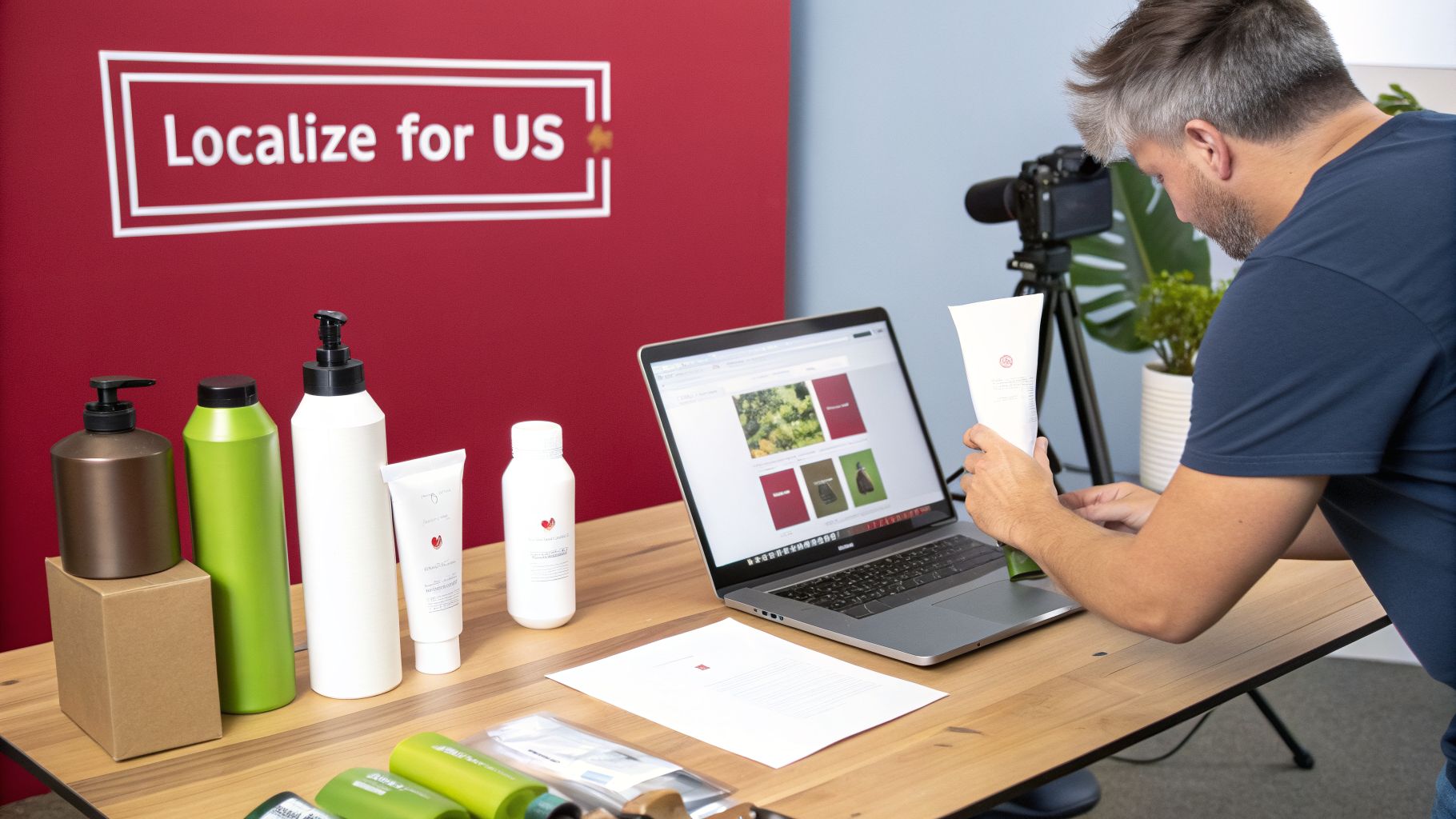
Beyond Language Translation to Cultural Nuance
The first mistake many founders make is assuming that because Australia, the UK, and the US all speak English, the language is the same. It’s not. The differences are subtle but incredibly powerful, affecting everything from word choice to the overall tone of your brand.
- Vocabulary: Words like “torch” (flashlight), “trolley” (shopping cart), or “rubbish” (trash) are instant signals to a US consumer that your brand isn’t local. These small tells can create a subconscious barrier.
- Tone and Formality: American marketing copy tends to be more direct, energetic, and focused on benefits. A witty or reserved British tone can sometimes come across as aloof or just unclear.
- Cultural References: Using idioms, humour, or cultural examples that don’t land with an American audience can make your content feel confusing at best, and irrelevant at worst.
For founders, localisation is not about erasing your brand’s origin story. It’s about learning to tell that story in a language your new audience instinctively understands and trusts. You want your brand to feel aspirational and international, not awkwardly foreign.
This process has to be applied consistently across every customer touchpoint—your product title, bullet points, A+ Content, Brand Store, and even your automated customer service emails. It’s the only way to build a cohesive, native-feeling brand presence on Amazon USA.
Adapting Visuals and Packaging for US Expectations
Your product’s visual identity is just as important as its written voice. High-quality, professional photography and videography are table stakes on Amazon USA, but true localisation goes much deeper than that.
The lifestyle imagery that works in your home market might not connect with American consumers. For example, a kitchen gadget shown in a small, European-style kitchen might feel less relatable than one featured in a larger, open-plan American kitchen. The models, settings, and overall aesthetic must align with your target customer’s aspirations.
Packaging is another critical area. It needs to do more than just meet US labelling regulations. It must also feel substantial and trustworthy. American consumers often associate heavier, more robust packaging with higher quality. A flimsy box or a confusing design can make an excellent product feel cheap before the customer even opens it.
Localising for Regional American Consumers
Finally, it’s a mistake to think of the “American consumer” as one single group. The US is a vast, diverse country with major regional differences in culture, lifestyle, and even vocabulary. Amazon is pouring billions into expanding its delivery network into rural areas, bringing faster shipping to millions of customers in small towns.
This means your audience on Amazon USA isn’t just in major cities like New York and Los Angeles. It includes customers in places like Abbeville, Louisiana, and Mansfield, Ohio. A brand selling outdoor gear might find its messaging needs to resonate differently with a hiker in Colorado than with a hunter in the rural Southeast.
Smart brands understand these regional nuances. They use geographic targeting in their Amazon Ads campaigns and tweak their messaging to reflect the specific values and pain points of different consumer segments across the country. This level of detail is what separates brands that achieve deep market penetration from those that just skim the surface.
Executing an Amazon USA Go-To-Market Strategy
Getting your products live on Amazon USA isn’t the finish line; it’s the starting pistol. I’ve seen countless founders execute a flawless technical launch, only to watch their products stagnate within months because they had no plan for what came next.
Sustaining growth demands a sophisticated, long-term go-to-market plan. This isn’t about just switching on ads. It’s about orchestrating a series of strategic moves to build initial momentum, generate social proof, and establish a sales velocity that Amazon’s algorithm will reward. Smart brands use Amazon’s powerful tools without ever losing control of their brand narrative. This is where the real work begins.
Architecting Your Launch for Maximum Impact
Your first 90 days on Amazon USA are absolutely critical. This period sets the tone for your brand’s entire trajectory on the marketplace. A slow start is incredibly difficult to recover from, as you miss out on the crucial “honeymoon period” where Amazon’s algorithm gives new products a slight visibility boost.
A winning launch strategy integrates several key components working in concert. You simply cannot rely on a single tactic.
- Amazon Ads: This is your primary engine for generating demand.
- Promotions: Strategically deployed deals and coupons create urgency and secure those vital first sales.
- Early Reviews: Generating credible social proof is non-negotiable. Without it, even the best product will struggle.
This integrated approach is what separates a professional launch from an amateur one. Each element feeds the others, creating a powerful flywheel effect that drives visibility, conversions, and eventually, organic ranking.
Deploying the Amazon Ads Arsenal
A common mistake I see brands make is simply throwing a budget at Sponsored Products and hoping for the best. A strategic approach requires using the full suite of Amazon’s advertising tools, with each playing a specific role.
Sponsored Products: These are the foundation of any launch. Focus on long-tail keywords that speak directly to your product’s unique value. This is about capturing “hand-raiser” customers who are actively searching for the solution you provide. It’s about precision, not just volume.
Sponsored Brands: Use these top-of-search placements to tell a bigger story. Link them to your carefully crafted Amazon Storefront to showcase your product range and reinforce your brand identity. This is how you move beyond a single transaction and start building a relationship with the customer.
Sponsored Display: This is your retargeting and audience-building tool. Use it to re-engage shoppers who viewed your product but didn’t buy, or to target audiences based on competitor products. This keeps your brand top-of-mind and pulls hesitant buyers back into your funnel.
For founders, the goal of advertising isn’t just to generate a sale; it’s to acquire a data point. Every click and conversion tells you what messaging resonates, which keywords are driving value, and who your real American customer is. This intelligence is gold.
Generating Early Momentum and Social Proof
No one wants to be the first person to buy a new product online. This is why securing early reviews is perhaps the most critical task in your entire launch sequence. The Amazon Vine program is your most powerful tool here.
Amazon Vine invites its most trusted reviewers to receive new products and post impartial opinions. Enrolling a product in Vine can quickly generate the first 5-30 high-quality reviews needed to build shopper confidence. It’s an investment, but the ROI in terms of conversion rate uplift is immense.
Alongside Vine, you should use promotions like coupons and limited-time deals to incentivise those initial purchases. A 15-20% off launch coupon can be highly effective at overcoming the friction of buying from a new, unknown brand. This combination of social proof from Vine and a compelling introductory offer is what creates the initial sales velocity you need to start climbing the search rankings.
Tapping into Amazon Business B2B Channels
Finally, a truly strategic go-to-market plan looks beyond the individual consumer. Amazon Business represents a massive—and often overlooked—revenue stream. This B2B marketplace allows you to sell directly to registered businesses, from small offices to large corporations.
By offering quantity discounts and creating business-specific pricing, you can open up a completely new sales channel. For brands in categories like office supplies, household goods, or consumer electronics, this can be a significant volume driver. It turns your product from a single retail item into a potential bulk procurement solution, creating stability and predictability in your sales forecasts.
Navigating these interconnected systems—advertising, reviews, and B2B sales—requires a level of insight that goes beyond basic seller tutorials. It’s about using the marketplace’s tools on your own terms to drive controlled, sustainable growth on Amazon USA.
Protecting Brand Value on Amazon USA
The moment your brand starts getting noticed on Amazon USA, it paints a target on your back. Success attracts a predictable swarm of hijackers, counterfeit sellers, and unauthorised distributors.
These bad actors will erode your pricing, dilute your brand’s reputation, and steal customers you’ve worked hard to win. I’ve seen founders spend years perfecting a great product, only to watch its market value get completely dismantled in a few short months.
Brand protection isn’t something you do after a problem appears. It’s a proactive strategy you need to build into your expansion plan from the very beginning. This defensive thinking is what separates brands that achieve long-term, profitable growth from those that get slowly picked apart by third-party chaos.
Building Your Fortress with Amazon Brand Registry
Your first and most important line of defence is enrolling in Amazon Brand Registry. For any serious brand, this is completely non-negotiable. Registration gives you access to a powerful set of tools designed to put you back in control of your intellectual property and product listings.
Think of Brand Registry as the foundation for your entire protection strategy. It officially verifies you as the brand owner, giving you the authority to manage your brand’s presence and fight back effectively.
Once you’re enrolled, you unlock several proactive protection programs. These aren’t just simple “report a violation” buttons; they are automated systems designed to find and stop infringement before it ever reaches your customers.
-
Project Zero: This program uses Amazon’s machine learning to automatically scan listings and remove suspected counterfeits. It also gives trusted brands the unprecedented power to remove counterfeit listings themselves, without waiting for Amazon to act.
-
Transparency: This is a product serialisation service. You apply a unique Transparency code to every single unit you manufacture. Amazon then scans these codes at the warehouse before shipping, which guarantees only authentic products can be delivered. It stops counterfeits in their tracks.
The Power of a Selective Distribution Strategy
While Amazon’s tools are powerful, they only solve half the problem. Real brand control comes from managing your own distribution channels with discipline. Often, the biggest threat to your brand’s value isn’t a counterfeiter, but a flood of unauthorised legitimate sellers.
When too many sellers are listing your product, it always triggers a race to the bottom on price. This constant downward pressure devalues your product in the consumer’s eyes and absolutely destroys your profit margins.
For founders, the goal is not to have your product on every possible digital shelf. The goal is to control the shelves your product appears on. Scarcity and controlled distribution are essential for maintaining brand premium and price integrity.
A selective distribution strategy simply means you have a clear, enforceable policy about who is allowed to sell your products on Amazon—and at what price. This brings us to a critical enforcement tool.
Implementing and Enforcing a MAP Policy
A Minimum Advertised Price (MAP) policy is a unilateral agreement that sets the lowest price an authorised reseller can advertise your product for. This isn’t about price-fixing; it’s about protecting your brand’s perceived value and preventing the price erosion I mentioned earlier.
Implementing a MAP policy involves three key steps:
- Draft a Clear Policy: Work with legal counsel to create a formal MAP policy document. It should clearly outline the rules, the products it covers, and the consequences for any violations.
- Communicate to All Distributors: Make sure every single wholesale account and distribution partner receives, understands, and acknowledges the policy. There can be no ambiguity.
- Enforce Consistently: This is the part that truly matters. You must monitor pricing—often using software—and enforce the policy without exception. If you penalise one violator but let another one slide, the entire policy becomes unenforceable.
Combining Amazon’s internal tools with your own strict, external policies creates a formidable defence. It ensures that as you scale on Amazon USA, you are the one who remains in control of your brand’s destiny—not a crowd of anonymous sellers in a chaotic marketplace.
Founder FAQs for Entering Amazon USA
What is the best way to enter Amazon USA?
Most brands succeed by entering Amazon USA through a phased expansion strategy focused on compliance, fulfilment, localisation, and controlled inventory scaling.
Is Amazon FBA necessary for Amazon USA?
Amazon FBA is not mandatory, but it significantly improves delivery speed, Prime eligibility, and conversion rates for most ecommerce brands.
Why do international brands fail on Amazon USA?
Many brands fail because they underestimate US competition, operational complexity, advertising costs, and fulfilment requirements
Expanding into Amazon USA creates enormous growth potential, but success rarely comes from simply transferring an existing business model into a larger market.
The brands that scale successfully in the United States treat expansion as a strategic operational process rather than a marketplace experiment. They invest in localisation, fulfilment systems, compliance infrastructure, pricing strategy, and controlled brand positioning long before growth accelerates.
Amazon USA rewards brands that can combine operational discipline with strong market positioning. Fast delivery, inventory stability, review generation, and pricing control all contribute directly to long-term profitability and marketplace visibility.
For founders, the objective is not simply launching products in the United States. The objective is building a scalable Amazon USA strategy capable of supporting sustainable growth in the world’s most competitive ecommerce market.
If you have an exceptional product and are exploring strategic partnerships to scale globally, we invite you to connect with us at https://tprbrandsau.com.