For ambitious founders, Amazon selling in Australia is far more than simply launching products on another marketplace. Many great brands struggle internationally not because demand is weak, but because the expansion strategy is flawed. Many great products struggle internationally, not because demand is weak, but because the expansion strategy is flawed. This guide isn’t about basic tutorials; it’s designed to frame your launch as a brand-scaling exercise, focusing on the compliance pillars that build long-term, defensible growth.
Why Amazon Australia Is More Than Just a Sales Channel
Many international brands see the “Add to Cart” button on Amazon Australia and think only of transactions. This is a critical error in judgment. For a founder with a great product, the platform isn’t just a sales channel; it’s a strategic entry point into one of the most lucrative and digitally mature consumer markets in the Asia-Pacific region.
The numbers alone tell a compelling story. Amazon Australia has skyrocketed to become the nation’s top online marketplace, recently overtaking eBay with a massive 75.2 million average monthly site visits—that’s 48% more than its rival.
This dominance is fuelled by explosive sales growth. Direct sales hit $1.29 billion in 2023, a huge jump from $883.3 million in 2022. At the same time, third-party seller revenue soared to $316.9 million from $181.7 million the previous year.
The Founder’s Dilemma: Rushed Entry vs. Strategic Placement
The temptation for founders is to rush in, drawn by these impressive figures. They push products live, hoping early sales velocity will solve all their other problems. In our experience, this almost always backfires.
Market entry without a robust compliance framework isn’t a strategy; it’s a gamble. It exposes your brand to significant risks that can kill momentum before it even starts:
- Account Suspension: A single compliance failure, from incorrect electrical certifications to improper product labelling, can lead to a sudden account deactivation that is often irreversible.
- Inventory Seizure: Australian customs can seize and destroy non-compliant goods, resulting in a total loss of your investment before a single unit is even sold.
- Legal Penalties: Breaching Australian Consumer Law can trigger substantial fines and reputational damage that echoes far beyond the Amazon marketplace.
- Brand Erosion: A poorly executed launch riddled with compliance issues signals to discerning Australian consumers that your brand isn’t serious, destroying trust from day one.
The core mistake is treating compliance as a bureaucratic hurdle to clear, rather than the very foundation of your brand’s authority and defensibility in a new market. Smart brands build their Australian presence on a bedrock of compliance, turning it from a defensive chore into a competitive advantage.
To help founders prepare properly, we’ve outlined the essential compliance areas that must be mastered before launching on Amazon Australia.
Core Compliance Pillars for Amazon Australia Entry
| Pillar | Strategic Importance | Key Focus Areas |
|---|---|---|
| Product Regulations | Ensures market access and prevents seizures. | Mandatory safety standards, material restrictions, specific industry rules (e.g., TGA for supplements). |
| Testing & Certification | Validates product safety and legal compliance. | Electrical safety (RCM mark), chemical testing, performance validation for specific categories. |
| Labelling & Packaging | Communicates compliance and brand information correctly. | Country of origin, ingredient lists, mandatory warnings, units of measurement, importer details. |
| Customs & Tax | Manages financial obligations and ensures smooth import. | GST registration, tariff classifications (HS codes), accurate import declarations, duties. |
| Amazon Policy | Maintains account health and listing visibility. | Category-specific requirements, restricted products, listing accuracy, brand gating. |
| Documentation | Provides proof of compliance to authorities and Amazon. | Test reports, compliance certificates, supplier declarations, technical files. |
Mastering these pillars is non-negotiable for building a lasting, profitable brand on the platform.
This guide provides a founder-focused roadmap, moving beyond the generic “how-to” advice that clutters the internet. We are focused on the strategic imperatives for building a real brand on Amazon Australia—starting with these non-negotiable pillars of compliance.
If you need a foundational overview of the platform itself, you can check out our guide on how to sell on Amazon Australia. From there, this deep dive will give you the strategic insight needed for sustainable success.
Navigating Australian Product Regulations and Standards
Execution is everything when you’re entering a new market, and nowhere is that more true than with compliance. We’ve seen great products fail instantly because they didn’t meet Australia’s specific safety standards, which are often worlds apart from what’s required in the US or Europe. For founders in hardware, consumer goods, or electronics, this isn’t just red tape—it’s a critical path you cannot afford to get wrong.
Imagine launching a new cordless power tool without the required Regulatory Compliance Mark (RCM). This isn’t a small oversight; it’s a non-starter. The RCM is the official signal that your product meets all of Australia’s electrical safety and electromagnetic compatibility (EMC) rules. Without it, your product is illegal to sell and will be pulled down immediately.
Or think about a household cleaning product. Here in Australia, the Australian Competition and Consumer Commission (ACCC) has strict rules on ingredient labelling and safety warnings. If you launch with your US or European packaging, you’re almost certainly in violation. The best-case scenario is a costly relabelling project; the worst is a full product recall.
Figuring Out Which Standards Apply to Your Product
Your first job is to pinpoint the exact regulations that govern your product category. This isn’t a quick Google search. It demands a systematic approach, because Australian regulations are managed by several different bodies. The right one for you depends entirely on what you sell.
Here are the key regulatory bodies you need to know:
- ACCC (Australian Competition and Consumer Commission): Sets mandatory safety and information standards for a huge range of consumer goods.
- ACMA (Australian Communications and Media Authority): Manages regulations for electrical and electronic products, including the RCM scheme.
- TGA (Therapeutic Goods Administration): Governs any product making health claims. This includes supplements, certain skincare products, and medical devices.
A classic mistake is to assume your product fits neatly into one general category. For example, a “smart” kitchen appliance isn’t just a kitchen good. It’s also an electronic device, which means it falls under ACMA rules as well.
This visual simplifies the journey for brands entering the Australian market and shows exactly where compliance fits into the bigger picture.
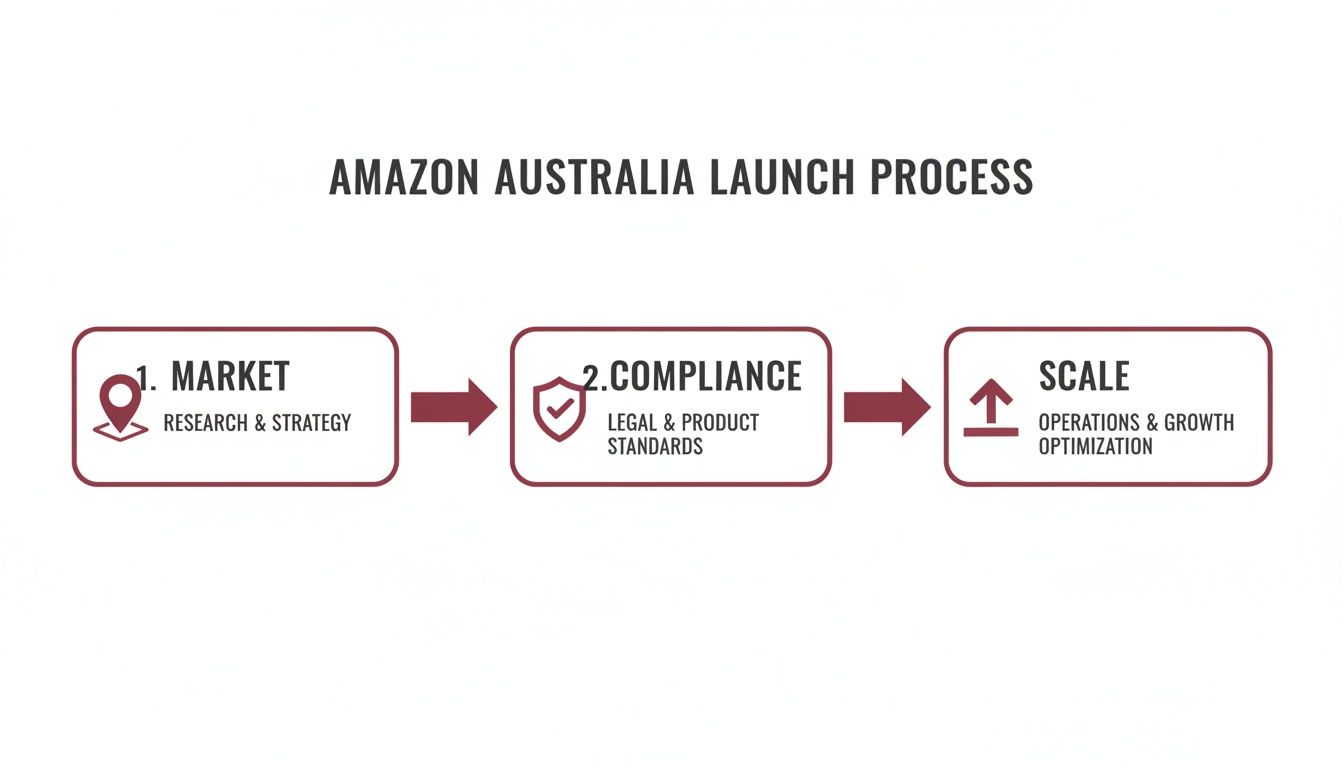
This flow highlights that compliance isn’t just a box-ticking exercise. It’s the central pillar that supports any real effort to scale your brand on Amazon Australia.
The Certification Process and What Happens If You Fail
Once you know which standards apply, the next phase is getting the right certifications. This usually involves sending your product to a NATA-accredited testing lab in Australia to get its safety and performance claims validated. The process typically requires submitting technical files, product samples, and detailed information about your supplier.
For founders, the key insight here is that compliance is not a one-time event. It’s an operational discipline. Trying to manage this from overseas without local expertise is a huge drain on your resources and a massive business risk.
The consequences of non-compliance are severe and can stop a brand’s expansion in its tracks:
- Immediate Amazon De-listing: Amazon’s compliance bots and review teams are always watching. A request for a missing certificate can get your ASIN suppressed without any warning.
- Inventory Stranding or Destruction: If your products are in an FBA warehouse and found to be non-compliant, Amazon may refuse to return them. That’s a total loss.
- Legal and Financial Penalties: The ACCC has the power to issue massive fines and public recall notices, causing irreversible damage to your brand that goes far beyond Amazon.
For any brand founder, the cost of getting this wrong is far greater than the investment in getting it right from day one. Successful Amazon selling is built on a foundation of solid compliance. Smart brands don’t just comply; they turn their certified status into a competitive advantage and a mark of quality that builds consumer trust.
Mastering Australian Labelling, Customs, and Tax
A fantastic product can fail long before it ever reaches an Australian customer if its packaging and import documents aren’t right. Brands that are hugely successful in their home markets often stumble badly at this stage of their expansion. This is the operator’s guide to Australian labelling laws, customs obligations, and Goods and Services Tax (GST) for serious brands planning to sell on Amazon Australia.
This section moves beyond generic advice to cover the specific requirements enforced by the ACCC, like country-of-origin labelling, mandatory warning statements, and unit pricing. This isn’t beginner-level content; it’s a look into the operational details a strategic partner handles to ensure a smooth market entry.
Unpacking Australian Labelling Requirements
In Australia, your product’s packaging isn’t just a marketing tool—it’s a legal document. Failing to comply with the ACCC’s strict labelling rules is one of the fastest ways to get your inventory flagged and your listings suppressed.
Founders often make the mistake of assuming their existing packaging will be fine. This is a costly error. Key Australian requirements include:
- Country of Origin Labelling (CoOL): For many products, especially food, you must clearly state where it was made, produced, grown, or packed. The rules around using logos like the kangaroo symbol are incredibly specific.
- Mandatory Warning Statements: Certain products, from kids’ toys and cosmetics to anything with button batteries, need specific warning labels. These are non-negotiable and have prescribed wording and formatting.
- Unit Pricing: For many consumer goods sold by weight, volume, or measure, you have to display the price per unit (e.g., per 100g or per litre). This helps shoppers compare value and is a common oversight for international sellers.
- Importer Details: Your packaging must show the name and Australian business address of the importer. This creates local accountability, which is essential for regulators and for Amazon.
Smart brands don’t treat packaging as an afterthought. They build Australian compliance into their design and production cycle from day one. This prevents expensive and time-consuming relabelling projects after the stock has already landed.
Demystifying the Import Process
Getting your products into Australia is about more than just booking a freight forwarder. The Australian Border Force (ABF) runs a tight ship, and any mistake in your documentation can lead to major delays, fines, or even having your goods seized.
For brands outside Australia, the process can feel completely opaque. Here’s a breakdown of the critical elements you or your partner must get perfect.
Harmonized System (HS) Codes
Every single product you import needs to be classified with a specific Harmonized System (HS) code. This code is what determines the rate of duty and tax you’ll pay. Misclassifying your goods, even by accident, can lead to back-payments and penalties. A “smart watch” and a “fitness tracker,” for instance, might have different HS codes and duty rates. Getting it wrong is a common and expensive mistake.
Calculating Duties and Handling GST
Once your goods are classified correctly, you can calculate the customs duty. Most imported goods have a 5% duty rate in Australia, but this can definitely vary.
On top of that, you’ll be liable for a 10% Goods and Services Tax (GST) on the total value of the goods, plus the cost of shipping and insurance. For any business with an Australian annual turnover of $75,000 or more, GST registration is mandatory. This means you must collect GST on your sales and file regular returns with the Australian Taxation Office (ATO).
Managing all this from overseas is a huge operational headache. It’s a perfect example of why so many brands grow faster by working with a local partner who already has these systems and registrations sorted. This approach, which we cover in our guide on how to sell on Amazon Australia from overseas, removes the administrative friction and lets founders focus on growing their brand instead of getting buried in tax compliance.
Building a Compliant and Defensible Amazon Listing
Your Amazon listing is far more than a digital sales page. It’s a legal and commercial asset that represents your brand in a hyper-competitive marketplace. All the meticulous off-platform compliance work can come undone right here, on the listing itself. A fantastic product can be instantly undermined by a listing that makes unsubstantiated claims or omits critical compliance details.

This is where you translate your product’s certifications and legal documents into a defensible Amazon Seller Central presence. It’s about building a listing that not only sells but also withstands scrutiny from both Amazon’s internal teams and Australian regulators.
From Documentation to a Defensible Listing
The first move is getting all your compliance paperwork uploaded correctly in Seller Central. This includes your test reports, safety certificates like the RCM, and any TGA approvals. Failing to have these documents on file before you list is a rookie mistake that puts your account at immediate risk.
Amazon’s automated systems and manual reviewers frequently request this documentation. If you can’t produce it within their tight deadlines, your listing will be suppressed, or worse, your account suspended. This isn’t a theoretical risk; it’s an operational reality of Amazon selling in a regulated market.
A compliant listing acts as a shield. When a competitor makes a false complaint or Amazon conducts a random audit, having your documentation in order allows you to resolve the issue quickly and professionally, minimising business disruption.
Crafting Claims That Build Trust Without Breaking Rules
One of the biggest pitfalls for ambitious brands is making claims they can’t back up. In your home market, you might get away with phrases like “100% waterproof” or “medically proven,” but in Australia, those claims demand hard evidence that satisfies the ACCC.
Your listing copy—from the title and bullet points to the A+ Content—must be meticulously vetted.
- Avoid Absolute Claims: Words like “guaranteed,” “unbreakable,” or “completely safe” are red flags unless you have accredited test data to prove them.
- Align with Certifications: If your product is certified for a specific standard, like water resistance to IP67, state that precisely. Don’t exaggerate it to “fully waterproof.”
- Scrutinise Imagery and Video: Your visuals are also part of your claim. Showing a product being used in a way that implies a capability it doesn’t have can be deemed misleading by the ACCC.
Successful brands use their compliance as a marketing tool. Highlighting that your electronic product is RCM-certified or your cosmetic is TGA-compliant builds immense consumer trust. It signals quality and safety, differentiating you from sellers who cut corners. Founders interested in a deeper dive into Amazon’s ecosystem can find more context on the opportunities for established Amazon sellers.
The Strategic Value of a Compliant Listing
A robust, compliant listing is also crucial for capitalising on peak sales periods. Take Amazon Prime Day, for example. In what was a record-breaking event for Australian sellers, we saw a 128% surge in first-time Amazon customers and a 55% leap in conversion rates for participating brands.
Brands that were unprepared with non-compliant listings missed out entirely on this massive influx of traffic. Their products were either suppressed or flagged for review at the worst possible time.
Ultimately, your Amazon listing is the frontline of your brand’s presence in Australia. Building it on a foundation of verified compliance isn’t just about avoiding trouble; it’s a strategic act of brand building. It proves to customers, competitors, and the marketplace that you are a serious, professional operator.
Maintaining Compliance for Long-Term Growth
Getting your product successfully launched on Amazon Australia is a huge milestone, but it’s the starting line, not the finish. We have seen countless brands enjoy impressive early sales only to have their momentum completely wiped out weeks or months later by a compliance issue they thought was already sorted.
Market entry is just the beginning. Sustained success requires ongoing operational discipline.
Compliance isn’t a static, one-time task you can just tick off a list. It’s a living, breathing process. Regulations change, Amazon updates its policies, and new standards are introduced. For founders who are focused on product development and growth, this can feel like an impossible treadmill to stay on.
The Proactive Framework for Sustainable Growth
Reactive compliance is a recipe for disaster on Amazon. Waiting for an email from Seller Performance or a notice from the ACCC before you act is how brands get their listings suppressed and, in the worst cases, their accounts suspended.
Smart brands operate differently. They build a proactive framework to manage compliance as a core business function, not an afterthought.
This means actively monitoring for regulatory updates. It’s not enough to know the rules today; you have to anticipate the rules of tomorrow. Following updates from key bodies like the ACCC or the Therapeutic Goods Administration (TGA) is essential.
When new safety standards for button batteries were introduced in Australia, for example, proactive brands were already redesigning packaging and updating warnings months ahead of the deadline. Reactive brands were left scrambling, leading to lost sales and stranded inventory.
For founders, the strategic lesson is this: compliance must be integrated directly into your supply chain and operational planning. It’s not a separate department or a problem for your legal team; it’s a fundamental part of how you source, manufacture, package, and sell your products.
Conducting Periodic Audits and Managing Documentation
Another critical part of staying compliant is running periodic internal audits. This doesn’t have to be a massive, formal undertaking. It can be as simple as a quarterly review of your top-selling ASINs to ensure all documentation is current and easily accessible.
Amazon is notorious for requesting compliance documents with very tight deadlines—sometimes as little as 24-48 hours. When that email lands asking for a specific test report or certification for a product you’ve been selling for a year, you need to be able to produce it immediately.
We’ve watched brands lose their best-selling products because their documentation was a mess. Keeping a secure, organised digital repository of all compliance documents—test reports, certifications, supplier declarations—is a simple but powerful way to protect your business.
Ongoing Compliance Operational Checklist
This practical checklist can help brands turn compliance from a reactive scramble into a predictable, manageable operation. It provides a framework for protecting your Amazon business for the long term.
| Activity | Frequency | Ownership | Strategic Purpose |
|---|---|---|---|
| Regulatory Monitoring | Monthly | Operations/Compliance Lead | To anticipate changes from bodies like the ACCC and TGA before they impact sales. |
| Compliance Documentation Audit | Quarterly | Operations Lead | To ensure all test reports and certifications are current and instantly accessible for Amazon reviews. |
| Listing Claims Review | Bi-Annually | Marketing/Brand Manager | To verify that all product claims in titles, bullets, and A+ Content are still accurate and defensible. |
| Supplier Compliance Check | Annually | Supply Chain/Sourcing | To confirm that your manufacturing partners continue to meet Australian standards and quality controls. |
| Packaging & Labelling Review | Annually or per batch | Operations/Design | To ensure all packaging meets current labelling laws, including importer details and mandatory warnings. |
Many founders find that managing this ongoing operational burden detracts from their core focus of building a great brand and product. This is why many successful brands choose to grow through strategic partnerships.
They realise that scaling faster often means working with an expert who already has a robust compliance framework and on-the-ground expertise in place. At TPR Brands, we work with founders navigating these exact challenges as they expand into international markets and build sustainable, scalable businesses.
Key Questions Founders Ask About Amazon Australia
When founders consider expanding to Australia, the same few strategic questions always come up. These aren’t just about operations; they’re about the core challenges of entering a new market and building a profitable channel. Here are the answers to the concerns we see most often from brands evaluating the opportunity down under.
Is FBA the Only Way to Sell in Australia?
While Fulfilment by Amazon (FBA) is a fantastic tool for getting Prime eligibility and tapping into Amazon’s logistics, it’s a mistake to think it’s the only path. We’ve seen established brands, especially those with bulky, heavy, or high-value products, find much better margins and control over the customer experience with a Fulfilled by Merchant (FBM) or hybrid model.
The right choice comes down to your product’s dimensions, how fast it sells, and what operations you already have. A strategic partner can help analyse these factors to map out the most profitable fulfilment strategy, which might even mean using a specialised third-party logistics (3PL) provider. The goal isn’t just to sell—it’s to build a profitable and sustainable business.
How Much Does Australian Compliance Really Cost?
Compliance costs are a non-negotiable investment, and they vary enormously. A simple consumer good might just need accurate labelling, which is a fairly low design and print cost.
But a complex electronic device could require extensive testing from NATA-accredited labs, potentially costing several thousand dollars per product. These are costs you absolutely must factor into your market-entry budget from day one.
Brands that fail to budget for this almost always end up cutting corners. This leads to delistings, fines, or recalls that are exponentially more expensive than getting it right the first time. Smart founders treat this as part of the landed cost of goods for the Australian market.
Can I Just Use My US or EU Compliance Documents?
No, you generally can’t. While international standards like CE marking (Europe) or FCC (US) are seen as signs of quality, they are not a substitute for Australian-specific compliance. Australia has its own unique regulatory framework.
The most common example is the Regulatory Compliance Mark (RCM) for electrical safety. Simply handing over a CE or UL certificate isn’t good enough and will get rejected by Amazon during a compliance check. Your products must be formally tested and certified against Australian standards to be sold legally. A partner with on-the-ground expertise is critical for translating your existing documents into what’s actually required locally.
What’s the Biggest Mistake Brands Make When Launching in Australia?
The single biggest mistake is confusing a quick burst of early sales with a viable, long-term brand strategy. So many brands get an initial revenue lift from market enthusiasm but completely fail to build a defensible position for sustainable growth.
They often neglect to:
- Register their trademarks in Australia, leaving them wide open to hijackers.
- Secure their supply chain for ongoing compliance, not just the first batch.
- Invest in a brand story that actually connects with Australian consumers.
This short-sighted thinking leaves them exposed to brutal price wars, sudden regulatory crackdowns, and copycat competitors. Success isn’t measured by your first 100 sales; it’s defined by building a brand that can scale to 100,000 sales and beyond. This requires a strategic, defensible foundation from the start.
Frequently Asked Questions About Amazon Selling in Australia
Do I need GST registration to sell on Amazon Australia?
Can overseas brands use Amazon FBA Australia?
What certifications are required for electronics in Australia?
Is Amazon Australia profitable for international brands?
Final Thoughts on Amazon Selling in Australia
Successful Amazon selling in Australia is not built on shortcuts, rushed listings, or temporary sales spikes. Long-term growth comes from building a compliant, defensible brand that can scale sustainably in a competitive international market.
For founders expanding into Australia, compliance is not simply a legal requirement. It is part of brand positioning, operational resilience, and customer trust. Brands that invest early in certifications, packaging, tax structure, and listing quality place themselves in a far stronger position to scale profitably over time.
Learn more about how we help great products become defensible global brands at https://tprbrandsau.com.