Amazon Australia FBA is more than a logistics solution. For founders expanding internationally, it is a strategic growth channel that can accelerate brand expansion when executed correctly.
For founders who have built traction in the US, UK, or Europe, Australia looks like an easy add-on. But treating it as a copy-paste marketplace is the fastest way to burn capital and stall momentum.
Australia isn’t just another line on an expansion spreadsheet; it’s a distinct strategic arena where the rules of engagement are different.
Why Australia Is Not Just Another Amazon Marketplace
Amazon Australia is still in its growth phase, which is precisely why timing matters. Compared to the US marketplace, competition density is lower, but buyer expectations are rising rapidly. Founders entering now are not late, they are early to a market that is consolidating around strong brands.
Marketplace success requires strategic positioning, and global expansion demands deep market understanding. Founders who treat Australia as an afterthought—a quick add-on to their existing Amazon operations—are the ones who inevitably face stalled growth, shrinking margins, and brand dilution.
The ‘launch everywhere’ mindset is a trap for ambitious founders. It spreads resources thin and ignores the market nuances that determine success or failure. What connects with a shopper in Ohio or London will not necessarily resonate with a customer in Sydney or Melbourne. Brands that win internationally invest the time to understand the local market dynamics before committing a single unit of inventory.
Understanding the Australian Consumer Psyche
Australian shoppers are discerning and hold high expectations, but what drives their purchasing decisions differs significantly from more mature Amazon marketplaces. While the promise of fast, free Prime delivery is a universal draw, other factors carry immense weight in Australia.
-
Value Perception: Australians are accustomed to higher prices in traditional retail, but this does not translate to a willingness to overpay online. They are adept at comparing international prices and factoring in shipping. Your pricing strategy must be sharp, justifiable, and transparent.
-
Brand Trust: In a market that is not yet saturated, brand reputation is paramount. Australian consumers gravitate towards brands that feel local or demonstrate a clear understanding of the Australian lifestyle. Generic, American-centric messaging often feels disconnected and can instantly erode trust.
-
Competitive Landscape: While Amazon.com.au is growing at an accelerated pace, it is still maturing. This presents a critical window of opportunity. Brands that establish a strong foothold now can build a dominant category position before the market becomes as hyper-competitive as the US or UK.
The core mistake founders make is viewing Amazon Australia as a sales channel rather than a market. A channel is a tactic; a market is a complex ecosystem of competitors, consumers, and culture. Success requires a strategy for the ecosystem, not just the channel.
The Strategic Imperative for a Unique Approach
Entering the Australian market with a generic, one-size-fits-all strategy is not just inefficient—it’s financially perilous. The logistics are more complex, and the costs can evaporate profits if not managed with absolute precision. Shipping products across an ocean only to have them sit unsold in a fulfilment centre is a cash-flow nightmare that has ended many expansion attempts.
Key Challenges of Expanding into Amazon Australia FBA
– Localising brand messaging
– Managing GST and landed costs
– Handling international logistics
– Maintaining inventory velocity
– Building Australian customer trust
– Scaling profitably with FBA
This is why a deliberate, market-specific plan is not a luxury; it’s a necessity for any founder serious about global growth. It involves more than just setting up an account and leveraging Amazon Australia FBA. It means conducting a deep analysis of the competitive environment, adapting your brand voice, and building a financial model that accounts for all the unique costs of operating down under. For a deeper analysis on this topic, you can learn more about why great products often struggle when expanding to Amazon Australia in our detailed article.
Australia offers immense potential for brands that approach it with strategic foresight. It’s a chance to build a real, profitable presence in a thriving economy, but only for those who do the work to understand what makes it different. The founders who win are the ones who stop thinking about “another Amazon marketplace” and start thinking about how to build a brand for Australia.
Positioning Your Product for the Australian Shopper
A great product does not automatically become a great brand. I’ve seen countless international brands with superior products fail on Amazon Australia, not due to quality, but because their positioning and messaging failed to connect with the local culture.
Assuming a brand’s existing value proposition will translate globally is a mistake that costs founders dearly. Success with Amazon Australia FBA requires a much deeper, more deliberate approach to positioning your product as the clear and obvious choice for an Australian shopper.
Do Your Homework: A Practical Competitor Deep Dive
Your first move should be to become a student of the Amazon.com.au marketplace. This isn’t a quick glance at star ratings and prices. It’s a forensic analysis of your competitors’ listings through the eyes of an Australian customer.
- Read the Negative Reviews: What are the recurring complaints about incumbent products? Are there consistent themes around quality, sizing, or features that fail in the local climate? These are the precise gaps your product and messaging can fill.
- Analyse the Customer Questions: The Q&A section on a listing is a goldmine of consumer anxiety and missing information. It tells you exactly what your competitors are failing to communicate.
- Deconstruct Their Messaging: How do top sellers communicate? Is their tone formal or casual? Do they reference the Australian lifestyle? A US brand selling outdoor gear might talk about “tailgating,” a concept foreign to Australia. The local equivalent is a “weekend barbie” or a “camping trip.”
This research allows you to shift from merely listing product features to solving uniquely Australian problems, informing everything from your A+ Content to your core brand narrative.
Establish Brand Authority Before You Launch
Before you can win a single customer, you must establish control over your brand within Amazon’s ecosystem. For any serious brand founder, this is a non-negotiable foundation for international expansion.
Many brands treat compliance as a box-ticking exercise. In a new market, however, it’s a strategic weapon. Securing your brand identity early prevents countless future headaches and signals to both Amazon and consumers that you are a legitimate, professional operation.
Two steps are absolutely critical from the start:
- Amazon Brand Registry: This should be your first priority. Enrolling in Brand Registry provides powerful tools to manage your listings, access premium advertising formats like Sponsored Brands, and protect your intellectual property from hijackers. It is your brand’s shield in the marketplace.
- GS1 Australia Barcodes: While you may have barcodes from your home market, using official GS1 Australia barcodes for products sold in Australia is a non-negotiable best practice. It ensures seamless integration with all local retail and logistics systems, preventing the inventory conflicts and listing errors that plague brands using unverified codes.
These are not administrative tasks; they are strategic moves to build a defensible position for your brand in a new market.
Pre-Launch Checklist for Amazon Australia
For established brands, launching on Amazon Australia requires methodical preparation. The table below outlines the key strategic actions we ensure are completed for our partners before a single unit goes live.
| Strategic Action | Why It Matters for Brand Founders | Associated Cost and Effort |
|---|---|---|
| Secure Amazon Brand Registry | Provides ownership over your product detail pages, unlocks A+ Content and Brand Stores, and offers critical protection against listing hijackers. It’s the foundation of brand control. | Low cost (requires a registered trademark), moderate effort to complete the application process. |
| Obtain GS1 Australia Barcodes | Ensures unique, globally recognised product identification that prevents listing conflicts and is required by major retailers, including Amazon. It future-proofs your distribution strategy. | Moderate annual subscription cost, low effort to assign barcodes to products. |
| Conduct Competitor Messaging Analysis | Identifies gaps in the market and reveals the language and value propositions that resonate with Australian shoppers, allowing you to tailor your message for maximum impact. | Low cost (time investment), moderate analytical effort. |
| Adapt Packaging & Inserts | Ensures compliance with local regulations (e.g., measurement units, safety warnings) and provides an opportunity to localise marketing messages for a better customer experience. | Varies from low (minor digital edits) to high (complete redesign and production run). |
By systematically addressing these foundations, you move from simply putting a product online to strategically launching a brand. This is the work that separates brands that see a few fleeting sales from those that build a lasting, profitable presence in the Australian market.
Getting Your Logistics and FBA Economics Right
You can have a brilliant product and perfect positioning, but if the numbers don’t work, the entire expansion will fail. This is the point where so many international brands see their Australian dream collide with a harsh operational reality. Getting the economics of Amazon Australia FBA right isn’t just about Amazon’s fees; it’s about mastering your entire supply chain, from your factory floor right to the customer’s doorstep.
Founders consistently get caught out by margin erosion. They model their profits based on familiar US or UK fee structures, completely forgetting the unique costs of the Australian market. This is a critical mistake. Your final landed cost in Australia is a completely different calculation, and getting it wrong means you could be losing money on every single sale without even realising it.
Before you even think about shipping, you need to have your brand positioning locked down. These foundational steps directly impact your long-term financial viability.
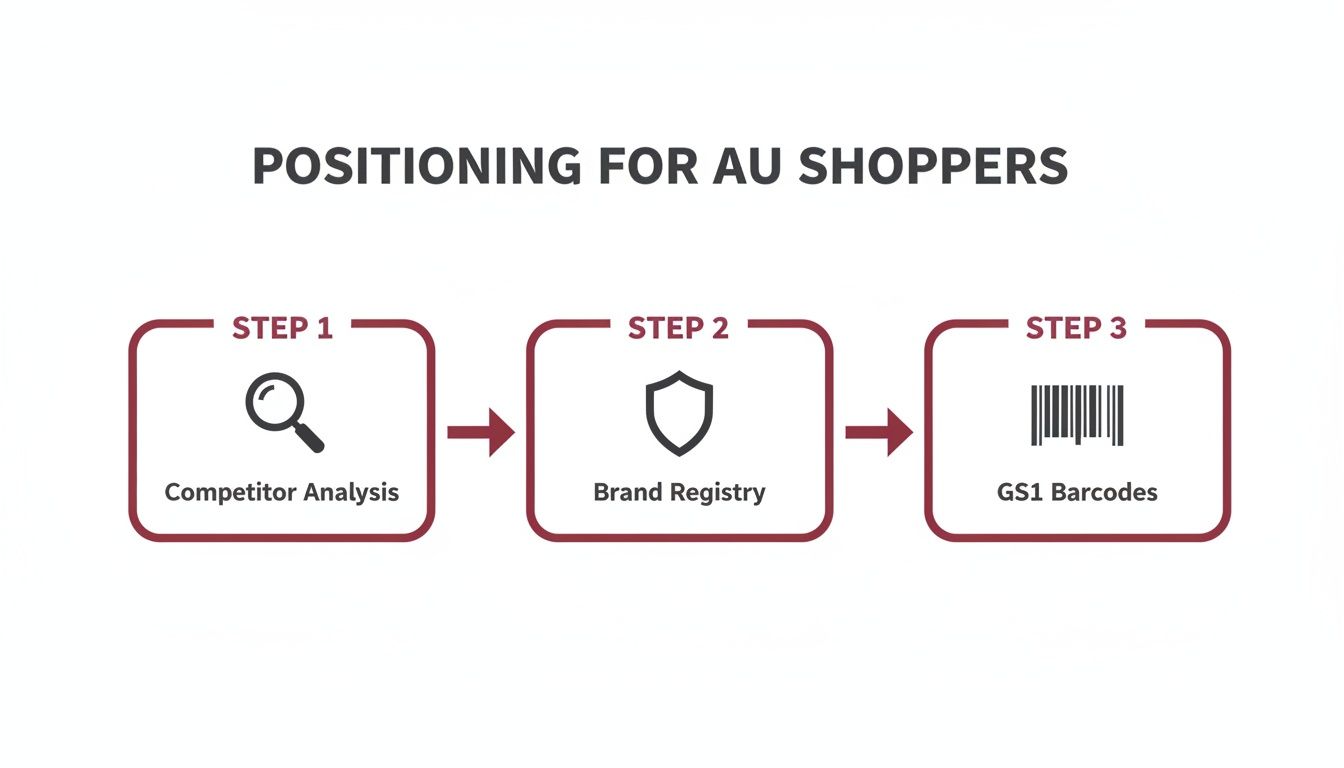
Without this groundwork, you have no real way to protect your margins or build a sustainable business on the marketplace.
Modelling Your True Landed Cost
Your true landed cost is the sum of every single expense needed to get your product into an Australian Amazon fulfilment centre, ready to sell. If you overlook even one of these components, a seemingly profitable product can quickly turn into a loss-maker.
Your cost model absolutely must include:
- International Freight: The cost to ship your goods from their origin country to an Australian port. This will vary massively depending on whether you choose air or sea freight.
- Import Duties: Even with free trade agreements, duties can still apply. It’s typically between 0-5%, but you have to verify this for your specific product classification.
- Goods and Services Tax (GST): This is a non-negotiable 10% tax on the total value of your imported goods, which includes the cost of the goods, insurance, and shipping. You must factor this in and understand how to claim GST credits if you’re registered.
- Customs & Port Charges: These are the fees you’ll pay to customs brokers and port authorities to process your shipment when it arrives.
- Local Freight: The final leg of the journey—the cost to get your inventory from the port to Amazon’s designated FBA warehouse.
Failing to account for these costs properly is the single biggest financial mistake brands make. It’s a silent killer of profitability.
Inbound Logistics: The Founder’s Dilemma
Once your cost model is solid, you’re faced with a major strategic choice: how do you physically get your inventory into Amazon Australia? This decision has huge implications for your cash flow, operational complexity, and speed to market.
Option 1: Shipping Direct to Amazon FBA
At first glance, shipping directly from your factory to an Amazon warehouse seems like the simplest path. It minimises handling and can be quicker if everything goes perfectly.
But in my experience, this is the highest-risk approach. Any small issue—a problem with customs, an incorrectly placed label, or non-compliant packaging—can lead to Amazon rejecting your entire shipment. Your stock is then stranded in Australia with no local address for it to be returned to, creating a logistical and financial nightmare that’s almost impossible to solve from overseas.
Option 2: Using a Local 3PL Partner
A much safer, more resilient strategy is to first ship your inventory to a local third-party logistics (3PL) partner here in Australia. The 3PL receives your bulk shipment, inspects it, deals with any customs headaches, and then prepares and drip-feeds smaller, compliant shipments into Amazon FBA as you need them.
This approach creates an essential operational buffer. It de-risks the entire inbound process and gives you on-the-ground flexibility to manage your stock without having to commit all your capital to Amazon at once.
While it does add a 3PL fee to your cost structure, it dramatically reduces the risk of a catastrophic shipment rejection and gives you far more control over your inventory and cash flow. For founders who are serious about long-term success, this strategic buffer is invaluable. The key is to understand how to sell on Amazon Australia from overseas, which involves much more than just shipping.
This market is expanding quickly, which makes getting your logistical and financial foundations right more important than ever. By 2026, Amazon Australia’s share of the country’s total internet sales is projected to hit around 10%, a massive jump from where it was in 2021. This growth, which is outpacing competitors like eBay, is a clear signal for brands to look beyond traditional retail. With online spending in Australia hitting $69 billion in 2024, Amazon’s slice of the pie is a multi-billion-dollar opportunity you can’t afford to get wrong.
Mastering Your Launch and Growth on Amazon Australia

Getting products live on a new marketplace is just the beginning. The real challenge for founders is not the launch; it’s building sustainable, profitable growth long after the initial sales have settled. For brands expanding into Amazon Australia FBA, this requires building a growth engine from day one, not just a launch plan.
I’ve seen too many brands celebrate a successful first month, only to see momentum stall. Sustaining growth requires a far more sophisticated approach than just getting products into a warehouse. It’s about building a brand that wins and keeps the trust of Australian shoppers.
Optimising Your Listings for the Australian Market
Your product detail page is your brand’s digital storefront. It must speak directly to Australian consumers, using their language and connecting with their culture.
One of the most common mistakes is brands simply copying and pasting their US or UK listing content. This instantly looks lazy and alienates local shoppers. Smart brands invest in creating new copy that genuinely resonates. This includes:
- Localised Keywords: Using Australian slang and search terms, like “esky” instead of cooler, or “mozzie” for mosquito.
- Metric Measurements: Listing all dimensions and weights in grams, centimetres, and litres, not ounces, inches, and gallons.
- Culturally Relevant Imagery: Using lifestyle photos that reflect the Australian environment, not a generic North American suburb.
This isn’t about simply translating words; it’s about translating your entire brand’s value for a completely new audience.
Winning Initial Traction with a Sophisticated PPC Strategy
In a less crowded marketplace like Australia, an intelligent Pay-Per-Click (PPC) strategy can help you secure a dominant position with surprising speed. However, just throwing a budget at broad keywords is a recipe for wasted ad spend and poor results.
Many brands fall into the trap of early Amazon success followed by stalled growth. This often happens because their initial launch strategy isn’t built for the long term. They rely on brute-force advertising instead of building a defensible brand presence.
A strategic launch involves a multi-layered campaign structure built to capture different types of customer intent. You can be aggressive on highly specific, long-tail keywords to win those crucial initial sales and reviews. As your sales velocity builds, you can gradually expand into more competitive, high-volume terms. This methodical approach builds organic rank and reduces your reliance on paid advertising over time.
Building Sales Velocity and Brand Reputation
Once you have some initial traction, the focus must shift to building momentum and protecting your brand. Amazon’s algorithm rewards products that sell consistently and earn positive customer feedback.
You have to manage this actively by:
- Using Amazon’s Promotional Tools: Deploying coupons and deals strategically to drive traffic and boost your Best Seller Rank (BSR) during key sales periods.
- Proactively Managing Customer Reviews: Responding professionally to all feedback, especially negative reviews. This shows you are an engaged and trustworthy seller.
- Efficiently Handling Returns: The FBA system handles the logistics, but you are still responsible for the customer experience. Analysing return reasons can provide invaluable feedback for product improvements.
This is what separates a simple product listing from a thriving brand asset on the marketplace. It’s the difference between a short-term sales spike and long-term, sustainable growth.
Amazon’s commitment to the Australian market shows exactly why this strategic approach is so critical. The company launched Fulfilment by Amazon (FBA) in Australia in February 2018 with just a single warehouse. By 2026, the network is set to include six operational centres with five more planned—a clear signal of Amazon’s massive investment in local logistics. For international brands, this expanding infrastructure provides a reliable channel to reach over 10 million active Australian shoppers without building your own warehouses. You can find more insights on the growth of Amazon FBA in Australia on zonguru.com.
When to Partner Instead of Expanding Alone
The final, and perhaps most important, question a founder must ask is not how to expand internationally, but who should actually drive the expansion. The DIY approach to entering a new market like Australia is always tempting. On paper, it looks like you maintain maximum control and keep all the profit.
In reality, it often becomes a massive drain on a founder’s most valuable assets: their time, focus, and strategic energy. Many brands grow faster through strategic partnerships.
Trying to navigate complex customs compliance, manage cross-border logistics, and adapt to local market dynamics from the other side of the world isn’t a side project. It’s a full-time job. This is the classic founder’s trap—getting so bogged down in the engine room that you lose sight of where the ship is really heading.
The Hidden Costs of Going It Alone
The true cost of a solo international launch isn’t measured in shipping fees or advertising spend. It’s measured in the opportunity cost of what you, as the founder, are not doing while you’re trying to put out logistical fires.
Every hour spent on the phone with a customs broker in Melbourne or trying to decipher an FBA inventory issue in a different time zone is an hour you can’t spend on:
- Product Innovation: Developing the next generation of your core offering.
- Brand Vision: Building the long-term narrative that drives customer loyalty.
- Core Market Growth: Defending and growing your primary revenue streams.
A brand expansion partnership isn’t about outsourcing a task; it’s a strategic decision to protect your focus. It’s for leaders who realise their greatest value lies in steering the brand, not getting lost in its operational complexities.
An intelligent partnership provides the on-the-ground structure, local expertise, and operational support to turn potential disasters into managed processes. This allows you to scale with speed and confidence, knowing the day-to-day execution is being handled by a team that understands the local landscape.
Identifying the Right Moment to Partner
So, how do you know when a partnership is the right move? The signs are usually clear for founders who are honest about their resources and long-term goals.
You should seriously consider a partnership if:
- Your team lacks international logistics experience.
- You have no existing presence or team in Australia.
- Your focus absolutely needs to remain on product development and your home market.
- You want to de-risk the financial and operational burden of a solo launch.
A partnership accelerates your entry into Amazon Australia FBA by providing an established framework for success. The high adoption of FBA in Australia—projected at 68% among sellers by 2026—shows its power, especially when you consider FBA sellers see 6.3x more sales in their first year. For a brand founder, this means a partnership can help you tap into that potential much faster and more effectively. You can discover more about how sellers are leveraging FBA at redstagfulfillment.com.
An effective partner doesn’t just manage logistics; they act as a local extension of your brand, ensuring your market entry is both swift and sustainable. For founders ready to scale internationally without sacrificing their core business focus, understanding the different models is key. Check out our guide on finding the right Amazon expansion partner for your brand to learn more.
At TPR Brands, we work with founders navigating these challenges as they expand into international markets. Our model is built to help established brands expand intelligently, providing the strategic support and operational backbone required to turn a great product into a global brand.
Frequently Asked Questions About Amazon Australia FBA
When brand founders consider expanding into a new market like Australia, it’s natural for strategic questions to come up. The technical side of using Amazon Australia FBA might seem simple, but the real-world challenges go much deeper. Here are the questions we hear most often, with answers based on our experience.
How Is Amazon Australia FBA Different From the US or UK?
While the core FBA system works the same way everywhere, the market dynamics in Australia are completely different. The Australian marketplace is far less saturated, which creates a window of opportunity for strong brands to establish a dominant position relatively quickly. It’s a land-grab phase that has long passed in more mature markets like the US and UK.
However, you can’t just copy and paste your existing strategy. Australian consumer expectations, logistics complexities, and tax regulations (like the mandatory 10% GST on imported goods) all demand a unique approach. While there might be less direct competition on the platform, it also means a powerful, well-executed launch is crucial for capturing attention and building momentum from day one.
Do not just replicate your US or UK playbook; adapt it for the local environment. Assuming what worked in one market will work in another is the fastest way to burn through capital with minimal return. Smart brands treat Australia as a distinct strategic challenge.
What Is the True Landed Cost of Selling in Australia?
This is where so many brands miscalculate. Your true landed cost goes far beyond Amazon’s FBA fees. There’s a whole chain of other expenses that can quickly destroy your margins if you don’t model them precisely from the start.
Your calculation must include every single one of these costs:
- International shipping (sea or air freight)
- Import duties (often 0-5%, but always verify this for your product)
- A mandatory 10% Goods and Services Tax (GST) on the total value
- Customs clearance fees
- Local freight from the port to an Amazon FBA centre
Underestimating these ‘hidden’ costs is the most common reason for an unprofitable international expansion. A successful strategy involves modelling all of these variables before your first shipment leaves the warehouse, not after you get the bill.
Can I Really Manage an Australian Expansion Remotely?
Technically, it’s possible. But from a strategic perspective, it’s a huge risk. Trying to manage unexpected customs holds, sort out inventory problems, or handle nuanced customer feedback from a completely different time zone is incredibly difficult and inefficient.
In my experience, brands that succeed almost always have a partner on the ground. This gives you an essential operational buffer and local expertise, allowing you as the founder to focus on high-level brand strategy instead of putting out daily logistical fires. A remote-only approach often traps founders in a cycle of reactive problem-solving, whereas an on-the-ground presence turns potential fires into managed processes.
Final Thoughts on Amazon Australia FBA
Amazon Australia FBA is not simply a logistics tool for international brands. It is an operational and strategic framework that can accelerate expansion when supported by the right positioning, financial planning, and local market understanding.
Brands that succeed in Australia are rarely the ones that move fastest. They are the ones that adapt their messaging, understand local customer behaviour, and build systems capable of supporting long-term growth.
For founders, the real opportunity is not just entering another marketplace. It is building a defensible international brand with sustainable operational foundations.
At TPR Brands, we help established brands navigate international expansion, marketplace logistics, localisation, and long-term Amazon growth strategies.
Learn more about our partnership model at https://tprbrandsau.com.