Most founders don’t realise they have a problem with Amazon fees in Australia until the payouts start coming in. On paper, everything looks profitable. Strong product, solid demand, good pricing. Then the fees hit. Fulfilment, storage, GST, shipping.
Suddenly, the margins that looked healthy on paper start shrinking fast.
Mastering these costs—before the first sale, not after—is the foundational step in a successful international marketplace strategy.
Understanding Amazon Australia’s Fee Structure

Many great products fail in new markets. It’s rarely because of weak demand. More often, it’s because of a flawed financial model. Founders frequently underestimate the total impact of Amazon’s fees on their margins, which leads to stalled growth and, eventually, an unprofitable venture.
Viewing these fees as just “the cost of doing business” is a critical strategic error. Experienced brand builders see each fee as a variable in a larger strategic plan. Every cost—from your monthly account subscription to the commission on each sale—is a data point that should inform your pricing, inventory strategy, and overall market positioning.
The Core Components of Amazon Fees
To operate profitably on Amazon Australia, you must understand the primary costs you’ll face. These aren’t just separate charges; they’re an interconnected system that directly impacts your bottom line.
The primary fees you’ll encounter are:
- Subscription Fees: This is the recurring monthly cost for a Professional Seller account, which is essential for any brand with scaling ambitions.
- Referral Fees: Think of this as Amazon’s commission. It’s a percentage-based fee taken from every sale, which varies significantly by product category.
- Fulfilment Fees (FBA): For brands using Fulfilment by Amazon, these fees cover the cost of picking, packing, and shipping products to customers.
- Storage Fees: This is the cost to store your inventory in Amazon’s Australian fulfilment centres, calculated based on volume and duration.
Key Amazon Australia Costs Founders Must Track
– Monthly seller subscription fees
– Category referral fees
– FBA fulfilment costs
– Inventory storage fees
– GST on Amazon services
– Advertising and PPC spend
– Returns and removal fees
For founders, the key isn’t just knowing these fees exist; it’s understanding how they interact. A high referral fee might be acceptable for a small, fast-selling item with low storage costs. But that same fee could be fatal for a bulky product that sits in a warehouse for months.
This strategic perspective is vital. I’ve seen products that are wildly profitable in the US market become completely unviable in Australia once local fees, GST, and international shipping are factored in. This is a common trap for brands that expand without building a localised financial model first.
Mastering these marketplace economics is a foundational step before you even think about launching. For a closer look at getting set up, you might want to read our guide on how to sell on Amazon Australia. This article will build on that foundation, diving deeper into how each fee directly impacts your brand’s long-term profitability.
Decoding Referral and Subscription Costs

Before your product ever lands in a customer’s hands, two core costs shape your profitability on Amazon Australia: the subscription fee and the referral fee. Many brands get this wrong early on, turning a promising product into an unprofitable venture. These aren’t just line items; they’re the price of admission and the sales commission for accessing one of the world’s most powerful marketplaces.
The subscription fee is straightforward. For any serious founder, the Professional Selling Plan is the only viable option. This fixed monthly fee, currently $49.95 AUD (plus GST), unlocks the tools required to build a brand—advertising, advanced reporting, and Brand Registry features like A+ Content. Without it, you’re on a per-item plan suitable only for hobbyists. For a brand focused on growth, this subscription is a non-negotiable investment in your marketplace infrastructure.
The Critical Role of Referral Fees
This is where true marketplace strategy comes into play. The referral fee is Amazon’s commission, taken as a percentage of the total price for every item sold. It’s not a flat rate; it changes dramatically depending on your product category, which directly dictates your pricing and profit margins.
These percentages aren’t arbitrary. Amazon sets them based on the market dynamics of each category, from competitor pricing to the perceived value of the products within it. A product in the beauty category will have a completely different fee structure to one in consumer electronics.
One of the most common mistakes founders make is applying a single, averaged fee percentage across their entire product range. This masks the true profitability of individual SKUs and often means your winning products unknowingly subsidise your losers.
A precise, product-by-product understanding of referral fees is non-negotiable for accurate financial forecasting. It reveals which products can sustain higher ad spend and which ones have razor-thin margins that demand disciplined cost control.
Understanding these category-specific rates is key to forecasting your costs accurately. Below is a breakdown of what you can expect for some key categories.
Amazon Australia Referral Fee Rates by Key Category for 2026
This table compares the referral fee percentages for various product categories, helping you estimate your cost of sales on the platform.
| Product Category | Referral Fee Percentage | Example Product Type |
|---|---|---|
| Fashion & Apparel | 15.0% | T-shirts, Dresses, Shoes |
| Electronics Accessories | 13.5% | Phone Cases, Charging Cables |
| Kitchen & Dining | 12.0% | Cookware, Small Appliances |
| Furniture | 12.0% | Desks, Bookshelves, Chairs |
| Beauty & Personal Care | 10.0% | Skincare, Makeup, Haircare |
| Health & Household | 10.0% | Supplements, Cleaning Supplies |
| Pet Supplies | 10.0% | Pet Food, Toys, Grooming Tools |
| Consumer Electronics | 8.0% | Headphones, Smart Devices |
As you can see, the variance is significant. A brand selling both a 12% furniture item and an 8% electronic gadget needs a dynamic approach to pricing and promotion. You can find the complete, most up-to-date breakdown on the official Amazon Australia pricing page.
How Referral Fees Are Calculated
Amazon calculates the referral fee based on the total sales price—that includes the item price, any shipping costs, and even gift-wrapping charges paid by the customer. Most categories also have a minimum referral fee, ensuring Amazon receives its commission even on very low-priced items.
Let’s walk through a practical example:
- Product: A high-end kitchen gadget
- Sale Price: $80.00
- Category: Kitchen (we’ll use a 12% referral fee)
- Referral Fee Calculation: $80.00 x 0.12 = $9.60
That $9.60 is deducted directly from your sale proceeds. Before accounting for fulfilment, storage, advertising, or the cost of your product, more than a tenth of your revenue is gone. This is why successful founders build their pricing models up from these fees, instead of subtracting them from a predetermined retail price. Mastering this calculation is the first step toward building a resilient, profitable brand on Amazon.
How Amazon Calculates FBA Fees
The True Cost of FBA Fulfilment and Storage
Fulfilment by Amazon (FBA) is the engine that drives rapid delivery for many brands, but its convenience comes with a complex cost structure that founders frequently underestimate. It’s a strategic mistake to see FBA as just a shipping service. It’s a dynamic cost centre where your product’s physical size and sales velocity directly impact your profit. This is where margins quietly disappear.
For any founder building a brand, the two most important parts of FBA fees are fulfilment fees and inventory storage fees. These aren’t fixed charges; they are variables that can either fuel your growth or silently bleed your margins dry, turning a promising product into a money pit if not managed strategically.
To control these costs, you must look past the surface-level benefit of outsourced logistics and start thinking like a founder focused on the financial implications of every operational choice.
Deconstructing FBA Fulfilment Fees
The FBA fulfilment fee is what Amazon charges to pick, pack, and ship each item. It’s not a flat rate. Instead, it’s calculated based on your product’s <strong>size tier and its shipping weight.
Amazon sorts products into tiers like “Small Standard,” “Large Standard,” and various “Oversize” levels. A small, light item like a phone case will have a much lower fulfilment fee than a bulky kitchen appliance. This has massive implications for your product selection and pricing strategy. A product that appears profitable on paper can quickly become unviable once the FBA fulfilment fee is factored in. Founders must analyze this cost before committing to the Australian market, as it sets the baseline margin required for success.
The Hidden Risk of Inventory Storage Fees
Why Inventory Storage Costs Matter
While fulfilment fees are charged per transaction, storage fees are a constant cost. Amazon bills you monthly for every cubic metre your inventory occupies in their fulfilment centres. Where many brands get into trouble, however, is with long-term storage fees. This is where slow products quietly turn into losses.
The Risk of Long-Term Storage Fees
These are penalty fees that hit inventory that remains unsold for long periods (typically over 365 days in Australia). Amazon’s business model is built on high-velocity inventory turnover, not acting as a long-term storage unit. Slow-moving stock clogs up their network and becomes a financial anchor on your business.
For founders, the strategic lesson here is clear: FBA rewards products with strong, consistent sales. A product that sells slowly might generate revenue, but long-term storage fees can easily wipe out any profit, leaving you paying to store a failing product.
This reality demands a proactive approach to inventory management. Accurately forecasting demand and avoiding overstocking aren’t just operational chores; they are critical financial controls. For a deeper dive into the operational side, you can explore our guide on leveraging Amazon Australia FBA effectively.
This inventory risk is compounded by the fact that the cost landscape is always evolving. For instance, Amazon is constantly optimising its network, which affects its fee structure. Starting August 1, 2025, Amazon Australia will adjust its fees to reflect rising operational costs, a move supported by a $1.6 billion investment in new fulfilment centres. You can learn more about these upcoming changes on the official Amazon Seller Central forums.
Ultimately, the decision to use FBA must be a strategic one, aligned with your product’s margin profile and expected sales velocity. It’s a powerful tool for scaling, but only for brands that understand and manage its true costs.
Calculating Your True Landed Cost: A Practical Walkthrough
Theory is one thing, but profit is what lands in your bank account. Countless brands get excited about launching in Australia, only to realize months later that they miscalculated their true profitability from the very beginning. Everything looks profitable on paper… until it isn’t.
This is a common pattern. They fail not because the product is bad, but because they lacked a firm grip on the numbers. This section is designed to prevent that by walking you through a real-world calculation, step-by-step.
We’ll use a hypothetical premium kitchen gadget to model the costs, peeling back the layers to find your final net profit. You can use this exact template to build a financial model that works for the Australian market.
Example Profitability Calculation for a Product on Amazon AU
Let’s get practical and break down the numbers for a sample product. This is a clear financial breakdown showing how the various Amazon fees eat into your retail price, directly affecting your final net profit.
| Line Item | Amount (AUD) | Notes |
|---|---|---|
| Retail Price | $79.99 | The price the customer pays on Amazon.com.au. |
| Referral Fee (12%) | -$9.60 | Calculated as 12% of the $79.99 retail price for the Kitchen category. |
| FBA Fulfilment Fee | -$7.55 | Based on a standard-sized item weighing between 500g and 1kg. |
| Monthly Storage Fee | -$0.25 | Assumes the product is a standard size and sells within one month. |
| Gross Revenue After Amazon Fees | $62.59 | This is the amount Amazon deposits before your other costs are factored in. |
| Landed Cost of Goods | -$20.00 | Includes manufacturing, shipping to Australia, and customs duties. |
| Net Profit Per Unit (Before GST & Ads) | $42.59 | Your profit before accounting for Australian taxes and marketing spend. |
Building a Realistic Profit Model
The calculation reveals a critical insight: core Amazon fees consume nearly 22% of your retail price before you even account for your product cost or advertising. This is a pattern that catches inexperienced sellers by surprise. For more detail on the logistics of selling from abroad, see our guide on how to sell on Amazon Australia from overseas.
Accounting for GST on Amazon Fees</h2>
Don’t Forget the Goods and Services Tax (GST)
One of the most frequent and costly errors international brands make is overlooking Australia’s Goods and Services Tax (GST). This isn’t a tax on your product sale; it’s a 10% tax on the services Amazon provides to you as a seller.
Amazon is required to charge this on all its fees for Australian-based sellers. Let’s re-examine our numbers, this time with GST added.
- Referral Fee + GST: $9.60 + $0.96 = $10.56
- FBA Fulfilment Fee + GST: $7.55 + $0.76 = $8.31
Just like that, another $1.72 in costs has been added, shrinking your net profit from $42.59 down to $40.87. While it seems small on a single unit, this quietly erodes thousands of dollars from your margin over time if not accounted for upfront.
The flowchart below shows where these FBA costs originate, breaking down the main components of the program.
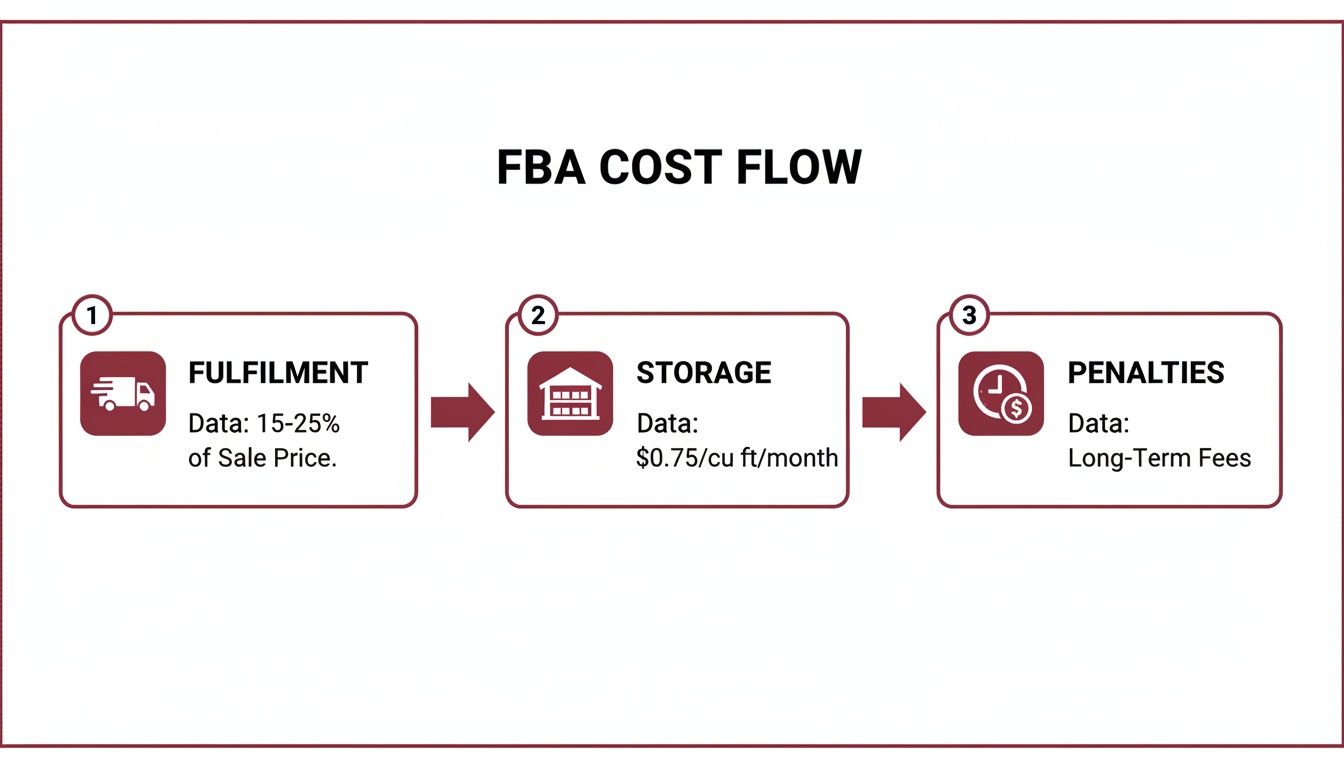
This provides a clear visual of how costs build, from the moment a product is picked to potential penalties for slow-moving stock.
Why Localised Financial Forecasting Matters
For founders, the strategic lesson is that profitability is a function of meticulous planning. Simply translatin
g a US or EU pricing model to Australia without localising for FBA fees, referral rates, and GST is a recipe for failure.
Successful international expansion demands a financial model built from the ground up for the specific market you’re entering. This disciplined approach separates brands that achieve sustainable growth from those that flame out after a few months of disappointing payouts.
To truly understand your Amazon Australia financials, you must look beyond the standard fee schedule. I’ve seen countless founders build what they believe is a solid profit model, only to be blindsided by less obvious costs that quietly erode their margins.
These aren’t minor details. They are operational realities that can turn a great product into an unprofitable venture if not managed strategically.
The most common costs that surprise brands relate to returns, unsellable inventory, and the “optional” services that are, in reality, essential for growth. However, experienced brand operators reframe these not as expenses, but as strategic investments and powerful operational levers.
Turning Expenses Into Strategic Levers
A common mistake is to view a customer return as a simple loss. A strategic founder sees it as a data point. High return rates are a clear signal that something is wrong—it could be product quality, listing accuracy, or a mismatch in customer expectations. The returns processing fees you pay are the cost of that crucial feedback.
This principle applies across the board. These “hidden” costs aren’t just deductions from your payout; they’re signals from the marketplace about your operational efficiency.
- Removal and Disposal Orders: When stock is damaged or unsellable, you pay Amazon to return it or dispose of it. Ignoring this cost leads to dead stock occupying valuable warehouse space, risking long-term storage penalties on top of your initial loss.
- Advertising (PPC) Spend: Pay-per-click advertising is technically optional, but for a new product launching in a competitive market like Australia, it’s a non-negotiable investment. Treating ad spend as just another expense is a massive misstep. It’s your primary tool for generating initial sales velocity, which is critical for ranking and, importantly, for avoiding the long-term storage fees that punish slow-moving products.
- Brand Enhancement Tools: Features like A+ Content and Brand Story allow you to build out product pages. While there’s no direct fee for these tools (you need Brand Registry), the real investment is your time and creative resources. This effort pays off by lifting conversion rates, which boosts sales velocity and improves the return on every dollar spent on ads.
The most successful brands on Amazon don’t just pay the fees; they understand the behaviour each fee is designed to incentivise. Long-term storage fees incentivise rapid inventory turnover. Advertising drives that turnover. The two are deeply connected.
By managing your advertising budget effectively, you aren’t just buying traffic—you are actively investing in the health of your inventory and protecting your margins from future penalty fees. This operator-led perspective is crucial. It’s about shifting your mindset from simply trying to minimise Amazon fees to strategically investing in the levers that drive profitable growth. This is how strong products avoid getting bogged down by operational costs and scale into powerful brands in a new market.
The Real Cost of Getting Bogged Down in a New Market
Trying to master Amazon’s fee structure, Australian GST, and international logistics all at once is a huge operational drag. For founders focused on building a great product and a memorable brand, this is often where an entire expansion plan begins to falter.
I’ve seen it happen many times. Incredible products stall not because of a lack of customer demand, but because the founder gets completely swamped by the financial complexity of a new market. They spend their days buried in spreadsheets instead of building their brand.
This is where the most successful brand builders make a strategic choice. Instead of trying to become experts in every aspect of marketplace management, they find a partner to handle the complexities. This isn’t about giving up control; it’s about regaining focus.
From Spreadsheets to Strategic Growth
Working with a brand expansion partner removes the guesswork and financial risk of launching in a new country. It shifts the challenge of calculating Amazon fees from a reactive headache to a clear, market-level growth strategy. This frees you to think about long-term brand positioning, not just immediate costs.
A strong strategic partner will handle the details for you, including:
- Accurate Financial Modelling: Building profitability forecasts based on local data, accounting for all referral fees, FBA costs, and GST implications from the start.
- Compliance and Logistics: Managing the entire importation, customs, and tax process so you are not buried in administrative work.
- Strategic Inventory Planning: Ensuring stock levels match local demand to maintain sales velocity and avoid expensive long-term storage penalties.
The goal is to ensure your brand’s entry into Australia is not just a launch, but a profitable, scalable operation from day one. A partnership provides the operational framework to make that happen, turning a complex cost centre into a predictable component of your growth plan.
This model is a more intelligent way to scale. It ensures that your time and capital are invested in building brand equity, not just managing operational friction. By handing off the granular details of marketplace execution, you can get back to what truly matters: ensuring your great product becomes a great global brand.
At TPR Brands, we work with founders navigating these exact challenges. We help them implement the structures needed to expand into international markets profitably and sustainably, protecting brand value while unlocking controlled growth.
Frequently Asked Questions About Amazon Fees Australia
When founders plan their expansion into Amazon Australia, the conversation almost always turns to fees. Understanding the real cost of selling is a critical part of building a sustainable marketplace strategy. Here are the most common questions we get from brands preparing to launch.
How Does GST Work with Amazon Fees in Australia?
For any brand operating in Australia, Amazon is required to charge a 10% Goods and Services Tax (GST) on all seller fees. This applies to your referral fees, FBA fulfilment and storage costs, and your monthly plan.
I’ve seen too many brands build financial models without accounting for this tax. It’s an easy mistake that leads to a nasty surprise when you realize your net profit is 10% lower than you projected. You must factor this into every fee calculation to get an accurate picture of your margins.
Is an Individual or Professional Plan Better?
For any founder serious about building a brand on Amazon, the Professional selling plan is the only real choice. The Individual plan might seem tempting with no monthly fee, but it charges a per-item fee and locks you out of the tools you need to grow.
If you plan on selling more than 30 items a month, the Professional plan is already more cost-effective. More importantly, you cannot access essentials like Amazon Advertising (PPC), A+ Content, or advanced brand analytics without it. These are non-negotiable for scaling a brand.
To make the decision easier, Amazon Australia often gives new sellers a 50% discount for the first two months on the Professional plan, which normally costs $49.95 per month (excluding GST). This brings the initial cost down to just $24.98 plus GST. You can explore more about initial setup costs with these insights on Amazon Australia seller fees.
Are There Ways to Reduce FBA Storage Fees?
Absolutely. But reducing FBA fees isn’t about finding secret loopholes. It comes down to disciplined inventory management. The FBA system is designed to reward products that sell through quickly, not to function as a cheap, long-term warehouse.
<blockquote>
The most effective way to control storage costs is to maintain a healthy inventory turnover. Overstocking is what drives up storage fees and exposes you to the far more punishing long-term storage penalties.
A few key tactics can make a big difference:
- Use Amazon’s Forecasting Tools: The data inside Seller Central is surprisingly powerful for predicting demand. Use it to avoid sending in too much stock initially.
- Monitor Inventory Age: Keep a close watch on how long your products have been at the fulfilment centre. Take action on any units approaching long-term storage deadlines.
- Run Strategic Promotions: If you have slow-moving items, use deals, coupons, or a targeted ad campaign to boost sales velocity and clear them out before they start costing you money.
Final Thoughts on Amazon Fees in Australia
Understanding Amazon fees in Australia is not simply an accounting exercise. It is one of the most important strategic foundations for building a profitable and scalable marketplace business.
Brands that succeed long term are rarely the ones with the cheapest products. They are the brands that understand margin structure, inventory velocity, fulfilment economics, and operational efficiency before they scale.
For founders expanding internationally, accurate financial modelling is what turns Amazon from a risky experiment into a sustainable growth channel.
The difference isn’t the product. It’s whether the numbers were understood before the launch.
That’s where most brands get caught out.
If you’re looking at Amazon FBA and want to make sure it actually works financially before you scale, this is the part worth getting right.
At TPR Brands, we help founders navigate Amazon expansion, operational modelling, and international marketplace growth strategies built for long-term profitability.
Learn more at https://tprbrandsau.com.