Many great products struggle internationally, not because demand is weak, but because the expansion strategy is flawed. Founders often assume a proven domestic product will translate seamlessly into a new market like Australia. This assumption is the single most common and costly mistake in global ecommerce. It overlooks the fundamental differences in marketplace economics, consumer trust, and distribution dynamics that define success in a new territory.
A Proven Product Is Not a Proven Brand

The confidence that comes from building a successful brand in a home market is powerful. You've validated the concept, found your audience, and built a loyal customer base. It seems logical that the next step is to replicate this success in new markets, with Australia often appearing as an attractive, English-speaking target.
This is precisely where promising brands stumble. The strategies that fueled domestic growth rarely work in the unique and competitive Australian marketplace. What works in the US or UK does not simply translate.
The Myth of "Copy-Paste" Expansion
The most common strategic failure is assuming that a product that resonates with American or European consumers will automatically connect with Australians. Founders often face a completely different set of expectations, cultural nuances, and competitive pressures.
This isn't just about adjusting marketing copy. It's about fundamental differences in:
- Marketplace Economics: The cost to acquire a customer, advertising expenses (PPC), and fulfilment fees in Australia are unique. Applying a US or EU cost model can destroy margins.
- Consumer Trust Signals: What builds credibility with a shopper in Los Angeles is not what a consumer in Sydney looks for. Brand story, local reviews, and regional validation play different roles.
- Distribution Dynamics: Australia's geography presents unique logistical challenges. The complexities of moving products across a vast continent are profoundly different from the dense networks of Europe or the US.
Ignoring these market-specific realities is a recipe for a stalled launch and wasted capital.
From Market Leader to Unknown Entity
The transition from being a recognized name in your home country to a complete unknown in Australia is a jarring experience for most founders. The brand equity you've painstakingly built means almost nothing to a shopper in Melbourne or Perth.
You are, for all intents and purposes, starting from scratch.
The harsh reality is that a great product is not enough to build a great global brand. Marketplace success requires deliberate positioning, and international growth demands deep market understanding.
This reset demands more than just a marketing budget. It requires a total recalibration of strategy—from pricing and positioning to supply chain and customer service. You can see how this plays out by looking at the specific demands of certain categories, like the consumer electronics landscape on Amazon Australia. The operational strain of managing this transition can quickly overwhelm even the most capable teams.
Time and again, we see brands whose growth stalls not because their product is weak, but because they completely underestimated the strategic and operational lift required. They burn through capital on flawed launch campaigns, get bogged down by unforeseen logistical hurdles, and watch their brand message get lost in a crowded market.
Why Amazon Australia Is A Strategic Global Launchpad
Most international founders view Amazon Australia as a secondary, smaller market. It’s seen as a place to capture incremental sales after conquering the US or Europe. This perspective misses the strategic value entirely.
Experienced brand builders understand that Amazon Australia is a sophisticated, lower-risk testing ground—a place to validate an international model before taking on the hyper-competitive US and UK markets.
Australia acts as a near-perfect microcosm of more mature Western ecommerce ecosystems. It shares a common language, similar consumer laws, and a digitally savvy population with high disposable income. The key difference is that it’s a smaller, more contained, and far less saturated battleground. This allows brands to stress-test every part of their marketplace strategy—from logistics and marketing to pricing and customer service—on a manageable scale. Mistakes here are learning opportunities, not company-ending disasters.
A Rapidly Maturing Market With Evolving Consumer Behaviour
Since its 2017 launch, Amazon’s growth in Australia has been relentless. The platform is no longer an emerging player but an established giant that has fundamentally reshaped consumer expectations around speed, convenience, and product choice.
This rapid market takeover offers a critical insight for ambitious brands. According to recent data, Amazon Australia now connects with 60% of Australian shoppers and boasts 8.8 million active users. This growth highlights a major shift in how Australians shop. You can discover more findings on how global ecommerce giants are impacting Australia’s market online.
What's really telling, though, is the change in what drives purchase decisions. While price was once the main factor, its influence has faded. Today’s shoppers prioritize service and reliability, creating a massive opportunity for brands that can deliver a genuinely superior experience.
The most insightful data point isn't just the growth in users, but the shift in their priorities. The fact that price as a motivator dropped by 42% while delivery speed and Prime benefits became top drivers signals a market that values operational excellence over deep discounts.
This is a profound lesson for any brand planning to expand internationally. It proves that competing on price is a race to the bottom. Building a resilient, scalable brand depends on mastering the non-negotiable elements of the modern customer experience.
Proving Your Operational Model Before Scaling
The shift in Australian consumer priorities provides a clear blueprint. Success on Amazon here—and by extension, globally—is increasingly decided by your operational capabilities. Can you consistently meet Prime delivery expectations? Is your inventory management precise enough to avoid stocking out during peak sales periods?
Amazon Australia's Fulfillment by Amazon (FBA) network, while still growing, gives you a contained ecosystem to perfect these exact processes. You can refine forecasting, streamline inbound shipping, and master the FBA dashboard in an environment where a logistical misstep won't cripple your entire operation.
Think of it as a pre-season training camp for your brand. In Australia, you can perfect:
- Logistics & Fulfilment: Learn to navigate the FBA system, optimise packaging for cost efficiency, and manage inventory across key fulfilment centres.
- Listing Optimisation: Test different image styles, copywriting approaches, and A+ Content to see what actually resonates with a Western audience before you launch in the US.
- Review Generation: Build a repeatable strategy for generating authentic, local reviews—one of the most critical trust signals in every Amazon marketplace worldwide.
Getting these elements right on Amazon Australia creates a proven, repeatable model. You're not just selling products; you’re building a scalable operational engine. When it's time to enter larger markets, you aren't guessing what works. You're deploying a battle-tested strategy.
Common Patterns Of International Expansion Failure
Many great products fail internationally. It’s rarely because of weak demand. More often than not, it’s because the expansion strategy itself is broken from the start.
We see the same cautionary tales play out again and again. They serve as a crucial warning for any brand thinking about stepping beyond its home turf.
A classic scenario: a brand achieves strong, profitable growth on Amazon.com. They’ve nailed their listings, built thousands of reviews, and have a good grip on US FBA logistics. Feeling confident, they decide the next logical step is Australia. The plan? A direct copy-paste launch.
The Copy-Paste Catastrophe
This is without a doubt the single most common and costly mistake we see. Leadership assumes that because the product, branding, and listings work so well in their home market, they’ll do just as well in Australia.
So, they replicate their Amazon storefront, switch the currency, and wait for the sales to pour in.
The result is almost always a slow-motion disaster. Growth stalls immediately, and the launch budget disappears with very little to show for it.
What went wrong is a mix of things they completely failed to anticipate:
- Underestimated Competition: While less saturated than the US, the Australian market has strong local players and savvy international brands that have already adapted their strategies. A newcomer is not just competing on product, but against established local trust.
- Consumer Mismatch: Australian consumers have different expectations. Their buying decisions are shaped by different cultural cues, trust signals, and brand stories. A message that connects with a buyer in Miami can fall completely flat with someone in Melbourne.
- Regulatory Nightmares: Suddenly, the brand discovers their packaging doesn’t meet TGA (Therapeutic Goods Administration) requirements, their electronic product isn’t RCM certified, or their label violates local consumer law. Operations grind to a halt.
This copy-paste method isn't a strategy; it's a gamble. It treats global expansion like a simple admin task instead of the complex, market-specific challenge it really is.
The Hidden Costs Of Going It Alone
The next pattern is a huge underestimation of operational complexity and its effect on profitability. Founders who successfully manage their own logistics in a single region often assume they can do the same in Australia without a partner on the ground.
This mistake leads to a flood of hidden costs that slowly eat away at what should have been healthy margins.
Many brands grow faster and more profitably through strategic partnerships. Attempting to navigate the complexities of international logistics, compliance, and marketing alone often leads to significant margin dilution and brand damage.
Think about the real-world impact on your bottom line:
- Logistics Miscalculations: A small error in calculating import duties, GST, 3PL storage fees, or cross-country freight costs in Australia can turn a profitable product into a loss-leader overnight.
- Wasted Ad Spend: Without a deep understanding of local keyword trends and competitor bidding, marketing budgets are burned through with almost no return. You can’t gain traction against entrenched local players.
- Inconsistent Brand Messaging: Trying to manage customer service, social media, and brand voice across different time zones and cultures without a local presence leads to a disjointed and untrustworthy customer experience.
These failures don't happen because of a bad product. They are the direct result of a flawed expansion strategy—one that lacks the critical market understanding and on-the-ground expertise needed to truly scale globally.
The Strategic Blueprint For Global Marketplace Success
Too many brands think a great product is enough to guarantee international success. It’s not. A great product gets you in the door, but a smart, deliberate blueprint is what actually builds a global brand.
This isn’t about some document that gathers dust. It's a live roadmap that governs every decision, from market entry to the KPIs you track on launch day. It’s about building a model that’s both scalable and defensible, far beyond the comforts of your home market.
Data-Driven Market Prioritisation
The first mistake many brands make is picking the wrong market or entering with the wrong expectations. A truly strategic approach means letting data define the opportunity.
You need to look at potential markets like Australia through a sharp lens:
- Real Competition: How crowded is your niche, really? Use tools to compare the number of direct competitors on your home marketplace versus Amazon Australia. A less saturated market often provides a much faster and more profitable entry point.
- Actual Customer Demand: Forget broad categories. What are customers actually searching for? Dig into keyword data to find markets where search behaviour shows a genuine need for what your product does, not just a vague interest.
- True Landed Cost: Model your all-in costs. This means factoring in tariffs, international freight, local fulfilment fees, and returns for each market. You might find that a market with slightly lower demand but far healthier margins is the smarter move.
This process replaces expensive guesswork with a clear, prioritised plan.
Building Your Regulatory Shield
The next piece is compliance, and this is where most brands stumble when going it alone. What’s perfectly fine in your home country can get your entire inventory seized or your listings shut down in Australia. A robust regulatory and compliance checklist isn’t just paperwork; it’s non-negotiable.
This means a deep dive into specific Australian rules. We’re talking about everything from product safety certifications (like RCM for electronics) to packaging and labelling laws overseen by the ACCC, or TGA requirements for health products. A single oversight here can bring your entire expansion to a dead halt.
A proactive compliance strategy is your brand's insurance policy. We see it less as an administrative task and more as a critical function that protects your business from catastrophic—and entirely avoidable—risks.
Choosing Your Channel Strategy
With your market prioritised and compliance sorted, you need to decide how you’ll go to market. Your channel strategy dictates everything from your pricing and margins to your control over the customer experience. Each path has its own benefits and serious risks.
For established consumer brands, the primary options are direct-to-consumer (e-commerce), working with distributors, entering retail partnerships, or licensing your product. The right choice depends entirely on your product, your appetite for risk, and your long-term ambition.
International Market Entry Channel Strategy
| Channel Strategy | Best For | Key Benefit | Associated Risk |
|---|---|---|---|
| Direct E-commerce (DTC) | Brands with strong digital marketing skills and a desire for high margins. | Complete control over brand, pricing, and customer data. | High upfront investment in marketing, logistics, and customer service. |
| Distributors / Wholesalers | Brands looking for rapid market access and broader reach without heavy operational lift. | Fast entry and access to an existing retail network. | Lower margins and loss of control over brand presentation and pricing. |
| Retail Partnerships | Well-established brands with proven sales data and strong brand recognition. | Credibility and high-volume potential through major retail chains. | Long sales cycles, high slotting fees, and strict vendor requirements. |
| Licensing | Brands with strong IP (patents/trademarks) but limited capital or operational capacity. | Low-risk, royalty-based revenue stream. | Minimal control over quality, marketing, and brand reputation. |
Choosing your channel isn't just a tactical decision; it's a long-term strategic commitment. A DTC-first approach gives you maximum control, but a distributor might get you onto shelves faster. Weighing these trade-offs honestly is critical to building a sustainable international presence.
Using Amazon Ads To De-Risk Market Entry
Most brands see Amazon Advertising as just a sales tool. Smart brands treat it like a strategic intelligence weapon, using it to de-risk market entry and prove demand before committing to a huge investment.
This isn't standard pay-per-click advice. It's about using the platform’s surgical precision to gather real-time market data from a new country. You can test product positioning, validate your messaging, and figure out what actually connects with local consumers, all with a relatively small, controlled budget.
The journey of moving a product into new markets follows a clear path from initial research through to logistics.
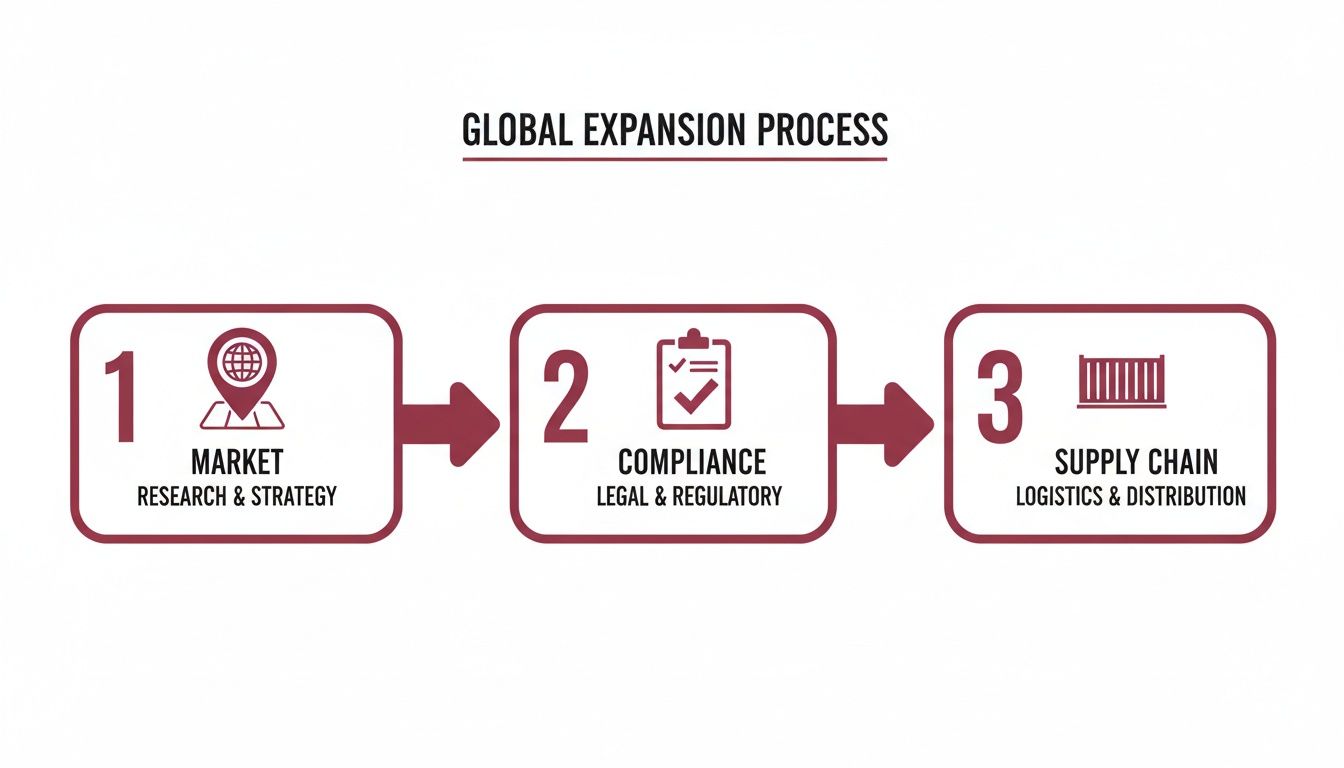
This process breaks down the expansion journey into three core pillars—market selection, compliance checks, and supply chain setup—all of which need to be driven by a solid data strategy.
Using Ads As A Market Intelligence Tool
Before shipping a single container of inventory to Australia, you can be running targeted ad campaigns to test the waters. By setting up a 'ghost listing' (a product detail page that isn't actually for sale yet) or advertising a similar product, you can start collecting incredibly valuable data.
This lets you measure real-world interest directly from potential customers. You can analyse:
- Keyword Performance: What search terms are shoppers in Australia really using? This is gold for refining your listing copy and future campaigns.
- Click-Through Rates (CTR): Do your product images and headlines actually grab attention on a crowded search results page? A low CTR is a massive red flag that your positioning is off.
- Audience Response: Test different ad creative against specific audience segments. Do lifestyle shots work better than technical callouts? Amazon Ads gives you the answer.
This data-first approach shifts your launch from a blind guess to a calculated move. You’re no longer assuming what will work; you're building your strategy on real feedback.
The Australian Ad Market Proves The Point
The advertising landscape on Amazon Australia is the perfect case study. Amazon Australia’s ad business has seen explosive growth, pulling in $242.5 million in net sales in a recent year—a massive 58% year-on-year jump.
For consumer goods brands, this is a critical signal. Yet a staggering 96% of brands admit they struggle with measuring ROI, and over 80% find the reporting capabilities lacking. This gap between adoption and actual results shows just how important it is to have a strategic partner to get the most from the platform. You can discover more insights about Amazon's influence on Australian retail media online.
The real insight for founders isn't just that Amazon Ads drives sales. It's that the platform is a powerful, low-cost focus group. You can test pricing strategies, messaging, and branding in a new market for a fraction of the cost of a traditional launch failure.
By setting up small, targeted campaigns, you gain indispensable market intelligence. This allows you to walk into a new territory with a validated strategy, de-risking the entire expansion. You’ll know which keywords to target, what images resonate, and how to position your brand for success long before your first big inventory shipment leaves the port. This is how smart brands use advertising not just to sell, but to learn.
Why Smart Founders Prioritise Strategic Partnerships
Every founder faces the classic dilemma: go it alone to keep total control, or partner to grow faster. The solo path for global expansion is riddled with predictable—and expensive—risks. You’re suddenly forced to become an overnight expert in Australian tax law, import regulations, and multi-regional logistics. Each new market comes with a steep learning curve, and the inevitable mistakes can drain capital and kill momentum.
The Real Role of a Partner: A Strategic Multiplier
True control isn’t about doing everything yourself; it's about making sure everything gets done right. The right partner doesn’t take control away—they protect your brand from costly blind spots while amplifying your existing strengths. A good partner provides immediate, on-the-ground expertise.
Imagine launching in Australia with a team that already has:
- Established Distribution Networks: Instead of spending months building relationships from scratch, you plug directly into a ready-made network of warehouses, 3PL providers, and last-mile couriers.
- Ready-to-Go Compliance Solutions: Your partner has already navigated the complex web of regulations, from product certifications to labelling laws, ensuring your products get to market smoothly.
- Deep Market Intelligence: They know the local consumer inside and out, which means your marketing and positioning are sharp from day one.
A great product needs more than a great strategy; it needs the right team on the ground to execute it. Partnership is how you scale faster and more predictably while protecting the brand value you’ve worked so hard to build.
This isn’t about outsourcing your brand. It’s about strategically insourcing the critical capabilities you don’t have. This frees you up to focus on what you do best—product innovation and brand vision—while your partner handles the immense operational lift of going global. To learn more about selecting the right ally, you can explore our comprehensive guide on finding an Amazon expansion partner.
Your Top Amazon Australia Expansion Questions, Answered
Founders considering global expansion ask the same high-level strategic questions. They are the critical hurdles that can make or break an international launch. Here is the practical, founder-focused insight you need.
Is Amazon Australia a Good Test Market for the US?
Yes, but with a critical caveat. Amazon Australia is a fantastic, lower-risk environment to refine operations, test listing strategies, and build an initial base of reviews with an English-speaking, Western audience.
However, a strong launch in Australia does not guarantee success in the US. The American market is a different beast—vastly more competitive, with higher advertising costs and more complex consumer behavior. Think of Australia as your dress rehearsal. Use it to perfect your operational playbook, not to assume US market-fit.
What Are the Biggest Hidden Costs When Expanding Overseas?
Founders budget for shipping and marketing. It’s the hidden costs that bleed margins dry. The most common culprits are:
- Compliance and Certification: Unexpected fees for product certifications (like RCM in Australia), state-specific regulations, or redesigning packaging to meet local laws. These costs add up fast.
- Logistics Inefficiencies: Miscalculating import duties and GST, underestimating 3PL storage fees, or getting domestic freight costs wrong in a vast country can instantly turn a profitable product into a loss-maker.
- Returns and Reverse Logistics: Dealing with international returns is not only expensive but an operational nightmare. A return rate even slightly higher than planned can become a major financial drain.
Many brands fail not because their product is flawed, but because they are bled dry by a thousand small, unforeseen operational costs. A strategic partner with on-the-ground knowledge anticipates these expenses, protecting your margins from the outset.
How Do I Protect My Brand on a Global Marketplace?
Your brand isn't automatically protected when you expand. You need a proactive, multi-layered strategy to maintain control, especially on a platform as massive as Amazon.
The non-negotiable first step is enrolling in Amazon Brand Registry in every new market. This is your foundation for controlling your listings and fighting counterfeiters. But it doesn't stop there. You need crystal-clear Minimum Advertised Price (MAP) policies and iron-clad legal agreements with any distributors or partners. This is how you prevent price wars and ensure your brand is presented consistently. For more on this, we've shared our insights on how to sell on Amazon Australia from overseas while keeping control.
True brand protection is about having the right systems and the right partners in place before a problem ever arises.
At TPR Brands, we work with founders navigating these challenges as they expand into international markets.