The most popular advice on customer satisfaction is still too narrow. It treats satisfaction as a support outcome, a survey score, or a service team responsibility. That framing breaks down the moment a brand tries to scale across channels, marketplaces, and regions.
What becomes visible during international expansion is that customer satisfaction behaves less like a soft sentiment metric and more like a structural signal. It tells you whether your catalogue, fulfilment model, local positioning, service promise, and operational discipline are working together, or subtly pulling against each other. Strong products can still generate weak customer confidence when the surrounding ecosystem feels inconsistent.
Across multiple marketplace ecosystems, one pattern we continue seeing is simple. Brands often assume that if the product is proven and the listing is live, satisfaction will follow. It rarely works that way. Satisfaction is usually the commercial output of ecosystem cohesion.
The Customer Satisfaction Disconnect in Australian Brands
Australian brands often assume the service problem is one of tooling. Add a better helpdesk. Improve response routing. Introduce automation. Tighten service workflows. Those changes matter, but they don't explain why customer perception still lags behind internal effort.
The sharper issue is that the market is signalling a trust problem, not just a process problem. According to Change Factory's analysis of Australian service expectations, 65% of consumers perceive companies are paying less attention to service, only 2% feel expectations are exceeded, and 40% feel their needs are unmet. Australia ranks second only to France in service failure relative to expectations.
That gap matters because founders often read customer satisfaction too narrowly. They look at contact centre outputs, ticket closure, or internal SLAs. Customers judge something broader. They notice whether the brand feels attentive, reliable, accessible, and coherent.
Why the disconnect is commercially dangerous
A brand can believe it's improving while the market feels ignored. That's not a branding issue in the superficial sense. It's a commercial blind spot.
When customers believe attention is fading, they don't just complain more. They become less forgiving about delivery friction, less open to product substitutions, less patient with channel inconsistency, and less likely to trust the brand in a new context. That becomes especially risky when businesses move from traditional retail into more complex channel structures such as marketplaces, direct-to-consumer, distributor networks, or international online selling through new expansion pathways.
Practical rule: If service perception is deteriorating while internal teams feel more efficient, the business is probably optimising the wrong layer.
One issue we repeatedly observe is that established brands confuse operational activity with customer confidence. More systems don't automatically create more trust. In some cases, they create more distance. A faster workflow can still feel impersonal. A clean escalation path can still feel fragmented. A polished service script can still miss what local customers expect.
Why customer satisfaction isn't a solved problem
Australian consumers are not evaluating service in a vacuum. They're assessing whether the brand behaves in a way that matches local expectations around honesty, accessibility, and effort. That's why customer satisfaction can't be treated as a reporting formality.
A recent marketplace review revealed that the strongest operators don't ask, "How do we answer faster?" first. They ask, "Where does the customer feel dropped?" That question usually uncovers something structural.
- Channel mismatch: The product promise is strong in retail but weak online.
- Ownership confusion: Customers don't know who is responsible when something goes wrong.
- Service inconsistency: Different touchpoints communicate different levels of competence.
- Expansion strain: The operating model stretches into new channels before trust is stable at home.
Customer satisfaction starts deteriorating long before a brand sees margin pressure from churn, discounting, or review decline. By the time those symptoms are obvious, the underlying trust gap has often been widening for some time.
Rethinking Satisfaction as a Commercial Asset
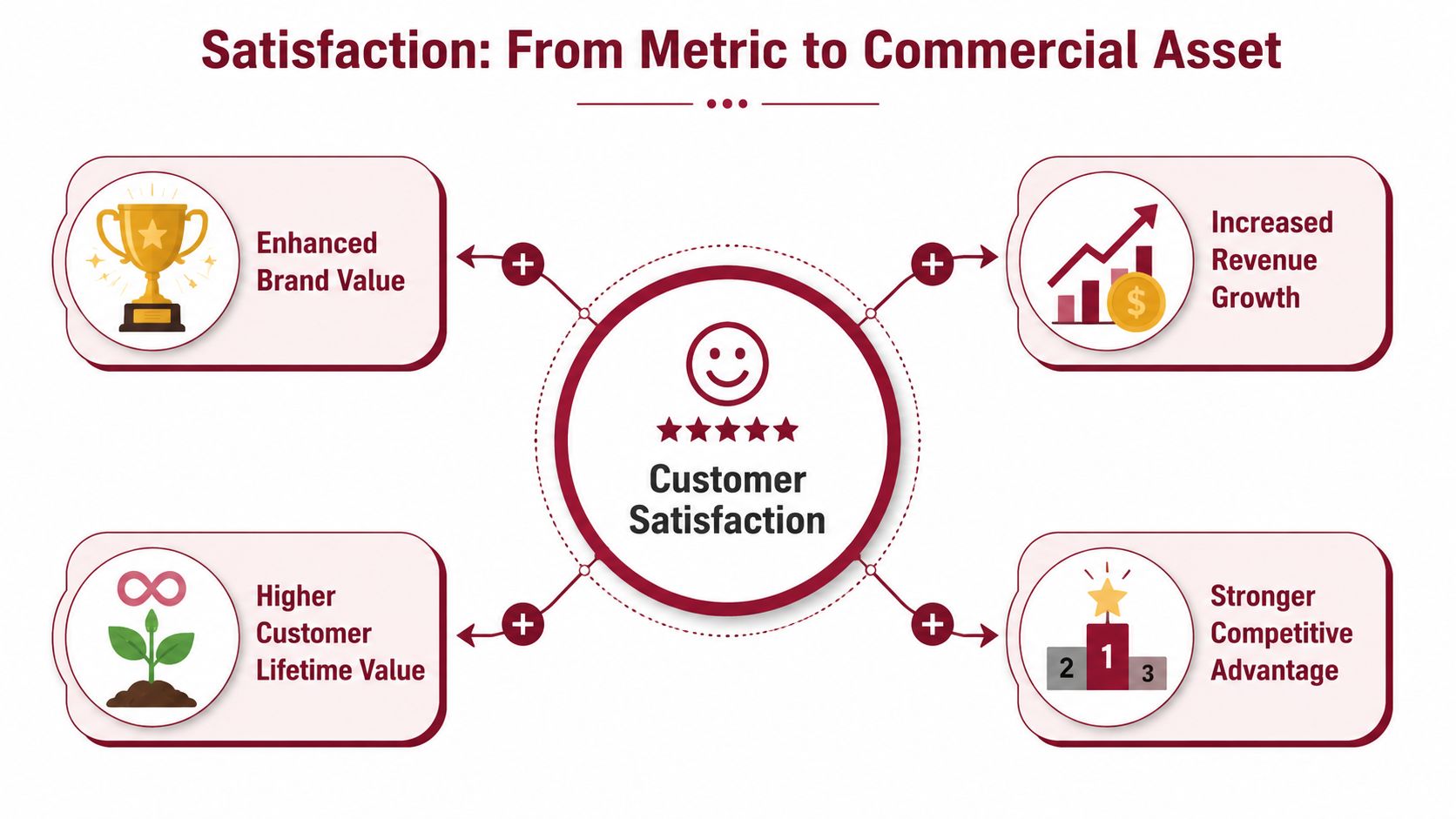
Customer satisfaction isn't just a reflection of whether a recent interaction went well. For an operator, it's a read on whether the business is commercially organised in a way customers can believe in.
That distinction matters because satisfaction compounds. If customers consistently experience a brand as dependable, accessible, and easy to deal with, the business gains more than goodwill. It gains resilience. That resilience shows up in repeat purchase behaviour, stronger channel performance, and greater tolerance when inevitable friction appears during growth.
Satisfaction reveals ecosystem health
In marketplace environments, customer satisfaction is rarely produced by the service team alone. It is shaped by listing accuracy, fulfilment reliability, packaging clarity, returns design, stock integrity, after-sales ownership, and the consistency of the brand promise across channels. When one part weakens, customers don't isolate the failure. They attach it to the brand as a whole.
One pattern we continue seeing is that strong catalogues do not automatically create strong marketplace presence. A business can have quality products and still generate weak customer confidence if the surrounding ecosystem feels improvised. That is why satisfaction should be read as a commercial asset tied to ecosystem health.
A useful operator lens is to treat satisfaction as evidence of whether these layers are aligned:
| Commercial layer | What customer satisfaction is really testing |
|---|---|
| Product promise | Whether the item performs as expected in the market context |
| Channel execution | Whether the buying journey feels dependable and coherent |
| Fulfilment structure | Whether delivery and post-purchase experience reinforce competence |
| Brand positioning | Whether the offer feels relevant and trustworthy in that region |
Why expansion magnifies weak satisfaction
A local business can sometimes absorb ecosystem inconsistency because familiarity fills the gap. Customers already know the retailer, recognise the category, or understand the brand's reputation. International expansion strips that away. The new market has no reason to extend that same patience.
Customer satisfaction is often the first commercial signal that the ecosystem is becoming harder for customers to trust.
This is why satisfaction belongs in strategic discussions about expansion readiness. If the business delivers uneven experiences across domestic channels, those inconsistencies usually become sharper, not softer, once localisation, compliance, regional delivery expectations, and marketplace competition are added.
The brands that travel well don't just chase higher scores. They build operating models that make trust easier to sustain. They reduce contradiction between what the brand says, what the marketplace shows, and what the customer receives.
That is the point where satisfaction stops being a support KPI and starts behaving like a real asset on the balance sheet of brand value, even if it isn't recorded there in formal accounting terms.
Translating Satisfaction Metrics into Commercial Intelligence
Metrics become useful when they change decisions. Too many businesses collect customer satisfaction data as a retrospective scorecard. Operators need something else. They need signals that tell them whether the current model is stable enough to scale.
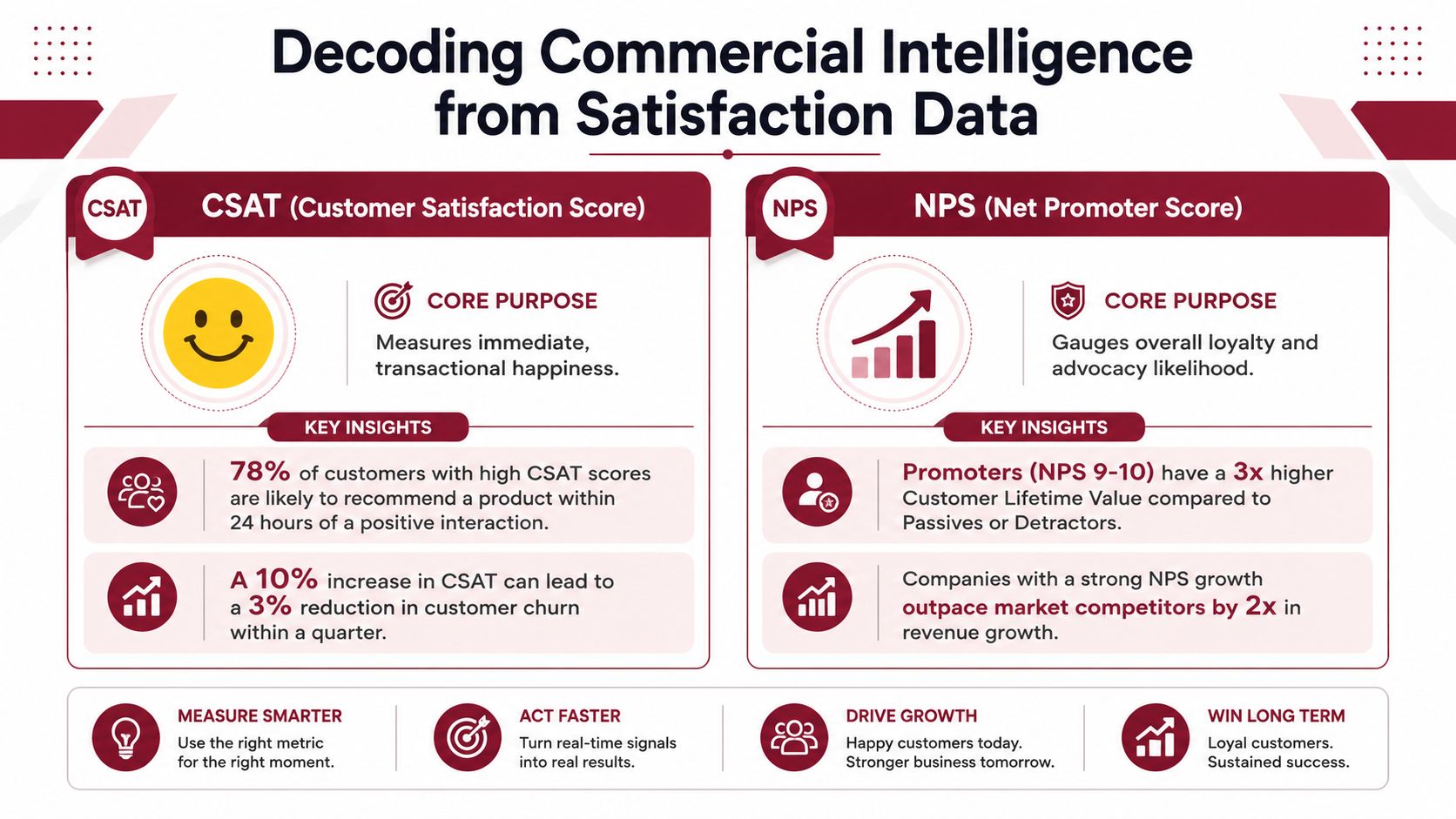
The Australian benchmarks matter because they provide a practical line between acceptable performance and commercial vulnerability. In the Australian market, a CSAT score between 75% and 85% is considered good service, and for long-term loyalty, an NPS above 30 is associated with significantly higher customer lifetime value and repeat purchase rates, as outlined in Verint's CSAT benchmark explanation. For brands making decisions about channel growth, that isn't abstract reporting. It's operating intelligence.
A useful visual summary sits below.
What CSAT tells you now
CSAT is best read as a near-term performance signal. It captures whether a recent interaction, delivery, support exchange, or transaction met expectations. In practical terms, it helps operators isolate friction while it is still specific enough to fix.
When CSAT drifts downward, the question isn't only whether support quality has fallen. It may indicate listing inaccuracy, product mismatch, delivery confusion, returns friction, or channel-specific promise inflation. The score is immediate, but the cause often sits elsewhere in the operation.
For teams reviewing commercial performance benchmarks, CSAT is useful because it answers a direct operational question: are we executing cleanly enough, at the point of interaction, to protect trust?
Here are the signals experienced operators usually pull from CSAT:
- Transaction quality: Did the last interaction validate or weaken the purchase decision?
- Channel reliability: Are customers getting the same standard of experience across touchpoints?
- Issue containment: Is friction staying local, or expanding into complaints, reviews, and repeat contacts?
Later in the reporting cycle, the pattern often becomes visible in broader commercial performance. CSAT usually moves before revenue quality does.
The practical calculation discussion is straightforward, but a short explainer is still useful in context.
What NPS tells you next
NPS answers a different question. It doesn't ask whether the last experience was satisfactory. It asks whether the brand has earned enough confidence to be recommended. That makes it more strategic.
In the Australian context, an NPS above 30 suggests a stronger foundation for loyalty and advocacy. For operators, that matters because recommendation behaviour tends to reflect accumulated trust, not one-off service recovery.
A brand with decent CSAT and weak NPS is often solving incidents without building belief.
That is a common pattern in fragmented ecosystems. Customers may be satisfied with individual fixes while still feeling uncertain about the brand overall. They buy once, but hesitate to recommend. They accept resolution, but don't become advocates.
Reading the two metrics together
CSAT and NPS should never be treated as competing measures. They answer different questions.
| Metric | Operator meaning | Strategic use |
|---|---|---|
| CSAT | Immediate experience quality | Diagnose active friction in product, support, and fulfilment |
| NPS | Accumulated confidence and advocacy | Judge loyalty strength before further expansion |
When both are healthy, the operation is usually coherent. When CSAT is strong but NPS is soft, the brand may be operationally competent but strategically forgettable. When both are weak, expansion should slow until the ecosystem is stabilised.
Operational Patterns That Shape Customer Perception
Customer perception is often formed by details commonly classified as operational, not strategic. That classification is a mistake. Customers read operational behaviour as evidence of brand quality.
One pattern we see across connected devices, household products, premium consumer categories, and home organisation brands is that customers use small moments to decide whether a business is competent. The clarity of a dispatch update. The consistency of carton condition. The speed of ownership when something arrives damaged. None of these moments sits inside a glossy brand deck, yet all of them shape customer satisfaction.
Where competence becomes visible
In practice, customers don't separate fulfilment from brand trust. They don't distinguish between marketplace friction and manufacturer accountability. They ask whether the experience felt organised.
That is why operational design matters so much in high-volume channels and international expansion. Once inventory moves through more nodes, more partners, and more customer touchpoints, inconsistency becomes easier to notice and harder to explain away. Brands looking at supply chain optimisation in expansion environments usually discover that service quality and fulfilment structure are much more tightly linked than internal teams expected.
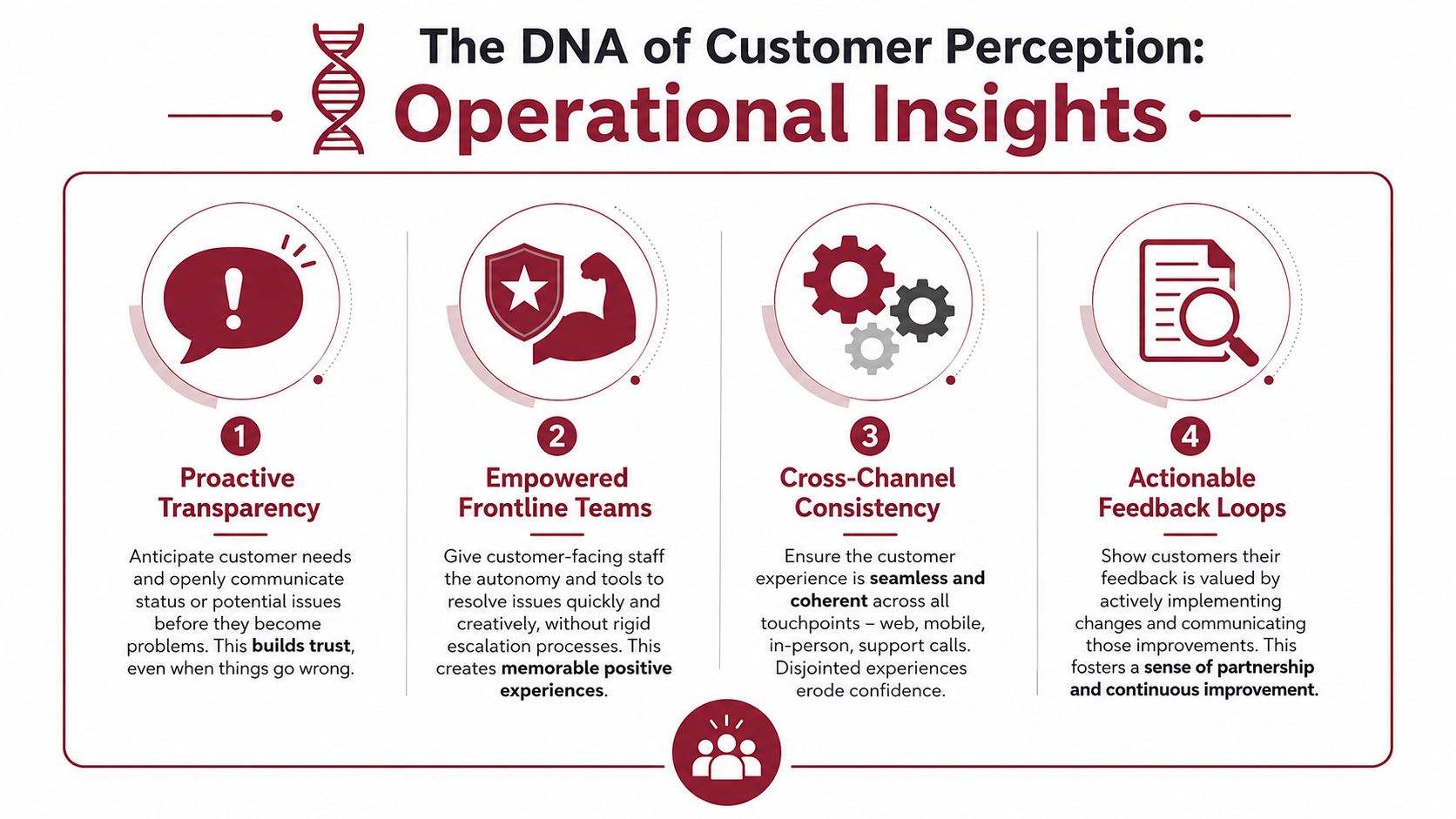
A recent marketplace review revealed a few patterns that consistently shape perception:
- Proactive communication reduces doubt: Customers tolerate delays better when the brand speaks before the problem escalates.
- Frontline authority protects confidence: Teams that can resolve issues cleanly create stronger trust than teams locked in layered escalation.
- Cross-channel consistency matters: A polished website cannot offset confusing post-purchase communication.
- Feedback loops need visible action: Customers notice when brands collect feedback but never visibly adapt.
The physical environment also changes satisfaction
One underused insight sits outside the usual CX playbook. According to Ohio State University's research on business shapes and customer response, angular shapes signal competence and increase customer satisfaction when venues are busy, while circular shapes signal warmth and boost satisfaction in non-crowded settings.
That finding matters more than it first appears. It suggests that physical design cues alter how customers interpret the same operational environment. In a busy collection point, trade counter, showroom, or logistics-heavy retail setting, angular design can reinforce an impression of competence. In calmer, lower-pressure spaces, circular design can make the brand feel more welcoming.
Physical design isn't decorative. It influences how customers interpret operational stress.
This is one reason generic customer service advice falls short. It assumes satisfaction is driven mainly by scripts, policies, and digital channels. Operators know better. Perception is shaped by the total environment in which the brand is experienced.
Small frictions stack faster than teams expect
Operational weaknesses rarely arrive one at a time. They stack.
A listing promises one thing. Packaging suggests another. Delivery timing creates uncertainty. Support responds politely but without ownership. The issue is resolved, yet the customer leaves with a weaker impression of the brand's seriousness.
That stack effect is why customer satisfaction often falls before teams can identify a single dramatic failure. The operation doesn't collapse. It just stops feeling trustworthy.
Building Ecosystem Cohesion Through Customer Trust
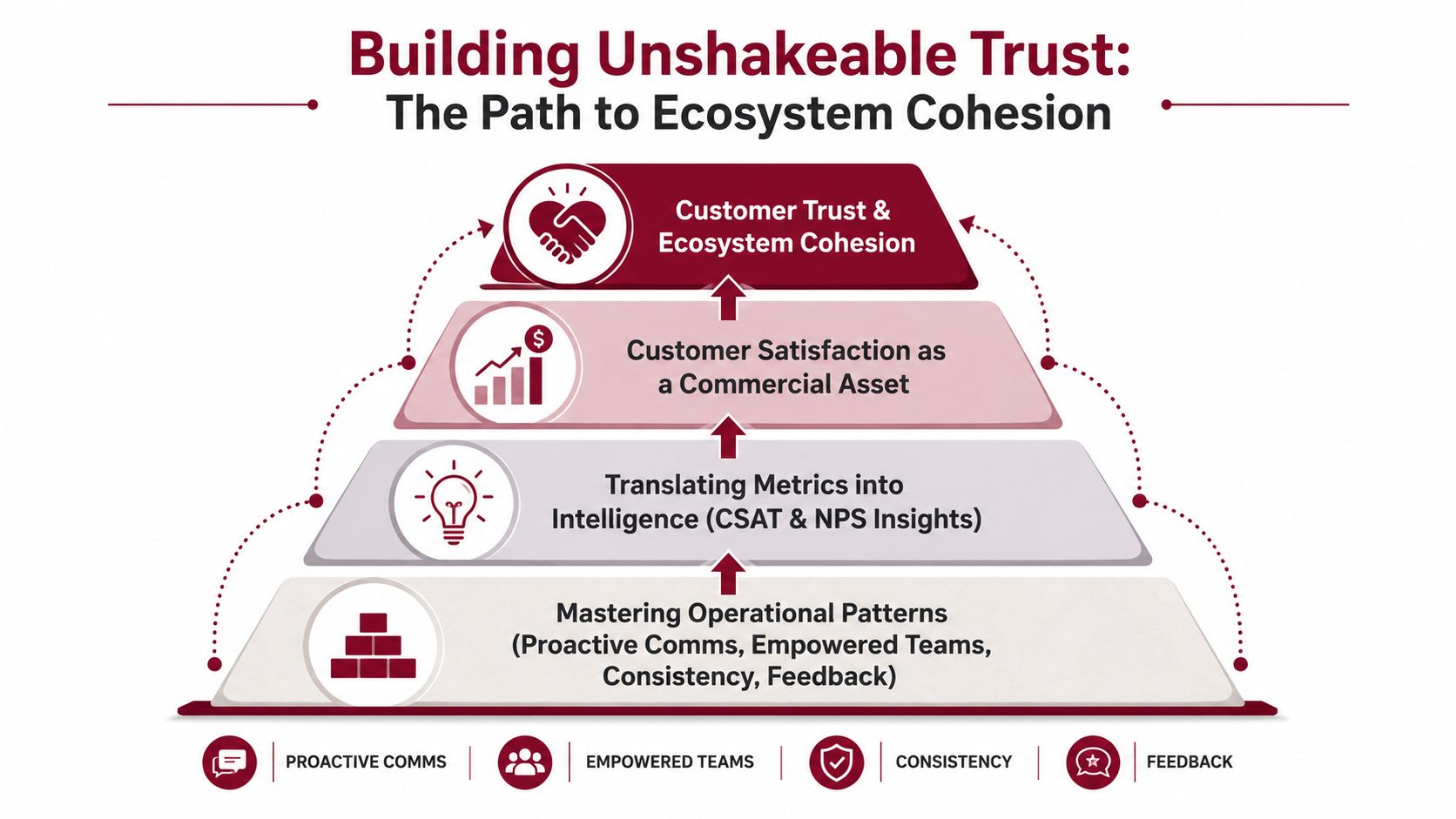
The strongest brands do not manage customer satisfaction as an isolated function. They build conditions in which trust becomes the normal customer conclusion.
That shift in thinking matters because customer trust is earned through cohesion. The product, price point, service accessibility, channel presentation, fulfilment experience, and local relevance all need to support the same commercial story. When they do, satisfaction becomes a natural output. When they don't, the brand starts forcing customer service teams to compensate for structural misalignment.
What local customers actually value
Localisation transcends cosmetic considerations. According to the Roy Morgan Single Source survey summary published by Statista, the key drivers of customer satisfaction in Australia's supermarket sector are value for money, freshness of produce, and customer service accessibility. Those drivers translate well beyond grocery. For hardware, home improvement, and other tangible product categories, the underlying lesson is clear. Customers want confidence that the offer is worth the spend, the product quality is dependable, and help is easy to access when needed.
The brands that perform well across regions are usually good at decoding those local trust drivers early. They don't assume a global best practice will land cleanly in every market. They localise around what customers use to judge competence and reliability.
A useful framing looks like this:
| Trust driver | What it means operationally |
|---|---|
| Value for money | Clear pricing logic, consistent quality, and no surprise friction |
| Product confidence | The item arrives as expected and feels true to promise |
| Service accessibility | Customers can reach the brand without effort or confusion |
Why ecosystem cohesion matters more than channel presence
One issue we repeatedly observe is that brands expand channel presence faster than they build ecosystem cohesion. The catalogue appears in more places, but the buying and ownership experience becomes less consistent. That fragmentation erodes customer trust.
A customer doesn't care that one part of the experience sits with a distributor, another with a marketplace, and another with the brand team. They evaluate the total result. If ownership feels blurred, trust weakens. If communication differs across touchpoints, satisfaction becomes fragile.
Strong brands create fewer contradictions for the customer.
This matters during international expansion because a new market doesn't inherit your internal logic. It only sees your external execution. If the ecosystem feels joined-up, the brand appears mature. If it feels patched together, customers become cautious, even when the product itself is good.
For brands navigating marketplace localisation across different regions, customer satisfaction becomes a way of checking whether the new ecosystem makes sense locally. Not whether it is merely live, but whether it feels credible.
Trust is the operating result
Customer satisfaction rises more reliably when teams stop chasing isolated service wins and start removing structural contradiction. Better localisation. Cleaner ownership. More accessible support. More coherent fulfilment. Fewer mismatches between brand promise and delivered experience.
That is how ecosystem cohesion is built. It isn't a messaging exercise. It's an operating discipline.
From Local Satisfaction to Global Brand Strength
Customer satisfaction becomes strategically useful when a brand stops treating it as a customer service score and starts reading it as an expansion signal. It tells you whether the market experiences the business as coherent, dependable, and worth trusting under pressure.
That matters because growth places strain on every weak point in the operating model. New channels expose catalogue inconsistency. New regions expose localisation gaps. More volume exposes fulfilment weakness. Customer satisfaction is one of the earliest places those tensions become visible.
There is still reason for confidence. In Australia, 55% of companies have seen CSAT scores improve in the last two years, aligning with the global average, according to Capterra's review of technology and CSAT performance. That tells us businesses are making progress. It doesn't mean the work is finished. It means the market is getting better at using technology and process to improve service outcomes, while the harder strategic task remains the same: turning those gains into durable customer trust.
What stronger brands understand
The strongest operators don't ask whether customer satisfaction matters. They ask what it is revealing.
Sometimes it reveals that service access is too hard. Sometimes it exposes weak channel integration. Sometimes it shows that the product promise translates poorly across regions. Sometimes it identifies a business that is commercially ready at home but not yet operationally cohesive enough for international marketplace expansion.
That is why customer satisfaction deserves a place in commercial planning, not just service reporting.
- As a local signal: it shows whether the current operating model is winning trust.
- As an expansion filter: it helps identify whether the ecosystem is stable enough to travel.
- As a brand indicator: it reveals whether customers see a coherent brand or a collection of disconnected functions.
One pattern we continue seeing is that brands with strong products often underestimate how much customer confidence depends on ecosystem design. Great products do not automatically become great brands. Marketplace success depends on the surrounding structure.
For founders, commercial directors, and operators, the question isn't how to push satisfaction higher in isolation. It's how to build an ecosystem where satisfaction remains strong as the brand moves across marketplaces, partners, and countries.
If you're assessing whether your brand is structurally ready for new channels or international marketplaces, TPR Brands helps established product businesses interpret those signals in commercial terms. The work isn't about chasing surface-level marketplace activity. It's about building cohesive expansion pathways that protect brand value, support localisation, and carry customer trust across Australia, the US, Canada, and the UK.