The most popular advice on distribution network design is also the least useful. “Put stock near demand” sounds sensible until you try to build a real brand across multiple regions, channels, and service expectations. Then the obvious answer starts breaking down.
A product can be proven at home and still underperform abroad because the network behind it isn't commercially coherent. Orders arrive late. Marketplace fulfilment sits out of sync with wholesale replenishment. Inventory gets duplicated in the wrong places. Margin slips gradually, not dramatically, which is why founders often miss the root cause for too long.
Across multiple marketplace ecosystems, one pattern keeps surfacing. Brands treat network design as a logistics project after the commercial plan is already set. In practice, the network is part of the commercial plan. It shapes customer trust, channel confidence, reorder behaviour, and how much room you have to scale without losing control.
Beyond the Warehouse Why Your Network Is Your Brand
A strong domestic product doesn't automatically become a strong international brand. That assumption fails most visibly when customer demand spreads across new geographies, but fulfilment logic stays stuck in the home market.
One issue we repeatedly observe is that founders separate brand building from fulfilment structure. They'll spend months refining packaging, channel messaging, and market entry sequencing, then default to a network decision based on whichever warehousing option looks cheapest in the short term. That's where the cracks begin.
The network is where the promise gets tested
Customers don't experience your internal org chart. They experience delivery reliability, stock availability, returns handling, and whether every buying channel feels joined up. Retail partners notice the same thing. So do marketplaces.
If your direct-to-consumer orders ship quickly but wholesale replenishment slips, the market sees inconsistency. If Amazon FBA is fully stocked while your own site shows extended lead times, you create channel tension. If regional buyers face long, unpredictable fulfilment windows, your product may still be good, but the brand starts to feel less dependable.
A fragmented fulfilment structure rarely looks like a branding problem at first. It shows up as service friction, margin leakage, and patchy channel performance.
That's why Amazon is a distribution channel, not just a sales channel. The same logic applies more broadly. Your warehouse layout, transfer flows, inventory positioning, and fulfilment partnerships all influence how your brand is perceived in-market.
What weak network design actually does
Poor distribution network design usually creates problems in a sequence, not all at once.
- Service inconsistency appears first: Some customers get a smooth experience, others get delays, split shipments, or unclear lead times.
- Commercial confidence drops next: Retail buyers, distributors, and marketplace algorithms respond to inconsistency faster than most brands expect.
- Margin pressure follows: Expedites, stock imbalances, extra handling, and duplicated inventory start absorbing the gains the expansion was meant to create.
- Brand value gets diluted: Customers don't separate product quality from fulfilment quality as neatly as internal teams do.
What stronger operators do differently
More mature brands design the network around the market they want to become, not just the sales pattern they already recognise. They ask harder questions earlier. Which channels need priority? Which service levels matter commercially? Which customer segments can tolerate longer lead times, and which can't?
That shift matters because international expansion isn't just a volume exercise. It's an ecosystem transition. Your network is the physical architecture that makes the expansion believable.
First Principles of Network Design
Most distribution network design goes wrong before anyone compares warehouse locations. The failure usually starts with unclear objectives. A business says it wants lower costs, faster delivery, stronger retailer support, tighter inventory, better marketplace responsiveness, and cleaner cash flow, all at the same time. In reality, those aims often conflict.
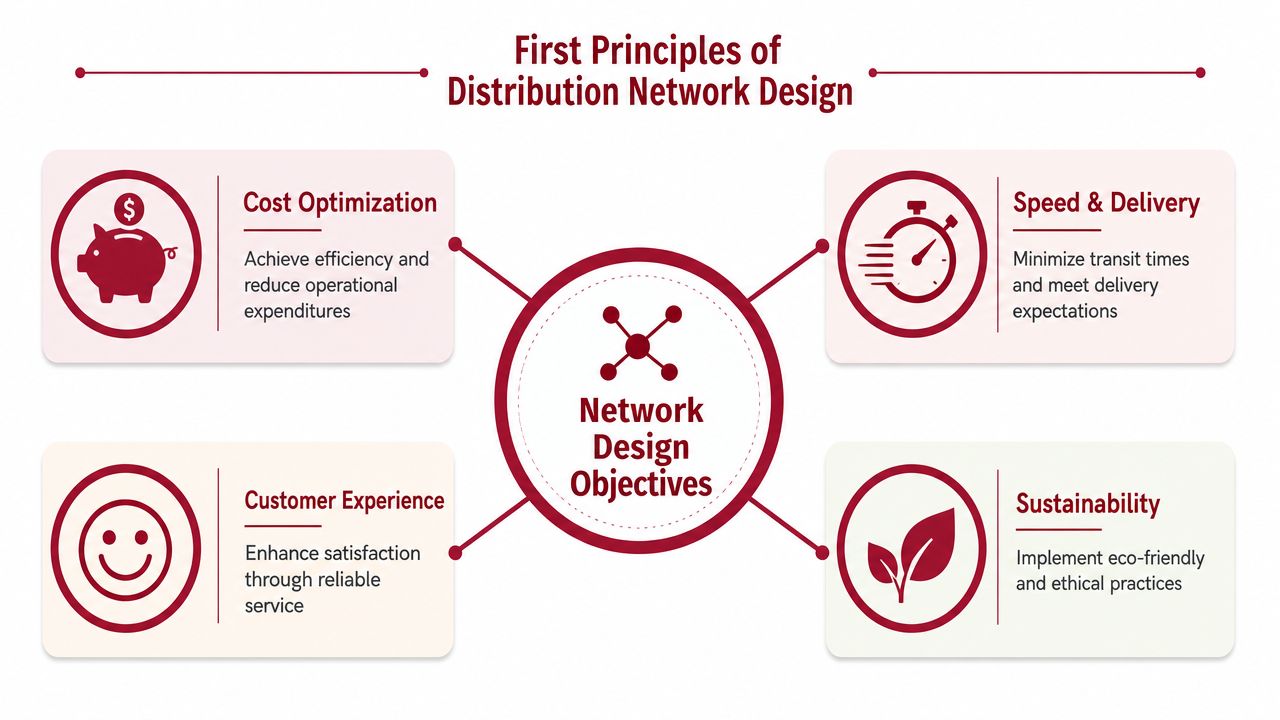
Start with the commercial promise
The right network begins with the promise you're making to the market. If you sell premium consumer hardware, your tolerance for delivery inconsistency is different from a bulk replenishment model. If you're entering a channel where buyers expect dependable stock availability over headline speed, that changes the design again.
A practical starting point is to rank your priorities rather than listing all of them as equal:
- Service position: Are you selling reliability, speed, broad availability, or controlled selectivity?
- Margin discipline: How much cost-to-serve can the category absorb before the economics start to break?
- Channel mix: Will marketplace, wholesale, and direct-to-consumer all draw from the same inventory logic?
- Expansion shape: Are you testing a market, building a long-term operating base, or supporting an existing distributor network?
When teams skip this discipline, they end up modelling a network that looks efficient in a spreadsheet but doesn't support the commercial reality.
Demand analysis comes before location selection
In newer regions, you won't have perfect history. That doesn't remove the need to model demand. It changes how you infer it.
Use what you already know. Look at current order patterns by postcode or state in your home market. Compare that with likely analogue regions abroad. Study where your category already has channel maturity. Separate fast-moving core products from bulky or slower-turning lines. The network should reflect order shape, not just total volume.
Practical rule: Don't pick facilities first and hope demand fits later. Start with order profiles, service promises, and route logic. Then test the footprint.
Australia serves as an especially useful operating example. The country covers about 7.69 million km², yet roughly 85% of Australians live within 50 km of the coast, which creates a design problem built around long inland distances and concentrated coastal demand, as outlined in this Australian distribution network analysis.
That matters because the obvious “single national warehouse” answer can become expensive in more ways than one.
Geography changes the economics
A founder entering Australia from the UK or parts of Europe often underestimates how much geography shapes network performance. The market isn't evenly distributed, and the distance between demand centres changes freight exposure, service speed, and stocking logic.
Here's the more useful way to think about it.
| Network input | What it changes commercially |
|---|---|
| Customer-location density | Where speed matters and where stock concentration is viable |
| Route distance and transit time | Whether a centralised model protects or damages service |
| Warehouse capacity | Whether growth creates bottlenecks before revenue justifies another node |
| Demand variability | Which SKUs can stay centralised and which need smarter positioning |
That's why robust planning in Australia usually starts with customer locations, route data, warehouse capacity, transportation cost, and demand variability rather than a simplistic national map view. Founders dealing with this kind of complexity should also think in terms of broader supply chain risk management during expansion, because the network decision affects resilience as much as cost.
Choosing Your Physical and Digital Footprint
Once the commercial objectives are clear, the next decision is structural. Not which warehouse is cheapest, but which footprint keeps the brand coherent across channels.
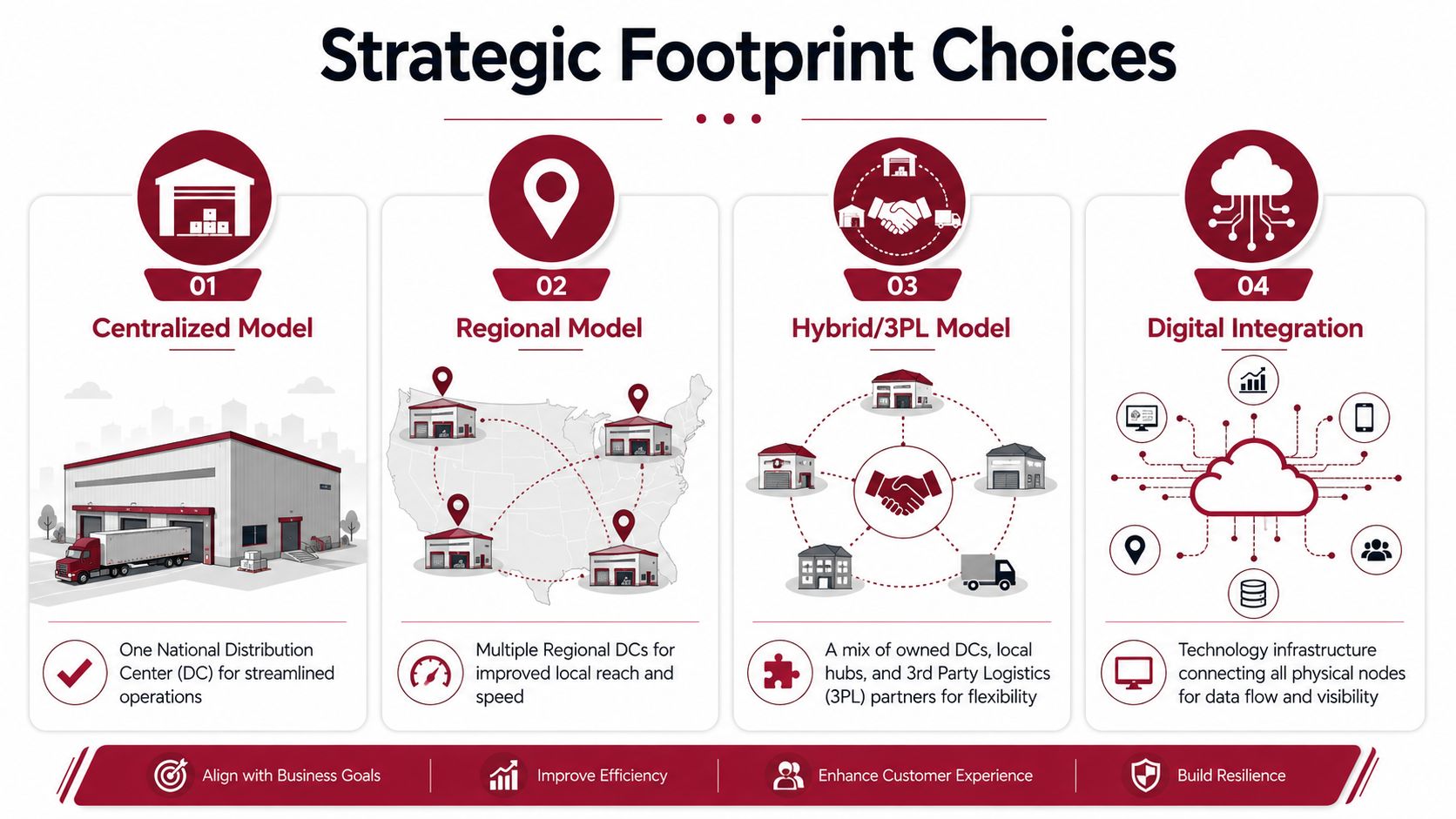
The central tension is straightforward. More nodes can reduce transport exposure and improve service in distant regions. They can also increase inventory duplication, handling complexity, and planning risk. That trade-off is central to effective distribution network design.
Centralised, regional, and hybrid models behave differently
A centralised national DC works best when the assortment is manageable, service expectations are realistic, and inventory concentration matters more than regional speed. It's often the cleanest entry model for a brand testing a new market.
A regional network makes more sense when lead times are commercially sensitive, the country is physically large, or channel partners expect local responsiveness. The problem is that every extra node creates another inventory decision, another replenishment problem, and another opportunity for stock imbalance.
A hybrid model often suits established brands best. One import or primary distribution centre handles inbound control, slower-moving stock, and channel allocation. Regional cross-docks, 3PL nodes, or marketplace-specific fulfilment points handle selective speed requirements.
The wrong model often looks right on paper
One pattern we continue seeing is brands choosing a centralised structure because it looks neat and controllable at launch. Then order mix changes. A wholesale account lands in one region, marketplace demand grows in another, and direct-to-consumer volume starts pulling inventory in a third direction.
At that point the model strains. The business starts using workarounds instead of redesigning the network. Emergency transfers increase. Marketplace stock gets ring-fenced. Key retail orders receive special treatment. The network becomes operationally political.
The smarter question is not “How many warehouses do we need?” It's “Which node types should hold stock, which should solely move flow, and which channels need dedicated rules?”
A cross-dock solves a different problem from a stocked regional node. Treating them as interchangeable is where many networks become expensive without becoming better.
Match the footprint to the order profile
The source of confusion is usually order composition. Bulky hardware, mixed-BOM products, accessory-led replenishment, and marketplace units don't place the same demands on the network.
Research on network design trade-offs across large service areas makes the point clearly. The model should be treated as a trade-off between inventory duplication and transport exposure, particularly in large, low-density territories where a paper-efficient design can still fail on lead time, regional service, or freight cost-to-serve.
A simple comparison helps.
| Footprint choice | Usually works when | Usually fails when |
|---|---|---|
| One national DC | Demand is concentrated and service tolerance is wider | Regional expectations tighten and freight distance starts dominating |
| Multiple stocked nodes | Core SKUs move consistently across several regions | The range is broad and inventory gets fragmented |
| National DC plus cross-docks | Speed matters in selected regions but full stock duplication doesn't | Cross-docks are asked to compensate for poor forecasting |
| Marketplace-specific fulfilment added to a wider network | Marketplace demand is significant and channel-specific | FBA or similar programmes become the de facto network strategy |
Physical design also needs a digital counterpart. Inventory visibility, order routing logic, channel allocation rules, and transfer discipline matter as much as the buildings. Without that layer, multi-node expansion becomes a guessing exercise. That's especially important in global logistics strategy for international expansion, where channel complexity and geography compound each other quickly.
From Theory to a Commercially Viable Model
A network design isn't commercially viable because it looks tidy in a deck. It's viable because it keeps working when the market behaves imperfectly.
Founders often ask for the “best” network. That's usually the wrong brief. The useful brief is to find the network that can tolerate volatility without forcing the business into constant exception management. The strongest model is rarely the most elegant. It's the one that still makes sense when demand skews, channels compete for stock, and a market launches unevenly.
Pressure-test the assumptions, not just the layout
Every network is built on assumptions about order density, transport reliability, throughput, and service requirements. If those assumptions aren't tested, the model is still theory.
The first pressure test is commercial, not operational. Ask where the margin fails first. Is it long-haul freight into remote areas? Is it inventory duplication across multiple nodes? Is it handling complexity created by trying to serve retail, distributors, and direct-to-consumer from the same stock pool?
Then test the service promise. A premium product with weak delivery consistency doesn't hold its positioning for long. A marketplace launch with poor stock availability tends to distort ranking, forecasting, and replenishment behaviour. A wholesale partner who can't rely on replenishment cadence starts protecting themselves with lower confidence buys.
Model scenarios that reveal hidden weaknesses
Good scenario work doesn't need theatrics. It needs clarity.
Use a small set of scenarios that reflect real commercial stress:
- Regional demand spikes: One market or metro area starts outperforming earlier than expected.
- Channel imbalance: Marketplace volume accelerates faster than wholesale, or vice versa.
- Inventory skew: A few core SKUs carry the business while the long tail ties up space and cash.
- Distance sensitivity: Regional orders remain profitable only if they move through a different node structure.
- Capacity strain: The warehouse can technically ship the volume, but cut-off times, receiving discipline, or labour flexibility begin to break.
Those scenarios tell you where the network needs structural help and where process fixes are enough.
If the only way a network works is under average conditions, it isn't ready for expansion.
Build a model the commercial team can actually use
The best network models aren't just for supply chain teams. Commercial leaders should be able to use them to make channel decisions. If a distributor opportunity appears in a region with difficult freight economics, the model should help answer whether the business can support it. If a new marketplace programme shifts service expectations, the model should show where that affects stock placement and margin.
That's where lane-level logic becomes valuable. You don't need fantasy precision. You need enough structure to compare transport exposure, warehouse throughput, service targets, and product profile by scenario. Done properly, this also improves how to evaluate distributor performance in new regions, because distribution quality can't be judged in isolation from the network that supports it.
A commercially usable model turns network design into an operating tool. Without it, founders tend to make node decisions reactively, usually after service issues or margin pressure have already surfaced.
Launching and Measuring Network Performance
Launch is where many reasonable network designs lose credibility. The plan may be sound, but the operating detail isn't localised enough. Customs handling is slower than expected. Product labelling doesn't align cleanly with market requirements. Returns don't route back through the same logic as outbound orders. Channel-specific service rules clash with warehouse processes.
That's why network execution needs two forms of discipline. Compliance discipline at launch. Performance discipline after launch.
Local compliance changes how the network behaves
A recent marketplace review revealed a familiar pattern. Brands often think they've solved expansion once stock is in-country. In practice, the market starts judging the operation only after local handling begins. That includes customs processing, packaging conformity, channel documentation, returns routing, and any market-specific product or labelling obligations attached to the category.
The network's function extends beyond merely moving cartons. It translates a product into an operationally acceptable local offer. If that translation is weak, service reliability suffers even when inventory is available.
Some practical checks are simple but often missed:
- Inbound readiness: Confirm import documentation, product classification, and receiving process before launch stock ships.
- Local handling rules: Make sure 3PLs, distributors, and marketplace fulfilment partners work from the same product and packaging assumptions.
- Returns logic: Define where returned stock goes, how it's assessed, and whether it can re-enter sellable inventory.
- Channel-specific requirements: Retail replenishment, direct-to-consumer dispatch, and marketplace prep often need different execution rules.
Measure the network the way customers feel it
Too many businesses judge the network by freight spend alone. That misses the actual question. Is the network performing as designed?
Best-practice guidance on distribution network success factors recommends KPI tracking such as on-time delivery, fill rate, and inventory accuracy, while also warning against over-engineering because more nodes can improve service but increase inventory holding and complexity.
Those are useful measures because they expose whether your structure is helping or harming the brand.
| KPI | Why it matters |
|---|---|
| On-time delivery | Shows whether service promises are credible in-market |
| Fill rate | Reveals if inventory placement supports actual demand |
| Inventory accuracy | Indicates whether planning and execution are aligned |
| Warehouse throughput | Exposes bottlenecks before service levels visibly fail |
| Landed cost discipline | Keeps expansion grounded in commercial reality |
Avoid complexity that sounds strategic but performs poorly
Founders often get attracted to multi-node networks because they appear more advanced. More locations, more flexibility, more local presence. Sometimes that's true. Often it just means more stock fragmentation and more management overhead.
Operator's view: A network should earn its complexity. If an extra node doesn't create a clear service or cost advantage, it usually becomes a long-term drag.
That's why launch governance matters. Set KPI gates early. If a design improves delivery speed but erodes inventory health, it hasn't solved the underlying problem. If regional presence boosts service for one channel while weakening another, the ecosystem isn't coherent yet.
The network should become more stable after launch, not more dependent on interventions.
Building a Network That Scales Your Brand
Distribution network design isn't a support function sitting behind brand growth. It is part of brand growth. That's the point many businesses only fully grasp after expansion has already become messy.
A brand can have a strong product, capable sales leadership, and genuine demand in a new market, then still lose momentum because the operating structure underneath it doesn't hold together. The issue usually isn't effort. It's misalignment. The network was designed for internal convenience rather than external confidence.
Cohesion protects both margin and trust
What becomes visible during international expansion is that fulfilment structure influences far more than delivery. It affects channel credibility, retailer confidence, customer expectations, and how much friction the organisation has to absorb just to keep normal trading on track.
The strongest brands build cohesion deliberately. They don't chase every possible service promise in every region at once. They choose a model that supports the category, the geography, and the economics of the offer. Then they expand from a stable base rather than improvising from exception to exception.
That's especially important in marketplaces. Marketplace ecosystems magnify inconsistency. If inventory is unstable, lead times drift, or fulfilment rules differ too sharply between channels, the brand feels less reliable even when the product itself is excellent.
Commercially mature expansion looks different
Commercially mature operators tend to make three decisions earlier than everyone else:
- They define what the network must protect: Margin, service reliability, channel coherence, or a specific mix of the three.
- They reject false efficiency: A cheap node structure that forces future workarounds is usually more expensive than it first appears.
- They treat fulfilment as ecosystem design: Warehousing, routing, inventory logic, and channel operations all need to reinforce the same market position.
That's why great products don't automatically become great international brands. The network has to make the brand believable, repeatable, and scalable in the eyes of customers and channel partners.
A well-designed network doesn't just move inventory. It protects brand value while the business grows.
If you're scaling into new regions and want a more commercially coherent approach to fulfilment, channel structure, and market entry, TPR Brands works with established product brands to build expansion plans that protect margin, localise properly, and hold together operationally across the US, UK, Canada, Australia, and beyond.