Most advice on Australian product labelling treats the issue like a packaging checklist. Add the country of origin. Add the net contents. Add the local contact details. Print. Ship. Launch.
That thinking breaks down fast in a mature market.
In practice, product labeling requirements Australia sit much closer to market-entry infrastructure than design hygiene. A label is where customs, consumer law, trade measurement, category regulation, recall readiness and brand credibility all meet on one physical surface. If that surface is wrong, the product doesn't just look unprepared. The wider operation is exposed as unprepared.
One pattern we continue seeing is that successful brands often underestimate labelling precisely because they've already succeeded elsewhere. Strong sales in the US, Canada or the UK can create false confidence. Teams assume the local packaging can be adapted late, or that minor edits after print approval will solve any friction. Australian expansion tends to punish that approach because the label is tied to how the whole ecosystem works, from importer accountability to post-market traceability.
For founders and commercial leaders, that's the more useful frame. Australian labelling isn't a legal footnote. It's one of the first hard tests of whether your business can localise properly, coordinate supply chain decisions, and enter a regulated retail environment without creating avoidable commercial drag.
Why Australian Product Labelling Is a Strategic Test
Treat labelling as a late-stage packaging task in Australia and the market will expose the weakness for you.
A product can arrive with strong creative, a solid margin profile, and proven demand elsewhere, then stall because the pack does not hold up under local review. Border checks, retailer onboarding, marketplace approvals, and post-sale scrutiny all put pressure on the same surface. When the label is wrong, teams lose time, rework inventory, and create doubt around the wider launch plan.

Labelling is where readiness gets exposed
Australia's country-of-origin food labelling reforms, introduced under the Australian Consumer Law in 2016, signalled a clear position. Claims on-pack are treated as operational commitments, not marketing decoration. That principle reaches further than food. It reflects a regulatory environment that expects origin statements, mandatory disclosures, and product claims to be accurate, supportable, and easy to interpret.
That is why labelling works as an ecosystem-readiness test.
In mature markets, compliance sits inside commercial performance. Retail buyers, marketplace operators, importers, and enforcement bodies all read the packaging as evidence of how the business runs. If the label looks patched together, they often assume document control is weak, local accountability is unclear, and post-market issue handling will be harder than it should be.
The brands that expand well usually treat packaging decisions as part of market-entry design early. They align label content with sourcing records, importer setup, fulfilment flow, channel requirements, and customer-facing claims before artwork is locked. The same operating discipline tends to carry into listings and channel management, which is why brands assessing the requirements of selling on Australian marketplaces usually need more than a few packaging edits.
Practical rule: If final label calls are happening after production planning is set, cost and delay are already on the table.
The commercial cost shows up across the whole operation
Weak labelling choices create friction well beyond a legal review.
- Supply chain friction: Non-compliant packs can trigger relabelling work, hold inventory, or force short-notice packaging changes that disrupt launch timing.
- Channel friction: Retailers and marketplaces are wary of catalogue risk. Ambiguous claims, missing mandatory details, or inconsistent pack information slow approvals.
- Brand friction: Customers notice when mandatory information is buried, inconsistent, or awkwardly added. Trust drops fast in a market that expects polish and accuracy.
- Governance friction: Label failures often point to a deeper issue. Poor SKU control, weak importer accountability, and inconsistent product records tend to show up in the same businesses.
Australian product labelling is strategic because it tests whether the company behind the product can operate with discipline in a high-trust, highly structured market. Product quality still matters. So does proof that the business can support that product properly once it enters the ecosystem.
Navigating Australia's Regulatory Ecosystem
Brands usually get into trouble when they look for one authority, one rulebook and one packaging answer. Australia doesn't work like that.
The compliance environment is broader and more connected. Consumer law, trade measurement, food standards, ingredient disclosure, import trade descriptions and category-specific warning rules can all affect the same pack. Teams that only look at one regulator often miss the rule sitting beside it.
The system is wider than food law
Australia's product-labelling rules are enforced through a broad consumer-law and trade-measurement framework, not just sector-specific food rules. Business.gov.au states that most retail food products sold in Australia must carry a country-of-origin label, labels must be truthful, clear and accurate under Australian Consumer Law, and pre-packaged goods must comply with trade measurement laws covering the position, size and format of quantity information. The U.S. Department of Commerce's Australia country guide adds that quantity must be stated on the main display panel in metric units, that packaged food labels must include nutrition information covering fat, protein, energy, carbohydrates and salt, plus key-ingredient percentages and major allergens, and that cosmetics suppliers must comply with the ACCC's mandatory ingredient-labelling standard. Together, that creates a highly structured compliance environment across origin claims, net contents, ingredients, allergens and measurement statements (Australia labelling and marking requirements guide).
That's the point many brands miss. There isn't a single “labelling law” doing all the work. There are overlapping obligations that need to be interpreted together.
A useful way to think about it is as a regulatory stack.
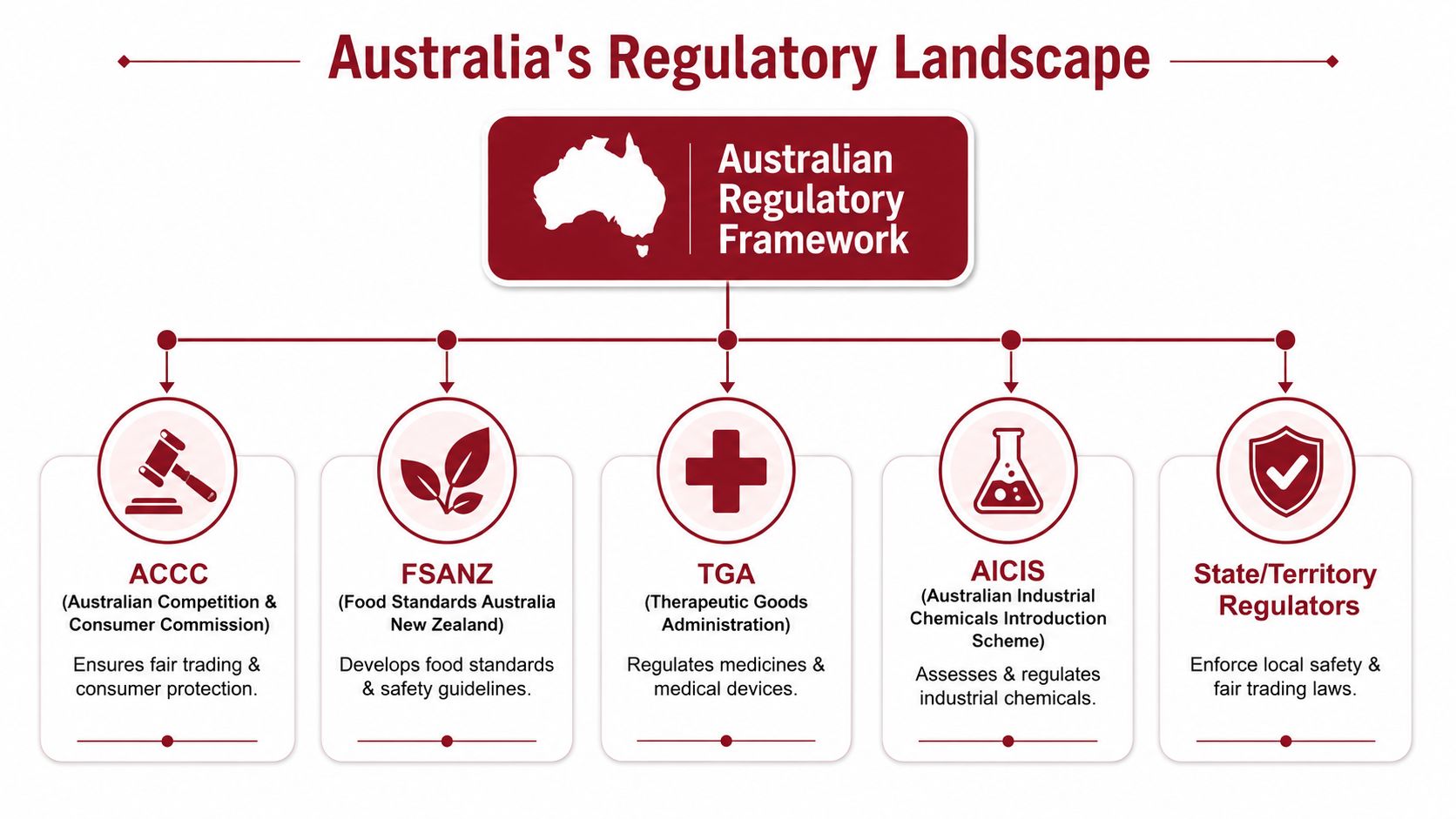
Who governs what in practice
The agencies matter, but the commercial question is how their roles intersect on your SKU.
| Regulatory body | Practical relevance to labelling |
|---|---|
| ACCC | Oversees consumer law issues such as truthful claims, misleading conduct and standards affecting product presentation |
| FSANZ | Sets food standards that affect food composition, mandatory panels, allergens and other food label content |
| AICIS | Relevant when cosmetics or chemical-based products enter Australian market requirements |
| TGA | Becomes critical when product claims move into therapeutic territory |
| State and territory regulators | Enforce applicable local safety and fair trading obligations |
| Trade measurement framework | Controls how quantity information appears, including format and metric expression |
One issue we repeatedly observe is that internal teams split these responsibilities too narrowly. Legal reviews the claim language. Packaging checks dimensions. Procurement sources labels. Regulatory checks ingredients. Nobody owns the whole pack as a commercial control point. That's where costly misses happen.
A compliant launch usually comes from one integrated decision process, not five separate departmental approvals.
Stronger operators map the full compliance path
The better approach is to scope Australian rules in layers before artwork starts.
- Classify the product correctly. Food, cosmetics, household chemicals, devices and therapeutic-adjacent products all trigger different label obligations.
- Identify the governing stack. Don't stop at the obvious regulator.
- Test claims against category status. Marketing language can alter the regulatory position.
- Review quantity, origin and mandatory disclosures together. These aren't separate design details.
- Tie the label back to importer accountability and documentation.
That's why brands entering Australia often need disciplined compliance documentation planning before they think about final packaging artwork. The label isn't just what the customer sees. It's where your internal governance becomes visible to everyone else.
Universal Labelling Mandates for All Products
Once the regulatory map is clear, the next question is simpler. What must almost every packaged product get right, regardless of category?
Australian labelling ceases to be abstract. Most failures aren't exotic. They come from missing fundamentals that should have been locked before packaging goes to print.
The non-negotiables on pack
For many packaged goods sold in Australia, the label must satisfy trade description, metric quantity, and anti-misleading claims rules under the Australian Consumer Law and Border Force import rules. Quantity must be stated on the main display panel in metric units, and the information must be true, prominent and not obscured by optional marketing copy. For imported goods, a compliant trade description is required before release into the market. In category-specific sectors, food labels require nutrition and allergen information, cosmetics must list ingredients in descending concentration order using INCI names, and mandatory warnings may apply for hazardous or flammable formulations (National Retail Association product labelling overview).
That single fact pattern carries a lot of operational weight. It means the main display panel cannot be treated as brand territory alone. It's regulated space.
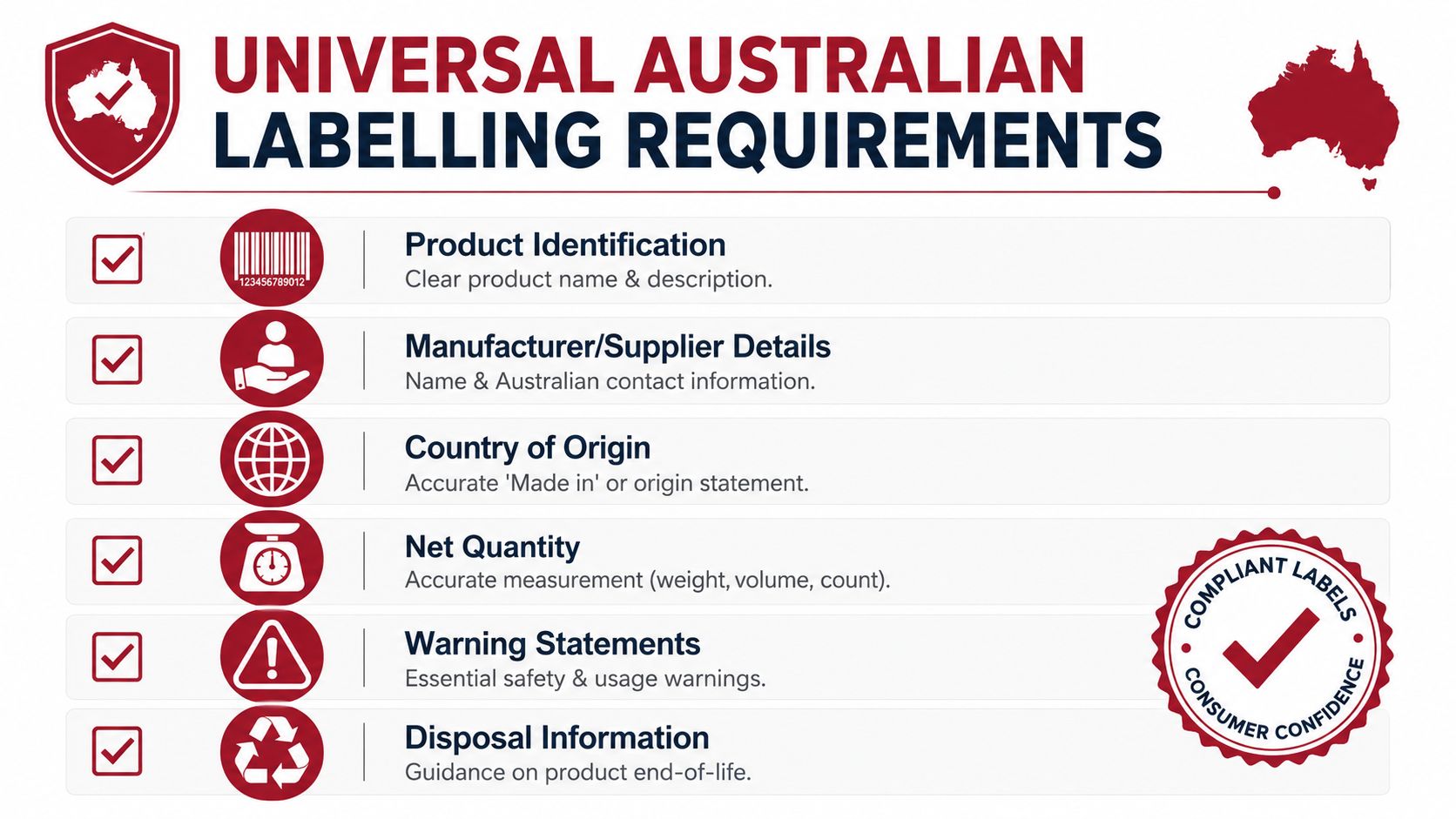
The universal labelling baseline usually includes the following:
- Clear product identity: The item must be identifiable as the product being sold, not just as a branded object.
- Accurate quantity statement: Weight, volume or count must appear correctly and in metric units where required.
- Truthful origin representation: If you make an origin claim, it has to stand up.
- Local supplier or importer details where required: The Australian market expects accountability that can be traced locally.
- Mandatory warnings or ingredient details where the category demands them: These can't be buried under marketing language.
- Trade description readiness for imports: Border release depends on more than good design.
What works and what doesn't
The labels that work in Australia usually share a few traits. They're designed with hierarchy in mind. Mandatory information is planned early, not squeezed in after the brand team has filled the front, sides and base with campaign copy. Quantity declarations are visible. Legal text is legible. Claims are restrained enough to stay inside the intended classification.
What doesn't work is the “global master artwork plus local sticker” mindset unless that approach has been designed very carefully from the start. It often creates visual clutter, weakens trust and increases the chance that mandatory information is obscured, inconsistent or physically impractical once the product is packed.
A recent marketplace review revealed another recurring issue. Teams often approve packaging digitally without checking how the printed pack reads in hand, on shelf, or in a fulfilment environment. A claim that seems visible on a screen can disappear once curved packaging, shrink wrap or reflective substrates enter the equation.
Operational reality: If the mandatory copy only works in the artwork file, it doesn't work.
Universal rules still need local interpretation
Founders should think commercially, not just legally. Every mandatory element takes up space, affects front-of-pack decisions and can influence unit economics if a new carton, bottle, tube or label format is required.
That's one reason packaging review should sit alongside sourcing, importer structure and risk planning, not after them. The same businesses that invest early in compliant label architecture also tend to think more clearly about product liability insurance considerations and broader market-entry governance. In Australia, those decisions connect.
Category-Specific Compliance Deep Dives
Category rules decide whether a product is market-ready or stuck in revision loops.
This is the point where Australian labelling stops looking like a legal checklist and starts exposing how disciplined the wider business really is. A brand can have strong design, good demand forecasts and capable distributors, then still lose time because the product category was scoped too loosely at the start. In practice, category compliance tests whether sourcing, claims, packaging, technical files and local accountability were built to work together.
Food and beverages
Food is often the first category where international brands realise Australia expects label claims to match operational truth. Country-of-origin rules, ingredient declarations, allergen disclosure, nutrition information and product naming all sit close to the commercial core of the pack. If one element changes, the others often need review too.
Australia's current country-of-origin food labelling system began on 1 July 2016 under the Country of Origin Food Labelling Information Standard 2016. It applies broadly across food sold through stores, markets, online channels and vending machines. Priority foods, including products such as meat, seafood, fruit, vegetables, most dairy, bread, breakfast cereal, nuts, honey and non-carbonated fruit juice, usually require the standard mark. Non-priority foods, including confectionery, biscuits, many snack products, bottled water, soft drinks, tea, coffee and alcoholic beverages, can often use text-based origin statements instead. The standard also narrowed the circumstances in which a business can rely on a “made in” claim. Minor processing is not enough.
That matters far beyond front-of-pack wording. Origin claims affect supplier selection, manufacturing steps, import planning and the evidence a business can hold if a retailer, regulator or customer asks questions. Food brands that treat origin language as marketing copy usually end up revisiting the supply chain itself.
Cosmetics and chemicals
Cosmetics create a different pressure point. The risk is often not missing information entirely, but presenting ingredients, warnings and performance claims in a way that shifts the product into a more sensitive regulatory category.
I have seen this happen with otherwise well-established beauty brands. The formula may fit a cosmetic pathway, but the pack starts promising treatment outcomes, physiological effects or therapeutic-style benefits. That single decision can create a classification problem that did not exist in the product brief.
Chemical-based consumer goods add another layer. For household cleaners, fragranced products, aerosols and flammable formulations, warning text has to work on the physical pack, not just in an artwork file. Legibility, placement and durability matter because the label has to survive freight, storage, handling and everyday consumer use.
Electronics and connected products
Electronics often look simpler than they are because there is less ingredient content to manage. The complexity sits in the product system. Product identification, Australian supplier details, safety information, technical markings, power specifications and user instructions need to align across the device, carton, inserts and digital support materials.
The state of ecosystem readiness becomes quickly evident. A consumer tech brand may localise its marketplace listing and paid media, then ship a product whose physical labelling still reflects the home market. Australia exposes that gap quickly because the issue is not one missing sentence. It is inconsistency across the product, packaging and support documentation.
Therapeutic-adjacent goods
Some of the hardest products to assess are not obviously regulated at first glance. Wellness products, topical relief items, recovery tools, supplements-adjacent goods and other consumer health products often sit close to a classification boundary.
In these categories, claims control is part of market-entry strategy. A small wording change on the pack can alter the compliance path, the evidence standard and the regulator that matters most. Strong brands set those limits early and keep packaging, ecommerce copy and campaign language aligned. They do not leave the boundary to creative interpretation late in the process.
Apparel, textiles and mixed-category products
Textiles and apparel can look straightforward, then become messy once they are bundled with cosmetics, accessories, care products or performance claims. Kits and gift sets are a common failure point because the outer pack may need to represent more than one product type accurately.
Mixed-category packs also expose ownership problems inside the business. One team approves the garment labelling, another team manages the accessory, and nobody checks whether the outer packaging creates a new disclosure issue. That is less a packaging mistake than a coordination failure.
| Product category | Primary regulator(s) | Key labelling considerations |
|---|---|---|
| Food and beverages | ACCC, FSANZ, related enforcement bodies | Origin marks or statements, nutrition information, allergens, ingredient visibility, claim control |
| Cosmetics | ACCC, AICIS | Ingredient listing, local supplier accountability, claim discipline, warning statements where relevant |
| Household chemicals | ACCC, AICIS, other applicable safety frameworks | Ingredient and warning requirements, hazardous or flammable statements where applicable |
| Electronics and connected products | ACCC and product-specific regulatory frameworks | Product identification, importer details, technical markings, safety information, instruction alignment |
| Therapeutic-adjacent goods | TGA where classification triggers apply | Claim sensitivity, product classification, packaging language controls |
| Textiles and mixed bundles | ACL and product-specific requirements | Fibre or care obligations where applicable, bundled-product clarity, outer-pack information consistency |
Where Strong Brands Fail on Australian Labelling
The brands that struggle most in Australia usually aren't careless. They're overconfident.
They assume their existing packaging system is mature enough to absorb one more market with minor edits. Then the edge cases appear. A required detail doesn't fit the carton. An imported pack names the global brand owner but not the correct Australian supplier. A portion pack inside a multi-unit format needs attention nobody scoped. Suddenly the issue isn't the label file. It's the operating model behind it.
The copy-paste problem
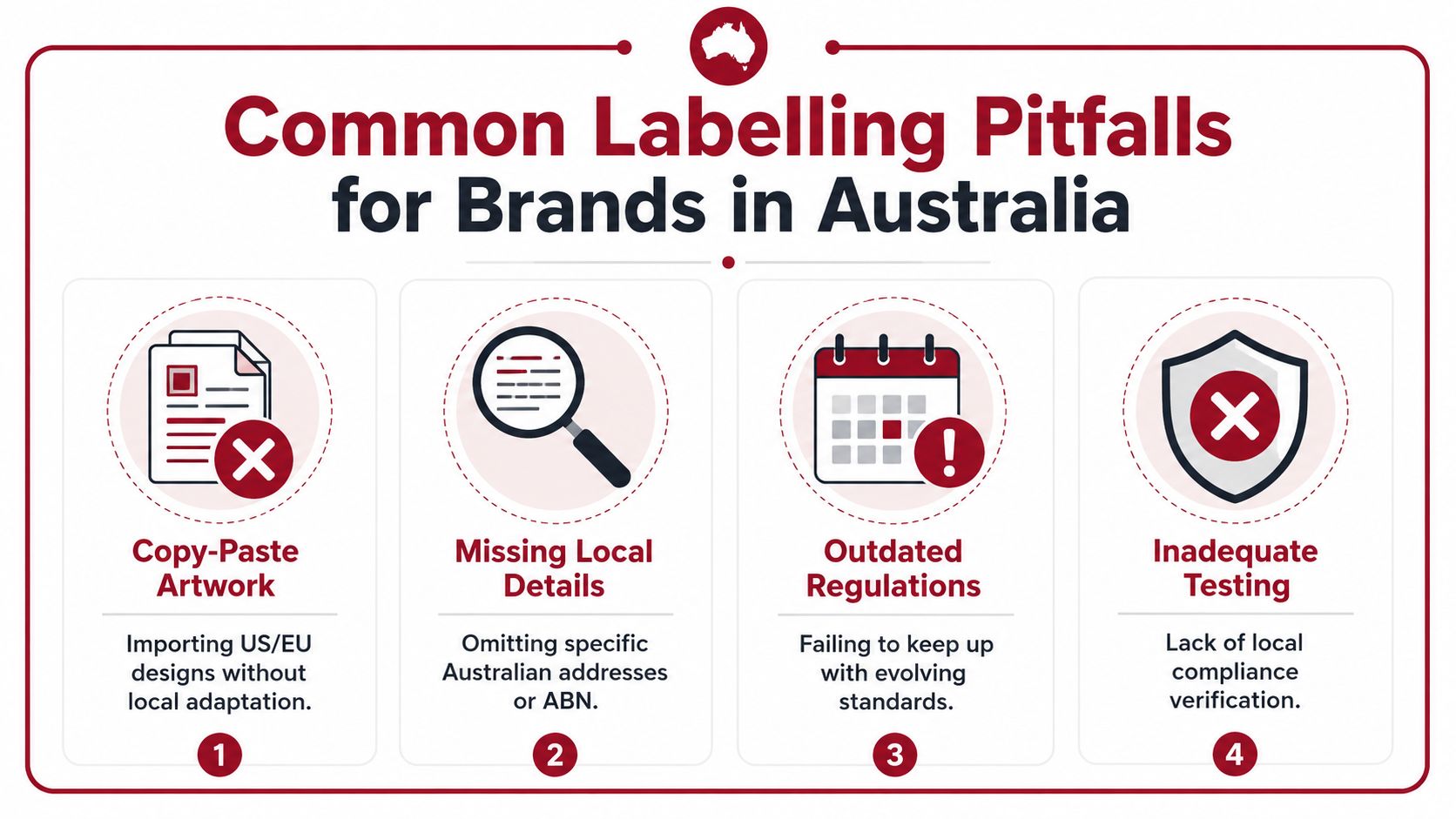
One issue we repeatedly observe is direct reuse of US or EU artwork. The design may be strong, but it often carries the wrong assumptions about quantity display, origin language, local contact details or warning hierarchy. These aren't cosmetic tweaks. They affect whether the product is market-ready.
The second failure is organisational. Teams often don't know who owns the final compliance sign-off. Brand approves aesthetics. Operations approves print timing. The importer assumes legal has reviewed the local details. Legal assumes packaging has the latest requirements. The gap sits in the handoff.
A label rarely fails because nobody worked on it. It fails because too many people worked on only their own part of it.
Packaging architecture creates hidden risk
Many guides stop at generic ACL advice, but multi-layer packaging is where practical confusion starts. NSW Food Authority notes that only one label is generally required when a product has more than one layer of packaging, yet portion packs not intended for individual sale with a surface area of 30 cm² or greater must be individually labelled. It also lists exceptions where packaged food does not need a label at all, including assisted-service display cabinets and some fresh produce (NSW Food Authority labelling laws guidance).
That matters because a packaging decision can change the compliance burden. Inner packs, refill formats, bundles, club packs and service-channel versions may not all follow the same logic. What works on a single retail SKU may fail once the same product is sold in a multipack or in a channel where the unit presentation changes.
Failure patterns worth pressure-testing
The most common friction points tend to look like this:
- Imported artwork without local adaptation: Mandatory details are missing, badly placed or visibly patched in.
- Wrong address logic: The brand prints a mailing address or foreign contact detail when the market expects local accountability.
- Packaging too small for mandatory content: Teams choose a format before calculating whether the required information can be presented clearly.
- Inner pack neglect: Multi-layer packaging gets assessed only at the outer-carton level.
- Claim sprawl: Marketing language expands faster than regulatory review.
Strong operators pressure-test these points before purchase orders lock. Weak ones discover them after inventory exists.
Building Your Australian Compliance Roadmap
The most reliable launches follow a sequence. Not because Australia is unusually difficult, but because packaging decisions touch too many parts of the business to improvise.
Stage one begins with classification
Start with the product itself, not the artwork.
Identify what the product is in regulatory terms, what claims it makes, which authorities are likely to care, and whether the same SKU will be sold across retail, marketplace and distributor channels in the same form. If you get classification wrong, every later packaging decision sits on unstable ground.
Stage two sets local accountability
Under Australia's Food Standards Code, food labels must carry a lot or batch identifier for traceability, plus the supplier's name and Australian street address. PO boxes are not permitted, and the same address rule also aligns with National Trade Measurement Regulations. For imported products, that matters because the label must support post-market recall execution and physical identification of the legal supplier in Australia, not just the brand owner. Wine guidance shows how technical this can become in practice, with a standard 750 mL bottle requiring a minimum character height of 3.3 mm, and larger containers scaling to 4.8 mm for sizes above 360 mm (Wine Australia guide to requirements).
That's why importer-of-record decisions should be made before artwork finalisation. The label needs to reflect the legal and operational reality, not a placeholder assumption.
Stage three verifies artwork against reality
This stage is where strong brands separate intent from execution.
- Review the hierarchy on the actual pack format. Curved surfaces, seals, folds and finishes change legibility.
- Check each mandatory field against the final market version. Don't rely on a global master file.
- Validate print feasibility before procurement commits. Small-format packs create predictable compression problems.
Stage four audits the launch path
Before inventory moves, audit the whole chain. Confirm the label version matches the approved SKU, the importer setup, the sales channel, and the product presentation the customer will receive. One mismatch between the listing, the shipper, the inner pack and the retail unit can create unnecessary friction.
Founders thinking about selling on Amazon Australia as part of a broader market-entry plan should treat this as ecosystem preparation, not just compliance administration. The label is one of the few places where legal accuracy, customer trust and supply-chain control become visible all at once.
TPR Brands helps established product companies enter new markets with the operational structure those markets demand. If you're assessing Australian expansion and need a commercially grounded view of packaging, compliance, channel fit and marketplace readiness, speak with TPR Brands.