Most advice about products like Smilie teeth whitening starts in the wrong place. It starts with the device, the gel, the before-and-after promise, or the speed of the treatment cycle. That's consumer framing. It misses the harder commercial question.
A whitening kit can look simple and still be structurally difficult to scale.
One pattern we continue seeing across multiple marketplace ecosystems is that wellness brands gain strong local traction by selling convenience, visual results, and perceived professional-grade outcomes at home. Then they try to expand and discover that the product wasn't the whole business model. The business model was local regulation, local trust signals, local claims language, local fulfilment confidence, and local category expectations all working together.
Smilie teeth whitening is a useful case study because it sits inside a category that appears highly transferable. The offer is easy to understand. The format is familiar. The value proposition is obvious. Yet the moment a brand tries to move this sort of product across borders, the pressure shifts from marketing to structure.
The Local Hero Problem in Wellness Brands
Domestic success often creates false confidence.
A wellness brand can build strong demand in one market because the proposition matches local buying behaviour. The audience understands the category, reviews accumulate, content performs well, and repeat purchase patterns start to form. Founders naturally read that as proof the brand is ready for broader expansion. In practice, it often only proves the brand is well matched to one commercial environment.
That distinction matters in at-home whitening.
Why the category looks easier than it is
At first glance, whitening kits travel well. They're compact, visually demonstrable, and easy to explain in paid media, marketplace copy, and creator content. The promise is immediate enough to attract impulse buyers, but functional enough to sit inside a repeat-use wellness routine.
The hidden issue is that buyers don't only purchase the formula. They purchase confidence in safety, legitimacy, and suitability. That confidence is built differently in every region.
Across multiple marketplace ecosystems, the same product can be read as premium, risky, cosmetic, or quasi-clinical depending on the local regulatory setting and the language surrounding it.
One issue we repeatedly observe is that brands overestimate how much of their home-market authority will transfer. It usually won't. Reviews from one market don't automatically create trust in another. Packaging that feels clean and persuasive in Australia may feel under-explained elsewhere. Claims that convert locally may become liabilities when copied internationally.
The real expansion challenge
The whitening category exposes a broader pattern. Strong products don't become strong international brands by default. They become strong international brands when the surrounding ecosystem is rebuilt with intent.
That means asking different questions:
- Claims discipline matters as much as creative performance.
- Localisation depth goes beyond spelling and currency.
- Operational fit shapes whether the product feels legitimate in-market.
- Marketplace presentation must align with category norms in each region.
This is the same commercial pattern visible in other product-led categories, including those discussed in TPR Brands' analysis of ecosystem fit and market context. Products that win locally often rely on structural advantages that founders don't fully see until expansion strips them away.
Deconstructing the At-Home Whitening Proposition
The commercial appeal of at-home whitening is often overstated as product innovation. In practice, the category wins because it compresses a clinical-looking routine into a consumer-friendly format that is easy to buy, easy to demonstrate, and easy to repeat.
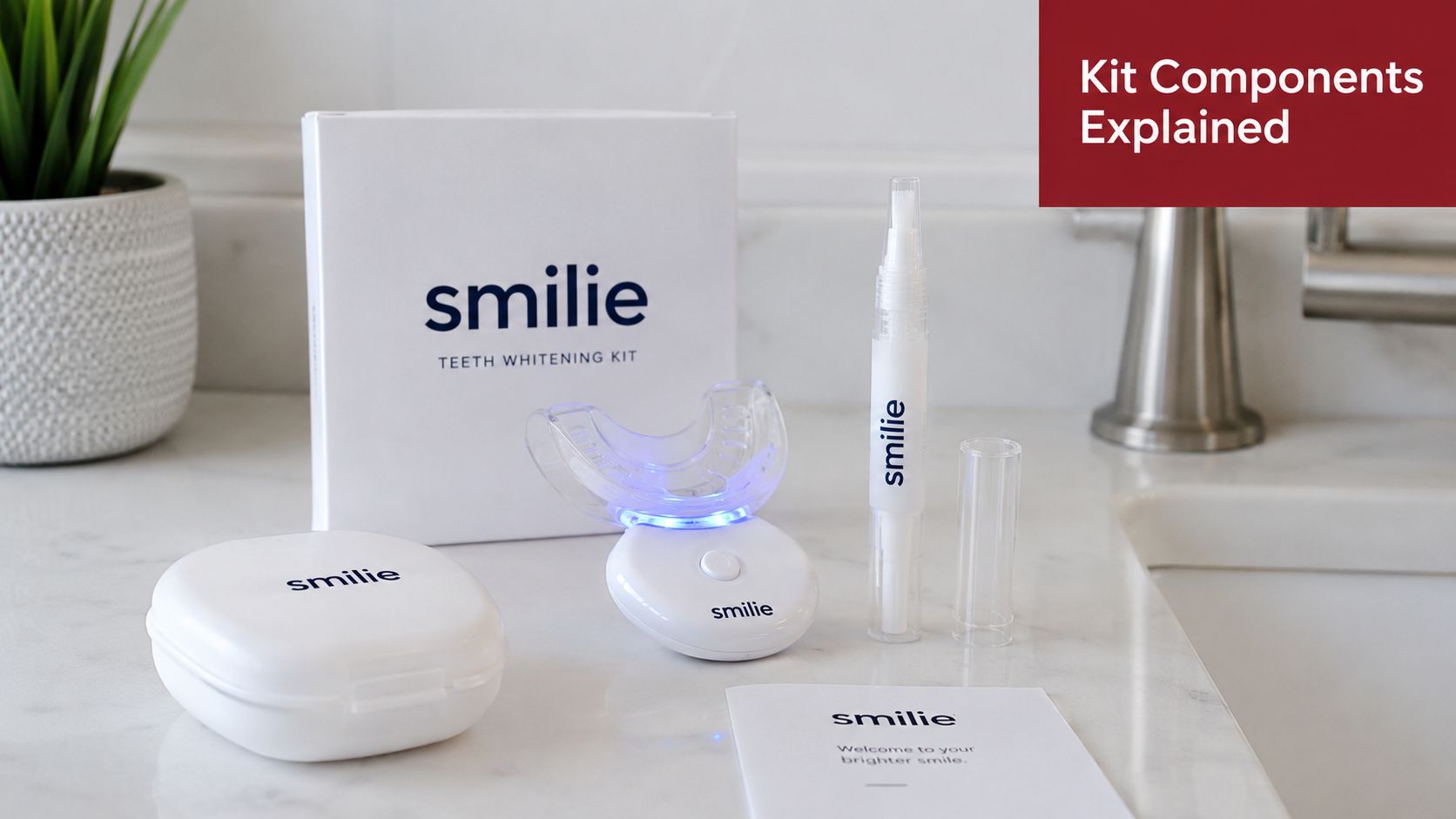
Smilie is a useful case study because the proposition is tightly packaged. An LED device, gel pen, and tray format create a treatment system that signals more intent than whitening toothpaste and less friction than an in-clinic service. For founders, that middle ground is attractive because it supports premium pricing without requiring the operating model of a dental provider.
The proposition is a system, not a single product
Consumers are not only buying whitening gel. They are buying a guided ritual with visible product cues that make the treatment feel higher value and more credible.
| Component | Consumer interpretation | Commercial function |
|---|---|---|
| LED light device | Technology, speed, clinical influence | Supports premium pricing and visual differentiation |
| Gel pen format | Controlled application, less mess | Strengthens convenience and usability |
| Tray-based application | Full-mouth treatment | Makes the offer feel more complete than strips |
| Timed routine | Simplicity and commitment | Improves compliance and repeat use |
The category sells well in channels where attention is short. On a marketplace listing, paid social ad, or retail shelf, the proposition can be understood in seconds. That is not a minor advantage. It reduces the educational burden that usually slows conversion in wellness.
What buyers are paying for
Its true value is reduced decision complexity.
A kit like this sits between professional whitening and low-intensity cosmetic products. That position is commercially powerful because it offers enough procedure to feel serious, while still fitting into a home routine. In brand terms, the product is doing three jobs at once. It borrows cues from clinical care, keeps the accessibility of direct-to-consumer beauty, and wraps both in a format that looks giftable and easy to use.
Founders often focus on the ingredient or the device. The stronger commercial question is whether the entire system feels trustworthy, simple, and controlled across every customer touchpoint. That is why clear quality assurance standards for wellness products matter well before international scale. If the ritual feels inconsistent, the premium disappears fast.
The category trade-off founders underestimate
At-home LED whitening performs well because it promises four things at once:
- home convenience
- visible improvement on a short timeline
- technology cues that suggest stronger performance
- a lower-friction alternative to dentist-led whitening
Each promise helps conversion. Each one also creates exposure.
The more a brand relies on speed, visible transformation, or quasi-clinical signals, the more carefully it has to handle substantiation, instructions, market classification, and post-purchase expectation setting. That is the hidden structural issue in this category. What looks like a simple beauty product at launch can start behaving like a regulated trust product as soon as the brand expands or scales into stricter channels.
For Smilie, the proposition is commercially strong because the format is legible and the use case is clear. The challenge is that this kind of offer does not travel internationally on presentation alone. It has to survive different local assumptions about safety, efficacy, cosmetic claims, and what consumers believe an LED-assisted whitening system should do.
Formulation Science and Efficacy Claims
Formula is where whitening brands stop being a creative exercise and start becoming an evidence management exercise.
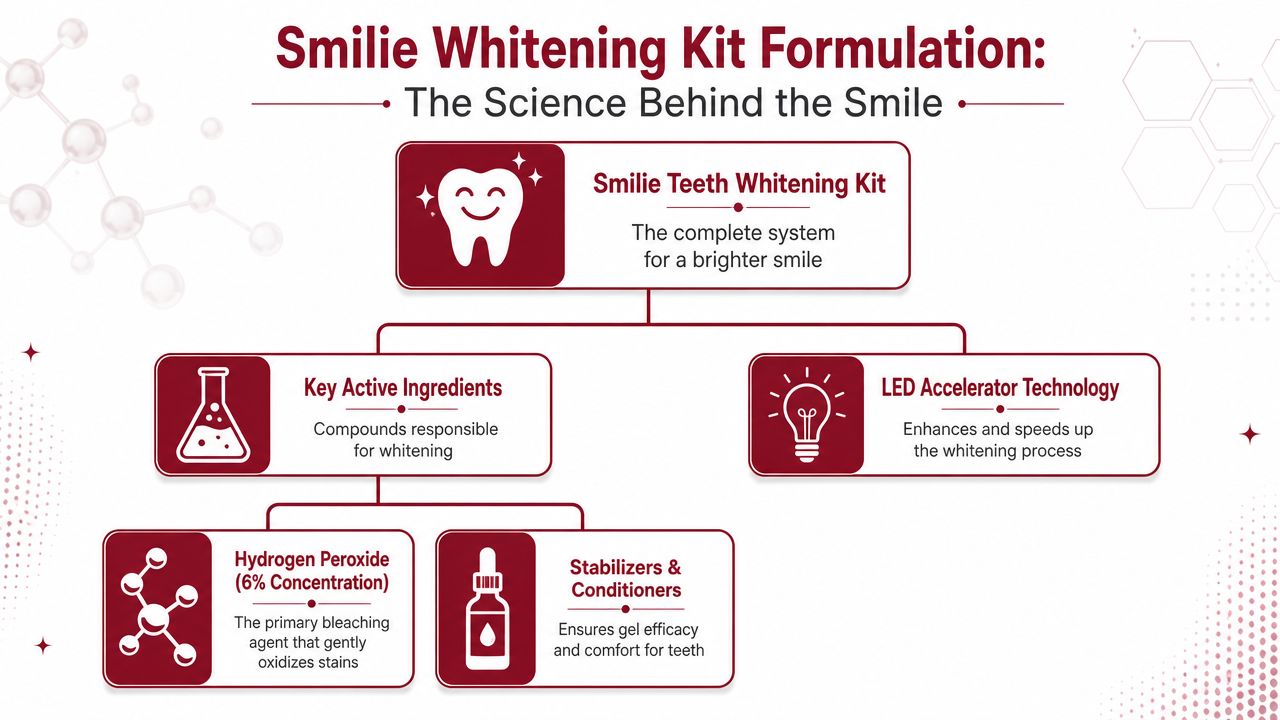
For Smilie, the commercial proposition rests on a familiar but difficult combination: 6% hydrogen peroxide, enamel-safe positioning, and “zero sensitivity” messaging. That mix sells because it addresses the category's biggest objection in one line. It also raises the standard for substantiation. Once a brand pairs peroxide-based whitening with strong comfort claims, formulation decisions, testing standards, and wording discipline all come under more scrutiny.
The trade-off founders have to respect
Whitening systems rarely win on speed, comfort, and universality at the same time.
Higher peroxide exposure can support more visible whitening. It can also increase the chance that some users report transient sensitivity, gum irritation, or uneven experiences depending on baseline enamel condition, application accuracy, and adherence to instructions. Lower-intensity, comfort-led systems can widen appeal, but they often shift the commercial burden elsewhere. Results may depend more heavily on repeat use, disciplined routines, and careful expectation setting after purchase.
That is why formulation cannot be separated from protocol design. In Smilie's case, the treatment cycle, session length, and desensitising components are part of the efficacy story, not supporting details. The product only feels credible if the chemistry, device timing, and user instructions work as one system. AU media coverage of the treatment cycle and product claims shows how tightly those elements are packaged into the promise.
Where claim strategy usually gets exposed
Founders often treat claims as copywriting. In practice, claims set the operating model.
A whitening brand has to choose which promise carries the range and which compromises it is prepared to accept in public. That usually means deciding whether the lead message is:
- visible speed
- low-sensitivity use
- enamel protection
- device-led credibility
- routine simplicity
Those choices shape more than ads. They affect what customer support needs to explain, how marketplaces review listings, how retailers assess risk, and how often a “worked differently than expected” complaint turns into a refund request.
LED adds another layer. It is visually persuasive and commercially useful because it signals modernity and higher performance. But the device does not rescue a weak claims strategy. If the gel system, wear time, and instructions do not produce outcomes that consumers consider believable, the LED becomes packaging theatre rather than product proof.
A whitening formula is also a claims architecture, a support burden, and a channel risk profile.
That is where internal discipline matters. Internationally scalable brands document why the formula was built this way, what each claim is based on, how tolerability language is qualified, and where usage boundaries sit for different customer profiles. Structured quality assurance standards for wellness products help keep that discipline intact as the business moves from one hero market into broader distribution.
International Compliance and Localisation Friction
International expansion usually breaks a whitening brand long before product demand does.
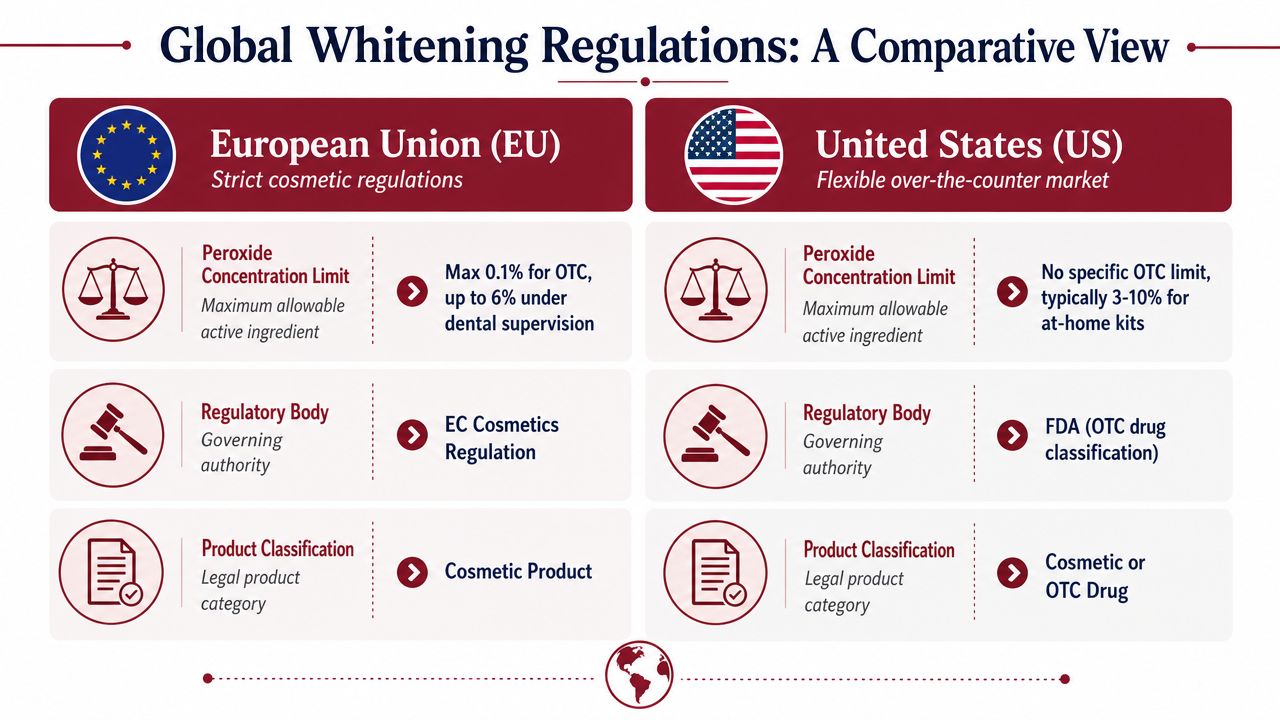
The failure point is rarely the LED tray or the carton design. It sits in the less visible layer: ingredient rules, claims thresholds, warning language, device classification questions, and the local standard for what counts as responsible consumer guidance. In at-home whitening, Smilie is a useful case because the commercial proposition is easy to export, while the compliance logic behind it is often not.
Compliance friction is rarely visible in the hero market
A brand can look disciplined in its home market and still be structurally underprepared for cross-border rollout.
That pattern shows up fast in whitening because the category sits close to health-adjacent risk. A formulation and message set that feels routine in one country can trigger a different level of scrutiny elsewhere, especially once the brand starts talking about comfort, suitability, repeat use, or who the product is for. Founders often underestimate how quickly a strong conversion message becomes a regulatory liability when it crosses into a market with different norms around self-treatment and consumer protection.
Sensitivity positioning is a good example. It may convert well, but expansion raises harder questions than ad performance. The issue is whether the wording remains supportable for consumers with enamel wear, prior dental work, orthodontic history, or pre-existing sensitivity, and whether the instructions explain when not to continue using the product. As noted earlier, product-led category content often gives more space to ease and convenience than to contraindications, edge cases, or discontinuation behaviour.
What localisation actually changes
Localisation changes the operating model.
A whitening brand entering a new region may need to reassess:
| Commercial layer | Why it changes by market |
|---|---|
| Claims wording | Regulators and marketplaces scrutinise efficacy, tolerance, and safety language differently |
| Warning labels | Local standards for risk disclosure and consumer instructions vary |
| Product instructions | Use patterns, treatment cadence, and acceptable framing differ by region |
| Support scripts | Customer care needs answers that reflect local suitability concerns and complaint risk |
| Retail and marketplace categorisation | Platforms and retailers may classify the product differently, which affects approvals and listing stability |
The commercial lesson is simple. Local trust is procedural. It comes from meeting the local version of normal across listing copy, pack language, customer support, and post-purchase guidance.
That is why localisation work cannot be treated as translation plus revised artwork. Brands that travel well usually rebuild the full go-to-market layer for each region, especially in categories where product safety and perceived efficacy sit close together. The wider issue is not whether the brand can enter a market, but whether it can feel credible there. TPR Brands is one operator in this wider space that works on those ecosystem shifts rather than just front-end listings, especially where marketplace localisation affects whether products feel native to a region.
Consumer Experience and Managing Expectations
Expectation management does more commercial work in whitening than creative direction. A polished kit can still underperform commercially if the buyer expects a dramatic colour change from a short, fixed routine.
Smilie sells a disciplined convenience proposition. The Australian presentation emphasises a short session length, a defined use cycle, a set number of treatments, and strong review volume. Those signals help conversion. They also create a narrow tolerance for disappointment if results arrive slowly, plateau early, or vary by user.
The gap between perceived speed and real outcomes
Independent dental research paints a more restrained picture of over-the-counter whitening. The review found that outcomes are often incremental, can take time to become noticeable, and usually involve lower sensitivity than in-office bleaching, while still producing visible change for some users after an early treatment (independent review of whitening outcomes and sensitivity patterns).
That gap matters.
Consumers do not buy whitening as a technical formulation decision. They buy a visible outcome. The problem for brands is that whitening results are uneven by design. Surface stains, age-related discolouration, enamel condition, restorations, and adherence all shape the result. A founder can write clean conversion copy around speed and simplicity, but support teams deal with the harder conversation later. Why did one customer see a quick lift while another saw almost none?
A closer look at the product positioning is useful here.
Reputation in this category is built after purchase
The strongest operators in this segment treat post-purchase guidance as part of the product, not a support cost. That usually means four things.
- They set a realistic assessment window so customers know when to judge progress.
- They explain variation clearly without sounding evasive.
- They screen suitability carefully for users with existing dental concerns, sensitivity history, or visible dental work.
- They keep listing copy, pack instructions, and support responses aligned so the customer hears one consistent version of the promise.
That discipline protects more than reviews. It protects unit economics.
Returns rise when a buyer interprets “visible results” as “fast, dramatic, and universal.” Complaint rates rise when instructions feel lighter than the claim. Marketplace friction increases when dissatisfied customers frame the issue as ineffectiveness or irritation rather than normal category variance. In cross-border expansion, those small failures stack up quickly because every market has a different tolerance for cosmetic disappointment versus perceived product risk.
This is also where operational exposure starts to widen. Once a whitening brand sits close to cosmetic, personal care, and health-adjacent claims, founders need clear instructions, defensible support scripts, and suitable product liability insurance for consumer wellness brands. The category looks simple from the front end. The backend burden is heavier.
Ecosystem Positioning and Competitive Landscape
Smilie teeth whitening sits in a crowded but structurally interesting part of the oral care category.
It doesn't compete only with other LED kits. It competes with every alternative way a buyer can pursue a “whiter smile” outcome, including dentist-led whitening, strips, whitening toothpastes, charcoal products, pens, and no action at all. That matters because category success depends on where the product sits in the buyer's decision hierarchy, not just how it performs in isolation.
The category slot this product is trying to own
At-home LED kits usually occupy the middle ground.
They aren't the highest-authority option. They aren't the lowest-commitment option either. Their role is to offer a perceived upgrade from basic whitening products without the cost, friction, or clinical setting of professional treatment.
That creates a useful strategic comparison:
- In-office whitening carries professional authority and stronger perceived intervention, but it also carries more friction and a narrower comfort profile.
- Whitening strips and pens are easier entry points, but they can feel less thorough or less “serious”.
- Whitening toothpaste sits closer to maintenance than transformation.
- LED kits bridge convenience and perceived efficacy, which is why they're commercially attractive.
Why this positioning is commercially valuable
The middle of the market is where many wellness brands scale fastest because the value proposition is broad enough for mass appeal and premium enough for brand building.
But that middle is also unstable. Buyers compare across formats, not just within one subcategory. If the kit feels too cosmetic, it loses authority. If it feels too clinical, it loses accessibility. If it leans too hard on technology, it may invite scrutiny. If it softens claims too much, conversion can weaken.
The category winner usually isn't the product with the loudest promise. It's the one with the clearest role in the customer's mental comparison set.
In this context, ecosystem positioning becomes more important than feature stacking. A founder needs to know whether the brand is selling reassurance, convenience, visible improvement, premium self-care, or dentist-adjacent legitimacy. Most expansion problems begin when the answer changes from one market to another, but the catalogue presentation doesn't.
Next Steps for Brand Owners
Smilie teeth whitening is a good reminder that high-growth wellness products often look commercially portable right up until they're tested outside their home environment.
The product format is strong. The proposition is easy to communicate. The category has clear demand drivers. None of that removes the harder work. Founders still need to assess whether the formulation can travel, whether claims can survive regional scrutiny, whether support language handles edge cases properly, and whether fulfilment and presentation create trust in each destination market.
The strategic lesson is simple. Marketplace expansion is an ecosystem transition, not a listing exercise.
A brand in this category should pressure-test four things before pushing into new regions:
- Formulation viability across different compliance settings and claim thresholds.
- Localisation depth across instructions, warnings, creative language, and support flows.
- Operational consistency in packaging, documentation, replenishment, and quality control.
- Category positioning so the product's role remains clear against local alternatives.
One pattern we continue seeing is that founders spend heavily on acquisition before resolving structural friction. That usually creates expensive learning. Better brands do the reverse. They make the product, the claims, the compliance posture, and the marketplace presentation cohere first.
That's the difference between exporting a product and building a brand that can hold its shape internationally.
If you're assessing whether a proven consumer product can translate across Australia, the US, Canada, or the UK without losing margin, trust, or compliance control, TPR Brands works on that broader expansion question. The focus is on ecosystem fit, localisation, channel structure, and operational cohesion for established brands moving beyond domestic traction.