If you're asking how to win Adelaide online, the more useful question is different. How should Adelaide fit inside your Australian market structure if your brand already works elsewhere?
That distinction matters for hardware, home improvement, household, and durable consumer categories. Too much content around e commerce Adelaide treats the city as a standalone local play. Established brands don't need another narrow local play. They need a commercially sensible way to enter, test, fulfil, and scale without creating channel conflict, margin leakage, or a fragmented customer experience.
For national and international operators, Adelaide is often more valuable as a strategic operating point than as a simple website geography. It can function as a launch market, a fulfilment node, a merchandising test bed, or a controlled entry into broader Australian demand. But only if the business is designed that way from the start.
Framing the Adelaide Opportunity Correctly
The wrong framing is, “Can we sell in Adelaide?” The right framing is, “Does Adelaide improve our Australian commercial model?”
Australia is no longer an emerging online retail story. It is a mature digital buying environment. One industry source estimates Australians spent A$69 billion online in 2024, up 12% from 2023, with online commerce representing almost 20% of total retail spending. The same source says roughly 9.8 million Australian households made online purchases in 2024, which is why online demand now behaves like a core retail channel rather than a niche one (Australian e-commerce statistics from Spark Interact).

That changes the meaning of Adelaide. It's not just a South Australian city opportunity. It can be one component inside a much larger national demand pool.
Adelaide is more useful as a system choice
For a proven product brand, Adelaide can serve several different roles:
- A controlled Australian entry point if you're expanding from overseas and want a market that reveals operational gaps quickly.
- A regional fulfilment base if your category depends on service confidence, stock availability, or bulky-item logistics.
- A channel coordination point for balancing direct-to-consumer, marketplaces, and retail relationships.
- A localisation layer if your brand needs to adapt range architecture, pricing logic, or content presentation before national rollout.
One pattern we continue seeing is brands entering Australia with a city-first mindset when they need an ecosystem-first model. They launch a store, list products, run paid traffic, and then discover core problems sit elsewhere. Inventory placement is weak. Marketplace positioning is inconsistent. Retail pricing creates distrust. Service expectations vary by region.
Practical rule: Adelaide only becomes commercially important when it improves your national structure, not when it merely adds another sales endpoint.
That's also why marketplace participation can't be separated from the broader channel model. A brand exploring Amazon Australia expansion strategy shouldn't think of Adelaide as a local SEO target. It should think about how Adelaide supports stock flow, content control, and channel visibility across Australia.
Local presence isn't the same as market readiness
A local warehouse, local agency, or local office doesn't automatically create a scalable Australian business. Strong brands usually realise this early. They ask harder questions.
| Commercial question | Why it matters |
|---|---|
| Where should Adelaide sit in the fulfilment map? | This affects speed, freight cost, and customer trust. |
| Which channels should launch first? | The wrong sequence can create unnecessary ad dependence. |
| How will catalogue structure translate across channels? | Strong assortments often break when channel logic differs. |
| What role will Adelaide play in national expansion? | Without a defined role, local activity becomes expensive noise. |
The strategic opportunity in e commerce Adelaide isn't that the city is small enough to test. It's that it can be organised intelligently enough to support bigger ambitions.
Adelaide Market Dynamics and Ecosystem Maturity
Adelaide's online environment is mature enough to support serious operators, but not forgiving enough to reward lazy market assumptions. That's the difference many brands miss.
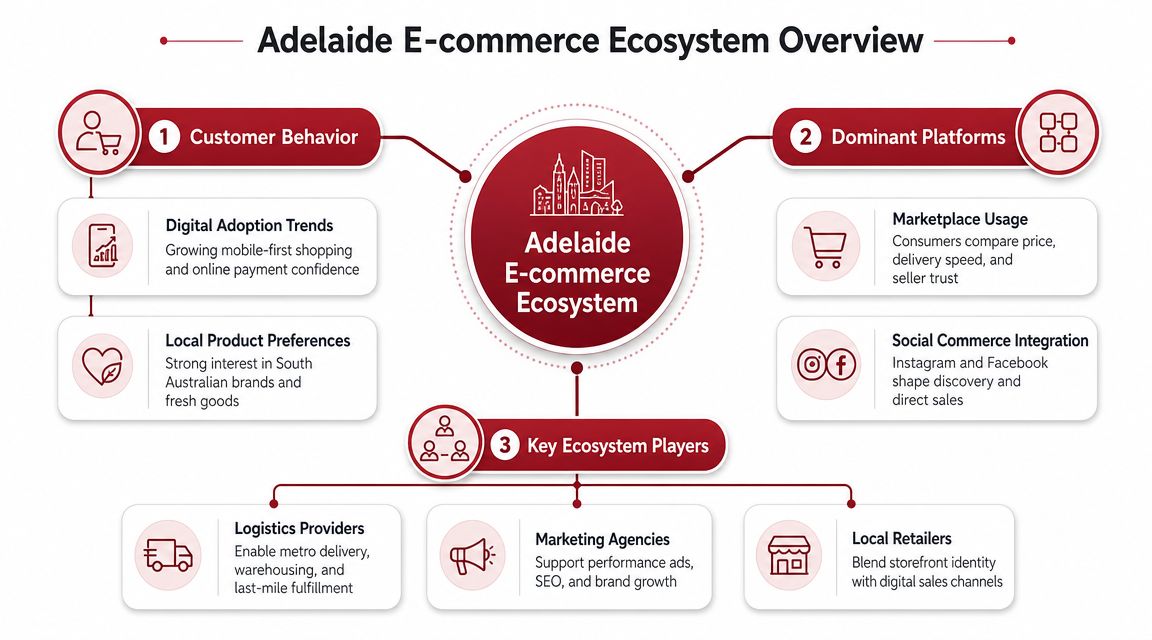
In practice, Adelaide sits inside a broader Australian buying system where customers move across brand sites, marketplaces, search, and retail expectations without caring how a business is internally organised. They notice whether the offer feels trustworthy, available, and coherent.
Trust is built differently across channels
For hardware, home improvement, and household categories, the customer doesn't evaluate every channel in the same way.
On a brand-owned site, buyers look for authority, product clarity, and confidence that the range is complete. On marketplaces, they look for consistency, availability, social proof cues, and pricing that doesn't feel disconnected from the rest of the market. Through retail and trade-adjacent channels, they often use the online experience as validation rather than the final point of purchase.
That creates a structural issue. Many brands think they have one online presence yet they have several competing versions of themselves.
A recent marketplace review revealed a pattern that appears across multiple product categories. The catalogue may be strong, but the ecosystem isn't. Product data differs by channel. Hero SKUs are overexposed in one place and absent in another. Bundles make sense on the website but not on marketplaces. Customers see the same brand through multiple windows and conclude, correctly, that the business hasn't fully decided how it wants to sell.
Customers don't experience channels separately. They experience one brand through several commercial surfaces.
Fragmentation usually arrives quietly
Adelaide offers an interesting example. The city's scale can make fragmentation harder to notice at first because early signals may still look acceptable. Orders come in. Traffic looks healthy enough. Retail conversations continue. Nothing appears broken.
Then the hidden costs show up:
- Margin erosion from duplicated channel effort and uneven pricing logic
- Slower product launches because content and merchandising aren't coordinated
- Customer hesitation when stock status, delivery expectations, or assortment differs by channel
- Internal confusion when sales, operations, and marketing teams optimise for different outcomes
For established operators, the point isn't to be everywhere. It's to make each channel perform a clear role.
Local nuance matters more than generic national planning
Adelaide also rewards brands that understand localisation at a structural level. That doesn't just mean spelling, currency, or shipping copy. It means deciding how the brand should feel inside a South Australian buying context while still fitting the national plan.
The strongest operators usually make decisions like these early:
| Decision area | Weak approach | Stronger approach |
|---|---|---|
| Range selection | Upload the full catalogue everywhere | Curate by channel role and demand behaviour |
| Pricing | Match broadly and reactively | Set pricing logic that protects trust and margin |
| Marketplace presence | Treat each marketplace as extra revenue | Use each one as part of a wider ecosystem position |
| Content | Reuse the same product copy | Localise based on buying context and channel behaviour |
That's where marketplace localisation for product trust becomes commercially relevant. Not as a content exercise, but as a way of reducing friction between brand intent and customer perception.
Adelaide isn't a beginner market. It's a market that exposes whether a brand's ecosystem is cohesive.
The Real Operational Challenge Fulfilment Beyond the Metro
A local Adelaide presence sounds like an advantage. Sometimes it is. Sometimes it's a costly illusion.
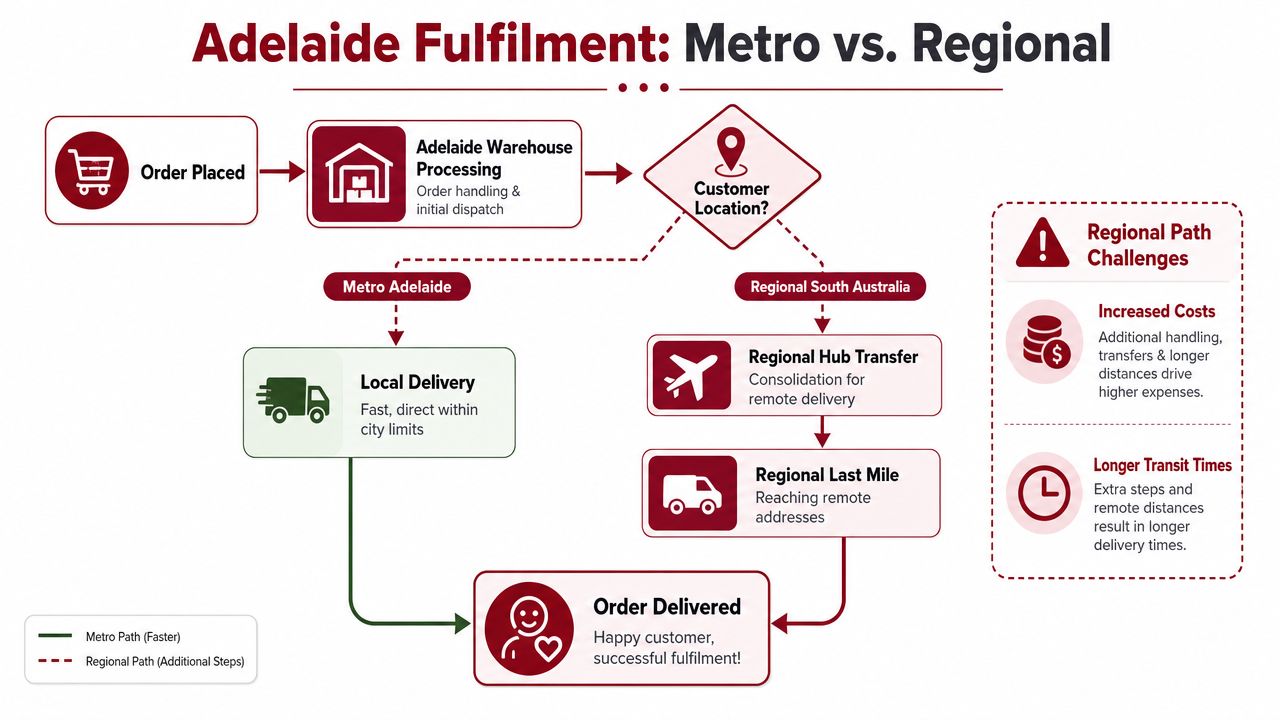
The most overlooked issue in e commerce Adelaide is what happens after the order is placed, especially once demand extends beyond metro Adelaide into broader South Australia. Australian ecommerce commentary notes that the country's large distances make same-day or next-day delivery across cities difficult and advises keeping stock as close to the customer as possible. It also highlights why a local warehouse alone does not solve regional demand coverage across South Australia (Australian e-commerce logistics challenges outlined by Keepspace).
The metro assumption is where many models break
One issue we repeatedly observe is brands designing fulfilment around office geography rather than customer geography. They set up in Adelaide, assume “local” means efficient, and then discover the model is only efficient for a narrow customer band.
That's manageable for low-friction categories with high margin tolerance. It becomes much harder for hardware, home improvement, and household products where order profile, package characteristics, replacement urgency, and service expectations create more operational pressure.
A single-node Adelaide setup can work. But it works best when the business is honest about what that node is meant to do.
When one Adelaide node makes sense
- Range control matters more than speed for the early stage of market entry
- Demand is being validated before broader inventory distribution
- The catalogue is selective, not sprawling
- Customer concentration is still clustered enough to justify central dispatch
When it becomes a margin problem
- Regional orders become meaningful and freight economics start drifting
- Delivery promises need to feel nationally credible
- Bulky or replacement-driven products create service sensitivity
- The catalogue expands faster than inventory logic
The contrarian point is simple. Being local in Adelaide doesn't automatically create a logistics advantage. Inventory design does.
Fulfilment structure influences brand perception
Founders often think of fulfilment as an operations topic. Customers experience it as a brand truth test.
If a buyer can't get a product when expected, or if shipping costs feel disconnected from order value, the brand loses trust even when the product itself is good. This matters more in practical categories than many marketing teams expect. Buyers don't separate product quality from stock reliability.
A stronger South Australian operating model usually asks questions like:
- Where does regional demand justify stock positioning?
- Which products need proximity because of urgency, weight, or replacement behaviour?
- Which carrier mix protects service quality without distorting margin?
- At what point does Adelaide need to plug into a wider national fulfilment network?
That's why international fulfilment strategy for growing brands is relevant even in a domestic discussion. The underlying issue is the same. Fulfilment architecture shapes commercial performance.
Smart operators separate presence from coverage
Many brands say they want South Australian coverage when what they really have is Adelaide presence. Those aren't equivalent.
A warehouse gives you a point on the map. A fulfilment strategy gives you a service model. Established brands need the second one.
Designing a Cohesive South Australian Channel Strategy
The bigger strategic question isn't whether to add more direct-to-consumer activity. It's whether another layer of direct-to-consumer activity improves the business at all.
Research on e-commerce adoption barriers makes an important point for established operators. Platform adoption works best when it solves a concrete business problem rather than merely adding another sales layer. Otherwise, businesses run into higher competition and higher advertising costs. The same analysis raises the core decision directly: for a proven local brand, is the stronger move more DTC traffic, or using e-commerce infrastructure to open new channels and geographic markets with more durable unit economics (analysis of e-commerce adoption barriers and channel trade-offs from Accion).
That tension is especially relevant in Adelaide because brands can mistake local online traction for channel strategy.
More DTC isn't always the smart next step
If a brand already has product-market proof, wholesale relationships, or retail credibility, chasing more website traffic may be the least efficient way to grow. It can increase customer acquisition pressure without solving the structural issues underneath.
A better question is whether the e-commerce layer can do heavier commercial work:
- support marketplace entry without damaging brand position
- improve sell-through in existing retail channels
- make regional demand visible
- open interstate expansion with more confidence
- create cleaner product data for wholesale and distribution partners
Many durable brands behave differently from fast-growth internet brands. They don't ask one channel to do everything.
Cohesion beats channel accumulation
Across multiple marketplace ecosystems, the businesses that scale cleanly usually treat channels as coordinated functions.
A South Australian channel model tends to become more resilient when it looks something like this:
| Channel | Primary role | Common mistake |
|---|---|---|
| Brand website | Brand authority, full-range control, account capture | Treating it as the only growth engine |
| Marketplaces | Demand access, discovery, availability signals | Listing too broadly without role clarity |
| Wholesale or retail partners | Volume, trust transfer, physical presence | Letting channel data remain disconnected |
| Distribution expansion | Geographic reach and operational leverage | Entering without a unified pricing and range logic |
That's why marketplace ecosystem strategy for established brands matters. Marketplace expansion isn't a listing exercise. It's an ecosystem transition.
A strong catalogue can still underperform if the surrounding channel system is pulling customers in different directions.
Adelaide can de-risk broader expansion
For hardware and home-improvement brands, Adelaide can be a useful proving ground for channel interaction. Not because it's small, but because it can reveal where the commercial model lacks cohesion.
You can see whether marketplace pricing destabilises wholesale conversations. You can see whether service expectations hold up outside metro zones. You can see whether the brand site supports channel confidence instead of merely existing beside it.
The businesses that use Adelaide well tend to learn one thing quickly. Sustainable growth comes from channel design, not channel accumulation.
Execution Capability and Regulatory Realities
Good strategy still fails when execution is casual. Adelaide has enough digital capability to support serious e-commerce operations, but that capability has to be organised around real commercial requirements.
Indeed lists 295 ecommerce/digital jobs in Greater Adelaide, and a representative role requires 3+ years' experience and proficiency in Adobe Creative Suite, which suggests the local labour pool is geared toward multi-channel digital production rather than simple storefront maintenance (Greater Adelaide ecommerce and digital roles on Indeed).
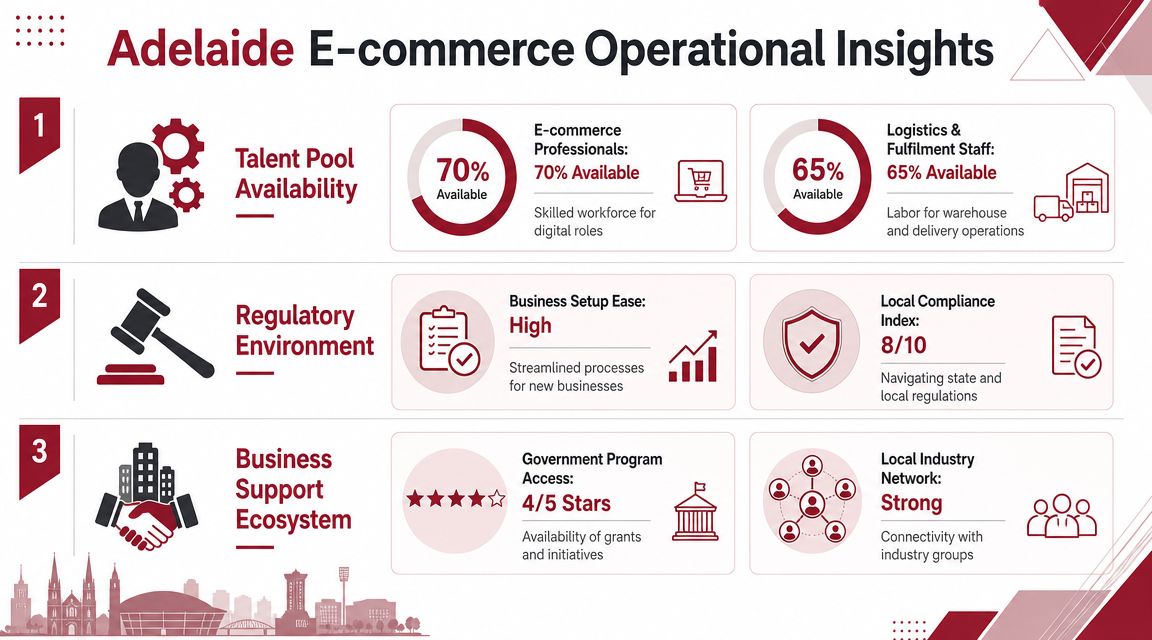
That's useful, but it doesn't remove the need for process discipline. Creative capability can improve content output. It won't fix weak catalogue governance, poor stock synchronisation, or inconsistent channel data.
Local capability is real, but it needs structure
Adelaide can support in-house or hybrid teams across content operations, merchandising support, automation, and digital production. That matters for established brands with enough catalogue depth to justify local execution.
The operational mistake is assuming talent availability equals commercial readiness. It doesn't.
What tends to separate stable operators from messy ones is whether they build structured workflows around:
- Catalogue enrichment so product information stays consistent across channels
- Compliance metadata for categories where specifications and claims matter
- Supply chain coordination so online availability reflects operational reality
- Channel governance so pricing and assortment don't drift
Cross-border pressure changes the standard
Australia doesn't operate in isolation. One trade source reports that about 20% of Australian e-commerce in 2024 came from cross-border purchases, and that the USA (47%) was one of the leading overseas sources for Australian shoppers in the same year. That matters because local operators aren't just competing with nearby brands. They're competing with overseas supply, international marketplace habits, and customer expectations shaped by imported offers.
For hardware, electronics-adjacent products, household goods, and regulated categories, this raises the execution bar. The business has to get the basics right:
| Execution area | Why it matters in practice |
|---|---|
| Consumer law alignment | Returns, representations, and customer communications need to be consistent |
| GST and pricing logic | Price presentation has to work across channels without creating distrust |
| Product compliance | Hardware and electrical-adjacent categories can't treat compliance as admin |
| Imported competition response | Brand trust and availability need to offset cross-border comparison behaviour |
Compliance work isn't separate from growth work
What becomes visible during international expansion is that compliance, fulfilment, and channel strategy are tightly connected. If product information isn't translated into channel-ready form, compliance slows listings. If pricing logic isn't settled, marketplaces create tension. If supply chain detail is weak, cross-border competition looks more reliable than the local brand.
Consequently, operator-led support becomes valuable. Some brands build this internally. Others use specialist partners. TPR Brands works on e-commerce and marketplace expansion for established product companies, particularly where channel structure, localisation, and international market fit need to align before scale.
Execution quality is rarely limited by effort. It's limited by how well the operating model connects content, compliance, stock, and channel decisions.
Adelaide can support execution. But it rewards businesses that treat operations as a commercial system, not as a collection of disconnected tasks.
Next Steps Building a Scalable Australian Presence
The most useful way to think about e commerce Adelaide is not as a local store project. It's as a market design decision.
Adelaide can be a smart entry point for established hardware, home-improvement, household, and consumer brands. It can help test assortment logic, support regional operations, and anchor a broader Australian rollout. But it only works well when it has a defined role inside a larger commercial system.
That means asking better questions at the outset.
The brands that scale cleanly usually decide five things early
- What Adelaide is for. A launch node, a regional service point, a brand-validation market, or part of a wider national inventory plan.
- How channels will work together. Website, marketplaces, wholesale, and distribution need complementary roles.
- Where fulfilment confidence comes from. Presence in Adelaide is useful, but coverage and service logic matter more.
- How the catalogue will stay coherent. Product data, pricing, and assortment need governance across channels.
- What operational detail must be localised. Compliance, delivery expectations, and cross-border pressure all shape execution.
Strong brands don't confuse activity with structure
This is the core lesson. Launching online activity in Adelaide is easy enough. Building a scalable Australian presence is something else entirely.
One pattern we continue seeing is that good products often arrive with fragmented execution. The website says one thing. The marketplace says another. Fulfilment promises don't match reality. Retail relationships sit off to the side. None of those problems look dramatic on day one, but they become expensive as volume grows.
The brands that protect margin and brand value usually move more deliberately. They build a channel system. They define inventory logic. They localise where necessary. They expand in a way that keeps trust intact.
Adelaide is valuable when it helps create that kind of structure. Not when it becomes another isolated growth experiment.
If your team is evaluating how Adelaide should fit into a broader Australian or international channel plan, TPR Brands works with established product brands to build structured expansion models across marketplaces, fulfilment pathways, and localised commercial ecosystems.