Most advice about Amazon profitability starts in the wrong place. It starts with the fee schedule.
That sounds sensible, but it creates a blind spot. Founders review referral fees, estimate FBA charges, and assume the economics are mostly understood. Then sales arrive, payouts land, and profit looks thinner than expected.
Amazon profit erosion is usually a story about cost layering, weak pricing discipline, inventory decisions, and expansion assumptions that weren’t stress-tested before launch.
Brands that scale well on marketplaces don’t treat Amazon as a simple sales channel. They treat it as an operating system with its own incentives, penalties, and margin traps. If you want durable profit, especially across borders, you have to model the full commercial reality, not just the line items Amazon shows first.
The Great Misdirection in Amazon Profitability
Founders often blame Amazon’s fees for shrinking margins because fees are easy to point at. They’re visible, published, and emotionally irritating. But the bigger issue is structural. Amazon’s marketplace was never built to make every seller comfortably profitable.
A useful way to understand that is to look at Amazon itself. Amazon Web Services represents about 15% of Amazon’s total revenue, yet contributes $93 billion to Amazon’s operating income, according to this Amazon revenue breakdown analysis. That gap matters. It shows how misleading top-line revenue can be when the underlying margin profile is completely different.
Revenue is not the same as economic quality
Retail and marketplace revenue can look impressive while carrying far thinner economics than founders expect. That’s why some brands celebrate early Amazon traction and still feel cash pressure a few months later. Unit movement improves. Revenue screenshots look strong. Profit quality deteriorates.
The marketplace rewards availability, price competitiveness, fast fulfilment, and constant visibility. Each of those requirements has a cost. Some costs are explicit. Others show up later through inventory ageing, discount pressure, freight inefficiency, or ad dependency.
Practical rule: If a channel looks easy to enter, it usually means the margin protection mechanisms are weaker, not stronger.
Many operators overlook this because they are trained to think as product creators rather than marketplace economists. They know their product is good. They know the domestic numbers work. They assume the channel will convert demand into profit.
It rarely works that cleanly.
Why early success often hides later problems
The pattern is familiar. A brand launches a focused SKU set, picks up reviews, sees decent conversion, and believes the model is working. Then complexity enters the system.
- Catalogue expansion adds slower-moving inventory
- Ad spend rises as competitors crowd search terms
- Operational exceptions increase through returns and stock balancing
- International launches introduce freight and compliance complexity
None of that feels dramatic on day one. That’s why the problem is easy to miss.
What works is disciplined profit visibility at SKU level and market level. What doesn’t work is treating Amazon payouts as proof of profitability. Payouts tell you cash moved. They don’t tell you whether the channel is strengthening the business.
The strategic shift founders need
The better question isn’t, “What are Amazon charging us?” The better question is, “What operating decisions are consuming the margin we think we have?”
That shift changes everything. It moves the conversation from complaint to control. You stop reacting to fees and start managing the full profit stack, including packaging, inbound freight, storage exposure, launch sequencing, pricing floors, and channel mix.
Founders who make that shift tend to build stronger marketplace businesses. They’re less surprised by erosion because they’ve already assumed friction is part of the model.
The Anatomy of Profit Erosion Beyond the Referral Fee
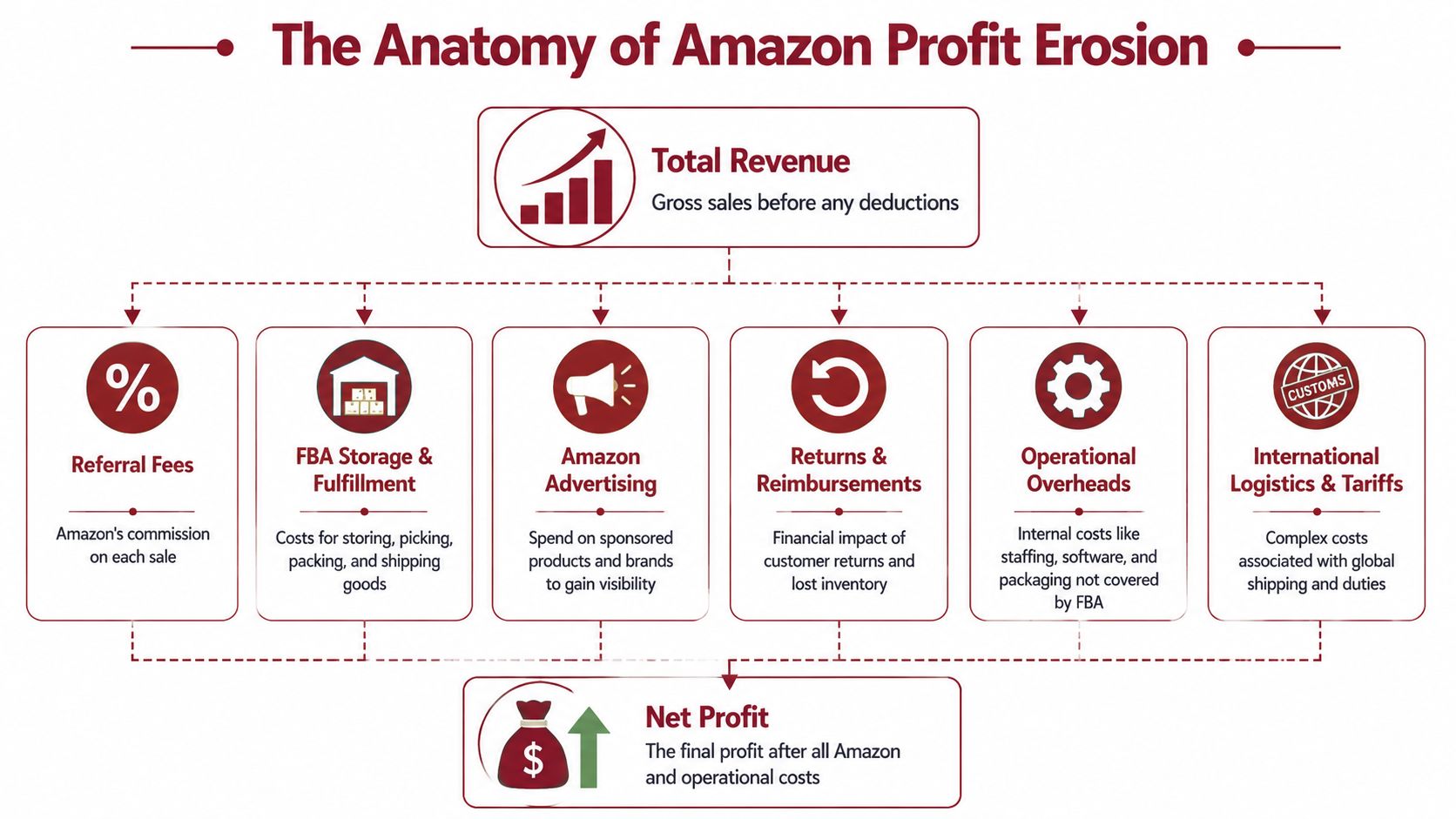
Amazon’s fee structure works like an iceberg. The part founders fixate on sits above the surface. The larger margin loss sits below it, spread across fulfilment mechanics, storage exposure, advertising pressure, and operational overhead that doesn’t appear in a simple fee estimate.
The visible charges are only the first cut
The referral fee gets most of the attention because it is easy to understand. But a workable profit model has to go further. According to this breakdown of Amazon profit analytics, sellers need to account for referral fees that are typically 15%, FBA fulfilment fees ranging from $2.50 to $15+ per unit, and long-term storage fees charged monthly at $6.90 per cubic foot for items stored over 365 days. The same source notes that a product with a $50 selling price and $20 COGS can lose 35-45% of gross margin to combined Amazon fees alone, before PPC advertising.
That’s the point many brands miss. The fee conversation isn’t wrong. It’s incomplete.
If you want a closer look at the published charges themselves, this guide to Amazon fee structures is a useful starting point. But for operators, the strategic issue is how those charges stack together over time.
Where margin usually slips away
A healthy Amazon P&L usually gets damaged through layering, not one catastrophic mistake.
- Fulfilment friction: Products with awkward dimensions, extra weight, or fragile packaging often carry worse economics than founders expect. On paper the item looks viable. In practice the fulfilment line keeps taking more.
- Storage drag: Slow sellers don’t just tie up cash. They attract fees, reduce flexibility, and force harder decisions later about markdowns, removals, or disposal.
- Advertising dependency: Many brands can launch with modest ad support, then find that maintaining rank requires more ongoing spend than the original plan assumed.
- Operational leakage: Packaging tweaks, prep requirements, software, team time, and account management all sit outside the neat FBA estimate but still hit profit.
The costs that rarely appear in casual models
Some of the most expensive margin mistakes come from expenses founders classify as “temporary” or “minor”. They aren’t.
Consider these examples:
| Cost area | Why it gets missed | Why it matters |
|---|---|---|
| Removal and disposal | Treated as occasional cleanup | It becomes material when inventory planning is weak |
| Reimbursement gaps | Assumed to balance out | They still require oversight and time to recover |
| Promotion funding | Filed under launch spend | Repeated discounting resets margin expectations |
| Packaging and prep | Buried in operations | It changes real landed profitability per unit |
A profitable Amazon business is usually the result of dozens of small controls held together well, not one clever pricing trick.
Founders often get caught here. They evaluate each cost in isolation. Amazon doesn’t operate that way. Amazon compounds cost interactions. A slightly oversized unit, held too long, supported by rising ad spend, in a listing that needs discounting, can turn a good product into a poor marketplace product without any single line item looking outrageous on its own.
What works and what doesn’t
What works:
- Model per SKU, not by catalogue average. Average margin hides weak products.
- Separate launch economics from steady-state economics. Early ads and promotions can distort reality.
- Review storage exposure before reordering. A product can be commercially sound and still be operationally wrong for FBA at a given time.
What doesn’t work:
- Using payout reports as a proxy for margin
- Assuming referral fees explain the whole problem
- Treating slow stock as a temporary inconvenience instead of a profit issue
Experienced marketplace brands understand how layered costs interact over time.
The International Expansion Blind Spot for Australian Brands
International expansion exposes weak margin logic fast. Australian brands often discover that only after they have committed stock, paid freight, and priced the range as if the home-market model still applies.
The error is usually upstream. Founders assume a product that works in Australia will remain commercially sound in the US once Amazon fees are added and demand is proven. In practice, the economics change before the first sale. Freight, duty treatment, local compliance, FX exposure, launch inventory positioning, and in-market service expectations all start pressing on margin at the same time.

The domestic model breaks first
I see the same pattern regularly. A founder builds a launch sheet using local COGS, a target retail price, and a rough Amazon fee estimate. The model looks healthy because the biggest international costs are either blended into a single line or ignored until later.
Later is where margin gets lost.
Freight comes in above plan. Currency conversion gets absorbed as “noise” instead of managed as a real cost input. Packaging and labelling need adjustment. Compliance requirements shift by market. Inventory timing becomes more critical because replenishment errors from Australia are slower and more expensive to correct than domestic mistakes.
For brands assessing Amazon seller expansion pathways, the fundamental work is not account setup. It is rebuilding the unit economics for the destination market from first principles.
Why Australian Economics Rarely Transfer Cleanly
The hidden layers that distort break-even
Cross-border expansion changes the break-even line in ways simple fee calculators do not capture.
Amazon’s own guide to selling globally outlines the operational layers brands need to account for when entering new marketplaces, including taxes, compliance, shipping, currency, and local customer expectations. Those costs do not sit neatly in one Amazon fee bucket. They show up across landed cost, working capital, conversion rate, and replenishment risk.
That matters because international profit erosion rarely comes from one dramatic mistake. It comes from a stack of smaller decisions that looked reasonable on their own.
- Inbound freight and customs costs can reset unit economics before stock reaches the fulfilment network.
- FX exposure can compress margin even when sales volume is healthy.
- Local compliance and packaging changes add cost without always improving selling price.
- Market entry ad spend is often higher than expected because overseas demand has to be re-earned, not assumed.
- Longer replenishment cycles increase the cost of forecasting errors. Stockouts force expensive fixes. Over-ordering ties cash up.
A product can be right and still be wrong for that market
This is the part many brands miss. Product strength and market viability are not the same thing.
A strong Australian SKU can still be a weak US Amazon SKU if the landed margin cannot absorb freight volatility, local ad costs, return behaviour, and the timing gap between cash outlay and cash recovery. I have seen good products fail for operational reasons long before they fail for customer reasons.
Expand with a market-specific P&L, not an edited version of your Australian spreadsheet.
Scale does not clean this up. It magnifies it. If carton configuration is inefficient, if reorder points are loose, or if pricing leaves no room for exchange-rate movement, higher volume increases the cost of being wrong.
A better way to assess international readiness
A stronger expansion model tests operational resilience, not just demand.
-
Can the product absorb landed cost without losing pricing flexibility?
Bulky, heavy, or fragile SKUs often weaken quickly once freight, prep, and returns are modelled properly. -
Can the offer hold conversion without constant discounting?
If the plan depends on aggressive launch pricing to stay competitive, the margin structure is usually too thin. -
Can replenishment tolerate long lead times?
International sellers do not get many cheap corrections. Forecasting mistakes usually show up as air freight, stockouts, or excess storage. -
Does the product need local adaptation to sell well?
Claims, copy, packaging, inserts, support expectations, and compliance details can all affect conversion and return rates.
The brands that expand well treat international Amazon as a new operating model, not a larger version of home-market ecommerce. That shift in thinking is where true landed profitability gets protected.
FBA vs 3PL: Which Protects Margin Better?
The fulfilment decision gets framed too narrowly. Most founders ask which option is cheaper. The better question is which option supports the kind of brand you’re building.
FBA is powerful. It can accelerate conversion, simplify operations, and improve marketplace velocity. But it also standardizes the experience around Amazon’s system. For some brands that’s efficient. For others it creates strategic constraints they only notice later.
Why this choice reaches beyond logistics
Fulfilment affects margin, stock flexibility, packaging control, customer experience, and channel expansion. It also affects how quickly you can correct mistakes.
Brands using Amazon FBA often benefit from speed and convenience. The trade-off is reduced control over certain parts of the customer journey and less flexibility when inventory needs to serve more than one channel.
A regional 3PL can be more operationally demanding. It can also be strategically stronger if the brand wants one inventory pool serving DTC, wholesale, retail support, and marketplace orders in parallel.
Fulfilment Model Comparison FBA vs Regional 3PL
| Factor | Amazon FBA | Regional 3PL Partner |
|---|---|---|
| Prime eligibility | Strong advantage for marketplace conversion | Usually requires a different setup |
| Brand control | Limited control over packaging and insert strategy | More control over presentation and packout |
| Oversized or awkward products | Can become expensive quickly | Often more flexible for non-standard products |
| Multi-channel inventory use | More channel-specific | Better suited to shared inventory strategies |
| Returns handling | Standardised through Amazon systems | More customisable, but operationally heavier |
| Speed of launch | Generally simpler inside Amazon | Requires more setup and process design |
| Data and process visibility | Good for Amazon-specific workflow | Often better for broader operational oversight |
When FBA is the better strategic move
FBA usually makes sense when the product is compact, replenishment is reliable, and the brand’s immediate goal is Amazon velocity rather than cross-channel orchestration.
It also suits catalogue slices that need marketplace trust signals quickly. If the unit economics still work after fulfilment and ad support, FBA can be the right instrument.
That said, some brands overuse it. They place every SKU into FBA because it feels administratively simple. Then they discover that certain items were never good fits for Amazon’s storage and dimensional logic.
When a 3PL gives you the better margin structure
A regional 3PL becomes more compelling when you need flexibility.
- Mixed channel strategy: One stock pool can support Amazon, DTC, and retail replenishment.
- Custom presentation: Packaging consistency matters more for premium positioning.
- Complex catalogue: Bundles, inserts, fragile handling, or market-specific pack outs need more control.
FBA is a strong tool. It is not a complete channel strategy.
What works is segmenting fulfilment by product and channel role. Fast-moving compact winners may belong in FBA. Slower, heavier, more brand-sensitive, or multi-channel stock may perform better through a 3PL model. What doesn’t work is choosing one system for the entire catalogue because operational simplicity feels comforting.
How to Model Amazon Profit Margins Properly
Amazon margin problems rarely start with Amazon fees. They start with a weak pricing model.
The key question is simpler and harder: what price does this SKU need in this market to produce defendable profit once actual operating costs show up? If that answer is unclear before stock ships, the launch is being priced on optimism.
Start with landed profitability, not target price
Landed profitability modelling works from cost reality upward. It asks what it takes to place one compliant, sellable unit into the destination market, support its visibility, and absorb the friction that comes with selling on Amazon.
Founders often start from the shelf price they want, then try to force the economics to fit. That approach usually breaks during launch. Freight comes in above plan. Ads cost more than expected. Return rates settle higher in the new market. Currency moves against you. The SKU still sells, but the margin you thought you had was never there.
As noted earlier, break-even is often materially higher than the first spreadsheet suggests once international shipping, local fees, ad support, and operating leakage are included. That gap is what turns a promising expansion into a high-revenue, low-cashflow problem.
Build the model in the right order
The order matters because each layer changes the next decision.
-
Start with actual COGS
Use current ex-factory or landed product cost. Do not use a hoped-for future cost reduction to make the maths work. -
Add market-entry unit costs
Include freight, duties where applicable, prep, relabelling, packaging changes, compliance work, and any handling needed to make the item sale-ready. -
Add Amazon channel costs
Layer in referral fees, fulfilment charges, storage exposure, and the ad spend required to win enough visibility for the SKU to convert. -
Add operating leakage
The model must account for returns, promotions, reimbursement shortfalls, and other marketplace frictions from the start. -
Set the margin floor
This is the minimum viable selling price for the SKU, not the aspirational one. -
Test market viability
Compare that floor with the actual in-market price range. If the gap is too tight, the product may be wrong for that marketplace, or the offer needs to change.
That sequence sounds basic. In practice, it exposes the commercial truth very quickly.
Where pricing models usually break
One common mistake is treating variable costs as optional because they are not guaranteed on every unit. That is not how Amazon works. If enough units attract returns, discounts, storage drag, or higher-than-planned CPCs, those costs belong in the model.
Another mistake is averaging too much. Blended ad assumptions, blended fulfilment assumptions, and blended overhead allocations make a catalogue look healthier than it is. I have seen brands approve expansion because the total account margin looked acceptable, only to find that a handful of SKUs were carrying the entire market while the rest were destroying contribution.
Strong operators model at SKU level first. They examine range economics second.
| Modelling question | Weak approach | Strong approach |
|---|---|---|
| Ad spend assumption | Uses one blended allowance | Uses market and SKU-specific assumptions |
| Pricing logic | Starts with competitor price | Starts with margin floor, then tests market viability |
| Inventory timing | Ignores ageing risk | Considers how stock velocity affects economics |
| Returns and promotions | Added later if needed | Included from day one as part of reality |
The model should filter out bad launches before they consume inventory, ad spend, and management attention.
Price for survival first, scale second
Break-even is only the floor. It does not give you enough room to operate.
A launch price also needs to absorb early inefficiency. New listings often convert below mature levels. PPC is rarely efficient on day one. Promotions may be needed to build review velocity. If pricing leaves no room for those realities, the brand gets pushed into bad decisions quickly. It cuts price to maintain sales rank, spends harder to hold visibility, and ends up training the market to expect a cheaper product.
That is why pricing has to be linked to offer design, not treated as a final spreadsheet output. If the market will not support the required price, the answer may be to change pack size, improve bundle logic, reduce cost-to-serve, or hold the SKU out of that market entirely.
The standard founders should hold
A margin model needs to survive questions from finance, operations, and commercial leadership at the same time. If one challenge breaks the logic, the launch plan is still too fragile.
Good modelling is conservative on purpose. It protects cash, protects pricing discipline, and shows which SKUs can carry international expansion without relying on perfect execution.
From Reactive Seller to Strategic Brand Partner
Profitable Amazon businesses are rarely built by chasing every available sale. They’re built by choosing where not to play, which SKUs not to push, which markets not to rush, and which costs not to ignore.
That’s the shift from reactive seller to strategic brand operator. A reactive seller responds to symptoms. Fees look high, so they cut price to move stock. Ads get expensive, so they trim spend and lose visibility. Inventory ages, so they discount harder and train the market to wait for deals. Each move feels rational in isolation. Together they weaken the brand.
Healthy margin is possible, but it isn’t evenly distributed
The encouraging part is that Amazon can still be profitable for disciplined operators. Data from 2023 shows that 65% of Amazon sellers make more than 10% net profit, and 19% earn at least a 25% profit margin, according to this analysis of Amazon seller profitability. The same data tells you something just as important. Profitability is achievable, but it is not automatic, and it is not evenly spread across sellers.
That aligns with what experienced operators see in market. Profit tends to concentrate with brands that are deliberate about catalogue shape, pricing control, stock planning, and market-entry discipline.
A phased playbook works better than aggressive rollout
Strong brands usually expand in phases.
- Phase one: Prove contribution margin
Launch a tight SKU set. Keep the catalogue narrow enough to understand what is working. - Phase two: Stabilise operations
Fix replenishment cadence, ad efficiency, and fulfilment routing before adding complexity. - Phase three: Expand selectively
Add SKUs, regions, or channels only after the base economics are holding.
That sequence sounds slower than the usual marketplace growth advice. It is slower in the short term. It is also far more effective at protecting brand value and preventing margin dilution.
What strategic operators do differently
They make a few disciplined choices that weaker sellers avoid.
-
They protect pricing architecture
They don’t let marketplace urgency break broader brand economics. -
They choose channels by fit
They understand that Amazon is powerful, but it isn’t the entire brand strategy. -
They build decisions around contribution, not vanity metrics
Revenue matters. Margin quality matters more.
Brands usually don’t get into trouble because they lacked demand. They get into trouble because they scaled an uneconomic operating model.
The practical lesson is simple. If profit is disappearing, don’t start by negotiating with Amazon in your head. Start by examining the system around the sale. Look at freight, stock age, ad dependence, fulfilment design, market fit, and pricing assumptions. That’s where most of the answer sits.
Founders who treat Amazon as one part of a controlled brand expansion strategy tend to make better decisions than founders who treat it as a growth shortcut.
What is a good Amazon profit margin?
Most healthy Amazon businesses target 10–25% net margin depending on category and fulfilment structure.
Are Amazon fees the biggest profitability problem?
Usually no. Freight, ad spend, storage exposure, and operational inefficiencies often reduce profit more than referral fees alone.
Is FBA always more profitable than a 3PL?
Not always. FBA improves convenience and conversion, while 3PLs can improve flexibility and multi-channel efficiency.
How do brands improve Amazon profitability?
Brands improve profitability through SKU-level modelling, inventory discipline, pricing control, and careful market expansion.
Amazon growth works best when profitability is engineered before scale begins. TPR Brands works with established brands that want to expand internationally, improve marketplace operations, and protect margin quality as they grow.