Most brands notice amazon multiple sellers after things seem to be working.
The listing is live. Reviews are coming in. Sales are moving. Then one morning, something changes.
The price shifts. The Buy Box isn’t yours. Another seller appears. Then another.
We’ve seen this happen with established brands more than most founders expect, and by the time it’s obvious, control is already slipping.
The listing is live. Reviews are coming in. Sales are moving. Then one morning, the product page looks different. The price has shifted. The seller name in the Buy Box isn’t yours. Another seller is attached to the listing, then another. Customer questions start referencing shipping delays, damaged packaging, or offers you didn’t make.
That moment matters more than most brands realise. Multiple sellers on your Amazon listing is not a minor marketplace irritation. It’s often the point where a product stops being managed as a brand asset and starts being traded like a commodity.
We’ve worked with brands where this shift looked small at first, but within weeks it affected pricing, customer experience, and overall control of the listing.
The Founder’s Dilemma When Success Attracts Unwanted Competition
The first reaction is usually mixed. On one hand, extra sellers can look like proof of demand. If other merchants want to sell your product, that can feel like validation. On Amazon, it’s rarely that simple.
A strong product listing attracts attention because Amazon is crowded. The platform has 9.7 million total sellers, with around 1.9 million actively selling as of 2025, and third-party sellers account for over 60% of products sold according to Helium 10’s Amazon seller market overview. In that environment, any listing with traction becomes a target.
Success changes the type of competition you face
A founder often thinks in terms of market competition. Better product. Better packaging. Better positioning. Better reviews. Amazon adds a second layer. You’re not only competing against substitute products. You’re also competing against sellers attached to your exact listing.
That changes the economics immediately.
You can spend months refining packaging, instructions, imagery, and compliance documentation, only to watch another seller sit on the same detail page and compete on price alone. The customer doesn’t see the backstory. They see one listing, one set of star ratings, one Buy Box, and a rotating cast of sellers.
The listing may still look like your asset, but the customer experience is no longer fully under your control.
This is where many brands realise they no longer have full control, even though the listing still carries their name.
We see this especially with brands entering new markets like the US or UK. The moment traction appears, other sellers move in.
Why founders misread the signal
Many brands delay action because they assume the issue is temporary. They think unauthorised sellers will run out of stock, lose interest, or price too aggressively to survive. Sometimes that happens. Often it doesn’t.
The deeper problem is that multiple sellers create confusion at the exact point where a brand needs consistency. That confusion tends to show up in a few ways:
- Pricing drift: One seller discounts heavily, another follows, and the listing starts signalling bargain-bin value.
- Message distortion: Product condition, fulfilment quality, and customer service vary by seller, even though the customer sees one brand.
- Ownership ambiguity: Founders start asking whether they still control the listing or merely participate in it.
The strategic issue behind the operational headache
If you’re building a serious brand, the question isn’t whether other sellers can generate some incremental unit volume. The question is whether that volume is worth the loss of control.
For established consumer product companies, especially those moving into the US or UK from Australia, this becomes a brand architecture problem. Once multiple unauthorised sellers gain traction, fixing the issue gets harder. The listing history becomes messy. Price expectations fall. Customers get trained to compare sellers instead of recognising the brand.
That’s why strong products often hit a strange ceiling on Amazon. Demand exists. Search visibility exists. Reviews exist. But brand control weakens right when scale begins.
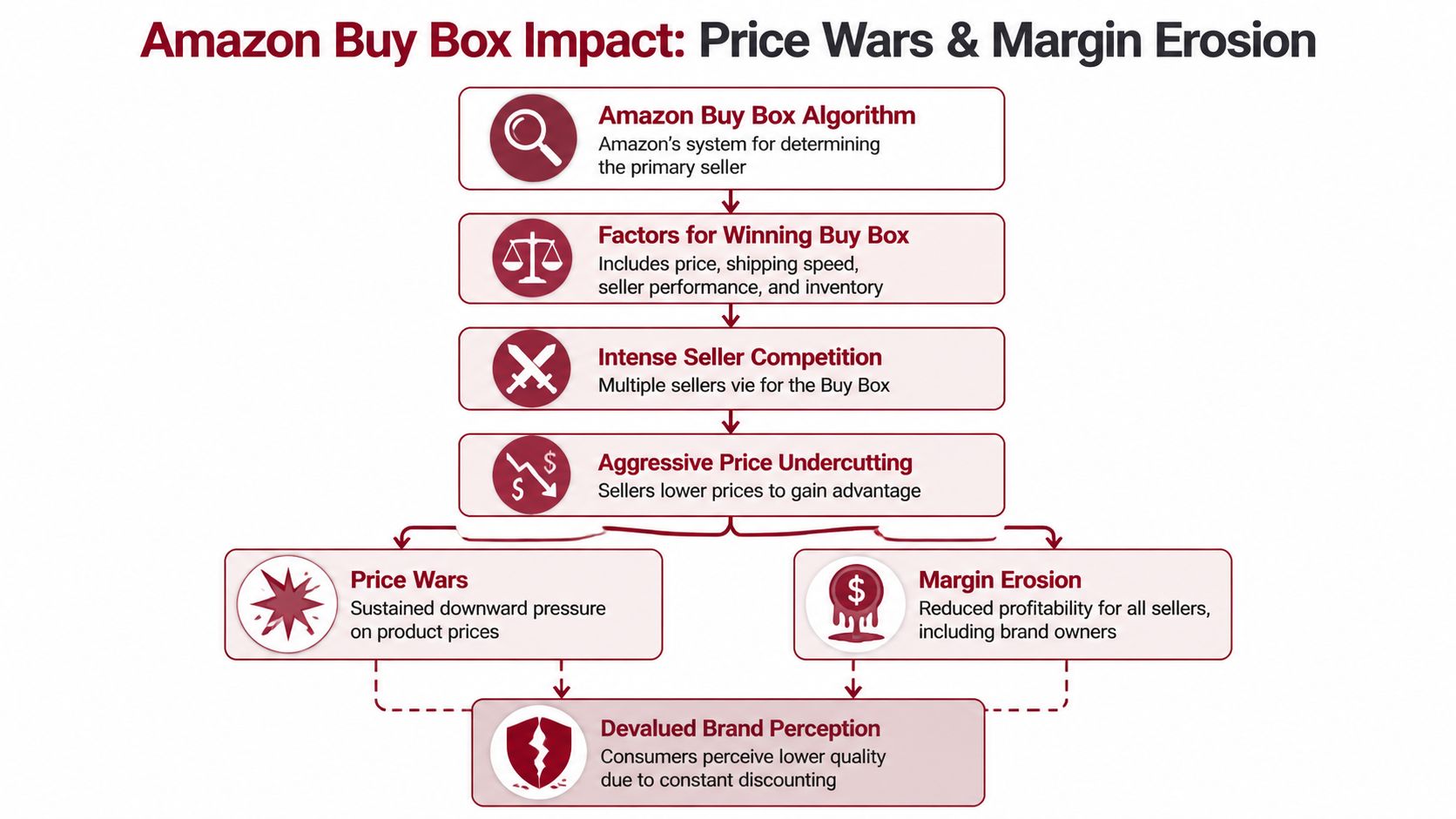
How The Amazon Buy Box Fuels Price Wars and Margin Erosion
The Buy Box doesn’t just reward good sellers. It creates a system where sellers make decisions to win the box, even when those decisions damage the brand.
When multiple sellers sit on the same ASIN, the fight centres on one position: the primary offer Amazon presents as the easiest path to purchase. That position gets the attention, the conversion, and the practical selling advantage.
Why the mechanism matters
Amazon combines sellers onto a single detail page, but each seller can set their own price. That sounds neutral. In practice, it pushes sellers into direct confrontation.
When several merchants compete for the same product listing, they don’t need to outperform your brand story. They only need to become the most attractive offer inside Amazon’s system. That often means lower pricing, tighter fulfilment, and constant repricing.
When multiple sellers compete on the same listing, the issue is not just pricing. It is control, positioning, and long-term brand perception.
What actually breaks first
Most founders think margin is the first casualty. Often, marketing efficiency breaks at the same time.
According to SupplyKick’s analysis of multiple sellers versus a single seller on Amazon, when multiple sellers compete on a single listing, the fight for the Buy Box drives prices down, and sellers without the Buy Box cannot run effective ad campaigns, which causes marketing efficiency to fall sharply. The same source notes that sellers with 10 to 20 products report average profit margins of 22%, compared with 18% for single-product sellers, and that about 77% of Amazon sellers offer fewer than 10 products, with a weighted average of 8.3 products per seller.
Those figures matter because they point to a fragmented marketplace. Many sellers are small, narrow, and highly reactive. They don’t need a long-term pricing strategy. They only need to win today’s placement.
Practical rule: If you’re trying to protect a premium or even mid-market position, don’t treat Buy Box volatility as a pricing issue alone. It’s a margin, media, and brand perception issue at the same time.
We’ve seen brands try to fix this by lowering price, only to reset their own positioning in the process.
The race to the bottom is structural
Founders often make the wrong move. They respond to the listing problem by matching the lowest offer. That can recover the Buy Box for a moment, but it also teaches the market that your product is price-flexible.
Once that happens, several consequences follow:
Once multiple sellers are active, the platform naturally pushes toward price competition, whether the brand intends it or not.
| Marketplace dynamic | Immediate effect | Strategic consequence |
|---|---|---|
| Another seller undercuts the price | Buy Box shifts | Your sales velocity weakens |
| You lower price to recover position | Margin compresses | Your own pricing floor gets reset |
| You lose the Buy Box | Ads become less effective | Paid media starts funding someone else’s sale |
| The listing keeps discounting | Customers anchor to the lower price | Brand value erodes over time |
Why this hits expanding brands harder
A domestic brand can sometimes absorb some Amazon messiness and recover. International expansion is less forgiving.
If you’re entering a new market, your Amazon listing is often one of the first places customers encounter your brand. Constant discounting tells those customers something whether you intend it or not. It says the product is common, replaceable, and available from anyone.
That’s the opposite of what a founder wants when entering a region where trust still has to be earned. If your pricing is being shaped by other sellers, you no longer have a pricing strategy.
The Four Hidden Dangers Beyond Simple Price Competition
Price wars get attention because they’re visible. A founder can see the lower offer, the lost Buy Box, the reduced margin. The more serious damage often sits underneath that surface.
Multiple sellers affect how the brand is perceived, how customers experience the product, how media spend performs, and how compliance risk enters the business without much warning.
Brand equity starts slipping before sales collapse
A listing with several sellers rarely stays clean for long. Some sellers ship in different packaging. Some use old inventory. Some answer customer messages poorly. Some create confusion around condition or delivery expectations.
The customer doesn’t separate those experiences neatly. They attach them to the product and the brand.
That’s what makes uncontrolled seller activity so costly. It blurs the line between authorised and unauthorised behaviour. Founders may still believe they are protecting the brand because the listing title and images look correct. The customer judges the whole transaction, not just the page content.
We’ve seen listings where sales stayed stable, but customer experience and brand perception were already weakening underneath.

Four risks founders often underestimate
-
Brand dilution through inconsistent execution
Premium positioning depends on consistency. If one seller cuts corners on packaging or customer service, the listing starts communicating lower standards than the brand intends. -
Customer trust failure
A buyer who receives old stock, damaged packaging, or the wrong item doesn’t care whether the seller was authorised. They remember the brand name on the listing. -
Advertising impotence
Once your offer loses the Buy Box, your own advertising can become a weaker tool. You may still fund visibility while another seller captures the transaction. -
Compliance and quality exposure through pooled inventory
This is the danger many brands don’t think about until it becomes expensive.
The inventory problem is bigger than most brands expect
FBA commingling introduces a risk that goes beyond customer disappointment. It can create a quality and compliance problem that spreads across jurisdictions.
As noted by Refunds Manager’s discussion of multiple sellers of the same item, inventory commingling in FBA pools stock from different sellers, and a single mix-up can result in a customer receiving a counterfeit or non-compliant item, which may expose the brand to regulatory issues across regions such as US CPSC and UKCA requirements.
For founders selling hardware, household, or regulated consumer products, that’s not a minor operational inconvenience. If a unit intended for one market ends up fulfilling an order in another, the issue can move from brand protection into product liability and compliance response.
A listing with loose seller control can create legal exposure without any deliberate misconduct from the brand owner.
This becomes a serious issue for brands operating across multiple regions, where product standards and compliance requirements differ.
Why second-order consequences matter more than the first one
Price pressure hurts. But many brands can survive a period of lower margin. The harder problems are slower and more expensive to unwind.
Consider the difference:
- Lower margin can sometimes be fixed with channel discipline.
- Damaged trust takes longer because customers remember bad experiences.
- Poor ad efficiency wastes budget while obscuring the true cause.
- Compliance failures can trigger investigations, removals, or reputational fallout.
This is why seasoned operators treat multiple sellers as a control problem, not only a commercial one. The issue isn’t merely that someone else is sharing the listing. It’s that your brand’s standards can no longer be enforced evenly across the transaction.
Amazon’s Silent Enforcement The Technical Risk of Multiple Accounts
When founders realise one listing is becoming crowded, a tempting workaround appears. Open another seller account. Add a separate entity. Use another region. Try to hold more of the listing infrastructure yourself.
That instinct is understandable. It’s also one of the fastest ways to create a larger problem.
Why the workaround backfires
Amazon doesn’t look at accounts in isolation. It evaluates relationships between them. Shared ownership signals, overlapping infrastructure, and repeated listing patterns can trigger scrutiny even when the accounts appear separate on the surface.
According to this analysis of multiple Amazon seller accounts and enforcement risk, cross-account listing overlap can trigger Amazon’s algorithmic enforcement systems, and 62% of multi-account enforcement actions stem from technical infrastructure overlaps that sellers didn’t recognise as policy violations.
The detail founders miss is that enforcement often isn’t immediate. Amazon may keep the accounts live while gathering evidence. That delay creates false confidence.
We’ve seen founders try to regain control by opening additional accounts, only to create a larger risk with Amazon’s enforcement systems.
Silent flags are more dangerous than visible warnings
A visible warning gives you a chance to respond. Silent enforcement doesn’t.
Amazon’s systems can link accounts through ownership and operational data points, then continue observing behaviour over time. A founder may think the structure is working because sales continue. Then a suspension arrives after months of apparent normality.
That pattern is especially dangerous for brands expanding internationally. Many teams assume separate country accounts equal acceptable separation. They don’t, unless the legal and operational structure is genuinely distinct.
If you control multiple accounts that touch the same product line, Amazon is likely evaluating the relationship more deeply than you are.
What a compliant structure actually requires
Discipline matters. If a business truly needs separate regional operations, the separation has to be real, not cosmetic.
A sound approach usually requires clear distinction in areas such as:
- Legal entity separation: Different company registrations and region-specific documentation.
- Financial separation: Distinct payment and banking structures tied to the correct entities.
- Operational separation: Independent records, workflows, and region-specific compliance handling.
- Inventory separation: Clean boundaries around stock ownership and fulfilment logic.
For founders trying to regain listing control, the better path is usually governance, not account proliferation. If you need a clearer framework around listing authority, seller permissions, and operational ownership, Amazon listing control strategy is where the conversation should start.
Trying to outmanoeuvre Amazon’s detection systems usually creates fragility, not control. A brand can recover from a pricing problem. Recovering from suspended infrastructure during an international rollout is much harder.
Regaining Authority with Brand Registry and Authorised Distribution
The cleanest way to deal with multiple sellers isn’t to outprice them or outnumber them. It’s to change the control structure around the listing.
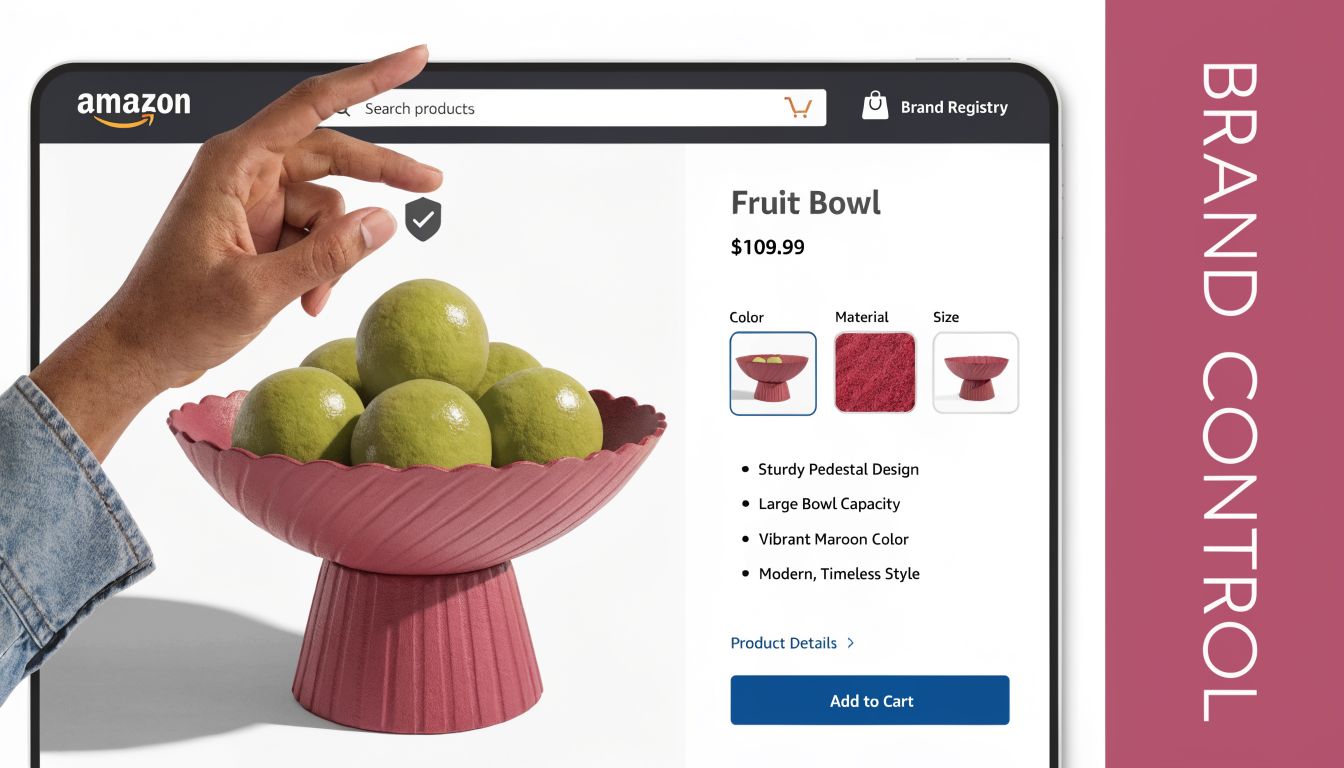
That’s where Brand Registry becomes strategically important. Too many founders think of it as an administrative Amazon feature. It’s closer to a defensive operating layer for the brand.
Why Brand Registry changes the conversation
Without formal brand protection in place, many founders spend their time reacting. They chase sellers, monitor pricing, file complaints, and try to clean up listing issues after the fact.
Brand Registry shifts the posture from reactive to controlled.
As referenced in Amazon seller forum discussion around Brand Registry and brand protection, Amazon Brand Registry is a critical tool for gating listings against unauthorised sellers. For established manufacturers, investing in global brand registry across markets such as the US, UK, and AU is a proactive way to stop third-party sellers establishing a foothold before official launch.
That’s the key point. Registry is not only about removing bad actors after they appear. It helps prevent early marketplace drift that later becomes difficult to reverse.
This is usually the point where brands shift from reacting to sellers to actually controlling how the listing operates.
What works better than ad hoc enforcement
Founders often ask whether they should focus first on legal action, channel cleanup, or Amazon tooling. In practice, the order matters.
A stronger sequence usually looks like this:
- Secure the trademark position first: If ownership isn’t formalised, marketplace control remains weak.
- Register before broad expansion: Don’t wait until a listing is already crowded in a target market.
- Define authorised sellers clearly: Ambiguity invites channel conflict.
- Align internal teams: Sales, operations, legal, and marketplace management need one shared rule set.
If you’re evaluating the mechanics and business case, Amazon Brand Registry support for scaling brands is the relevant framework.
Registry only works when distribution discipline matches it
Brand Registry is powerful, but it doesn’t fix a sloppy channel strategy on its own. If a brand continues selling through loosely controlled wholesale pathways, unauthorised resale can still feed listing problems.
That’s why authorised distribution matters just as much as the Amazon-side tools. A founder has to know who is allowed to sell, under what terms, in which regions, and with what consequences for deviation.
Here’s a useful way to understand it:
| Approach | Short-term effect | Long-term result |
|---|---|---|
| Tolerate multiple sellers | Some extra volume | Lower control and weaker pricing discipline |
| Fight sellers one by one | Temporary cleanup | Repeated operational friction |
| Build Brand Registry plus authorised distribution | More upfront structure | Better listing authority and cleaner expansion |
A short explainer on the broader mechanics can help clarify what the platform allows and what it doesn’t:
The real trade-off
Registry requires preparation. Trademarks take planning. Distribution rules can upset legacy reseller relationships. Internal teams may need to change how they think about marketplace access.
But compare that with the alternative. Ongoing price wars, weak ad efficiency, blurred accountability, and the constant risk that someone else shapes your Amazon presence before you do.
For serious brands, Brand Registry isn’t an optional layer of polish. It’s the foundation for controlled participation.
Building a Resilient Channel Strategy Beyond a Single Marketplace
Even a well-controlled Amazon presence shouldn’t carry the whole growth story.
That’s the next lesson founders usually learn after fixing listing chaos. Once Amazon is stable again, the question becomes whether too much of the brand’s commercial future is sitting inside one platform.
Amazon is a channel, not the business model
Amazon is useful because it compresses demand, fulfilment, discovery, and transaction into one environment. That convenience is exactly why overreliance becomes risky.
If the majority of a brand’s new-market visibility depends on one marketplace, the business becomes more exposed to platform-specific issues. Listing suppression, policy shifts, account reviews, unauthorised sellers, and pricing pressure all carry more weight when there are no other strong channels around them.
A resilient brand doesn’t ask, “How do we win on Amazon?” It asks, “How does Amazon fit inside a channel structure that protects value?”
We’ve seen brands rely too heavily on Amazon early, only to realise later that control across channels matters more than volume in one platform.
What smarter channel mixes usually do
A strong channel mix creates separation between discovery, conversion, repeat purchase, and brand building. Amazon can handle some of that, but it shouldn’t be expected to handle all of it.
Founders who scale more cleanly usually build around a few principles:
- Use Amazon for reach, not identity: It can accelerate market entry, but it shouldn’t define the entire brand narrative.
- Protect direct customer relationships elsewhere: Your own site, retailer relationships, and other channels give you more control over pricing and experience.
- Match channels to product behaviour: Replenishable products, considered purchases, and compliance-heavy products often need different channel logic.
- Keep distribution deliberate: More doors don’t always mean better growth.
Controlled expansion beats broad exposure
There’s a common mistake in international growth. A founder sees Amazon traction and assumes the answer is more listings, more countries, more resellers, and more volume paths. That often produces the opposite of scale. It creates overlap, channel conflict, and blurred accountability.
A more durable model uses Amazon as one part of a broader distribution design. That design may include direct ecommerce, selective retail, regional distribution partners, and marketplace participation with clear guardrails.
Operator’s view: The strongest brands don’t try to be available everywhere at once. They choose where control can be maintained while the brand still looks coherent to the customer.
For teams thinking through that balance, Amazon distribution strategy for established brands is the more useful lens than marketplace tactics alone.
A simple comparison
| Channel posture | What it feels like early | What it often becomes later |
|---|---|---|
| Amazon-only focus | Fast, efficient, measurable | Exposed to platform pressure |
| Loose multichannel expansion | Broad availability | Fragmented pricing and weak brand consistency |
| Structured channel mix | Slower to design | Stronger control and more durable brand equity |
The goal isn’t to reduce Amazon’s importance. The goal is to stop treating it as a substitute for strategy.
A great product can sell on Amazon without becoming a great brand. That distinction matters most when a company enters new markets, because channel choices made early tend to define pricing behaviour, customer expectations, and reseller dynamics later.
A Founder’s Checklist for Taking Back Control of Your Brand
Founders usually know when the listing has become unstable. The better question is whether the business is structurally ready to take control back and hold it.
This checklist is useful because it forces a commercial discussion, not just a marketplace one.
By the time most brands reach this point, they are already dealing with multiple sellers, pricing instability, or listing inconsistency.

Check your ownership before you check your ads
If the brand’s legal and channel foundations are weak, no amount of listing optimisation will solve the underlying issue.
Start here:
- Trademark position: Is the brand formally protected in each market that matters to your expansion plan?
- Entity structure: Are your operating entities aligned with how you sell across regions?
- Authorised seller rules: Can you name exactly who is allowed to sell on Amazon, and under what terms?
- Distributor leakage: Do any wholesale arrangements make grey-market resale likely?
Audit the listing like an operator, not a marketer
Many teams look only at content quality. That’s too narrow. The listing needs a control audit.
Review:
-
Who is currently attached to the ASIN
Don’t assume every seller is harmless because the offer is genuine. -
How pricing behaves over time
If the price repeatedly moves without your approval, the channel is already signalling weak control. -
Whether your own offer consistently holds the Buy Box
If not, the issue is broader than conversion optimisation. -
How customer complaints map to seller variation
Look for patterns in shipping, packaging, product condition, and support.
“If the customer experience varies by seller, your brand promise isn’t being delivered consistently.”
Pressure-test your fulfilment and compliance exposure
This part is often skipped because it feels operational. It shouldn’t be.
Ask tougher questions:
- Inventory handling: Is stock segmented clearly enough to avoid cross-seller confusion?
- Regional compliance: Could a unit intended for one market create a problem in another?
- Packaging consistency: Will every customer receive the same branded experience?
- Returns pathway: Do returned units risk re-entering circulation in a way that weakens quality control?
Decide what kind of growth you actually want
Some brands say they want scale when what they really want is controlled expansion. Those are not the same thing.
A useful self-test is whether you’d accept lower short-term marketplace volume in exchange for cleaner pricing, stronger customer experience, and less channel conflict. Mature brands usually should.
More volume does not always mean better growth if control is being lost at the same time.
Here’s a compact decision lens:
| If this is true | Then your next move should be |
|---|---|
| You lack trademark and registry readiness | Fix legal and brand protection first |
| Sellers are multiplying on your listing | Tighten authorised distribution immediately |
| Your pricing is unstable | Rework channel terms before adding spend |
| You rely too heavily on Amazon | Build a wider channel mix before scaling harder |
| Regional complexity is rising | Introduce structured expansion governance |
Know when a partner is the smarter move
Not every founder should solve this internally. If the business is entering new regions, dealing with multiple channel partners, and trying to protect brand value while scaling, the operational burden rises quickly.
That’s usually the point where the right external partner provides an advantage. Not because the brand lacks ambition, but because disciplined expansion requires local market knowledge, channel structure, and operational control that many teams don’t want to build from scratch.
The brands that scale best usually aren’t the ones that move fastest. They’re the ones that keep control while they move.
If you’re seeing multiple sellers on your Amazon listing, it’s worth looking at properly.
We’ve worked with brands dealing with this exact situation, and the pattern is usually the same. It starts small, then impacts pricing, customer experience, and control.
The sooner it’s addressed, the easier it is to fix.
👉 Reach out and we’ll take a look at where things are actually sitting.