Most advice about amazon fba is designed for opportunistic marketplace sellers, not established brands managing real products, margins, and long-term growth.
The usual recommendation is simple. Send inventory to Amazon, win Prime eligibility, scale ads, and let the platform handle fulfilment.
That approach can generate sales. It can also weaken pricing discipline, increase operational pressure, and reduce brand control when founders enter without a structured strategy.
For established product companies, Amazon FBA is not just a logistics solution. It is a commercial operating model that influences fulfilment, customer expectations, inventory management, pricing structure, and channel relationships simultaneously.
The real decision is not whether Amazon can move units. It is whether your brand can use Amazon strategically without losing the advantages that made the business successful in the first place.
Beyond the Buy Box Reframing Amazon FBA as a Strategic Decision
Why Most Founders Misunderstand Amazon FBA
The common advice is that every serious brand should be on Amazon. That’s lazy thinking.
A better view is this. Amazon FBA is a distribution infrastructure with strategic consequences. If your product has genuine traction, the platform can compress time to market, especially in regions where logistics quality shapes conversion. But the same infrastructure can pull your business into fee pressure, inventory mistakes, and price erosion if you treat it as a side channel.
The scale tells you why founders keep looking at it. Globally, 82% of Amazon’s 2.5 million active sellers used FBA in 2025, and adoption in Australia sat at 68% according to Red Stag Fulfillment’s review of Amazon seller FBA usage. That gap matters. Australia isn’t saturated in the same way more mature Amazon markets are, which creates room for established brands that already know how to sell, source, and support a real product line.
But lower adoption shouldn’t be mistaken for easy opportunity.
For Australian brands, and for US, UK, or Canadian brands entering Australia, FBA offers access to Prime-linked fulfilment and a marketplace environment where delivery reliability strongly affects competitiveness. That’s attractive. It also means Amazon becomes part of your brand promise, whether you like it or not. Late replenishment, misjudged inventory depth, poor compliance setup, or uncontrolled resellers stop being operational annoyances and start becoming brand problems.
What founders get wrong
Founders often evaluate amazon fba through the wrong lens.
They ask:
- Can Amazon ship this faster
- Will Prime help conversion
- Can we outsource pick and pack
They should ask:
- Does this channel strengthen or weaken our market position
- Can we protect pricing and presentation once the product is live
- Are we operationally built for Amazon’s inventory logic
- Does this move support controlled expansion, or just short-term sales
Amazon rewards availability and speed. It doesn’t automatically reward brand discipline.
That distinction matters most when the product already works elsewhere. If you’ve built demand through retail, DTC, trade, or distribution, amazon fba can be a force multiplier. If you haven’t built the controls around brand, stock, and compliance, it can expose weaknesses faster than almost any other channel.
For founders weighing whether to launch, expand, or hand over marketplace execution, the smarter starting point is strategic fit, not marketplace excitement. That’s also why many established brands first look at a more structured sell on Amazon approach rather than treating the platform like a self-serve growth hack.
The Amazon FBA Model Deconstructed for Brand Owners
FBA is usually described in warehouse terms. Amazon stores your inventory, picks and packs orders, ships them, manages returns, and handles much of the customer-facing fulfilment experience.
That description is accurate, but it misses the point for brand owners.
Amazon Changes More Than Fulfilment
When you use amazon FBA, you’re not merely outsourcing operations. You’re accepting Amazon as an operating layer inside your business. The platform now influences delivery standards, listing eligibility, customer expectations, stock positioning, and the economics of every unit sold through that channel.
What FBA changes in practice
For a founder, the first shift is perceived trust. Prime eligibility changes how buyers interpret risk. A product that looks uncertain under merchant fulfilment can look established under FBA because the fulfilment promise is stronger and more familiar.
The Real Cost of Convenience
The second shift is operational efficiency. Instead of building your own warehouse capacity for every new region, you can plug into Amazon’s system and expand with less direct handling. That matters when the brand is exploring international demand but doesn’t want to stand up a full local operation before the market proves itself.
The third shift is financial complexity. FBA creates convenience, but convenience isn’t free. Unit economics become tightly linked to storage behavior, replenishment discipline, packaging suitability, product dimensions, and return patterns. Founders who treat FBA as a margin-neutral service usually learn otherwise.
FBA versus FBM is really control versus convenience
The FBA versus FBM decision is not simply operational. It changes how the brand behaves commercially.
FBA creates speed, Prime visibility, and fulfilment consistency. In exchange, founders accept more platform dependency and tighter alignment with Amazon’s inventory systems and fee structures.
FBM Amazon fee considerations provides greater operational control and can suit fragile, premium, customized, or slower-moving products. But it also places more pressure on fulfilment quality, especially when serving customers internationally.
The right decision often depends less on preference and more on product economics, customer expectations, and channel strategy.
The founder’s version of the model
A useful way to frame FBA is as three simultaneous commitments:
-
A service commitment
You’re promising marketplace customers a faster, more standardized buying experience. -
An inventory commitment
You’re moving stock into a system that rewards availability and penalizes poor stock decisions. -
A brand commitment
You’re allowing a third-party marketplace environment to mediate part of how customers experience your product.
Practical rule: If your product only works when every detail is tightly hand-held by your team, FBA may solve fulfilment while creating a brand problem.
That doesn’t make FBA a bad choice. It makes it a consequential one. The right founder doesn’t ask whether Amazon can ship the order. They ask whether this operating model supports the kind of brand they’re trying to build.
A Founder’s Framework for Evaluating Amazon
A serious amazon fba decision deserves a structured filter. Not a gut reaction, and not a generic “we should probably be on Amazon”.
The cleanest framework I’ve seen founders use has five tests. If you can’t answer these well, the issue usually isn’t Amazon. It’s readiness.
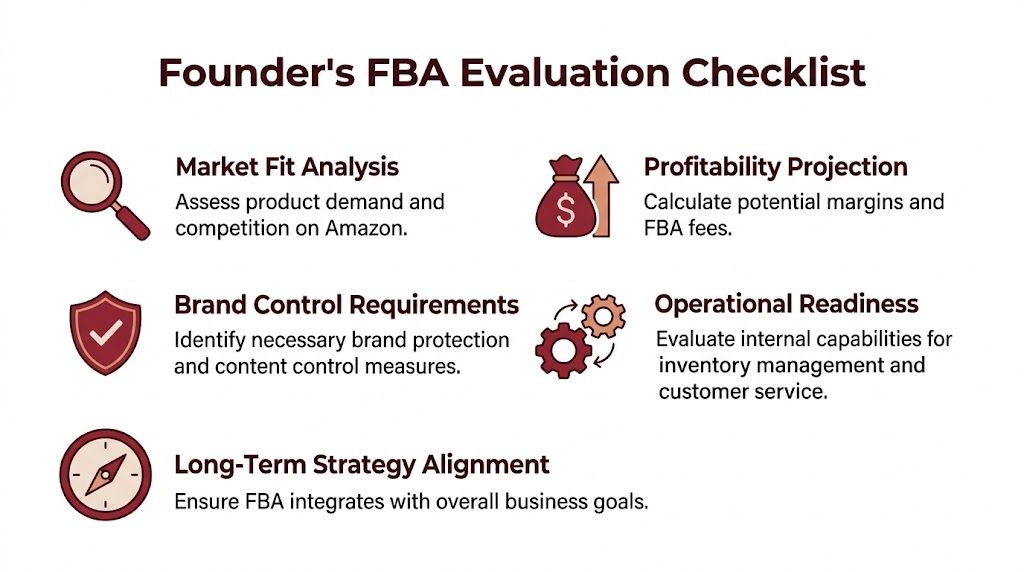
Financial test
Start with contribution margin, not revenue ambition.
Amazon creates a habit of looking at top-line opportunity before the unit economics are properly stress-tested. That’s backwards. If your product is already heavy, bulky, return-prone, or price-sensitive, you need a hard view of what happens after fulfilment fees, marketplace fees, GST obligations, storage exposure, and promotional pressure.
Many founders then discover the core issue. The product sells. The margin structure doesn’t.
Ask:
- Does the SKU still make sense after Amazon-specific fees
- Can the product tolerate promotional pressure without training the market to wait for discounts
- Will stock held for Amazon distort cash flow elsewhere in the business
Brand test
Some products thrive on Amazon. Others become interchangeable the moment they appear there.
Founders should assess whether their advantage comes from utility alone or from context, education, merchandising, retail support, or a more curated buying experience. If the product needs explanation, installation confidence, bundling logic, or premium presentation to justify its price, your listing strategy has to work much harder than your off-Amazon marketing does.
Brand questions are often blunt:
- Will this listing make the product look stronger or more generic
- Are you prepared to defend price architecture
- Can you control who sells the product and how they present it
A product can perform well on Amazon while the brand behind it gets weaker. Those are not the same outcome.
Operational test
Amazon rewards clean operations and punishes drift.
That means forecasting matters. Packaging matters. Labelling matters. Replenishment timing matters. Returns handling matters. If your internal team already struggles with stock visibility, supplier coordination, or prep requirements, Amazon won’t hide those weaknesses. It will magnify them.
Look for evidence, not optimism:
- Stable sourcing
- Reliable lead times
- Clear SKU rationalization
- Packaging suited to FBA handling
- A repeatable process for replenishment and exception management
Legal and compliance test
At this point, otherwise solid brands get caught.
For international sellers entering Australia, a sales threshold of AUD 75,000 annually triggers 10% GST on low-value imports, and compliant sellers often see 35% faster listing activation, while non-compliance is a leading cause of account suspension for new entrants according to Amazon’s guidance on FBA international expansion. That should change how founders think about launch sequencing. Compliance isn’t admin to tidy up later. It’s part of channel entry.
Use this as a checkpoint:
-
Entity readiness
Do you have the right tax and business structure for the market you’re entering? -
Product classification
Have you checked whether your category carries local requirements around safety, claims, labelling, or import treatment? -
Launch gating
Will your listings go live cleanly, or are you creating avoidable delays by trying to fix compliance after inventory moves?
Channel conflict test
Why Channel Control Matters
A founder also needs to decide what Amazon is allowed to do inside the wider channel mix.
If you already sell through retailers, distributors, trade accounts, or your own DTC store, Amazon can create friction fast. Retail partners don’t like seeing undercut pricing. Distributors don’t like unclear territorial boundaries. Your own site can suffer if Amazon becomes the de facto source of convenience while your brand site becomes little more than a catalogue.
A few direct questions expose most channel problems:
- Will Amazon undercut existing partners, even unintentionally
- Do you have a channel policy that defines assortment, pricing, and territory
- Is Amazon serving market expansion, or cannibalizing business you already own
What a pass actually looks like
A brand is usually well-positioned for amazon FBA when the product already has traction, the margin survives real fee pressure, compliance is set up early, and channel rules are explicit before launch.
That’s very different from “we think Amazon could be big for us”.
Choosing Your Path Strategic Options on the Marketplace
Not every Amazon model serves the same objective. Founders often collapse multiple decisions into one and then wonder why the channel becomes messy. The smarter move is to separate them.
First decide who controls the commercial relationship. Then decide who fulfils the orders.
The core pathways
The first split is 1P versus 3P.
With 1P, you’re effectively supplying Amazon as a wholesale customer through Vendor Central. Amazon takes a stronger hand in pricing and retail execution. This can create volume, but it usually gives the founder less control.
With 3P, you sell through Seller Central. You retain more control over listings, stock, pricing, and trading decisions. For most established brands that care about positioning, this is usually the more strategic route.
The second split is FBA versus FBM.
With FBA, Amazon fulfils orders from its network. With FBM, your business or logistics partner fulfils directly. Both can work. They solve different problems.
Amazon Strategic Model Comparison
| Model | You Are A… | Primary Control | Margin Potential | Best For |
|---|---|---|---|---|
| 1P | Wholesale supplier to Amazon | Lower control over retail execution | Lower to moderate, depending on wholesale terms | Brands prioritising broad retail access over direct marketplace control |
| 3P | Marketplace seller | Higher control over listing, pricing, and inventory decisions | Moderate to higher, if operations are disciplined | Brands that want tighter control over presentation and channel strategy |
| FBA | Seller using Amazon fulfilment | Lower fulfilment control, stronger marketplace integration | Can be attractive if velocity and stock planning are strong | Brands needing scale, Prime eligibility, and simpler regional fulfilment |
| FBM | Seller fulfilling orders directly | Higher operational control | Can be better for selective assortments or specialised products | Brands with their own fulfilment strength or products unsuited to FBA |
Testing a market without overbuilding
For international expansion, one of the most useful options is a controlled 3P launch with Remote Fulfillment by Amazon (RFBA) where it fits the product and market.
For brands testing Australia from US or UK centres, RFBA can produce 15 to 25% higher delivery success rates than non-FBA international shipping, and Amazon’s automated customs clearance reduces border delays by an average of 40% for relevant products according to Seller Labs’ overview of FBA-led international expansion. That matters if your goal is to validate demand before committing to local warehousing.
This approach is often stronger than the two extremes founders default to:
- Overcommitting early with a full local inventory and operating setup before the market proves itself
- Undercommitting badly with slow merchant-fulfilled cross-border shipping that damages conversion and trust
The best early-market Amazon strategy is often controlled exposure, not maximum exposure.
Which path suits which kind of brand
A practical pattern shows up across product businesses.
Premium or design-sensitive brands usually need 3P control, selective SKU choice, and disciplined pricing. They can still use FBA, but not as an all-in decision across the catalogue.
Utility-led, replenishable, or logistics-sensitive products often benefit more directly from FBA because fulfilment speed and reliability strongly influence conversion.
Complex, installation-heavy, or channel-sensitive products may need a mixed model. Some SKUs can sit in FBA for reach and convenience. Others may belong in FBM, trade distribution, or off-Amazon channels where the sales process is more controlled.
The real strategic lever
The important choice isn’t whether Amazon exists in your mix. It’s how narrowly you define its role.
You can use Amazon as:
- A market-entry test
- A demand-validation channel
- A core revenue driver
- A selective replenishment engine
- A defensive presence to control brand representation
Founders get into trouble when they use one model while expecting the outcome of another. A defensive channel needs different rules than a growth channel. A test-market launch needs different inventory logic than a scale play.
That’s why the right Amazon path usually looks deliberate and slightly constrained at first. The brands that hold value longest rarely start with “list everything and see what happens”.
Protecting Your Brand in the Amazon Ecosystem
The main risk with amazon fba isn’t that Amazon will ship your orders badly. The bigger risk is that your brand enters a marketplace environment without enough protection around it.
That risk shows up in familiar ways. Price drops start appearing from unauthorized sellers. Listings become inconsistent. Retail partners complain. Product pages lose clarity. Compliance issues trigger removals. The founder still sees sales, but the brand becomes harder to govern.

Start with control before scale
Many founders focus on marketplace growth before establishing the systems required to protect the brand.
That usually creates problems later through inconsistent listings, uncontrolled pricing, unauthorized sellers, or poor customer experience.
The stronger approach is to define operational guardrails before broad marketplace rollout. This includes seller permissions, listing governance, pricing structure, catalogue ownership, and inventory accountability.
Scale works best when control already exists underneath it.
-
Authorized seller rules
Decide who can sell the product on Amazon and under what conditions. -
Listing ownership
Keep control over core product content, images, naming conventions, and variation logic. -
Price architecture
Define where Amazon sits relative to your DTC site, retail channels, and promotional calendar. -
Operational accountability
Make one team or one operating partner responsible for catalogue integrity, stock health, and channel compliance.
If several parties can list, price, and ship the same SKU without central control, brand damage becomes likely.
MAP helps, but discipline matters more
A Minimum Advertised Price policy can support channel stability. But founders overestimate what a document alone will do. MAP only works when distribution is disciplined, seller permissions are clear, and breaches are dealt with quickly.
Amazon has a way of exposing weak channel policy. If the same product is widely available through loosely managed wholesalers, someone will eventually chase volume by dropping price. Once that happens, the marketplace starts pulling your whole channel architecture downward.
Operator’s view: Amazon doesn’t create pricing disorder out of nowhere. It usually reveals disorder that was already sitting in the channel.
Brand Registry and gating are not optional
If the brand is serious about Amazon, content control and counterfeit defense need to be built into the launch plan. Amazon Brand Registry is part of that foundation because it helps with ownership and enforcement.
For some categories, selective distribution and tighter seller approval also matter. Founders who want premium positioning can’t behave as if the product is a generic commodity and then complain when the marketplace treats it that way.
This is also where specialist operators can help. Some brands manage this in-house. Others use channel partners or marketplace operators with clear responsibility for listing governance, compliance, prep, and expansion execution. TPR Brands, for example, works with established product companies on controlled marketplace expansion where brand protection and cross-market readiness matter alongside logistics.
Australia adds a compliance layer many brands underestimate
This is especially important for hardware and adjacent product categories. Many guides miss Australia’s specific regulatory requirements, and non-compliance for products such as power tools and ladders leads to 25% higher product removal rates compared with other categories, based on AU marketplace observations referenced by Ecombrainly.
That changes the protection playbook. Brand protection isn’t only about price and unauthorized sellers. It also includes:
-
Product claims review
Make sure the listing language doesn’t create avoidable issues under local rules. -
Safety and labelling checks
Confirm the product presentation fits the category’s local expectations. -
Documentation discipline
Keep evidence, certifications, and product data organized before the account or listing needs them.
A brand gets damaged in two ways on Amazon. One is visible, through poor pricing and messy listings. The other is procedural, through preventable removals and account friction. Strong founders plan for both.
Readiness Indicators Is Your Brand Prepared for Amazon FBA
Readiness Matters More Than Excitement
A lot of brands want the upside of amazon FBA before they’ve built the conditions that make it safe.
Readiness isn’t about enthusiasm for a new channel. It’s about whether the business can absorb the operational and strategic pressure the channel creates.
Signs you’re probably ready
A brand is usually in a strong position for FBA when several of these are already true:
-
Demand exists outside Amazon
The product has proven it can sell without relying on marketplace discovery alone. -
The positioning is clear
Your team can explain why the product deserves its place and price. -
Supply is stable
You’re not improvising every purchase order or firefighting every inbound shipment. -
The SKU range is disciplined
You know which products are core, which are support items, and which shouldn’t be pushed into Amazon at all. -
Cash planning is deliberate
The business can hold inventory for a marketplace launch without starving other channels. -
Compliance is organized
Product data, packaging standards, and market-entry paperwork are not being assembled at the last minute.
Signs you should pause
There are also clear warning signs.
If your current business only works because the founder is manually fixing exceptions, Amazon will magnify those exceptions. If your margins already feel tight in traditional channels, marketplace fees and stock inefficiency will usually make the problem more obvious, not less. If your retail partners are sensitive and your channel policy is vague, Amazon can create unnecessary conflict.
A practical test is whether your team can answer these questions cleanly:
- Which SKUs belong on Amazon first
- Who owns inventory planning
- Who owns listing quality
- What happens when an unauthorized seller appears
- How will Amazon affect existing stock allocation across channels
Readiness is operational, not aspirational
The strongest launches usually come from brands that are already organized before they enter. They have a stable core range, clear stock logic, and enough logistics visibility to avoid using Amazon as a substitute for internal discipline.
If your team is still sorting out fulfilment processes, channel rules, or replenishment routines, it’s often smarter to solve that first. A more structured view of Amazon logistics tends to reveal whether FBA will act as an advantage or add pressure to weak systems.
A good Amazon launch rarely starts with urgency. It starts with control.
That’s the standard founders should use. Not whether the channel is exciting. Whether the business is ready to govern it.
Conclusion The Next Step in Your Global Expansion Journey
amazon FBA is powerful because it compresses distance, speed, and infrastructure. That’s exactly why founders underestimate it.
It looks like a fulfilment choice. In reality, it’s a business model decision wrapped in logistics. It affects how your product is discovered, how your brand is perceived, how your margins behave, how your stock moves, and how your wider channel strategy holds together.
For some brands, FBA is the right move. It can create cleaner entry into new regions, especially when speed and marketplace trust matter. For others, it becomes a trap because they enter too broadly, price too loosely, or rely on the platform before their own operating discipline is ready.
The brands that do well tend to share a few habits. They treat Amazon as one strategic channel, not the whole brand. They define the role of the marketplace before launch. They protect pricing and presentation. They think carefully about which SKUs belong there. They solve compliance early. They use FBA where it provides a genuine advantage, not merely because Amazon offers it.
That’s also why expansion decisions deserve more than a marketplace checklist. If you’re entering Australia or using Australia as part of a broader international strategy, the operational setup and brand controls matter as much as the product opportunity itself.
A founder doesn’t need to fear Amazon. But they do need to respect what it changes.
For brands that recognize both the upside and the risk, a strategic partner becomes useful. The challenge usually isn’t getting onto the marketplace. It’s building a version of marketplace growth that doesn’t dilute the brand on the way up.
Amazon FBA Is Powerful When the Operating Model Is Strong
Amazon FBA compresses logistics, fulfilment, and marketplace access into a single system. That efficiency is exactly why founders underestimate how much influence the platform can have over the wider business.
For some brands, FBA creates a faster and more controlled route into international markets. For others, it exposes weak pricing structure, operational gaps, inconsistent channel strategy, or poor inventory discipline.
The brands that succeed usually approach Amazon deliberately. They define the role Amazon should play before launch, protect pricing and presentation carefully, select SKUs strategically, and solve compliance and operational risks early.
TPR Brands works with established product companies using Amazon as part of a broader international growth strategy focused on controlled expansion, marketplace governance, and long-term brand protection.
If you’re evaluating whether Amazon FBA fits your business, the first step is understanding whether your operations, margins, and channel structure are genuinely prepared for marketplace scale.