A lot of founders reach the same point at roughly the same time. The product works. Domestic demand is stable. Retailers, distributors, or marketplaces begin asking about new regions.
That is usually when international expansion starts looking straightforward.
In practice, a global product launch is rarely just a larger version of a domestic rollout. The product may already be proven, but pricing structures, customer expectations, compliance requirements, fulfilment systems, and channel economics often change dramatically from one market to another.
Brands that recognise those differences early tend to scale with more control. Brands that treat expansion like a simple export exercise often discover that demand was never the only challenge.
This guide explains how established brands approach global product launches more strategically, from market prioritisation and localisation through to compliance, pricing, supply chain planning, and phased go-to-market execution.
Why Domestic Success Does Not Guarantee Global Growth
A founder sees strong domestic sell-through, a retailer in another country shows interest, and the team assumes the hard part is done. In practice, that is the point where the risk profile changes.
Domestic success proves the product can win under one set of conditions. It does not prove the offer will hold once buyer expectations, retail economics, product rules, and service standards change at the same time. A brand can be well known at home and still enter a new market with no trust, no pricing room, and no margin for operational error.

The failure point is often outside the product itself. The product may be sound. The surrounding system is what breaks first: packaging that misses local buying cues, channel terms that erode margin, freight that destroys price competitiveness, or product claims that trigger compliance review. That is why international expansion needs a decision framework, not just ambition.
The home market teaches habits that do not always travel
Founders often read domestic momentum too broadly. What it usually confirms is narrower: the product solves a real problem, the proposition is clear enough for local buyers, and the current route to market works. None of that guarantees the same message will convert elsewhere, or that the commercial model will survive once duties, retailer margins, local promotions, returns, and after-sales expectations are added.
I see this most clearly with established brands entering a second or third region. They are not making amateur mistakes. They are making pattern-recognition mistakes. They assume buyers in the next market will read quality, value, urgency, or trust the same way domestic buyers do. That assumption is expensive.
A practical international expansion strategy for established brands starts by separating what is effectively transferable from what only worked because the home market made it easy.
Practical rule: If the launch plan starts with media spend and leaves compliance, channel terms, and landed margin until later, the business is not controlling expansion. It is exposing itself to preventable losses.
Global growth is a translation problem and a control problem
Two decisions drive the outcome early.
First, the value proposition has to translate commercially and culturally. “Premium,” “professional-grade,” “clean,” “natural,” or “built to last” can mean different things in different categories and countries. The words may translate. The buying signal may not.
Second, the business has to keep control as complexity increases. That includes who sets pricing in market, who owns retailer relationships, how inventory is allocated, how claims are approved, and how quickly the team can fix a mistake once stock is already in motion. Global growth usually fails at the points where control becomes unclear.
| Domestic scaling | Global expansion |
|---|---|
| Optimises a proven local playbook | Rebuilds key parts of the playbook for each target market |
| Relies on familiar consumer signals | Tests how trust and value are read in each market |
| Usually adds sales capacity | Adds compliance, logistics, pricing, and channel complexity |
| Can recover from small mistakes quickly | Pays more for each mistake and recovers more slowly |
What disciplined brands do differently
The strongest operators do not confuse demand with readiness. They pressure-test the business model before they commit inventory and brand capital.
- Market fit: Does the target market care about the same primary benefit, or does the product need a different lead message?
- Channel fit: Will the brand enter through distributors, marketplaces, specialty retail, or direct-to-consumer, and who controls pricing once it does?
- Margin fit: Does the product still produce acceptable landed margin after freight, duties, local trade spend, and returns?
- Execution fit: Can the business support service levels, documentation, packaging, and local partner management without weakening the core market?
That distinction separates controlled expansion from reactive expansion. Successful brands do not treat international growth as a bigger sales push. They treat it as a series of strategic trade-offs, then choose where to adapt and where to hold the line.
Phase 1 Prioritising Markets Beyond Obvious Choices
Most brands begin with the biggest market on the map. That’s often the wrong first move.
Large markets attract attention because the upside is easy to see. The downside is harder to see until money is committed. Entry costs are higher, competition is denser, retailer expectations are stricter, and operational mistakes get punished faster. Smart expansion starts with selecting the right first market, not the most famous one.
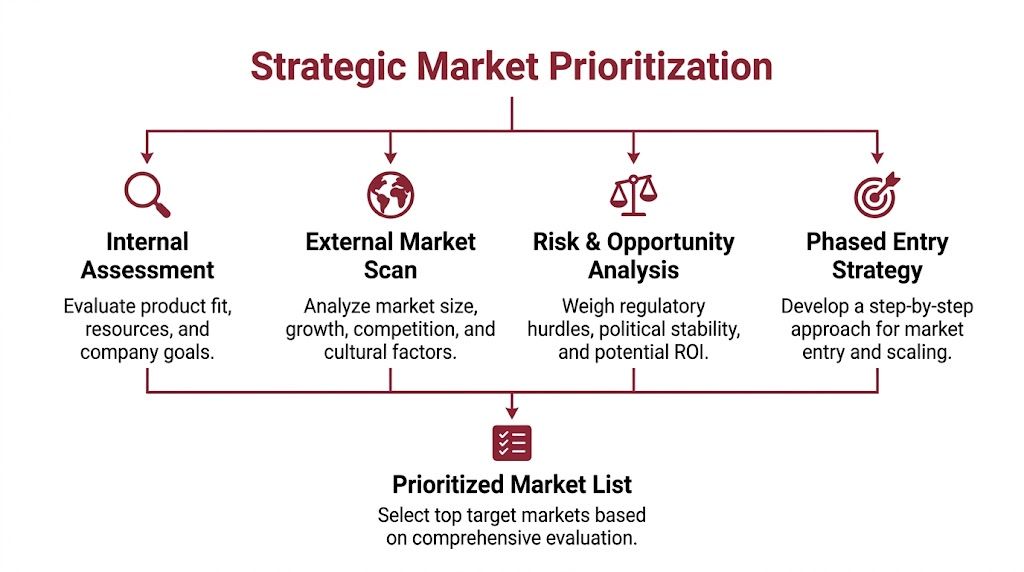
Build a weighted scorecard before you choose a country
I prefer a scorecard because it forces trade-offs into the open. Without one, teams tend to choose markets based on excitement, anecdotal demand, or whatever inbound enquiry arrived last week.
Use a short list of criteria and rank each target market against them. Keep it operational. GDP headlines don’t help much if the channel structure is hostile or the product needs heavy adaptation.
A practical scorecard should include:
-
Regulatory friction
How difficult is certification, labelling, product testing, or import approval for this category? -
Channel accessibility
Can you realistically enter through distributors, marketplaces, specialty chains, or direct channels without burning margin? -
Positioning alignment
Does the market already buy products like yours for the reason you want to sell them? -
Operational load
How much complexity will customer service, returns, fulfilment, and local partner management add? -
Strategic value
Does entry into this market create an advantage for neighbouring markets, proof for retailers, or better manufacturing scale?
Brands that want a disciplined framework for this stage usually benefit from an explicit market expansion strategy process, because market choice affects every later decision. Pick the wrong first market and even a strong product can look weak.
Don’t confuse demand with fit
Some markets generate interest quickly because the category is already active. That doesn’t mean your brand belongs there first.
Japan is a useful example for Australian household products. Positioning matters more than many teams expect. A Nielsen report found that AU brands mispositioned as “premium imports” saw 28% lower uptake in Japan due to perceived inauthenticity, while subtle adaptation via local co-branding can boost acceptance by 41% (reported in this Product Marketing Alliance reference). The lesson isn’t “avoid Japan”. It’s that the apparent prestige of being imported can become a liability if it creates distance rather than trust.
A market can look attractive on paper and still be the wrong place to start if your product story needs too much explanation.
Four filters that usually improve first-market decisions
Competitive density
A crowded market isn’t always bad. But if the shelf is already full of entrenched players and your differentiation depends on a long education cycle, the cost of entry rises fast. In those cases, a slightly smaller market with clearer whitespace often produces better learning.
Channel shape
Some products work through Amazon first. Others are better suited to specialist retail, trade counters, local distributors, or regional chains. If your product requires demonstration, installation confidence, or category education, channel design matters more than audience size.
Cultural translation
Many international plans become vague. Teams say “we’ll localise the copy” when the core issue is that the category promise itself may need reframing. What sounds practical in Australia can sound overly technical in another market. What sounds premium in one region can sound overpriced or inauthentic in another.
Speed to learning
Your first international market should help you learn quickly without exposing the whole business. That often means choosing a market where pilot distribution, retailer testing, and packaging adaptation are manageable. A market that teaches you how the product travels is often more valuable than one that appears large.
A simple way to prioritise
If you’re comparing several possible launch markets, pressure-test them with these questions:
- Can we get compliant without redesigning the whole product?
- Do we know which channel should carry the first wave?
- Can we explain the value clearly in local buying language?
- Will the first launch create usable proof for later expansion?
When one market scores well across all four, it usually deserves priority over the louder option.
Phase 2 Adapting Positioning and Packaging for Local Resonance
Once the market is chosen, the next trap appears. Teams think localisation means translation.
It doesn’t. Translation changes words. Adaptation changes meaning, context, and buying confidence. In a global product launch, that difference matters because the first encounter with your brand is often the packaging, the listing, or the retail display. If that first impression feels imported in the wrong way, the product starts from a trust deficit.

Packaging has two jobs
Founders usually treat packaging as a compliance deliverable. It’s more than that. It has to satisfy regulation and also communicate familiarity.
That second job is easy to underestimate. Buyers use packaging to answer silent questions. Is this product built for my market or just shipped into it? Does this brand understand local norms? Are the claims easy to trust? If the answer feels uncertain, conversion suffers even when the product is strong.
A useful audit starts with the basics and then moves into nuance.
-
Language and readability
Translation must be complete, accurate, and natural. Literal translation often creates stiff copy that looks foreign. -
Units and conventions
Measurements, care instructions, voltage, dosage, pack sizes, and use cases need to reflect local buying expectations. -
Visual cues
Colours, icons, and imagery can signal quality in one market and confusion in another. -
Claim hierarchy
The claim you lead with at home may not be the claim that matters most abroad.
Positioning should be transcreated, not copied
A founder often knows the product story too well. That’s why local adaptation has to be deliberate. The product’s truth should stay intact, but the framing around it often needs to shift.
For example, a household product positioned domestically around durability may need to lead with convenience, ease, or aesthetic fit in another region. The product didn’t change. The buying motive did.
Below is a quick comparison founders can use when reviewing localised assets.
| Element | Weak adaptation | Strong adaptation |
|---|---|---|
| Headline | Direct translation of domestic slogan | Reframed around local buying motive |
| Packaging copy | Technically correct but awkward | Native-sounding and category appropriate |
| Product imagery | Reuses domestic lifestyle shots | Reflects local use context |
| Feature emphasis | Same feature order as home market | Reordered by local value perception |
Operator’s view: The fastest way to look foreign is to insist your home-market language is “the brand voice” and therefore untouchable.
Run an adaptation audit before the first shipment
This work is easier before stock lands than after poor sell-through exposes the issue.
A practical adaptation audit should ask:
-
Brand name check
Does the name sound credible, pronounce easily, and avoid unintended meanings? -
Front-of-pack hierarchy
Is the most important value claim obvious in the first few seconds? -
Local proof signals
Does the pack include the cues that buyers and retailers expect in that market? -
Channel fit
Will the same packaging work on shelf, in marketplace thumbnails, and in distributor presentations?
Founders often discover that the domestic version was designed for one channel environment and doesn’t carry the same authority elsewhere.
A short explainer on how teams think about launch adaptation can help frame the work before creative changes begin:
Adapt enough to belong, not so much that you blur the brand
Over-localising can create another problem. The brand loses recognisable shape.
The goal isn’t to rebuild the product identity for every country. It’s to preserve the core brand while removing friction. Founders should be able to point to a product in three different markets and still recognise the same business behind it. What changes is the presentation layer around local trust and relevance.
That’s why strong international packaging work usually comes from cross-functional review. Commercial teams see channel friction. Compliance teams catch mandatory changes. Local partners flag what feels off. Brand teams protect coherence. When one group works alone, the result is usually either over-standardised or over-localised.
Phase 3 Managing the International Compliance Gauntlet
A founder approves inventory for a new market, books freight, lines up distributor conversations, and commits marketing spend. Then testing fails, the label needs mandatory changes, or customs documents do not match the product classification. The launch does not slow down politely. It slips all at once.
Compliance is one of the main decision gates in global expansion because it changes more than legal paperwork. It affects whether the product can be sold at all, which channels will accept it, how the packaging is built, who can import it, and how much margin survives after rework. Domestic success does not protect a brand from that reality.

The commercial risk sits upstream of the launch
Founders often treat compliance as a final approval step. In practice, it belongs much earlier because it determines the shape of the rollout.
A certification mismatch can force product changes. A labelling requirement can trigger packaging revisions across an entire production run. A customs or standards issue can hold stock at the border while retail windows close and paid campaigns keep running. By the time the problem is visible, the cost is already in the P&L.
This matters even more for established brands expanding into tightly controlled categories such as hardware, electrical products, beauty, food, or connected devices. The operator’s question is not just, “Can we get approved?” It is, “What version of this product can clear the market without breaking timeline, margin, or channel access?”
For brands using marketplaces as an entry path, timing pressure is even tighter. Inbound inventory, listing approvals, product claims, and account health all depend on the product being compliant before stock enters the system, especially when planning for Amazon selling across markets.
Start with a market-specific gap assessment
The first job is to identify where the current product falls short in the destination market. That sounds obvious, but teams still assume a domestic certification or packaging format will transfer with minor edits.
In many cases, it does not.
The practical review usually covers four areas:
-
Product standards
Safety, electrical, material, performance, and testing requirements that apply in the target country. -
Labelling and claims
Language rules, warning statements, units of measure, country-of-origin disclosures, and claim restrictions. -
Restricted materials or ingredients
Rules that affect coatings, chemicals, batteries, plastics, or other product inputs. -
Registration and data obligations
Requirements tied to connected products, warranties, customer information, or local product registrations.
That assessment should happen before final production planning, not after stock is already committed.
Compliance is a trade-off decision, not just a legal task
Stronger operators distinguish themselves from checklist-driven launches. Every market creates choices.
One option is to redesign the product so one version can serve multiple countries. That improves scale and reduces operational sprawl, but it may raise unit cost or slow the first launch. Another option is to localise by market. That can speed entry into one country, but it creates SKU complexity, smaller production runs, and more packaging control points. Neither path is automatically right.
The same trade-off applies to claims and features. A feature that drives conversion domestically may trigger extra testing abroad. A marketing claim that performs well in one market may be restricted in another. Smart teams decide early whether to pay for broader compliance scope, simplify the offer, or delay a market until the economics make sense.
Put one owner over the full compliance timeline
Compliance failures often come from fragmented responsibility. Product owns specs. Operations owns freight. Marketing owns pack copy. Legal reviews claims. Nobody owns the full chain from standard review to shelf-ready execution.
That structure creates expensive blind spots.
One commercial lead should control the timeline, dependencies, and decision log. The exact title does not matter. The accountability does. That person needs visibility into testing pathways, lab deadlines, artwork approvals, importer requirements, and channel launch dates so the business can make clear trade-offs before money is committed.
A disciplined sequence usually looks like this:
- Assess the current product against target-market requirements
- Identify redesign, retesting, or relabelling needs
- Assign document owners and approval deadlines
- Finalise compliance-dependent packaging before production
- Set launch dates based on actual certification timing
Early compliance work can feel slow. Late compliance work usually shows up as expedited redesign costs, delayed revenue, and inventory that cannot move.
Phase 4 Architecting a Resilient Supply Chain and Pricing Strategy
A global product launch fades when the unit economics break after the first shipment.
Founders often enter new markets with a rough margin assumption based on ex-factory cost, freight, and a target retail price. That’s not enough. International pricing only works when it’s built from a landed cost model that includes the hidden drains: tariffs, relabelling, local fulfilment fees, chargebacks, insurance, returns handling, and channel-specific deductions. If those aren’t modelled properly, the brand can hit sales targets and still damage profitability.
Start with landed margin, not top-line ambition
The correct sequence is simple. First calculate what it costs to sell profitably in that market. Then decide whether the market is still attractive.
For Australian hardware brands launching into North America, 40% overlook tariff recalculations, leading to 15 to 20% margin erosion. The same Austrade guidance also notes that rushed launches see a 28% stockout rate, while benchmarked supply chains maintain less than 14 day latency and 98% on-time delivery. Those benchmarks matter because pricing and service levels are linked. A launch that looks profitable in a spreadsheet can collapse once tariffs are wrong and replenishment is unstable.
Build pricing from channel reality
Different channels carry different cost structures and control points. That changes what “good pricing” looks like.
A simple comparison helps:
| Route to market | Main strength | Main trade-off |
|---|---|---|
| Cross-border direct fulfilment | Lower initial fixed setup | Slower delivery and weaker local trust |
| Local 3PL | Better service levels and easier replenishment | More setup complexity and local inventory risk |
| Distributor-led | Faster local access and relationships | Lower margin control and less direct customer visibility |
| Marketplace-first | Fast testing and demand visibility | Fee pressure and pricing transparency |
Many brands underprice themselves. They benchmark against shelf price without modelling what the channel takes out. Then they use promotions to force velocity and discover they’ve trained the market to buy at a price that doesn’t sustain the business.
Resilience matters as much as cost
Low freight cost isn’t the same as a resilient launch model.
If a new market depends on one fragile route, one undercooked forecast, or one rushed inbound cycle, stockouts become likely. That’s more damaging internationally because the recovery loop is slower. You’re dealing with customs, cross-border lead times, and retail or marketplace penalties while trying to rebuild trust.
For operators managing this stage, international logistics planning usually needs to answer three questions before launch:
-
Replenishment speed
How quickly can stock move once early demand proves stronger than expected? -
Buffer logic
What inventory cushion protects service without creating dead stock? -
Partner dependency
Which part of the chain creates the biggest risk if it fails?
A resilient supply chain doesn’t eliminate surprises. It gives the brand room to absorb them without breaking pricing or service.
Protect the brand while protecting margin
Pricing is not just a finance function. It’s a brand function. If the product enters too cheaply, the market learns the wrong story. If it enters too high without local justification, conversion stalls and channel partners lose confidence.
The right answer is usually controlled alignment. Keep the brand’s value architecture intact, but localise pricing around real landed economics and channel behaviour. That often means launching narrower, with fewer SKUs and stricter volume discipline, until replenishment, margin, and reorder patterns are proven.
Phase 5 Executing a Phased Go-To-Market Launch
The strongest international launches rarely begin with a national rollout. They begin with a controlled test.
That can frustrate founders who want momentum fast. But a phased launch gives you something more valuable than speed. It gives you usable signal. You learn whether the chosen market, adapted positioning, compliant product, and supply chain model work together under live conditions.
Start narrower than your ambition
A pilot market, a limited retailer group, or a constrained marketplace rollout is often the right first move. The point isn’t to think small. The point is to avoid paying full-market tuition for assumptions that should’ve been tested at lower exposure.
For Australian hardware launches into the US, Canada, and the UK, the more disciplined methodology reflected in Austrade-derived benchmarks includes partner-led market validation via beta distribution in 5 to 10 pilot retailers, measuring 15 to 20% conversion benchmarks, followed by a phased rollout with a 30% volume cap in the first quarter. Post-launch, the same framework targets NPS above 50 for iteration. Those details matter because they turn the launch into an operating system rather than a one-time event.
Track the metrics that reveal fit early
Founders often watch revenue first. That’s understandable, but early revenue can hide weak foundations.
The more useful launch dashboard usually includes:
-
Sell-through quality
Are products moving at a healthy pace relative to stock allocated? -
Reorder behaviour
Do channel partners want to repeat, or are they merely being polite after the first buy? -
Customer feedback patterns
Are complaints pointing to packaging confusion, pricing friction, or product expectation mismatch? -
Operational stability
Is stock flow holding up under real demand, or are service issues already appearing?
Build an iteration loop, not a launch event
Good international operators treat the first launch wave as a live diagnostic. If marketplace reviews reveal confusion, the packaging or listing gets refined. If one channel converts but another drags, stock allocation changes. If a distributor performs well but pricing discipline weakens, terms tighten before expansion continues.
Many brands lose control here. They interpret any early traction as proof they should widen distribution immediately. That can turn a promising pilot into a messy rollout before core issues are fixed.
Early success should earn the next phase, not trigger automatic expansion.
A global product launch works best when each phase answers one question clearly. Does the market understand the product? Does the channel support repeatability? Can the operation replenish without margin damage? Once those answers are positive, scale becomes a strategic decision instead of a hopeful reaction.
Common Global Product Launch Mistakes
Many international launches fail for predictable reasons. The product itself is often strong, but the expansion model underneath it is weak.
One common mistake is scaling too fast before the first market proves repeatable demand. Early traction can create false confidence, especially when operational systems are still unstable.
Another issue is poor localisation. Brands frequently translate packaging and messaging without adapting the positioning to local buying behaviour. What works domestically may not communicate value clearly in another market.
Margin pressure is another major risk. Founders often underestimate landed costs, retailer deductions, promotional spend, and replenishment complexity. Revenue can grow while profitability quietly deteriorates.
Channel conflict also becomes a problem when pricing control is weak across distributors, marketplaces, and retail partners. Without clear channel strategy, brands can damage long-term positioning for short-term growth.
The strongest global operators avoid these mistakes by treating international expansion as a controlled commercial system rather than a rapid sales push.
From Product to Global Brand The Partnership Advantage
A founder gets strong early orders from two overseas markets, signs a distributor, and assumes the hard part is done. Six months later, margin is thinner than planned, packaging changes are stuck in approval, channel conflict is starting, and the local partner is asking for concessions that weaken the brand long term.
That is the point where international growth stops being a sales story and becomes an operating model decision.
Domestic success proves the product can win in one system. Global brand building tests whether the business can repeat that performance across different retail structures, regulatory requirements, customer expectations, and commercial norms without losing pricing discipline or execution control. Brands that scale well usually make one decision early. They define which capabilities must stay in-house and which should sit with specialist partners in-market.
That trade-off matters more than founders often expect. Keep too much control internally and the team becomes the bottleneck on compliance, retail access, localisation, and distributor management. Hand off too much and the brand can drift through poor channel choices, inconsistent pricing, or weak market feedback.
The partnership advantage is not about outsourcing strategy. It is about assigning execution to the party best placed to handle it, while the brand keeps ownership of product standards, positioning guardrails, and expansion economics.
For established brands, that often means using partners selectively rather than broadly. A local regulatory specialist can reduce approval delays. A distribution partner can improve retail reach where relationships drive ranging decisions. An expansion advisor can pressure-test market sequencing, margin structure, and launch pacing before costly commitments are made.
Final Thoughts on Global Product Launch Strategy
International expansion rewards disciplined operators, not just ambitious ones. The brands that scale successfully are usually the ones that pressure-test market fit, localisation, compliance, pricing structure, and channel control before committing heavily to rollout.
A successful global product launch is not built on speed alone. It is built on operational clarity, controlled execution, and the ability to adapt without weakening the brand itself.
That is why the strongest international brands treat expansion as a long-term commercial system rather than a short-term sales opportunity.
At TPR Brands, we work with established product companies navigating international expansion across new markets, retail channels, and marketplace ecosystems. Our focus is helping brands assess market fit, channel strategy, compliance readiness, and scalable growth structure before expansion becomes unnecessarily expensive.
If your business is evaluating a global product launch, the right preparation usually matters far more than the speed of entry.