The ambition to sell on Amazon USA from Australia is a defining moment for any established brand founder. It represents the most direct path from local success to becoming a genuine global brand.
But this ambition is often met with a harsh reality. The US market is littered with the failures of promising Australian products. The common pattern isn’t a weak product—it’s a flawed expansion strategy. Many founders discover too late that marketplace success requires more than a great product; it demands strategic positioning and deep market understanding.
Why Most Australian Brands Fail in the US Market

Success on Amazon.com isn’t achieved by simply listing a product and hoping for the best. Time and again, brand founders underestimate the sheer operational lift and market-specific intelligence required for a successful entry. The dynamics of marketplace economics, consumer trust, and distribution are fundamentally different.
Why the US Market Attracts Australian Brands
The Scale of the Opportunity
The potential is enormous, and the numbers confirm it. Australian sellers are already generating over $100 million in export sales by tapping into Amazon’s US marketplace, a figure that proves the demand for quality products is there. This is especially true for brands in hardware, home improvement, and household goods looking for scale beyond our saturated local market.
To put the market opportunity into perspective, Amazon USA’s Gross Merchandise Value (GMV) reached a staggering $500 billion in 2026, completely dwarfing the Amazon Australia ecosystem. You can dig deeper into the seller landscape differences with eStore Factory’s detailed analysis.
This market is anchored by over 150 million Prime members—a massive, built-in audience of loyal customers expecting quality products and fast, reliable shipping. For a brand with a proven product, this is an incredible opportunity to connect with a ready-to-buy customer base.
Common Expansion Mistakes Australian Brands Make
Real-World Failure Patterns for Australian Brands
Despite the obvious potential, many brands stall because they treat the US as a simple copy-paste of their Australian operations. This is a critical strategic mistake. The US market rewards quality and preparation but brutally punishes a flawed entry.
The most common real-world patterns we see are:
- Underestimating Logistical Complexity: The supply chain from an Aussie warehouse to a customer’s door in Ohio is long and complex. It involves customs, duties, freight forwarding, and Amazon’s own FBA intake rules. One misstep can lead to crippling delays and wipe out margins.
- Misreading the American Consumer: Marketing language, brand positioning, and even visual preferences are different in the States. A message that works perfectly in Sydney can fall completely flat in Seattle without proper cultural translation.
- Flawed Pricing and Margin Calculations: This is the killer for most. Founders consistently fail to account for all the hidden costs—international freight, US storage fees, higher ad spend, and customer returns. The result is a business that looks profitable on paper but bleeds cash in reality.
The strategic lesson is this: a great product does not automatically become a great brand. The brands that win are the ones that pair a quality product with a robust, market-specific expansion strategy.
The Strategic Partnership Advantage
The alternative to navigating this complexity alone is to work with an expansion partner who already has skin in the game. A partner with established operations in the US brings the on-the-ground expertise needed to sidestep these common failures. They already understand marketplace compliance, have the fulfilment networks sorted, and know how to position a product for the American consumer.
This approach allows founders to focus on product and brand, transforming the overwhelming challenge of entering the world’s largest consumer market into a calculated, manageable process. Many brands find they grow faster and more sustainably through strategic partnerships.
At TPR Brands, we work with founders navigating these exact challenges as they expand into international markets.
Building Your Operational Backbone for US Market Entry

Entering the US market is a serious strategic move, but too many Australian brands focus entirely on the product and underestimate the corporate and financial structures needed to scale profitably. Getting this foundation right from day one separates sustainable growth from an expensive, administrative nightmare.
Your first operational task is creating a US Amazon Seller Central account. The process itself is straightforward, but it forces a critical decision with long-term consequences: will you operate as your Australian Pty Ltd, or form a US-based entity?
Setting Up Your US Amazon Seller Infrastructure
Deciding on Your US Business Structure
Many founders default to operating under their existing Australian Pty Ltd because it seems like the path of least resistance. It’s faster and cheaper upfront.
The problem is, this approach mixes your US and Australian liabilities and can create serious tax complexities down the line. For any serious brand, a much cleaner, more scalable option is to form a US Limited Liability Company (LLC). An LLC creates a legal firewall between your Australian operations and your US venture, protecting your home-market assets. It also projects a far more professional and committed image to US partners, suppliers, and even Amazon itself.
Forming an LLC isn’t as daunting as it sounds. Services like Stripe Atlas or Doola specialize in helping international founders establish US entities remotely in business-friendly states like Wyoming or Delaware.
If you’re still weighing this up, our guide on how to sell on Amazon Australia is a good primer on general marketplace fundamentals.
This framework outlines the key differences between the two main pathways.
US Business Entity and Tax ID Decision Framework
| Factor | Operating as Australian Pty Ltd | Forming a US LLC |
|---|---|---|
| Liability | US liabilities can potentially expose your Australian parent company and its assets. | Creates a separate legal entity, shielding your Australian business from US-specific risks. |
| Taxation | Can create complex cross-border tax obligations and withholding requirements on US revenue. | Streamlines US tax filing and makes it easier to manage US-sourced income separately. |
| Scalability | May be perceived as less permanent by US partners, banks, and large distributors. | Signals a long-term commitment to the US market, simplifying partnerships and financing. |
| Setup Cost & Time | Lower initial cost and faster setup. | Higher initial cost and takes several weeks to complete registration and EIN issuance. |
While operating as a Pty Ltd is quicker, forming a US LLC is the strategic choice for brands planning for significant, long-term success. It’s what smart brands do differently.
Securing the Right Tax Identification
Once you’ve chosen a business structure, you need a US tax ID. As a foreign entity, the IRS will require you to get an Employer Identification Number (EIN).
This is non-negotiable. An EIN is vastly superior to an Individual Taxpayer Identification Number (ITIN) for a growing product brand. An ITIN is for individuals; an EIN is for business entities. Having an EIN signals to Amazon, banks, and the US financial system that you’re a legitimate business operation. It smooths out everything from opening bank accounts to managing tax withholding.
Obtaining an EIN as a foreign entity without a Social Security Number (SSN) involves submitting Form SS-4 to the IRS. Using a registered agent or a formation service will get it done much faster.
Making the right foundational choices isn’t just about compliance; it’s about building a business that is defensible, scalable, and ultimately more valuable. It positions your brand for serious distribution, not just a side project.
Managing Your US Financials
The final piece of your operational backbone is managing cash flow and protecting your margins from crippling banking fees. Receiving Amazon payouts directly into an Australian bank account is one of the costliest mistakes you can make. You’ll lose a significant portion of your revenue to poor exchange rates and high transfer fees.
You have two much smarter options:
- Open a US Bank Account: If you’ve formed a US LLC, you can open a genuine US business bank account. This gives you complete control to hold USD, pay US-based suppliers locally, and choose exactly when to convert funds back to AUD.
- Use a Third-Party Payment Service: Services like Payoneer or WorldFirst give you a “virtual” US bank account number. Amazon pays your USD earnings into this account, and you can then transfer funds to your Australian account at much better rates than traditional banks offer.
These payment gateways are built specifically for international ecommerce and are an essential tool for any Aussie brand looking to sell on Amazon USA from Australia efficiently.
Navigating US Customs and Tax Compliance
For many Australian founders, expanding to the US feels like a purely commercial challenge. But the hidden complexities of customs and tax can derail a launch far more effectively than any competitor. This isn’t just about paperwork; it’s a critical lesson in risk management.
Successfully navigating this landscape separates amateur sellers from professional brands. One misstep can lead to seized inventory, unexpected penalties, or crippling delays that destroy launch momentum. The smartest founders treat compliance not as a burden, but as a genuine strategic advantage.
Understanding US Tax and Customs Requirements
Demystifying US Sales Tax for Australian Sellers
The first major hurdle is understanding US sales tax obligations. In the past, this was a nightmare of state-by-state regulations. Thankfully, the system is now simplified by Marketplace Facilitator Laws. These laws make Amazon responsible for collecting and remitting sales tax on your behalf in almost every state that has one. This is a game-changer for international sellers, removing an enormous administrative burden.
However, this doesn’t mean you can ignore US taxes entirely. You are still responsible for federal and potentially state income tax on your US-sourced profits. This is a key reason why forming a US entity provides a much cleaner structure for managing and reporting your American earnings.
Marketplace Facilitator laws solve the sales tax problem for you, but they do not absolve you of your income tax obligations. This distinction is critical for maintaining compliance and profitability.
The sheer scale of the US market makes these considerations vital. While Amazon Australia’s seller base is just 20% Australian-owned, the platform has propelled local brands to over $100 million in overseas sales. This highlights the immense potential, especially when you realize that Amazon USA is home to 1.1 million US sellers, representing 37.82% of Amazon sellers globally. With just 0.82% of sellers being Australian, there is massive room for established brands to capture demand. You can explore more detailed statistics on the global seller landscape at Adnabu’s blog.
Mastering Customs and Importation
Getting your products from Australia into a US FBA centre is where many brands face their first real-world test. This process is far more than booking a shipment; it’s a structured procedure demanding precision.
A Customs Broker is an essential partner, not an optional extra. Think of them as the licensed professionals who navigate the complex interface between your shipment and US Customs and Border Protection (CBP). For hardware and home improvement goods, their expertise is invaluable.
Your broker will manage several key tasks:
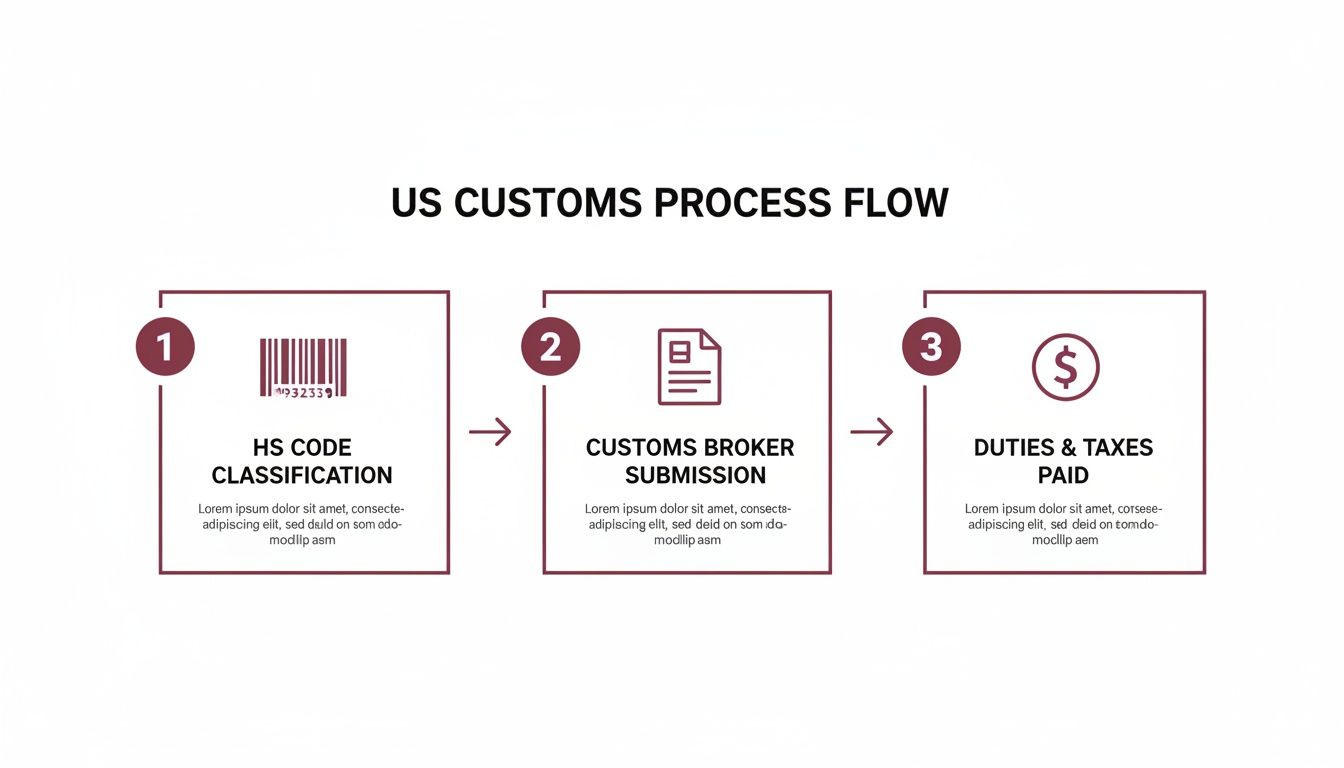
- HS Code Classification: Every product needs a Harmonized System (HS) code, which determines the duty rate you’ll pay. Getting this wrong can lead to incorrect payments, fines, and your shipment being held indefinitely.
- Customs Declarations: Your broker files all necessary entry documents with CBP on your behalf, ensuring accuracy.
- Duty & Fee Payment: They calculate and handle the payment of all import duties and taxes, a critical step before your goods can be released.
Navigating Specific Product Compliance
For many consumer products, especially in the hardware, home, or lifestyle categories, further compliance checks may be required. This is particularly true for products that fall under the watch of agencies like the Food and Drug Administration (FDA) or the Environmental Protection Agency (EPA).
For example, a kitchen tool that touches food may need FDA clearance. An electronic pest repeller could fall under EPA regulations. One of the costliest mistakes a brand can make is failing to secure these certifications before the goods arrive. This will result in them being denied entry and likely destroyed at your expense.
Proactive compliance is your best defence. A strategic partner with on-the-ground experience can identify these potential hurdles long before you ship, ensuring your product is correctly documented and cleared for sale. This turns a potential brand-killing disaster into a predictable part of your expansion strategy.
Designing Your US Logistics and Fulfilment Strategy
A brilliant product and a perfect US entity structure mean nothing if you can’t get your goods to American customers efficiently and profitably. Your logistics strategy is the engine of your US expansion, and getting it right is a core challenge when you want to sell on amazon usa from australia. This is not just about picking the cheapest shipping option; it’s a strategic decision that directly impacts your brand perception, profitability, and scalability.
Fulfilment by Amazon (FBA) vs Fulfilment by Merchant (FBM)
For an Australian brand looking to scale in the US, the choice between FBA and FBM is a necessity, not a choice.
Fulfilment by Merchant (FBM), shipping directly from Australia, is almost always unworkable for competitive growth. The shipping times are too long, the costs are prohibitive, and you are immediately disqualified from the all-powerful Prime badge. American consumers expect two-day shipping as a standard; a two-week delivery window makes your product uncompetitive from day one.
Fulfilment by Amazon (FBA) is the only viable path for serious brands. By shipping your products in bulk to Amazon’s US fulfilment centres, you hand over storage, picking, packing, and shipping to Amazon. More importantly, it gives your products the Prime badge, granting you access to Amazon’s most loyal customer base.
While FBA is the clear winner, it introduces its own complexities: intricate fee structures, careful inventory management to avoid costly storage penalties, and strict inbound shipping requirements.
Mastering the Middle Mile From Australia to the US
Choosing FBA solves the ‘last mile’ delivery, but it creates the ‘middle mile’ challenge: moving inventory from your Australian base to Amazon’s FBA warehouses across the United States. This is where many brands stumble, underestimating the costs and procedural demands.
You have two primary freight options:
- Air Freight: Faster, with transit times of about 5-10 days. That speed comes at a significantly higher cost, making it best for high-margin, lightweight products or for an initial stock-in to get listings live quickly.
- Sea Freight: More cost-effective but much slower, with transit times of 30-45 days or more. Sea freight is the standard for restocking once you have established sales velocity, but it requires meticulous forward planning to avoid stockouts.
Your logistics strategy isn’t just about moving boxes; it’s about managing cash flow and inventory velocity. A partner with established US logistics turns this puzzle from a major operational headache into a predictable, streamlined process.
This process highlights the non-negotiable roles of correct product classification (HS Code), professional customs brokerage, and duty payment before your goods are cleared for entry into the US.
The Non-Negotiables of FBA Preparation
Simply getting your goods to a US port isn’t enough. Amazon has stringent packaging and labelling requirements that must be met before your inventory arrives. Any failure to comply will result in your shipment being rejected, meaning significant costs and delays.
A critical requirement is FNSKU labelling. Each of your individual units must be labelled with a unique Fulfilment Network Stock Keeping Unit (FNSKU) barcode. This is different from a standard UPC/EAN barcode; it’s specific to your seller account and is how Amazon tracks your inventory correctly.
This preparation work—unpacking bulk cartons, inspecting goods, applying FNSKU labels, and re-packing into new cartons that meet Amazon’s strict limits—is almost impossible to manage effectively from Australia. For Australian brands, the value of a strategic partner with existing infrastructure becomes clear. You might also find our insights on selling on Amazon Australia from overseas useful for understanding marketplace nuances from the opposite direction.
This is precisely why a US-based freight forwarder or a 3PL (Third-Party Logistics) provider that specializes in Amazon prep is not a luxury, but a necessity. They act as your on-the-ground team, ensuring your shipment is compliant and ready for a smooth check-in at FBA.
Brand Positioning: From an Australian Product to a US Brand
After navigating the heavy lifting of logistics and compliance, the next challenge is positioning your brand for the American consumer. Getting this right isn’t about changing what makes your product great; it’s about translating its value for a different audience. Fantastic Aussie products can fall flat in the US simply because their messaging doesn’t connect. On Amazon’s crowded digital shelf, your brand has seconds to build trust and communicate value—it needs to speak fluent American from day one.
Localising Your Brand for American Consumers
Adapting Your Brand for the US Market
What works in Australia often gets lost in translation. The humour, cultural shorthand, and visual language need a strategic rethink. American shoppers tend to respond to more direct, benefit-focused marketing. Where Aussie brands might use dry wit, successful US brands often make bolder claims and put the problem they’re solving front and centre.
- Your Imagery: Product and lifestyle photos need to look and feel American. A shot of your product in a classic Aussie backyard can subtly signal “foreign” to a customer in Ohio, creating hesitation.
- A+ Content: This is your chance to build a genuine brand connection. Use it to tell a compelling story, address US-specific questions, and showcase quality in a way that resonates with American values.
The aim isn’t to hide your Australian roots. It’s about presenting your brand as an aspirational, high-quality international product, not a confusing or out-of-place one.
The Critical First Step: US Brand Protection
One of the costliest mistakes a brand can make is assuming an Australian trademark offers any protection in the United States. It doesn’t. To secure your brand, you must register your trademark with the United States Patent and Trademark Office (USPTO). This isn’t just about defence; it’s the key that unlocks Amazon’s most powerful brand-building tools through Amazon Brand Registry.
Without Brand Registry, you’re selling with one hand tied behind your back. With it, you get a suite of tools to build your brand, protect it from counterfeiters, and control your presence on the platform.
Registering your brand gives you full control over your product detail pages, access to powerful customer data through Brand Analytics, and the ability to use premium advertising formats like Sponsored Brands. It’s the difference between just listing an item and building a proper, defensible brand.
Getting Your Product Codes Right: UPCs vs. EANs
Another technical but crucial detail is your product identifier, or barcode. The barcode standards are different, and using the wrong one creates problems.
- EANs (European Article Numbers): These are the 13-digit barcodes standard in Australia and Europe.
- UPCs (Universal Product Codes): These are the 12-digit barcodes standard in the United States and Canada.
While Amazon’s system can sometimes process an EAN, it’s not the professional way to operate in the US. You should list all your products with proper UPCs sourced directly from GS1. Using the correct UPCs prevents listing conflicts and signals to the entire US retail system that your products are properly configured for the market. It’s a small detail that makes a big difference.
Launching and Scaling in a Competitive Marketplace
Getting your product live on Amazon USA is a huge milestone, but it’s just the starting line. Many Australian brands celebrate their launch, only to watch sales stall because they have no strategy for what comes next.
This is where the real work begins. You’re shifting from a logistics project to a relentless growth campaign. It’s also where an experienced partner becomes invaluable, turning a one-time product listing into a long-term growth engine.
Building a Profitable US Growth Strategy
Calculating a Profitable US Price Point
The most common reason brands fail to scale in the US is flawed pricing. Simply converting your Australian price to USD is a recipe for disaster. A profitable US price point must be reverse-engineered from all your landed costs.
Every single cost must be accounted for to protect your margins:
- Manufacturing Cost: Your base cost per unit.
- Logistics: All expenses to get your product from Australia to a US FBA centre, including freight, customs duties, and broker fees.
- Amazon Fees: This includes the referral fee (typically 15%), FBA fulfilment fees, and monthly storage costs.
- Marketing & Advertising: A realistic budget for Amazon PPC is non-negotiable for driving initial sales.
- Returns & Overheads: You must factor in a buffer for customer returns and other operational costs.
Only after mapping out every one of these inputs can you land on a US retail price that actually makes you money.
Using Amazon PPC as a Strategic Weapon
For a new product entering the crowded US marketplace, you have zero organic visibility. Amazon PPC (Pay-Per-Click) advertising isn’t an option; it’s the cost of entry. Beginners use PPC to chase a few extra sales, but strategic brands use it to manufacture launch velocity.
A well-run PPC campaign is your primary tool for:
- Gaining Initial Sales Velocity: Early sales are a powerful signal to Amazon’s A10 algorithm, directly impacting your organic ranking.
- Discovering High-Converting Keywords: Your first campaigns are a data goldmine, revealing what US customers are actually searching for.
- Capturing Market Share: You can strategically target competitor listings and category keywords to siphon off traffic and establish your brand’s presence.
In the US market, you don’t wait for sales to happen—you buy them. A strategic PPC spend is an investment in data, ranking, and momentum, not just an expense.
Managing Returns and Customer Service
Returns are a standard part of doing business in the US, and Amazon’s customer-centric policies make the process incredibly easy for the shopper. FBA handles the entire reverse logistics process—receiving the returned item and processing the refund.
Your job, however, is to pay close attention to why those returns are happening. Customer feedback, both in product reviews and return comments, is a goldmine of information. Is there a misunderstanding about the product’s features? A perceived quality issue? A problem with the packaging?
Actively monitoring this feedback loop allows you to protect your brand’s reputation and fix any underlying issues with your product or listing. It’s a crucial step that many overseas sellers ignore at their peril.
Frequently Asked Questions About US Market Expansion
Expanding into the world’s largest consumer market is a massive step for any Australian brand. Founders considering the move to sell on Amazon USA from Australia always have critical operational questions. It’s a significant strategic decision, so getting clear on the requirements from day one is essential. Here are the straight answers to the most common questions we get from established brand owners.
Do I Need a US Company to Sell on Amazon USA?
No, you don’t technically need a US company. You can launch on Amazon USA using your existing Australian Pty Ltd. This is often the fastest way to get your account active.
However, for any brand with serious long-term ambitions, forming a US-based LLC (Limited Liability Company) is the smarter strategic move. It creates a clean legal separation between your Australian and US operations, which is vital for liability protection. It also makes banking, US tax obligations, and dealing with American partners and distributors much simpler.
What Are the Realistic Startup Costs?
The cost of entry varies, but it’s a mistake to only budget for inventory. While some fees are fixed, the biggest expenses are variable and need careful planning.
A realistic budget for a proper brand launch needs to cover more than just stock:
- Amazon Professional Seller Fee: A fixed $39.99 USD per month.
- Business Formation: If you go with a US LLC, expect to pay from $500 to over $2,000 AUD depending on the service.
- Product Codes: You’ll need to secure proper GS1 UPCs for the US market.
- International Shipping: This is a huge variable. Sea freight is slower but cheaper; air freight is faster but costs a premium.
- Customs & Duties: Plan for 5-20% or more of your product’s declared value, depending on its HS code.
- Initial Advertising Spend: A well-funded Amazon PPC launch campaign is non-negotiable for gaining initial traction.
Excluding your inventory, a well-prepared brand should be ready to invest anywhere from $5,000 to $15,000 AUD to cover these foundational costs and give the launch a real chance of success.
Can I Use My Australian Bank Account?
Technically, yes, you can use Amazon’s Currency Converter for Sellers to get paid into your Australian bank account. But this is one of the most expensive mistakes a founder can make. You’ll lose a huge chunk of your revenue to terrible exchange rates and hidden fees.
The professional approach is to receive USD payments directly. This gives you control over your money and protects your margins from currency conversion losses.
The best practice is to open an account with a specialised payment service like Payoneer or WorldFirst. They give you a US-based receiving account number, so Amazon can deposit your earnings in USD. You can then hold the funds or convert them to AUD when the rates are in your favour, saving you thousands of dollars over time.
If you’re ready to move beyond hypotheticals and build a structured plan for US market entry, the team at TPR Brands can help. We work alongside established brand owners to navigate these challenges and turn a great Australian product into a global brand. Start a Brand Expansion Conversation.