If your product already works, your retailer relationships are stable, and demand is proven, why does growth still feel harder every quarter?
That gap usually isn't a product problem. It's a channel design problem. Established brands often assume the next stage of scale will come from more listings, more doors, or one more retail account. Across multiple marketplace ecosystems, that assumption breaks down fast. Strong catalogues don't automatically create strong brand presence, especially when customers discover, compare, validate, and buy across different environments.
One pattern we continue seeing is that brands treat alternative distribution channels as add-ons. A marketplace account sits over here. A DTC site sits over there. A reseller arrangement gets approved because a region needs coverage. Social commerce appears because someone in the team wants experimentation. Revenue may grow for a while, but the ecosystem gets noisier, less controlled, and less profitable.
For hardware and consumer product brands, channel selection isn't just about reach. It shapes pricing power, compliance exposure, fulfilment confidence, customer trust, and margin retention. During international expansion, those variables become even more decisive. A channel strategy that looks efficient on paper can subtly create fragmentation that blocks scale.
When Your Proven Product Hits a Growth Ceiling
A mature product line can still stall commercially. That usually happens when the original route to market stops matching how customers now buy.
In Australia, non-store retail reached $108.4 billion in 2023, up 12.8% year on year, signalling that these channels are no longer secondary for hardware and home improvement brands according to ABS Retail Trade Australia data. When channel behaviour shifts at that level, founders can't assume traditional retail will keep carrying the growth load.
The ceiling is often structural
A retail-first model works well in the early scaling phase because it creates visibility, credibility, and operational simplicity. But it also imposes limits. Shelf space is finite. Store staff control part of the sales narrative. Regional rollout depends on another party's priorities. Customer data usually sits outside your control.
What looks like slowing demand is often something else. The brand has clearly outgrown a narrow distribution structure.
Strong products rarely fail because the market disappears. More often, the route to market becomes too rigid for the next stage of growth.
A recent pattern in hardware and household categories is that discovery happens in one place, validation in another, and conversion somewhere else again. Buyers compare Amazon, branded websites, trade portals, installers, and content-led social platforms before committing. If your business is only built for one of those moments, the brand becomes visible but commercially underpowered.
Why more retail isn't always the answer
Adding another stockist can increase volume. It can also deepen dependency. If pricing, merchandising, and fulfilment already vary across accounts, more retail distribution can multiply inconsistency rather than solve it.
A useful way to think about this is through concentration. Brands that rely too heavily on one route to market often run into the same issue described in this view of power law distribution in marketplaces. Revenue doesn't spread evenly. A small number of channels, products, and buyer paths drive most commercial value. The wrong response is broad expansion without structure.
What the stronger brands realise earlier
The brands that move cleanly into the next phase stop asking, “Which channel should we add?” They start asking better questions:
- Where does trust form first: in-store, on a marketplace, through trade recommendation, or on a branded site?
- Where does margin hold: after fees, fulfilment, returns, and channel conflict are accounted for?
- Where does control matter most: messaging, compliance, pricing, or post-purchase support?
Alternative distribution channels matter because they let a brand redesign its growth architecture. But once that door opens, the true challenge begins. The issue isn't access to channels. It's building a channel ecosystem that can scale without eroding itself.
Deconstructing the Modern Channel Ecosystem
Most discussions about alternative distribution channels reduce the topic to a list. DTC. Marketplaces. Wholesale. Subscriptions. That framing is too shallow for established brands. These channels don't operate as isolated options. They behave like connected commercial layers.
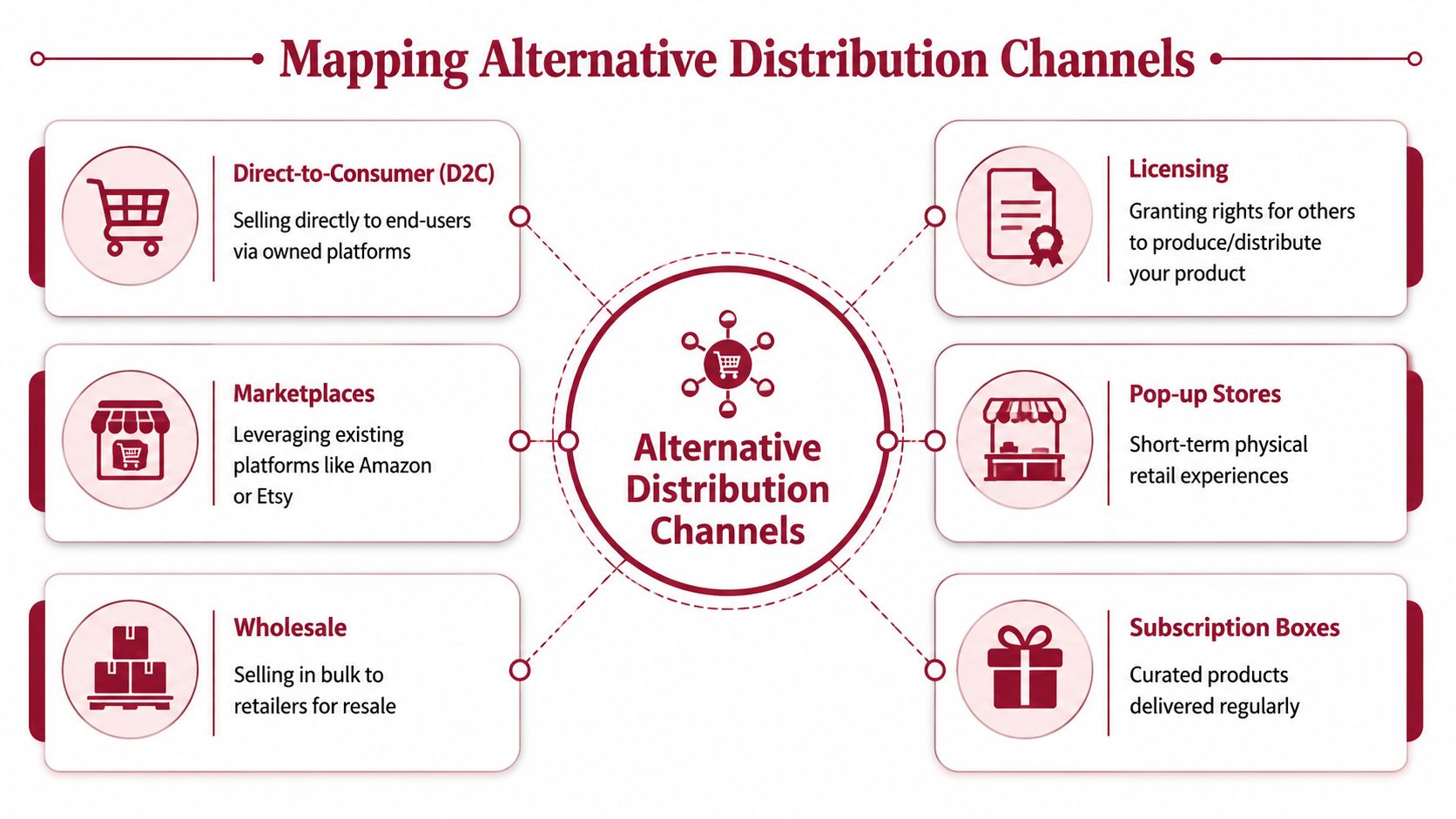
Channels do different jobs
A DTC site gives a brand tighter control over pricing, education, bundling, and customer data. That makes it useful for high-consideration products, premium positioning, and repeat purchase journeys.
Marketplaces do something else. They compress discovery. They place your offer inside an environment where buyers are already comparing options. That can create reach quickly, but it also introduces comparison pressure, duplicate listings, and seller contamination if governance is weak.
Wholesale and trade distribution still matter, especially in hardware, household products, and installation-led categories. They create physical coverage and can support regional account penetration. But they also dilute direct contact with the end customer, which makes it harder to control the brand story.
The overlooked middle layer
One issue we repeatedly observe is that brands ignore the middle layer between direct retail and open marketplaces. That middle layer includes:
- Value-added resellers: useful where technical advice, installation, certification, or local service matters.
- B2B portals: effective for trade buyers who want speed, account pricing, and procurement simplicity.
- OEM and licensing structures: relevant when a brand's product or IP can travel through another operator's installed distribution base.
- Short-term physical formats: pop-ups, event-led activations, or trade-show selling that support validation in tactile categories.
- Subscription models: sometimes suitable for replenishable goods, but risky when the product doesn't naturally fit recurring consumption.
These are not interchangeable. Each changes how buyers perceive the brand, how service gets delivered, and how margin is distributed.
Practical rule: Don't evaluate a channel only by sales potential. Evaluate it by the role it plays in the wider ecosystem.
Reinforcement versus conflict
The strongest channel systems are layered deliberately. A marketplace may support discovery. A DTC site may carry education, bundles, and retention. A reseller may handle regional trust and installation. Each layer supports a different customer need.
Poorly designed systems do the opposite. They create overlap without purpose.
| Channel combination | What works | What breaks |
|---|---|---|
| Marketplace plus DTC | Marketplace drives reach, DTC captures branded demand | Price inconsistency pushes buyers into distrust |
| Wholesale plus VAR | Broad coverage with local service capability | Resellers rewrite the value proposition |
| Subscription plus DTC | Useful for consumables or repeat-use categories | Forced recurrence can cheapen premium positioning |
| Licensing plus marketplace presence | Faster category extension | Brand standards drift across operators |
A recent marketplace review revealed a familiar pattern in connected devices and household products. The catalogue was strong, the offer was competitive, but the ecosystem lacked hierarchy. Every channel tried to do everything. That usually leads to internal competition, duplicated spend, and uneven customer confidence.
The channel question, then, isn't “Which options exist?” It's “What should each channel be allowed to do?”
Analysing Margin Impact and Commercial Tradeoffs
Reach attracts attention. Margin sustains the business. Brands that forget the second part usually discover too late that channel growth has made the company busier, not stronger.
In the Australian hardware and home improvement sector, shifting to DTC and value-added resellers can lift net margin per unit by 28 to 35 per cent, largely because intermediary commissions of 12 to 18 per cent are removed according to ABS industry overview data. That's the kind of shift that changes boardroom decisions, not just campaign plans.
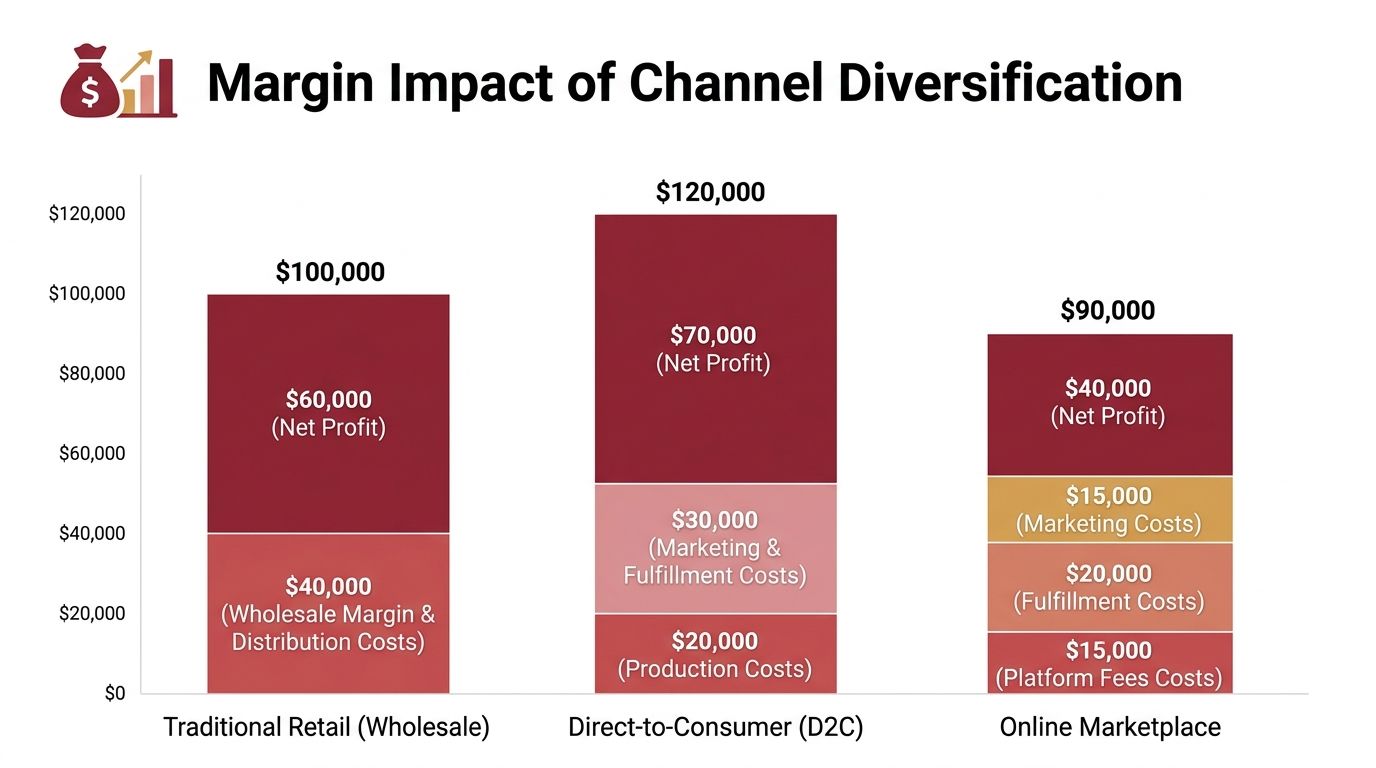
Top line can hide bad economics
A marketplace launch can look successful in the first reporting cycle. Orders appear quickly. Revenue starts moving. Search demand becomes visible. But that top-line view often ignores fee stacking, fulfilment leakage, promotional dependency, and channel spillover into other accounts.
That's why channel decisions should start with a commercial model, not a visibility argument.
Three questions usually expose the truth:
- What does the brand keep: after fees, freight, fulfilment, support, returns, and discounting?
- Who owns the customer relationship: the brand, the reseller, or the platform?
- What happens to adjacent channels: does a new route add demand, or instead shift demand at a lower quality of margin?
Control has economic value
DTC tends to improve control, but it also demands more from the operator. Inventory accuracy, customer support, content depth, returns management, and delivery experience all move closer to the brand. If those functions are weak, margin gains can evaporate operationally.
Marketplaces create the opposite tension. They can reduce friction in customer acquisition because demand already exists on-platform. But they also standardise comparison. Once your offer sits next to lookalikes, pricing discipline gets harder.
A channel with lower acquisition friction can still become a high-cost channel if the brand loses control of price, content, or fulfilment quality.
Many founders often misread performance. Gross sales rise, while the business absorbs more complexity and less pricing power.
The trade-off table founders should actually review
| Channel type | Primary commercial advantage | Primary commercial risk |
|---|---|---|
| DTC | Higher control over pricing, bundles, and customer journey | Requires stronger fulfilment and customer operations |
| Marketplaces | Fast access to active demand | Price comparison and seller fragmentation |
| Wholesale | Simpler bulk movement and account-based scale | Lower control over end-customer experience |
| VAR network | Better fit for technical, bundled, or service-led categories | Partner quality directly affects brand perception |
| Licensing or OEM | Faster reach through existing infrastructure | Reduced control over market presentation |
One pattern behind shrinking marketplace economics is misaligned assortment. Brands often place too much catalogue depth into low-control environments, then wonder why margin compresses. In many cases, only part of the range should sit on open marketplaces, while more technical, premium, or bundle-led offers stay in higher-control channels.
That logic sits behind a broader issue explored in this analysis of why Amazon margins shrink. Margin erosion rarely comes from one fee. It comes from structural leakage across the ecosystem.
The strongest operators don't chase the biggest visible channel. They choose the channels where economics, trust, and control can coexist.
A Framework for Strategic Channel Selection
Most channel mistakes happen before launch. They begin when a brand selects a route to market because a competitor uses it, a platform rep recommends it, or a distributor requests it. That isn't strategy. It's reactive channel accumulation.
A stronger approach starts with sequence. Not every viable channel should open at the same time.
Start with the commercial objective
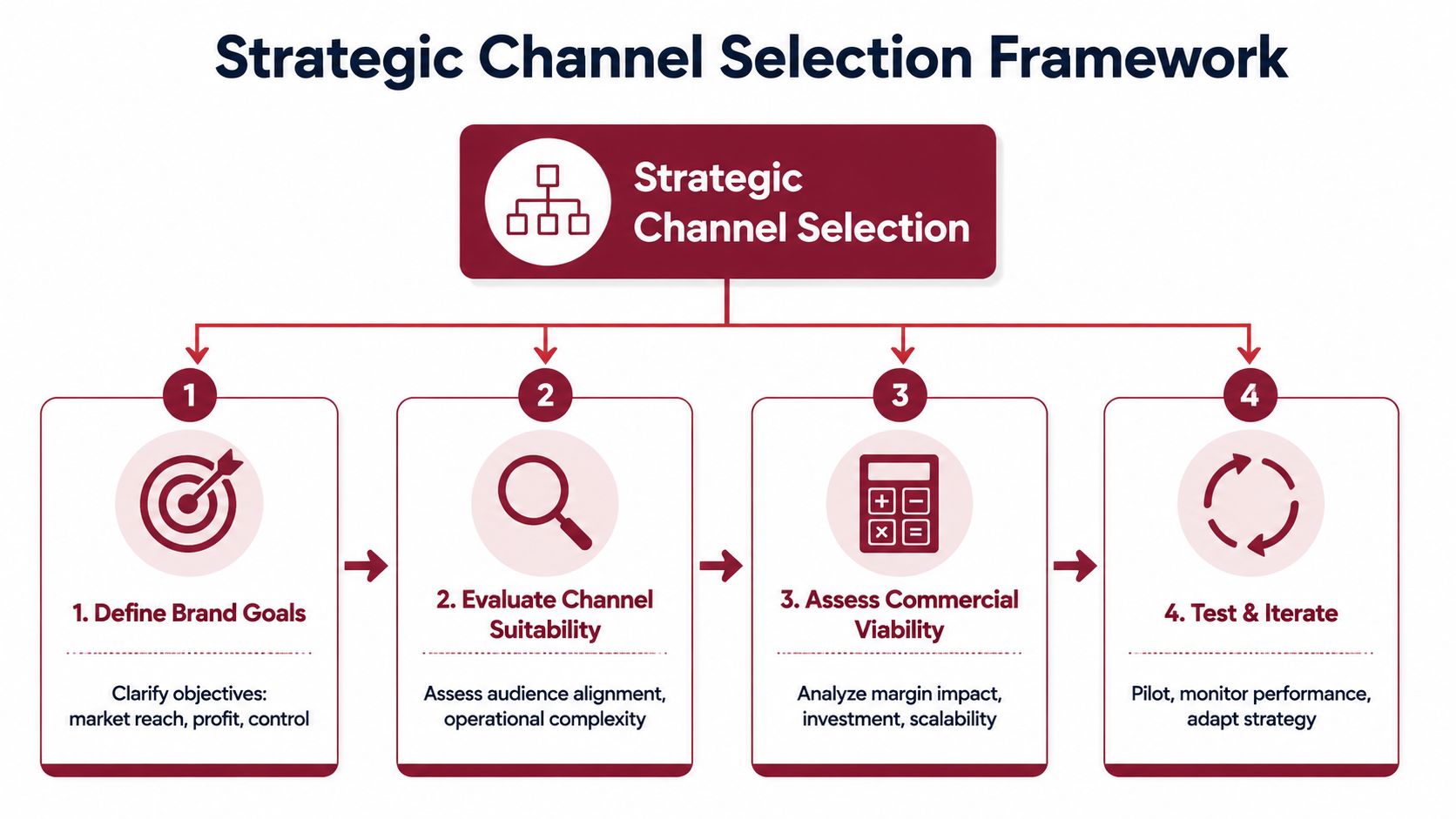
The first decision isn't where to sell. It's what the business needs the next channel to achieve.
Some brands need market entry. Others need margin improvement. Others need geographic coverage, better data ownership, or a cleaner path into trade and installer networks. If the objective isn't explicit, channel evaluation becomes distorted.
Use a simple decision lens:
Growth objective
Are you pursuing volume, margin, data ownership, customer retention, or regional access?Brand sensitivity
Will the channel support premium positioning, or turn the offer into a pure price comparison?Operational load
Can your team support the fulfilment, service, compliance, and merchandising demands that come with the channel?
Test fit before scale
A recent marketplace review for a connected devices brand showed a common failure point. The team had selected channels based on visible competitor activity rather than its own fulfilment structure and support capability. The result was predictable. The channel wasn't wrong in theory. It was wrong for that operating model.
This is the part many businesses rush past. Channel suitability isn't just about customer demand. It's about execution readiness.
A practical review should assess:
- Catalogue fit: Does the product need explanation, installation, bundling, or repeat replenishment?
- Buyer behaviour: Is the purchase impulsive, planned, technical, trade-led, or specification-driven?
- Service expectation: Will buyers expect fast support, live stock visibility, local certification, or installer referral?
- Partner dependence: Does success rely on a distributor, reseller, or platform operator controlling key parts of the experience?
For brands formalising that process, channel partner selection criteria is the right level of scrutiny. The wrong partner can create more channel friction than no partner at all.
A short walkthrough helps clarify how to turn that thinking into execution:
Build a channel roadmap, not a channel pile
Once fit is clear, sequencing matters more than scale. A sensible roadmap often uses one channel for entry, one for control, and one for reinforcement. That may mean a marketplace for discoverability, a DTC environment for authority and education, and a regional partner for fulfilment confidence or trade access.
Better channel systems are usually narrower at the start. They expand after the operating logic proves itself.
This is also where one structured operator can be useful. TPR Brands works with established product companies on channel expansion, market adaptation, and international rollout where distribution, localisation, and compliance need to be coordinated rather than handled as separate projects.
The key isn't to open more channels. It's to open the right channels in an order your business can absorb.
Navigating International Expansion and Localisation
International expansion exposes weak channel design quickly. What looked manageable domestically becomes unstable once buyer behaviour, regulation, fulfilment expectations, and platform maturity change across regions.
The most common strategic error is assuming a channel that performs in Australia will behave similarly in the US or UK. It usually won't.
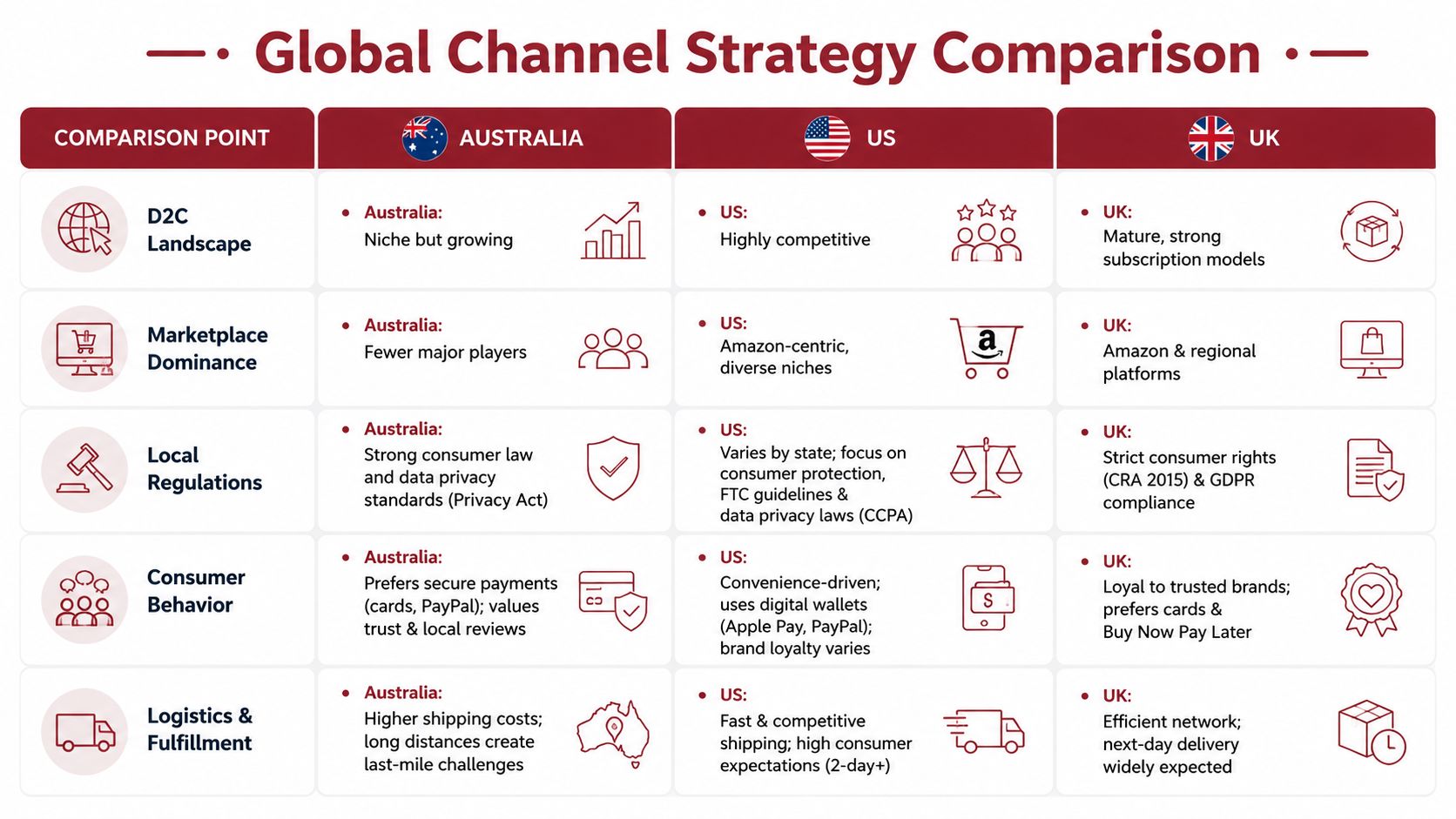
The US punishes loose channel structure
One pattern we continue seeing is Australian hardware brands underestimating the operational complexity of the US market. Sixty-eight per cent of Australian hardware exporters face unexpected compliance barriers in the US due to non-standardised channel practices, leading to an average 15 per cent margin dilution, according to Austrade reporting on exporter channel friction.
That issue rarely shows up in the initial expansion model. Founders tend to budget for freight, market entry, and advertising. They often don't budget properly for certification alignment, channel-specific documentation, local partner coordination, or the commercial cost of fixing non-compliant listings and sales pathways after launch.
The UK rewards structured digital trade access
The UK tends to favour brands that arrive with cleaner commercial architecture. B2B portals, direct online ordering, and clearer buyer expectations can make channel execution more legible for established hardware and trade-led brands. But the same rule applies. Local fit matters more than channel familiarity.
A wholesale-heavy Australian model can underperform in the UK if the offer requires more direct specification support or custom order logic. Likewise, a DTC-led approach can struggle if local proof signals, delivery assurances, and trade account expectations haven't been adapted.
Localisation is commercial, not cosmetic
Many teams still treat localisation as a content task. They update spelling, swap some imagery, and assume the market has been adapted. What becomes visible during international expansion is that localisation changes the commercial system itself.
A more useful comparison looks like this:
| Market | Channel reality | Common mistake |
|---|---|---|
| Australia | Mixed ecosystem with retail heritage and growing digital shift | Assuming domestic strength will transfer without channel redesign |
| United States | Larger but less forgiving, especially around compliance and channel discipline | Entering with fragmented seller, fulfilment, and documentation structures |
| United Kingdom | Digitally mature with strong expectation of operational clarity | Copying an AU wholesale model without adapting buyer journey and trade access |
For a closer view of how these differences affect customer trust and conversion, marketplace localisation and why some products feel closer than others gets to the operational layer many brands miss.
International marketplace expansion is an ecosystem transition. If the local channel structure, fulfilment design, and trust signals don't align, the product can be right and still underperform.
The brands that scale well across borders don't ask whether they can list internationally. They ask whether the local market has enough ecosystem cohesion for the brand to feel credible, compliant, and easy to buy.
Maintaining Brand Cohesion and Compliance
More channels don't automatically create more growth. In many cases, they create more distortion.
That's especially true when a brand enters alternative distribution channels without a position for each one. Fifty-two per cent of Australian consumer brands lose 20 per cent of perceived brand equity within 12 months when entering new channels such as subscriptions without a structured positioning framework, according to Brand Finance reporting on channel-driven brand erosion. For founder-led and premium product businesses, that isn't a marketing problem. It's an asset protection problem.
Cohesion has to be designed
Brand cohesion doesn't mean every channel looks identical. It means every channel reinforces the same commercial logic.
A marketplace listing may need compressed copy, sharper proof points, and tighter price architecture. A trade portal may need specification clarity and account-based ordering. A DTC site may need richer education, bundles, and post-purchase support. The message changes by environment, but the value proposition can't drift.
One issue we repeatedly observe is third-party seller dominance reshaping the brand narrative. The product is real, demand exists, but unauthorised or loosely managed sellers become the main visible operators. Once that happens, pricing becomes inconsistent, support standards diverge, and the brand story fragments in public.
Guardrails that serious brands put in place
The strongest operators usually formalise control before broadening distribution. That often includes:
- Selective distribution terms: not every willing partner should be approved.
- Price governance: minimum advertised pricing or equivalent policy discipline where legally and commercially appropriate.
- Brand registry and listing control: especially in marketplace environments where content duplication appears quickly.
- Channel-specific messaging rules: the same product can be positioned differently, but not contradictorily.
- Compliance ownership: someone in the business must own certifications, claims, product detail accuracy, and documentation consistency.
If no one owns cross-channel consistency, the channel will define the brand for you.
Compliance isn't separate from growth
In hardware and household categories, compliance failures rarely stay isolated. A single incorrect claim, missing document, or unsuitable reseller representation can affect account confidence well beyond one listing. That's why mature brands treat compliance as part of channel design, not a legal review after launch.
The practical test is simple. If a customer encounters your product through three different routes, does the brand still feel like one business? If the answer is no, expansion is already creating drag.
Your Go-To-Market Implementation Checklist
A solid channel strategy becomes valuable only when the operating model can carry it. That means turning broad ambition into a controlled rollout.
What to check before you open the next channel
- Clarify channel role: decide whether the channel is for discovery, conversion, retention, trade access, or geographic coverage. If the role is vague, overlap will creep in.
- Model contribution margin: review the full economics, including fulfilment, support, returns, platform costs, partner margin, and likely promotional pressure.
- Segment the catalogue: don't assume every SKU belongs everywhere. Technical, premium, bundle-led, or installation-sensitive lines often need tighter channel control.
- Audit fulfilment readiness: stock visibility, pick-pack accuracy, returns handling, and service responsiveness all shape channel viability.
- Set partner rules early: define who can sell, where they can sell, how they can price, and how they represent the brand.
- Prepare localisation inputs: for new markets, adapt claims, imagery, documentation, packaging expectations, and buyer reassurance signals before launch.
- Define channel-specific KPIs: evaluate each channel by its intended role, not by one generic revenue figure.
- Run a contained pilot: test on a limited catalogue, in a defined region, with clear review points before broad rollout.
What usually separates clean expansion from messy expansion
The better operators don't move faster just because they're more aggressive. They move better because they reduce ambiguity first. They know who owns the customer, who owns the listing, who owns compliance, and which parts of the catalogue should stay protected.
That discipline matters even more during international expansion, where weak assumptions become expensive very quickly.
If your team is weighing alternative distribution channels, the decision probably isn't whether to diversify. It's whether you'll do it with enough structure to protect margin, brand value, and market credibility while you scale.
TPR Brands works with established product businesses that are ready to move beyond retail dependence and build commercially cohesive channel ecosystems across Australia, the United States, Canada, and the United Kingdom. If you're evaluating alternative distribution channels, restructuring a fragmented marketplace presence, or preparing for international expansion, a strategic conversation with TPR Brands can help clarify the right sequence, partner model, and market structure before costly channel decisions lock in.