If a founder asks, what is an ASIN, they're usually asking the wrong question.
The more useful question is this. Why do some proven brands arrive on Amazon with strong products, solid retail history, and capable teams, yet still end up with a messy, weak marketplace presence that feels harder to control than it should?
One issue we repeatedly observe is that brands treat the ASIN as a technical label rather than a commercial asset. That mistake sounds minor. It isn't. On Amazon, catalogue structure shapes visibility, trust, review concentration, offer control, and the quality of expansion into new regions.
A strong product can still get trapped inside a fragmented marketplace footprint. Listings split. variants are mapped badly. Older product versions stay live. Distributors or third-party sellers attach themselves to the wrong product detail pages. Internally, the business thinks it has one catalogue. Amazon often shows a different reality.
The Hidden Asset Governing Your Brand on Amazon
An ASIN sits at the centre of that reality.
Most brands first encounter it as a field in Seller Central, a code in a URL, or a reference used in reporting. But in practical marketplace terms, the ASIN often becomes the point where brand control is either maintained or lost. If your catalogue is clean, your customer journey usually feels coherent. If your ASIN structure is compromised, everything downstream gets harder. Search visibility, offer quality, review integrity, and operational confidence all start to drift.
That's why a marketplace presence can look healthy on the surface while weakening underneath. The products are there. Sales may be coming through. But the brand is no longer controlling the commercial environment around those products.
Where fragmentation starts
Founders often assume Amazon will naturally organise the catalogue in a way that reflects the brand's own internal logic. It doesn't always work that way. Amazon organises products according to its marketplace architecture, and that architecture rewards clarity, consistency, and disciplined product identification.
A recent marketplace review revealed a familiar pattern. A brand had invested heavily in product quality and packaging consistency, yet its Amazon presence had become scattered across duplicate listings, inconsistent variants, and mixed seller contribution history. The issue wasn't product demand. The issue was that the catalogue lacked a strong control layer.
That control layer is often built around the ASIN.
Why founders should care early
If you want to understand listing ownership risk, catalogue drift, or why a marketplace can start feeling commercially inefficient, start by looking at ASIN structure before you look at ad spend or creative.
Practical rule: If your ASIN structure is weak, your marketplace brand will usually become weaker over time, even if the product itself is strong.
Brands that take Amazon seriously tend to move beyond listing management and focus on catalogue governance. That's also why control of the listing environment matters so much for long-term margin and brand stability, especially where multiple sellers are involved. This is closely tied to Amazon listing control and brand protection, because the ASIN is often where that control either starts or breaks.
The ASIN Explained as a Product's Digital DNA
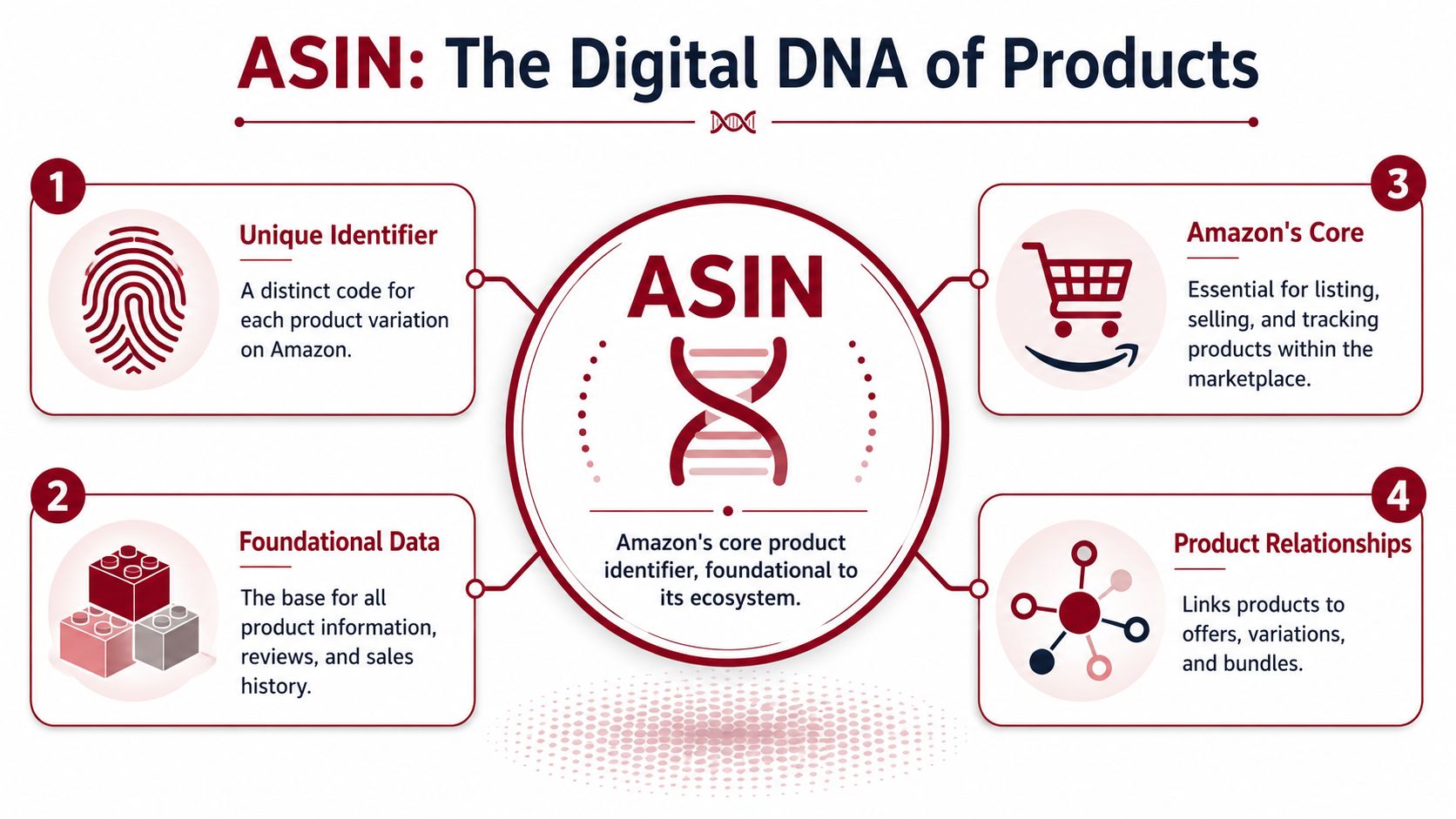
ASIN stands for Amazon Standard Identification Number. Amazon uses it as a unique 10-character alphanumeric identifier for products in its catalogue. For books, the ASIN is typically the same as the ISBN, while for other products Amazon creates a new ASIN when the item is added, according to Amazon's seller guidance on ASINs.
That definition is accurate, but it's incomplete.
On Amazon, the ASIN functions more like a product's digital DNA. It is the core identity object Amazon uses to organise how a product exists inside the marketplace. When operators talk about a listing “working” or “struggling”, they're usually talking about everything accumulating around that ASIN.
What the ASIN actually anchors
An ASIN doesn't just label a product. It anchors the commercial record attached to that product detail page.
That includes elements such as:
- Product identity on Amazon: The ASIN tells Amazon which product it is dealing with inside its own catalogue system.
- Offer attachment: Sellers don't just sell a product in the abstract. They attach offers to a specific ASIN.
- Listing continuity: Reviews, content contributions, and catalogue history tend to collect around that product identity.
- Operational reference: Teams use the ASIN to track, diagnose, and manage what is happening in-market.
If you reduce the ASIN to “just a code”, you miss why catalogue errors become so expensive. Misidentify the product, and Amazon may group the wrong offers, split what should be unified, or treat variants as disconnected products.
A short explainer helps make the mechanics clearer.
Why this matters in commercial terms
Across multiple marketplace ecosystems, one pattern continues showing up. Businesses often invest in the visible layer first. Images, copy, ads, and launch planning. But if the underlying product identity is weak, those improvements sit on unstable ground.
The ASIN is where Amazon decides what the product is. Everything else depends on that judgement being right.
For established brands, that changes the conversation. The question isn't only “what is ASIN”. The sharper question is whether the brand has enough control over the ASIN layer to protect catalogue integrity as the business scales.
Translating Your Catalogue ASINs vs GTINs UPCs and SKUs
Most established brands already have a product-identification system before Amazon enters the picture. Operations teams manage internal codes. Warehouses use their own inventory logic. Retail partners rely on standardised trade identifiers. Amazon then introduces a separate identifier that becomes dominant inside its ecosystem.
That's where friction starts.
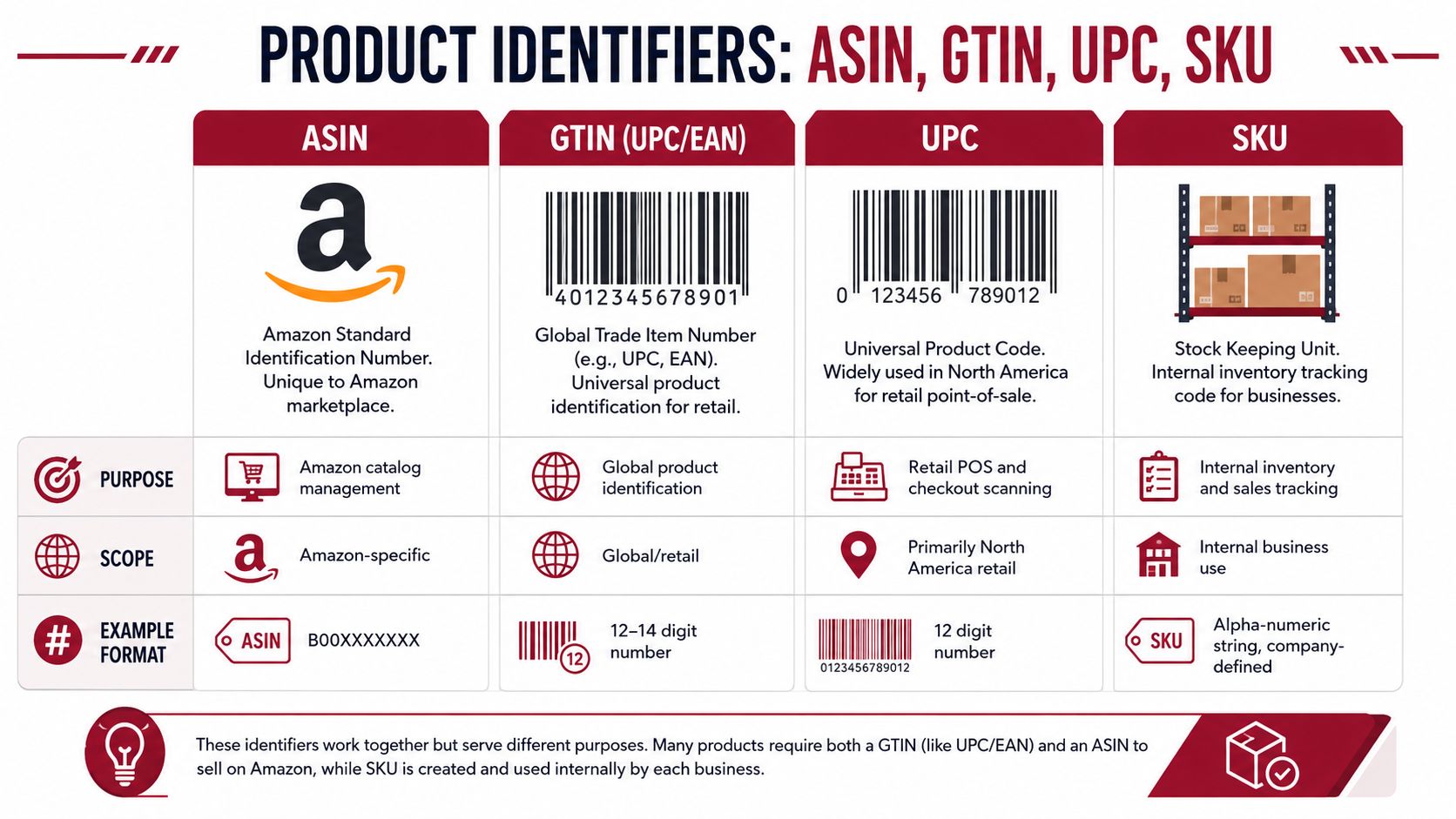
These codes don't do the same job
A practical way to think about the difference is scope.
| Identifier | Main role | Where it matters most |
|---|---|---|
| ASIN | Amazon catalogue identity | Amazon marketplace operations |
| GTIN / UPC / EAN / ISBN | Standard product identification | Retail and cross-channel product matching |
| SKU | Internal stock and operational tracking | Your own business systems |
The confusion comes when teams assume these identifiers are interchangeable. They aren't.
Your internal SKU might represent how your business tracks a product. A GTIN may represent how that product is recognised in broader retail systems. The ASIN represents how Amazon organises that product inside Amazon.
Where brands get into trouble
One SKU inside your ERP doesn't automatically translate into one clean Amazon listing outcome. In practice, a product can end up represented in ways that create complexity fast.
Common failure points include:
- Internal logic overriding marketplace logic: A business may group products one way internally, while Amazon treats each variation or configuration differently.
- Distributor-led catalogue creation: Different parties may create or contribute to listings without a shared catalogue rule set.
- Packaging or bundle ambiguity: Products that seem commercially “the same” to a founder may not be treated as the same product inside Amazon.
- Loose naming conventions: Teams often underestimate how quickly inconsistent identifiers create duplicate or misaligned listings.
Operator view: Translation is the real work. The challenge isn't having identifiers. The challenge is making sure your internal identifiers, retail identifiers, and marketplace identifiers refer to the same commercial reality.
Many catalogue problems transform from administrative issues into strategic challenges. If your internal source of truth doesn't translate cleanly into Amazon's source of truth, the marketplace begins creating its own version of your brand.
That's why the move from product catalogue to live marketplace presence is not a simple upload exercise. It is a structural translation problem, and that distinction matters if you're trying to preserve control across channels. The wider issue is explored well in this view of product catalogue versus marketplace ecosystem management.
What works better
The strongest operators usually do three things well:
- They define one internal source of truth before anyone starts creating or editing listings.
- They map product identifiers deliberately rather than assuming Amazon will resolve ambiguity correctly.
- They treat each marketplace identifier as part of a controlled catalogue architecture, not as an afterthought added during launch.
What doesn't work is letting commercial, operations, and channel teams all use slightly different product logic. That almost always produces catalogue drift.
Conducting an Ecosystem Audit to Locate Your ASINs
Many brands think they need to “find an ASIN”. In reality, they need to find their actual Amazon footprint.
That distinction matters. A clean brand presence should make ASIN discovery straightforward. But if distributors, resellers, legacy listings, or earlier catalogue decisions are involved, locating ASINs often becomes an audit exercise rather than a quick lookup.

Amazon's ASIN system has been structurally important for a long time. ASINs were introduced in 1996, when Amazon expanded beyond books and needed a product-ID system that could fit its existing 10-character ISBN-style database field. That decision made ASINs foundational to Amazon's catalogue architecture, as outlined in the Wikipedia background on ASIN history.
Where to locate ASINs in practice
At the practical level, teams usually locate ASINs in a few predictable places:
- On the product URL: Amazon's seller guidance notes that the code appears after “/dp/” in the product URL.
- In product detail information: The ASIN is commonly visible within the detail page information.
- Inside Seller Central reporting: Catalogue and inventory views usually expose ASIN-level references.
Finding the code is the easy part. Interpreting what it reveals is where commercial value appears.
What the audit often exposes
One pattern we continue seeing is that brands assume they have one active listing per product family, when the marketplace contains several disconnected listing histories.
An ecosystem audit often surfaces issues such as:
- Duplicate listings: Similar or identical products appear under separate ASINs.
- Older versions still live: Discontinued packaging, outdated imagery, or superseded items remain searchable.
- Seller confusion: Third-party offers attach to ASINs that don't reflect the current intended customer experience.
- Review fragmentation: Customer feedback is spread across multiple product identities instead of concentrating where it should.
A fragmented ASIN footprint usually tells you more about your marketplace risk than your top-line sales report does.
This is why brands with a reseller history should be especially careful. Once multiple parties have touched the catalogue, the live marketplace often contains hidden layers that internal teams don't see until performance stalls or customer complaints increase.
For brands dealing with offer overlap, pricing inconsistency, or unclear ownership signals, this often sits alongside the broader issue of multiple sellers operating on the same Amazon product environment.
A practical audit lens
When reviewing your own presence, don't just ask “what is our ASIN”. Ask:
- Which ASINs currently represent our products?
- Which ones are current, and which are legacy?
- Are variants grouped logically?
- Are sellers attached to the right product identities?
- Does the customer see one coherent brand story or a patchwork?
That audit lens is far more valuable than a simple identifier lookup.
The International Expansion Blind Spot ASIN Regionalisation
A surprising number of capable brands assume an ASIN travels globally with the product.
It doesn't.
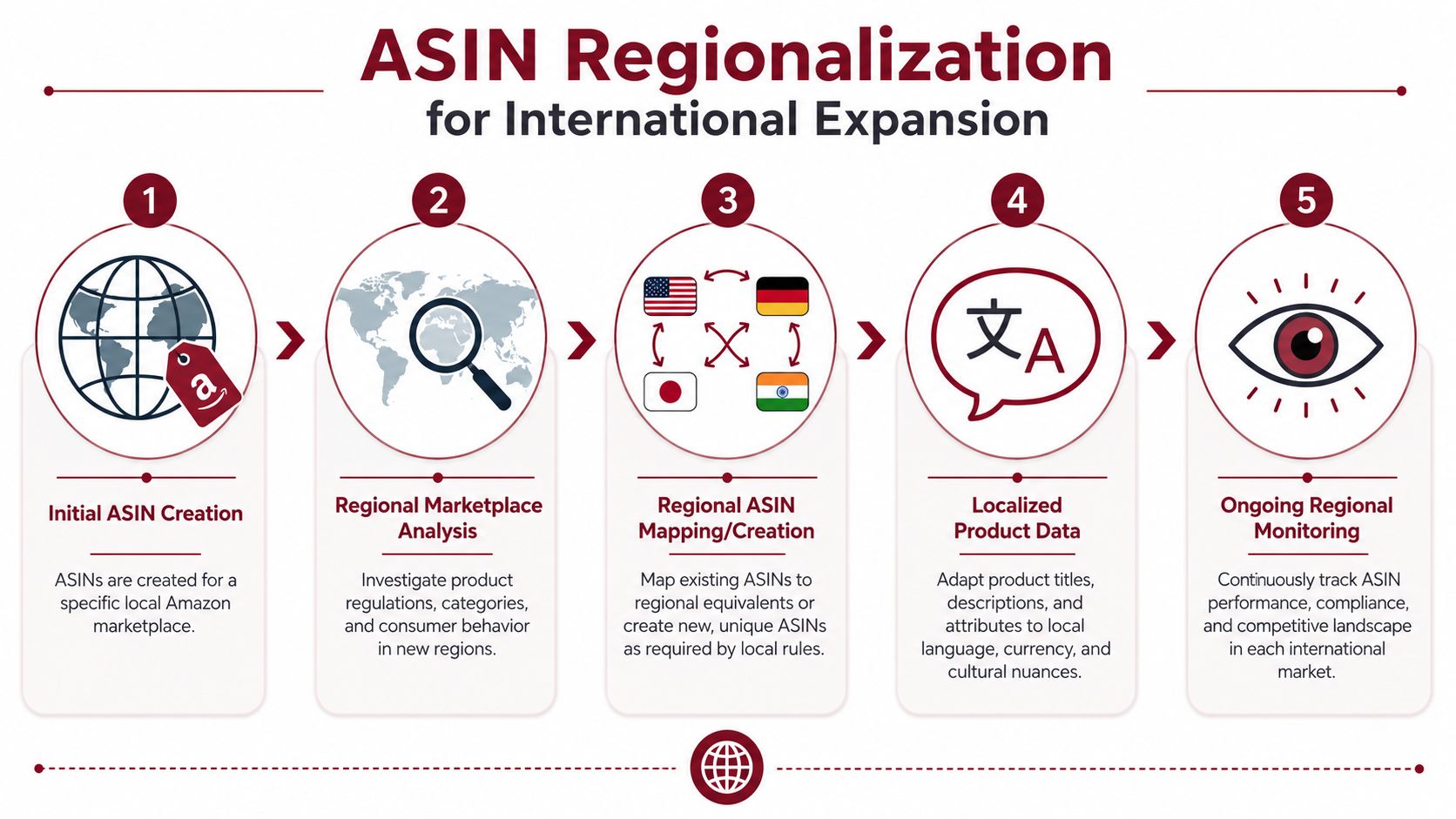
An ASIN is not globally unique. It is only guaranteed to be unique within a marketplace, so the same product can have different ASINs across Amazon country sites. This has significant implications for brands managing product data consistency across regions, as explained in this review of ASIN uniqueness across Amazon marketplaces.
Why regionalisation creates hidden complexity
For founders expanding from Australia into the United States, Canada, the United Kingdom, or other Amazon marketplaces, this changes the whole catalogue conversation.
Internally, the business still thinks it is dealing with one product range. Operationally, each regional marketplace may require its own ASIN mapping, local content structure, contribution history, compliance treatment, and commercial oversight. If that work is handled casually, the same product starts behaving like separate disconnected assets.
That creates several practical consequences:
- Catalogue consistency becomes harder: Product data can drift between marketplaces even when the product itself hasn't materially changed.
- Operational reporting gets messier: Teams start comparing performance across regions without clean product identity mapping.
- Expansion gets slower: Each new marketplace requires structured catalogue work, not just listing replication.
- Brand cohesion weakens: The customer experience starts reflecting local listing accidents instead of deliberate brand architecture.
What becomes visible during expansion
What becomes visible during international expansion is that marketplace ecosystems behave differently across regions. A product that feels mature and well-structured in one marketplace can appear underdeveloped in another if ASIN mapping, localisation, and variation handling are treated as admin rather than strategy.
Strong international expansion depends on mapping product identity market by market, not assuming the home-market structure will transfer cleanly.
This is one of the most expensive blind spots for established brands because it often appears late. The initial launch still happens. Products go live. Some sales come through. But the brand later realises it has built separate pockets of marketplace history rather than one coordinated international catalogue structure.
What works and what usually fails
The weak approach is simple duplication. Copy titles, port imagery, push listings live, and assume the market will sort itself out.
The stronger approach looks more disciplined:
| Weak approach | Stronger approach |
|---|---|
| Treats the ASIN as global | Treats ASINs as marketplace-specific assets |
| Assumes one catalogue fits every region | Maps product identity for each market deliberately |
| Copies content directly | Localises product data to market context |
| Launches first, audits later | Audits structure before scale compounds errors |
For Australian brands in particular, localisation stops being a marketing topic and becomes a catalogue governance issue. A product may be physically export-ready, but its marketplace identity still needs to be translated into the destination ecosystem. That's also why marketplace localisation changes how products feel to buyers in different regions long before advertising or pricing decisions do.
Building a Defensible Catalogue Structure
Once a brand sees the catalogue clearly, the next job is to make it harder for the marketplace to drift.
That means building a structure that can absorb growth, new variants, seller complexity, and regional expansion without turning into a patchwork of disconnected product identities. In practice, that usually comes down to ownership discipline, variation logic, and correction workflows.
Variation structure is where many catalogues weaken
A common challenge is how ASINs interact with product variants. Generic content often says an ASIN is “one product,” but variant-level catalogue management can create multiple child ASINs under a parent listing, which is a practical issue for brands trying to scale assortments without fragmenting reviews or ranking signals, as noted in this explanation of ASIN variant structure.
That issue sounds technical until it starts affecting customer behaviour.
A recent marketplace review of a consumer electronics range revealed a pattern that shows up across premium consumer categories. The brand had strong products, but its variation logic buried key options inside weak relationships. Customers struggled to compare configurations cleanly. Internal teams struggled to interpret performance properly. The catalogue existed, but it wasn't helping the customer make confident buying decisions.
What stronger brands do differently
Better catalogue operators usually focus on a few core aspects:
- They establish ownership early: They don't let listing creation drift across partners without a clear control model.
- They correct duplicates decisively: If catalogue sprawl is left in place, it tends to keep distorting performance signals.
- They build variants around customer logic: Colour, size, format, or bundle relationships need to make sense to the buyer, not just to internal teams.
- They use brand protection tools properly: Brand Registry can help brand owners assert more control over product detail accuracy and catalogue maintenance.
- They review structure before expansion: It's easier to scale a clean catalogue than to repair a fragmented one across several marketplaces.
Catalogue defence is not a one-off clean-up. It's an operating discipline.
The commercial standard to aim for
A defensible catalogue does three things well. It helps Amazon understand the product correctly. It helps customers browse the range confidently. It helps the brand expand without rebuilding its product architecture every time the business enters a new channel or region.
What doesn't work is treating catalogue structure as support work beneath the “real” growth strategy. On Amazon, it is part of the growth strategy.
If your business is preparing for tighter marketplace control, cleaner regional expansion, or a more coherent catalogue across channels, TPR Brands works with established product companies that need operator-level marketplace structure rather than generic Amazon advice. The focus is controlled brand expansion, stronger ecosystem cohesion, and commercial execution that holds up across regions.