Most advice about environmental regulations treats them like a late-stage admin task. Get the certificates, fill in the forms, move on.
That framing breaks down the moment a product brand tries to expand across borders. What looks manageable in one market becomes a layered operational problem once packaging changes, material declarations, recycling obligations, energy reporting, importer responsibilities, and marketplace enforcement start interacting with each other. The result usually isn't one dramatic compliance failure. It's a sequence of smaller delays, redesigns, document requests, and channel bottlenecks that steadily eat margin.
One pattern we continue seeing is that brands prepare for freight, distributor terms, and marketplace setup far earlier than they prepare for environmental regulations. That order feels rational until the first shipment is ready, the catalogue is built, and somebody asks for a technical file, a packaging statement, an energy record, or proof that a product configuration matches the market you're entering.
For founders, that's the key issue. Environmental regulations aren't just about legality. They're a practical test of whether the business can scale without losing control of cost, timing, and brand consistency.
The Real Cost of Global Ambition
The common assumption is that compliance becomes relevant after demand is proven. In practice, it often decides whether expansion works commercially in the first place.
For established hardware, household, and consumer product brands, the main drag on international growth often isn't marketing performance or freight complexity. It's fragmented environmental regulations that attach themselves to products, packaging, warehousing, documentation, and post-sale obligations in different ways across different markets. Teams usually notice the problem late because each issue looks small on its own.
Compliance rarely fails in one big moment
The operational damage usually comes from sequencing errors. A brand finalises packaging before understanding local waste obligations. It approves a supplier change without checking whether material declarations still hold. It signs a retailer or marketplace launch date before confirming which environmental documents the importer, customs broker, or channel partner will request first.
The sharper question isn't whether environmental regulation exists. It's which obligations become binding first when an established brand expands from domestic retail into new channels or countries, and how it should prioritise compliance work to avoid margin erosion, a gap highlighted in Transect's discussion of environmental regulation sequencing.
Practical rule: The first compliance task isn't the most visible one. It's the one that can stop inventory, delay onboarding, or force redesign after production has already started.
That's why treating compliance as a back-office checklist is such an expensive mistake. Once a brand enters multiple jurisdictions, environmental regulations start influencing commercial decisions long before legal teams are formally involved. They affect product architecture, carton size, documentation standards, who can import, who carries post-market responsibility, and whether a SKU should exist in a target market at all.
Readiness shows up in the small decisions
We've seen this especially with brands moving from steady domestic performance into cross-border marketplaces, wholesale distribution, or new fulfilment structures. The products are often proven. The demand case is often sound. What's missing is the operating discipline to sequence compliance alongside market entry.
That's where expansion plans start leaking money:
- Redesign costs when packaging or materials need to change after production assumptions are locked
- Slower channel activation when distributors or marketplaces ask for documents the brand hasn't organised centrally
- Margin compression when compliance work is handled reactively, through exceptions, rush testing, or fragmented supplier follow-up
- Catalogue friction when too many low-volume SKUs create disproportionate documentation and stewardship overhead
Founders usually feel this as drag rather than drama. Launches slip. Internal teams get pulled into rework. Inventory decisions become conservative because nobody wants stock stranded in the wrong configuration.
Environmental regulations don't just measure legal exposure. They reveal whether the business is built for controlled international growth.
What Environmental Regulations Mean for Your P&L
Operators don't need a legal definition first. They need to understand where environmental regulations hit the numbers.
In commercial terms, these rules shape cost of goods, operating expense, working capital risk, and market access. They determine what materials you can use, how products are packaged, what records suppliers must provide, how end-of-life obligations are funded, and whether a shipment can move without extra intervention. If the finance team only sees compliance as a line item for testing or consultant fees, the business is probably understating the actual cost.
The costs usually appear in three places
The first is product and packaging design. Australia's waste settings make that especially relevant for importers and manufacturers. The Australian Bureau of Statistics reported that Australia generated 75.8 million tonnes of solid waste in 2020-21, with a 63% recovery rate, reflecting a shift toward resource recovery and extended producer responsibility that directly affects packaging design, material choice, and end-of-life costs for importers, as noted in the National Agricultural Law Center overview citing the ABS figures.
The second is documentation and assurance overhead. A product that appears commercially simple can still require supplier declarations, material statements, packaging data, test records, and importer-facing compliance files. None of that feels expensive when discussed in isolation. It becomes expensive when teams need it across a broad catalogue, across changing suppliers, or under a launch deadline.
The third is risk transfer. If a product issue triggers a claim, dispute, hold, or recall scenario, the line between environmental compliance, product responsibility, and commercial protection gets thin very quickly. That's one reason brands entering new channels often review their broader risk stack alongside product liability insurance considerations, rather than treating environmental obligations as a silo.
Late discovery is where margin disappears
One issue we repeatedly observe is that brands discover environmental compliance costs after pricing has already been set. That's the worst moment to find them. By then, the options are usually all unattractive:
| P&L area | What environmental regulations can change | Typical commercial effect |
|---|---|---|
| Cost of goods | Materials, components, packaging inputs | Lower gross margin or forced repricing |
| Operating expense | Testing, documentation, reporting, advisory work | Higher fixed overhead during expansion |
| Working capital | Shipment delays, relabelling, redesign inventory | Cash tied up in non-selling stock |
| Revenue timing | Channel onboarding or customs friction | Slower market entry and weaker launch velocity |
Brands don't usually lose money because one rule was impossible. They lose money because they priced for a smooth launch and got a fragmented one.
The stronger operating approach is to treat environmental regulations as part of commercial modelling. Before launch, ask which SKUs carry extra packaging complexity, which suppliers can't support traceability, and which target markets create post-sale obligations that the current margin structure won't comfortably absorb.
That reframes compliance from overhead into planning discipline. And for scaling brands, that's a much more useful lens.
Key Regulatory Ecosystems and Their Commercial Quirks
Not all regulatory environments create friction in the same way. Some are highly structured and predictable. Others are less centralised, more variable, and harder to plan around commercially.
That distinction matters because many brands assume regional success transfers neatly. It doesn't. A product range that moves cleanly through one market can become operationally awkward in another because the governing philosophy is different. One market may ask for extensive upfront structure. Another may rely more heavily on fragmented oversight, channel-specific scrutiny, or uneven enforcement that changes by state, territory, or product pathway.
Australia is centralised in theory and layered in practice
Australia's modern framework has a clear federal anchor. The Environment Protection and Biodiversity Conservation Act 1999, which commenced on 16 July 2000, created a single national trigger for major environmental approvals and replaced a more fragmented approach, giving regulators a formal basis for conditions, offsets, and compliance action across protected matters, as outlined in the discussion of the EPBC Act and its historical role.
That sounds neat on paper. Operationally, brands still face a layered environment because approvals, waste settings, stewardship expectations, and state-level enforcement don't behave like one unified commercial system. For marketplace and channel expansion, the practical challenge is less about memorising one law and more about knowing where federal structure ends and state-level variation begins.
The real comparison is how markets create uncertainty
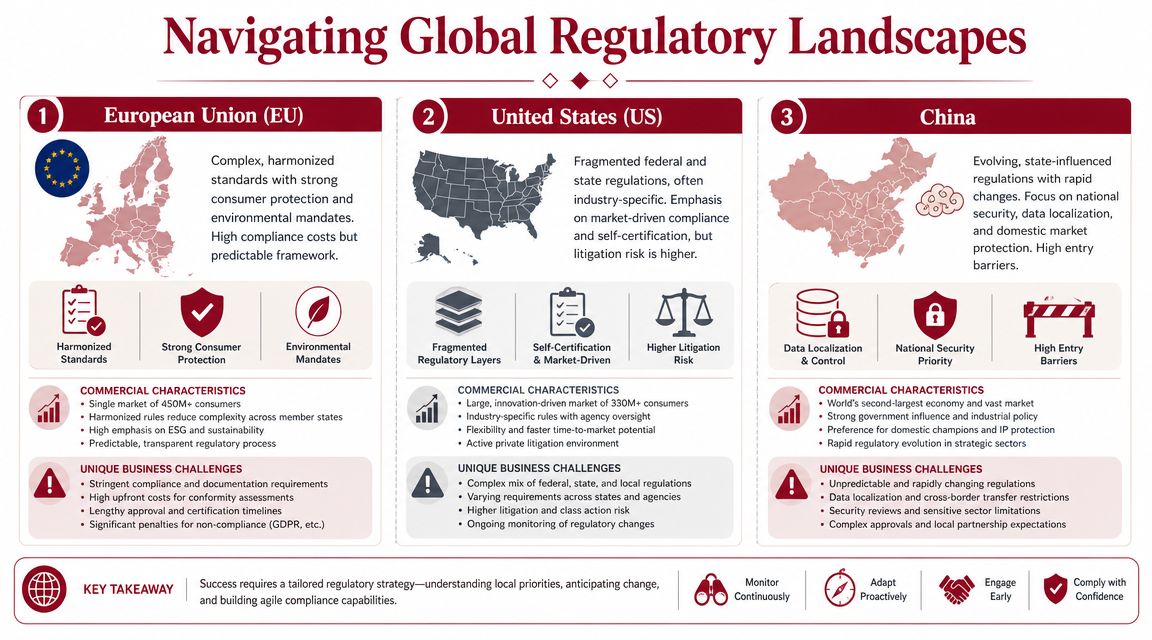
The European Union generally creates friction through detailed, harmonised standards. Brands often dislike the workload, but they can usually map the obligations with reasonable confidence.
The United States often creates friction differently. The issue isn't always that standards are stricter. It's that federal and state pathways can diverge, product categories can be treated unevenly, and litigation or channel pressure can shape behaviour as much as formal regulator action. That can make a “compliant enough” mindset particularly dangerous.
In Asia, several markets add another layer: the formal rulebook matters, but so do local administrative expectations, importer arrangements, documentation norms, and speed of regulatory change. Japan often rewards disciplined preparation. China can require a much more state-influenced, adaptation-heavy entry posture. The challenge is less about one universal standard and more about translation between systems.
Global regulatory ecosystems at a glance
| Region | Governing philosophy | Primary commercial impact |
|---|---|---|
| Australia | Federal anchor with meaningful state and territory variation | Approval and enforcement pathways can differ by jurisdiction and project footprint |
| European Union | Harmonised, prescriptive rulemaking | Higher upfront compliance workload, but clearer planning logic |
| United States | Mixed federal and state environment | Greater variability, channel risk, and inconsistent operating assumptions |
| United Kingdom | Structured but evolving post-EU framework | Similar categories of obligation, with local interpretation and adaptation needs |
| Japan and key Asian markets | Formal requirements shaped by local practice and importer structure | Strong need for localisation, document discipline, and in-market coordination |
A recent marketplace review revealed a familiar pattern. Brands often overestimate the transferability of existing compliance files. If a supplier pack worked for one channel or region, teams assume it will satisfy another. That assumption creates rework almost every time.
A better way to think about expansion is to treat each market as an ecosystem transition, not a document export exercise. That's particularly true for brands selling across channel models, where distributor requirements, retail onboarding, and marketplace standards can all apply differently. Teams building capability in this area often benefit from studying how Amazon selling environments vary across markets and channels, because platform entry rarely exists in isolation from the broader compliance environment.
The most expensive phrase in cross-border expansion is “we thought our existing paperwork would be enough”.
What founders should actually compare
When assessing a target market, don't start with a giant legal list. Start with commercial questions:
- Where does responsibility sit with the brand, importer, distributor, or channel partner?
- How fragmented is enforcement across national and subnational levels?
- Which obligations hit first at design, import, listing, warehousing, or post-sale stage?
- How often do rules change in practice, not just on paper?
- What evidence does the market expect when something is challenged?
Those answers tell you far more about launch risk than a generic compliance summary ever will.
Common Compliance Battlegrounds for Product Brands
Most product brands don't lose time on obscure edge cases. They lose time in the same recurring battlegrounds, usually because those obligations cut across sourcing, packaging, technical files, and channel readiness at the same time.
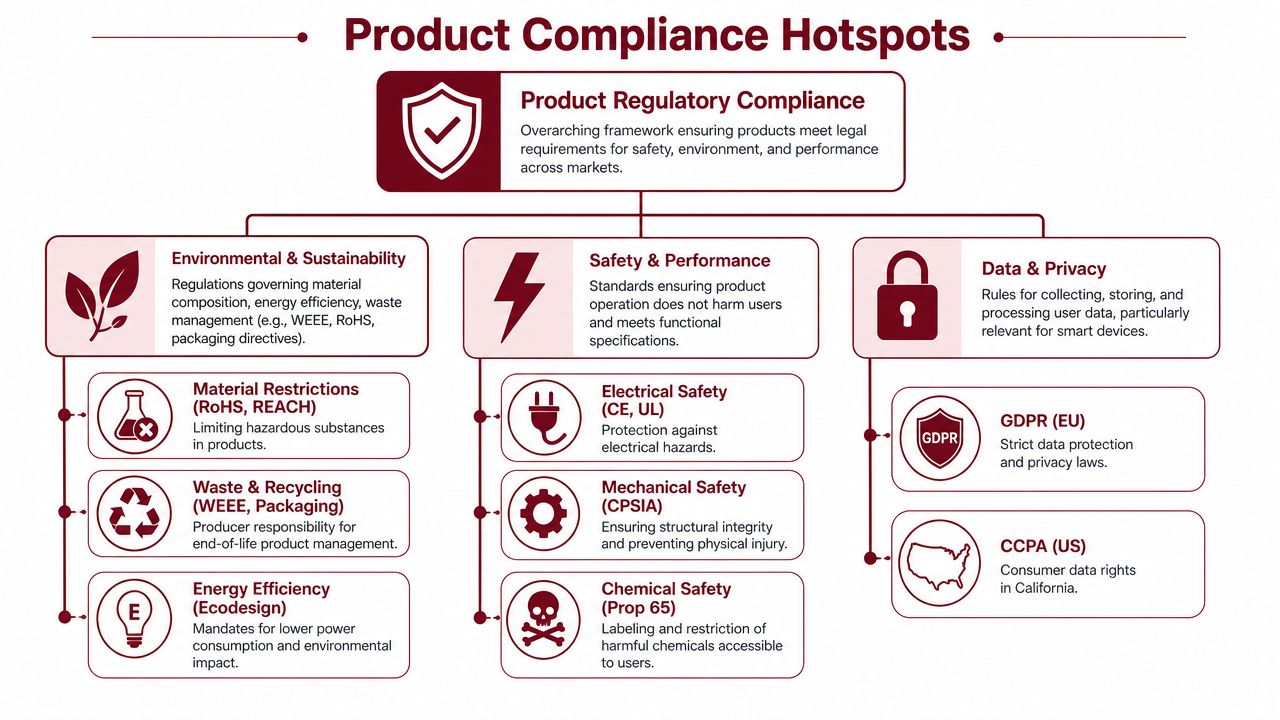
The first battleground is material composition, where teams discover whether their bill of materials is actually controlled or just commercially assumed. If a supplier changes a coating, resin, adhesive, battery component, finish, or cable input without strong disclosure discipline, your existing declarations can become outdated faster than the product roadmap.
The second is packaging and end-of-life responsibility. A brand may think it is selling one product, while the market sees a product plus carton, inserts, plastics, transport packaging, and disposal obligations. That matters more as resource recovery expectations rise.
Later in the cycle, another battleground appears around energy and operational reporting. In Australia, the National Greenhouse and Energy Reporting system requires corporations above thresholds such as 50 kt CO2-e, 200 TJ, or 25 kt of energy import or export to report, with facility thresholds of 25 kt CO2-e or 100 TJ, turning energy use into a formal compliance and data-governance requirement rather than just an operating cost, as explained in this practical guide to environmental requirements and NGER thresholds.
Stronger brands build compliance into product decisions
The difference isn't that better operators know every rule from memory. It's that they don't leave compliance isolated with one person late in the process.
They build a supply chain that can answer basic but commercially vital questions:
- What's in the product at component level, not just finished-goods level
- Which supplier declarations are current, and which rely on stale assumptions
- Whether packaging specs match target-market obligations
- Who owns the technical file, and who updates it when sourcing changes
- Which SKUs are worth the compliance load, and which are marginal from the start
For teams tightening this discipline, a broader review of quality assurance standards in product operations often helps because environmental compliance usually fails where QA, sourcing, and commercial planning have become disconnected.
Field note: The brands that enter new markets fastest are rarely the ones with the biggest catalogues. They're the ones whose product data is clean enough to support decisions without a week of supplier chasing.
A short video overview can help frame the wider category before teams get buried in document detail.
Four recurring hotspots
Chemical restrictions
Household goods, electronics, and lifestyle products often contain more regulated material inputs than founders realise. Adhesives, coatings, plastics, inks, and treatments all create documentation risk when suppliers swap formulations without a clear change-control process.Packaging obligations
The commercial trap here is volume. A packaging issue repeated across a broad SKU base creates an ugly operational burden quickly. Stronger teams rationalise packaging formats early instead of customising every carton for short-term sales convenience.Energy and efficiency requirements
This matters most when a product's operational profile, manufacturing footprint, or reporting boundaries begin attracting formal scrutiny. Once reporting enters the picture, data quality matters as much as engineering intent.Connected product spillover
Smart devices add another layer because environmental rules can sit beside safety, battery, and data obligations. If teams split those categories too rigidly, they create blind spots between product, software, and channel teams.
The strongest move is simple. Build fewer assumptions into the supply chain. Most compliance trouble starts where commercial growth outran document control.
Enforcement Realities and Protecting Brand Value
Founders often ask what the penalty is for getting environmental regulations wrong. That's usually the wrong question.
The sharper question is what happens to the business when a regulator, customs authority, retailer, distributor, or marketplace decides your documentation isn't sufficient, your product needs review, or your local obligations weren't met in the expected way. The immediate financial penalty may matter. The disruption usually matters more.
The commercial damage is usually indirect
A delayed launch has a cost. A paused shipment has a cost. A delisted marketplace listing has a cost. A distributor losing confidence in your readiness has a cost.
None of those outcomes sit neatly inside a legal memo, but they show up fast in sales velocity, stock ageing, customer support pressure, and internal workload. Emergency remediation is nearly always more expensive than planned compliance because it pulls senior people into reactive work and forces decisions under timing pressure.
What becomes visible during international expansion is that enforcement is rarely experienced as one clean regulatory event. It usually arrives through the operating system of the market. A customs review creates a stock delay. A retailer pauses onboarding. A marketplace asks for proof the team can't quickly produce. A local authority interprets an issue differently from another jurisdiction. Trust starts slipping before any formal sanction becomes the main problem.
Fragmentation creates more uncertainty than strictness
A useful contrarian view is that fragmented enforcement, not strictness alone, often creates risk. In Australia, inconsistent state and federal rules can materially change project timelines and channel economics, creating higher uncertainty from regulatory variability than from one uniform standard, as discussed in this analysis of fragmented environmental oversight and enforcement.
That insight matters because many operators still frame regulation as a yes-or-no burden. In reality, uneven interpretation is often harder to manage than one clear standard. A uniform system lets you build process. A variable system forces judgment calls, local advice, and contingency planning.
Protecting brand value means protecting continuity. If the product can't stay listed, move through the border, or satisfy the channel's evidence standard, the brand pays long before any formal case is resolved.
What risk-aware brands do differently
They don't wait for a dispute to discover whether their compliance structure is coherent. They pressure-test it in advance.
That usually means:
- Centralising documents so channel and importer requests don't trigger a scramble
- Clarifying local accountability before stock is committed
- Reducing SKU complexity where low-volume variants create outsized compliance drag
- Monitoring rule interpretation in the jurisdictions that matter commercially
Brand protection in this context isn't a marketing exercise. It's operational credibility. When the market asks hard questions, the business needs clean answers.
A Strategic Checklist for Market Entry
Strong market entry plans don't start with every possible rule. They start with a sequence. Environmental regulations become manageable when the business knows what to check first, what to simplify, and where to avoid false complexity.
Start with the product, not the paperwork
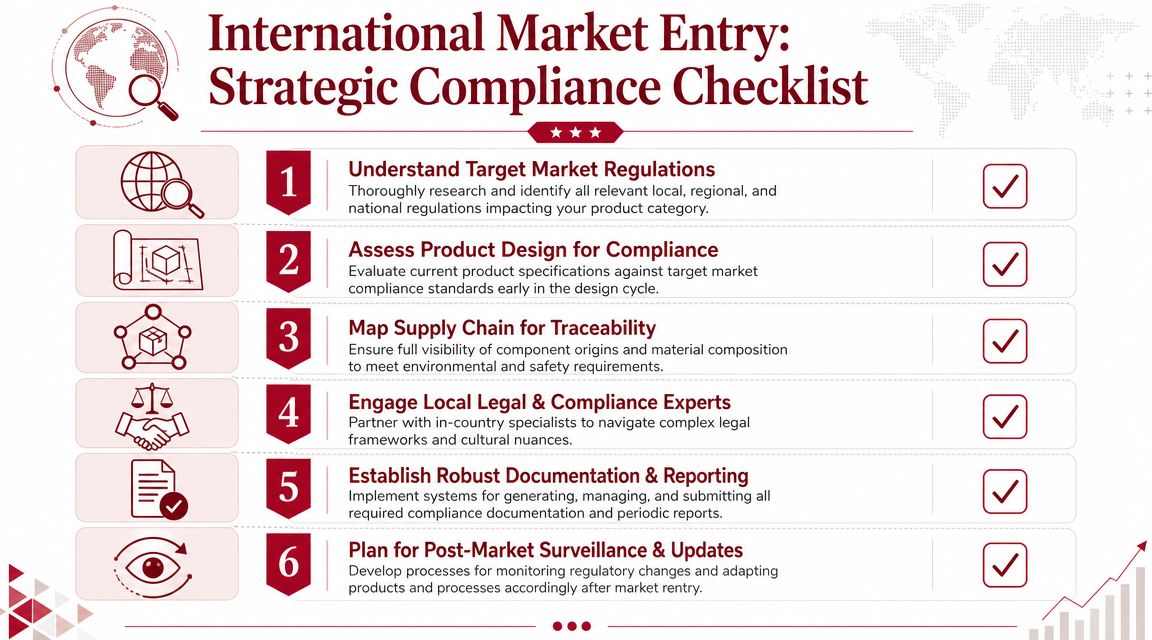
If the underlying product architecture is unstable, better documentation won't save the launch. Begin by mapping the bill of materials, packaging configuration, power profile where relevant, and supplier declarations against the target market. The point isn't legal perfection on day one. It's identifying where the current product will create obvious friction.
Then get disciplined about catalogue choice. Too many brands try to enter a new market with the full range. That multiplies packaging variants, document demands, and traceability work before the local economics are proven. A tighter entry assortment usually protects margin better.
Use a commercial sequence
This is the operating checklist we've found most useful for founders and commercial teams:
Map product composition early
Don't rely on old supplier files or assumptions carried over from another region. Confirm what is actually in the product and whether that information is current enough to support entry.Audit packaging before channel launch
Packaging is where environmental obligations often become visible to importers, distributors, and local schemes. If it needs redesign, you want that discovered before production scheduling, not after stock is booked.Decide who owns compliance inside the business
Shared responsibility often becomes no responsibility. Someone must own technical files, supplier follow-up, and market-specific document readiness.Build traceability into sourcing decisions
The cheapest supplier option can become the most expensive expansion option if they can't support declarations, changes, or evidence requests consistently.Prepare a living compliance file
Not a one-off folder built for one launch. A maintained operating file that can survive supplier changes, channel expansion, and future market questions.Review the post-entry operating model
Market entry isn't the finish line. Rules evolve, suppliers change, and channels raise new evidence requirements. The business needs a way to monitor and update, not just launch.
Good compliance sequencing protects margin twice. It reduces avoidable cost before launch, and it prevents ugly remediation after launch.
Expansion maturity matters more than effort
Many otherwise capable brands frequently get stuck. They work hard, but they work in the wrong order. They build listings before compliance files. They commit to broad assortments before rationalising packaging. They assume one market's readiness will transfer cleanly into another.
A more mature entry plan treats compliance as part of market architecture. That includes channel choice, assortment design, fulfilment structure, importer model, and in-market support. Teams preparing for a broader global product launch strategy usually perform better when they thread environmental obligations through those decisions rather than bolting them on afterwards.
The advantage isn't just reduced legal exposure. It's a cleaner launch, a simpler catalogue, fewer surprises for channel partners, and better protection of the margin you worked hard to create.
If your brand is preparing to expand into new channels or regions and you want a commercially grounded view of what market readiness looks like, TPR Brands works with established product companies to build structured, controlled growth across international marketplaces and distribution environments. The focus isn't generic ecommerce activity. It's helping proven brands enter new markets without losing cohesion, margin, or operational control.