Most advice about Amazon starts in the wrong place. It treats the platform like a demand engine, a digital shelf, or a high-volume sales channel that rewards whoever pushes hardest on listings, ads, and price.
That framing is convenient, but it's commercially expensive.
One pattern we continue seeing is brands celebrating Amazon revenue while losing control everywhere else. Retail partners start questioning price consistency. Margin gets thinner than expected. Stock lands in the wrong places. Unauthorised sellers appear once the product starts moving. The Amazon account looks active, but the wider channel picture becomes harder to manage, not easier.
For established hardware, home improvement, and household brands, the useful mindset shift is simpler than most operators realise. amazon isn't a sales channel. it's a distribution channel. Once you see it that way, a lot of Amazon behaviour starts making more sense. So do the mistakes.
The Marketplace Misconception Costing Brands Control
Founders often inherit a dangerous idea about Amazon. More sales must mean more success.
That logic breaks down quickly for brands that already have wholesale accounts, retail relationships, field sales teams, or their own direct channel. In those businesses, Amazon doesn't enter a vacuum. It enters an existing commercial system. If you treat it like a pure sales channel, you usually optimise the wrong things first.
Revenue can rise while control falls
A sales-first mindset pushes teams towards visible metrics. Buy Box wins. More sellers. More listings live. More aggressive pricing. More stock pushed in without a clear view of who controls the catalogue or where margin is being made.
The result is predictable:
- Pricing slips first: Teams discount to stay competitive without checking what that does to retailers and distributors.
- Seller sprawl follows: Inventory leaks into the marketplace through channels the brand didn't intend to create.
- Brand presentation fragments: Different sellers use different images, titles, bundles, and claims.
- Commercial trust weakens: Retailers start asking whether Amazon is a growth channel or a channel conflict machine.
Amazon rarely damages a brand all at once. The erosion usually starts with loose distribution, then shows up in price, margin, and trust.
That's why the goal shouldn't be “launch on Amazon”. For established brands, that's often the wrong question entirely. The better question is whether Amazon strengthens or weakens the structure of the broader business. That distinction sits behind why launching on Amazon is the wrong goal.
The real mistake is category confusion
Sales channels create demand. Distribution channels move product efficiently, predictably, and at scale. Amazon can do both, but the second function usually matters more to established brands than the first.
That's the misconception costing brands control. They enter Amazon thinking like advertisers when they should be thinking like network designers.
If your product reaches Amazon through too many paths, you lose authority over pricing. If stock sits too far from demand, service suffers. If your account team measures success only by gross sales, they can miss the fact that Amazon is cannibalising healthier channels rather than expanding the business.
For founders, this is the practical shift. Stop asking, “How do we sell more on Amazon?” Start asking, “How do we use Amazon without breaking the rest of our distribution?”
Why Amazon Behaves Like a Logistics Network
Amazon looks like a storefront from the outside. Operationally, it behaves much more like infrastructure.
In Australia, that point is hard to ignore. Amazon announced a A$2 billion investment in its Australian operations in 2024 and opened a second Victorian fulfilment centre in 2024, expanding the physical system that stores, sorts, and dispatches products closer to customers, as noted in this analysis of Amazon's Australian logistics expansion. That isn't the behaviour of a business focused only on digital shelf space. It's the behaviour of a network building delivery speed and inventory reach.

What Amazon is actually optimising
Once stock enters Amazon's system, the platform doesn't just display a listing and wait for orders. It allocates inventory, positions units closer to likely demand, manages fulfilment promises, and uses its network to make delivery look simple to the customer.
That means performance depends less on classic selling activity than many brands expect. It depends on operational discipline.
Three levers matter more than most founders initially assume:
| Operational lever | What it affects | What goes wrong when ignored |
|---|---|---|
| Stock placement | Delivery promise and conversion | Customers see slower delivery windows |
| SKU availability | Search continuity and sales consistency | Bestsellers drift in and out of stock |
| Inbound replenishment | Service level and margin stability | Urgent freight, stockouts, and messy forecasting |
For established brands, this is the central reframe. You are not merely listing products for sale. You are plugging inventory into a system that rewards availability, placement, and replenishment quality.
Why this changes how operators should think
A normal sales channel conversation revolves around customer acquisition. A distribution channel conversation revolves around where stock sits, how quickly it moves, and how reliably the network can fulfil an order.
That difference matters because many Amazon problems are really distribution problems wearing sales clothes.
- Slow conversion can be an inventory location issue.
- Margin pressure can come from poor network placement.
- Unstable performance can stem from weak replenishment discipline.
- Retail tension can come from using Amazon as an outlet instead of a controlled distribution layer.
One issue we repeatedly observe is brands handing Amazon to a marketing team without giving operations equal authority. That setup almost always creates friction. Marketing sees visibility. Operations sees split inventory, freight pressure, and service obligations the business didn't fully model.
The brands that handle Amazon well usually don't treat it like a media channel first. They treat it like a fulfilment environment with commercial consequences.
That's also why Amazon distribution strategy deserves more attention than listing tactics. The stronger operator usually isn't the loudest seller. It's the brand that understands where inventory should sit, how fast it needs replenishment, and which products belong in the network at all.
Regaining Control Over Pricing and Brand Integrity
The fastest way to lose control on Amazon is to think the marketplace problem starts with pricing. It usually starts earlier, with distribution.

If multiple parties can feed the marketplace, price becomes reactive. Sellers compete with one another, not because the product lacks demand, but because the network has no clear gatekeeping. By the time a founder notices discounting, the issue is often that too many sellers gained access to the same stock through wholesale, clearance, grey-market inventory, or loose account management.
Price erosion is usually a distribution leak
For Australian hardware and consumer brands, the margin equation on Amazon is distribution-led, not sales-led. The dominant cost stack is fulfilment, storage, and network placement, not just marketplace commissions, and a brand selling nationally must model landed cost by postcode cluster rather than only by SKU, as explained in this breakdown of Amazon's distribution cost structure.
That matters because a seller can win the Buy Box and still lose money in practical terms. The order looks healthy at top line. The contribution picture says otherwise.
Here's a simple perspective:
- Sales view: “We sold the unit.”
- Distribution view: “Where was the unit stored, what did it cost to move, and did the order strengthen or weaken the rest of the channel?”
The second question is the one that protects brands.
Integrity starts with authorised supply
When brands treat Amazon as a distribution rail, they stop arguing with symptoms and start controlling entry points. Who is allowed to sell? Which SKUs belong on the marketplace? What packaging, imagery, and content standards apply? Which channel gets access to which inventory pools?
Those decisions shape brand integrity more than reactive price monitoring ever will.
Practical rule: If you can't identify who is authorised to inject inventory into Amazon, you don't have a pricing problem. You have a channel architecture problem.
Many established brands get stuck in this predicament. They try to enforce pricing rules after the marketplace has already become structurally loose. That rarely holds for long.
A more durable approach is to define Amazon as a controlled extension of distribution, not as an open invitation to every reseller that can source the product.
A useful primer on that dynamic sits behind why discounting on Amazon is a sign you've lost control.
The commercial point is straightforward. Brand control doesn't begin on the listing. It begins upstream, where inventory enters the system.
Here's a useful example of how operators think about this problem in practice:
What works and what usually fails
A sales-led Amazon strategy often creates these patterns:
| Usually fails | Usually works |
|---|---|
| Chasing Buy Box share through discounting | Restricting authorised inventory sources |
| Letting multiple channel partners list the same SKU | Assigning clear marketplace responsibility |
| Measuring Amazon in isolation | Measuring Amazon against total channel health |
| Treating margin as commission minus COGS | Modelling storage, fulfilment, and delivery exposure |
Across multiple marketplace ecosystems, stronger brands don't just seek more Amazon volume. They decide what kind of Amazon volume is acceptable. That distinction is where pricing integrity starts to recover.
Designing Your Marketplace Channel Governance
Most brands don't lose control because they lack effort. They lose control because they try to manage Amazon with informal rules.
That doesn't hold once a marketplace starts affecting wholesale, retail, and direct channels at the same time. Governance has to be designed, not improvised.
Governance decides whether Amazon adds volume or steals it
A major underserved question for established brands is whether Amazon demand is incremental or cannibalised from retail, wholesale, or direct channels. Amazon's own multichannel tools are built to support inventory placement across channels, including the ability to support 1–2 day delivery, but that only works commercially when brands set clear inventory, pricing, and territory rules, as discussed in Amazon's view of multichannel selling and fulfilment.
That point matters more than most marketplace advice admits. A brand can use Amazon to place stock closer to customers and still support independent retailers, distributors, and its own direct site. But that outcome doesn't happen automatically.
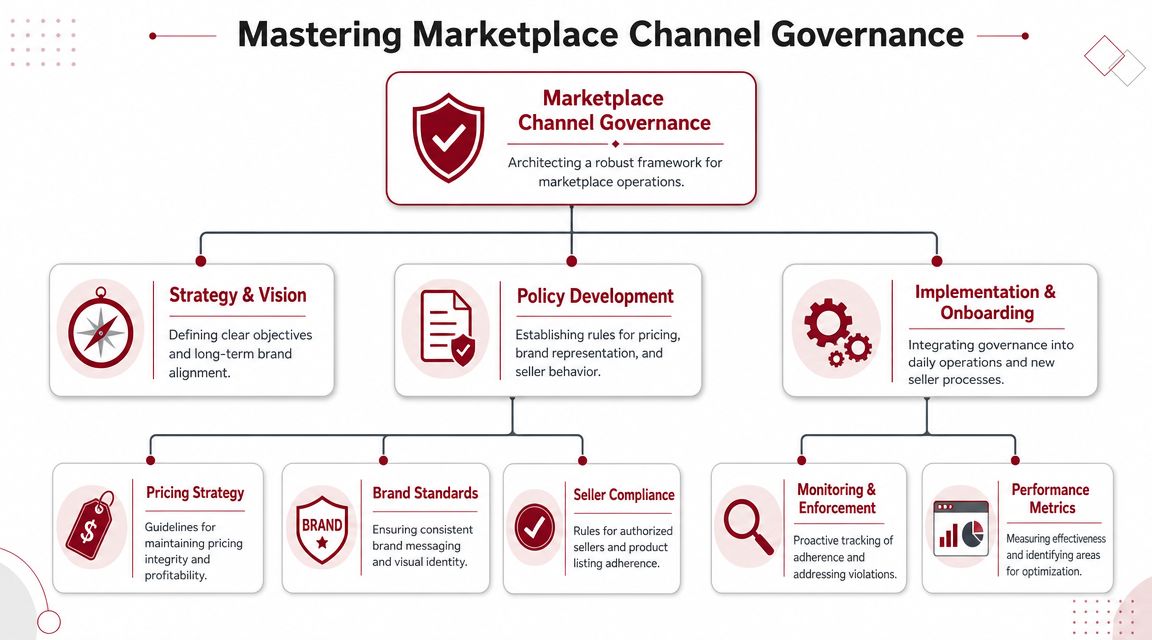
The four parts of a workable governance model
The brands that stay coherent on Amazon usually build governance around four connected decisions.
Access
Decide who can supply the marketplace.
That might be the brand entity itself, a single authorised marketplace operator, or a tightly controlled distribution partner. What matters is clarity. If access is broad, enforcement becomes theatre.
Product scope
Not every SKU belongs on Amazon.
Some products fit the platform well because they move cleanly through a fulfilment network, support repeat demand, and can hold price discipline. Others create channel conflict, poor shipping economics, or constant support friction. Mature operators curate the catalogue. They don't dump the entire range online and hope for the best.
Commercial rules
Pricing policy needs structure, but it can't sit alone. It should align with territory logic, promotional permissions, bundle rules, and reseller terms.
A simple governance table helps expose weak points:
| Governance area | Core question |
|---|---|
| Authorisation | Who is allowed to sell and replenish? |
| Pricing | What are the boundaries for advertised and transacted price? |
| Territory | Which partners can sell into which regions or channels? |
| Catalogue | Which SKUs are permitted, restricted, or excluded? |
Monitoring
Rules without active monitoring don't last.
That includes listing accuracy, seller presence, stock flow, pricing drift, and catalogue changes. The point isn't bureaucracy. It's preserving a controlled ecosystem before bad behaviour becomes the new normal.
Good marketplace governance feels restrictive only to businesses that benefited from the previous disorder.
One issue we repeatedly observe is brands trying to “clean up Amazon” after years of loose distribution without changing agreements upstream. They ask marketplaces to solve what channel design created. That's rarely enough.
Control lives upstream from the listing
A listing is only the visible layer. Governance sits behind it.
That's why Amazon listing control matters, but only as part of a wider operating model. Content ownership, seller permissions, inventory injection points, and pricing rules have to support one another. If they don't, the marketplace eventually reflects the weakest part of the system.
For founders, this is the practical lesson. Amazon becomes manageable when it is governed like a channel architecture problem, not a catalogue administration problem.
Expanding Internationally as an Ecosystem Transition
International expansion exposes weak marketplace thinking very quickly.
A domestic Amazon account can survive a lot of loose assumptions for a while. Cross-border expansion can't. Once a brand enters new regions, every shortcut in fulfilment, authorisation, localisation, and pricing starts showing up in operational reality.
New market, new ecosystem
In Australia, Amazon works operationally as a distribution layer because orders are fulfilled through local logistics assets, and performance is driven by stock placement, SKU-level availability, and inbound replenishment discipline, as outlined in Amazon's guide to ecommerce sales channels and fulfilment. That same principle becomes more important, not less, when a brand expands internationally.

What becomes visible during international expansion is that marketplace ecosystems don't behave uniformly. Customer expectations differ. Packaging norms differ. Compliance requirements differ. So does the practical meaning of “fast delivery”.
A founder who treats international Amazon as a listing exercise usually underestimates at least one of these:
- Local fulfilment expectations: Delivery speed influences trust, not just convenience.
- Catalogue translation issues: Product titles and bullets don't always carry commercial meaning cleanly across regions.
- Channel conflict risk: Existing distributors, importers, or retail partners may interpret Amazon presence very differently by market.
- Stock discipline: Replenishment mistakes become more expensive once they cross borders.
Why the distribution mindset scales better
A sales-led mindset asks, “How quickly can we get live?”
A distribution-led mindset asks better questions:
- Where will inventory sit in-market?
- Who controls supply into the marketplace?
- Which SKUs travel well across local demand conditions?
- How do we protect price integrity while adapting to each region?
Those questions create slower launches at the start. They usually create stronger businesses later.
International marketplace growth goes wrong when brands export listings without rebuilding the operating model around local fulfilment, local channel structure, and local expectations.
Across multiple marketplace ecosystems, the brands that scale well internationally don't assume one Amazon playbook travels perfectly from Australia to the UK, from the US to Canada, or from North America into Asia-Pacific. They localise the ecosystem, not just the content.
Expansion needs orchestration, not just activation
Many experienced product businesses hit a ceiling. Their products are proven. Their domestic channel is mature. But their international marketplace structure is fragmented from day one because each region is treated as a separate selling task.
A better model is to treat expansion as an ecosystem transition.
That means aligning:
- fulfilment structure
- authorised seller strategy
- pricing governance
- local catalogue adaptation
- regional commercial accountability
When those elements stay connected, Amazon can help a brand scale internationally with discipline. When they fragment, the business often creates a series of local marketplace problems that are expensive to unwind later.
From Marketplace Seller to Global Brand Architect
The strongest brands on Amazon usually don't look like “good Amazon sellers” in the narrow sense.
They look like disciplined operators who understand that marketplace performance sits downstream from distribution design. They know who controls inventory. They decide which products belong in the channel. They protect pricing by controlling supply, not by reacting to every pricing event after the fact. And when they expand internationally, they adapt the operating model to the region instead of copying and pasting domestic assumptions.
That is the true meaning behind the phrase amazon isn't a sales channel. it's a distribution channel.
Once a founder accepts that idea, different priorities come into focus. Listings still matter. Retail media still matters. Conversion still matters. But they stop sitting at the top of the decision stack. Inventory placement, channel governance, pricing integrity, and local ecosystem design come first.
That's also where long-term brand value is protected.
A business that treats Amazon as a sales outlet often ends up managing noise. A business that treats it as a distribution environment can make deliberate decisions about authorisation, territory, margin, and international scale. One reacts to the platform. The other architects how the platform fits into the company.
For established hardware, home improvement, household, and consumer brands, that difference is not semantic. It shapes channel conflict, retailer trust, margin quality, and the ability to expand without losing coherence.
Founders don't need a louder Amazon strategy. They need a more structured one.
TPR Brands works with established product companies that need that structure. If you're navigating Amazon channel conflict, protecting pricing integrity, or planning marketplace expansion into Australia, the US, Canada, or the UK, TPR Brands helps turn fragmented marketplace activity into a controlled commercial ecosystem.