The most popular advice in marketplace growth still treats Amazon like a milestone. Get the listing live. Turn on ads. Push for early sales. Call it a launch.
For established product brands, that framing is usually wrong.
A launch is an event. A channel is an operating system. When founders confuse the two, they end up optimising for the visible moment instead of the invisible structure that determines whether the channel will strengthen the brand, disrupt existing distribution, or erode margin. That mistake shows up often in Australia, where Amazon matters, but doesn't behave like the whole market.
One pattern we continue seeing is that brands ask, “How do we launch on Amazon?” when the more commercially useful question is, “What job should Amazon perform inside our wider channel architecture?” Those are not the same question, and they don't produce the same decisions.
The phrase why “launching on amazon” is the wrong goal sounds contrarian at first. It isn't. It's just a more mature way to think about marketplace expansion when your product already has traction, existing retailers, operational constraints, and a brand worth protecting.
The Allure of the Amazon Launch Button
Amazon creates the feeling of immediacy. A product page goes live, traffic can be bought, and there is a visible dashboard that makes activity look like progress. For founders used to slower retail cycles, that's seductive. It feels cleaner than negotiating distribution, rebuilding packaging for a new market, or sorting out channel policy with existing stockists.

The problem is that “launching” compresses a strategic decision into a tactical action. It turns a channel question into a listing question. That's why many brands follow a standard Amazon product launch strategy and still end up disappointed. The process may be competent, yet the objective was weak from the start.
Why the launch itself feels more important than it is
The launch button is attractive because it offers a clear before-and-after moment. Before launch, the brand is “not on Amazon”. After launch, it is. That binary state creates false certainty.
Commercial performance isn't binary. It's shaped by fit.
In Australia, this distinction matters more than many brands expect. Australia's total retail eCommerce sales reached A$63.73 billion in 2023, and Australia Post reported that 8.1 million households shopped online in 2023, yet Amazon is still only one of many places competing for that demand, not the automatic gateway to it, as noted in this Australia-focused Amazon launch analysis.
A listing can go live in a day. A viable channel role takes much longer to define.
What founders should ask instead
A stronger commercial question sounds less exciting, but it produces better decisions.
- What role should Amazon play: Is it there to capture replenishment demand, test a narrow product range, support international visibility, or clear excess stock without damaging the main channel mix?
- What happens to existing retail relationships: If your products already move through trade, specialty, or major retail, Amazon can create pricing and territory tension quickly.
- What has to be true operationally: Can the business support marketplace service expectations, returns handling, packaging requirements, and channel-specific customer friction without destabilising the rest of the operation?
Founders often want momentum. That's reasonable. But the market doesn't reward motion for its own sake. It rewards coherence.
Beyond the Listing Unseen Strategic Risks
The listing is the visible part. True exposure sits behind it.
One issue we repeatedly observe is that brands treat Amazon as a sales channel first and only later discover it is also a pricing environment, an operational discipline, a compliance surface, and a control problem. By then, the account is live, resellers have noticed, retailers are asking questions, and the team is spending time defending decisions that should have been made before launch.
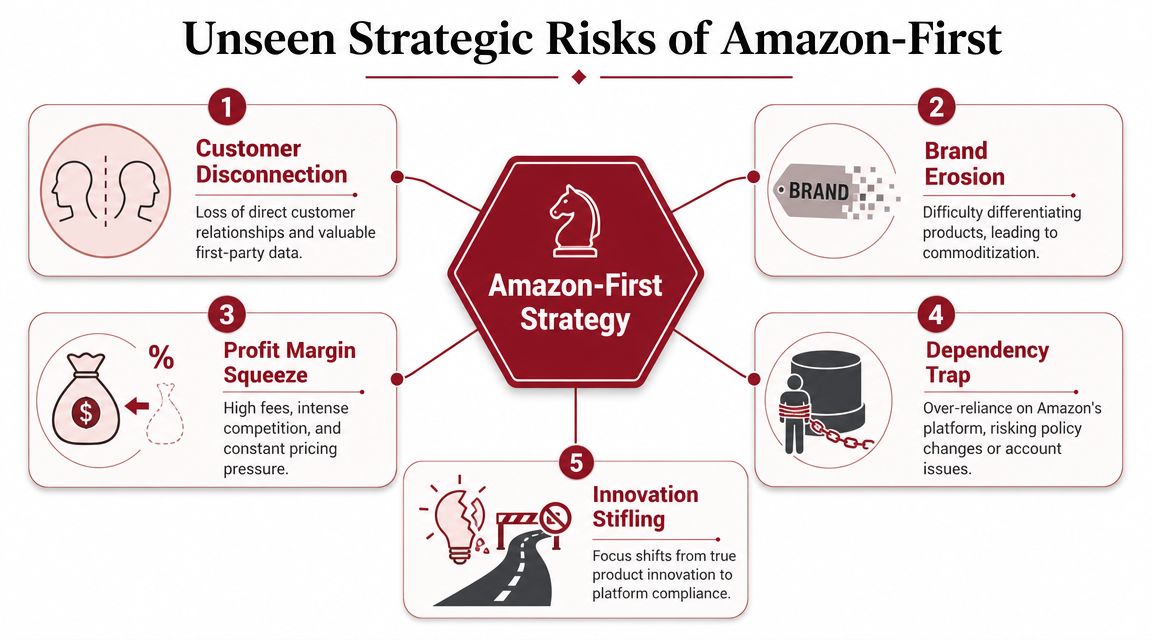
The four risks that usually arrive together
Brand dilution often starts subtly. The catalogue goes live, pricing becomes more exposed, and the product begins to sit beside lookalike alternatives in a compressed comparison environment. If channel governance is weak, the listing stops acting like a branded shelf and starts acting like an interchangeable offer.
Many brands discover that discounting isn't a growth lever. It's usually a sign of weak control. That dynamic is unpacked well in this piece on why discounting on Amazon is a sign you've lost control.
Margin erosion follows next. Not because Amazon is unworkable in and of itself, but because weak unit economics get exposed very quickly inside marketplaces. Freight, packaging, returns, service obligations, marketplace fees, and ad dependency all hit the same SKU at once. What looked commercially acceptable in a spreadsheet can become fragile once actual channel behaviour starts.
Customer disconnection is less visible but equally important. Amazon can be useful for demand capture, but it doesn't give brands the same depth of customer relationship they get through direct channels or specialist retail environments. That matters in categories where trust, education, installation support, replacement cycles, or product setup shape repeat purchase.
Operational strain is where many launches start to unravel. Internal teams are often structured around wholesale, trade, or standard ecommerce fulfilment. Amazon introduces a different rhythm. Catalogue formatting, inbound inventory discipline, claim substantiation, warranty logic, and returns handling all become tighter.
Why this is sharper in Australia
For physical products, the Australian context adds friction that generic launch advice tends to ignore. A useful observation from this analysis of hidden Amazon launch friction for AU brands is that online demand remains structurally strong, but fulfilment expectations are rising, and delivery performance shapes both conversion and repeat purchase. That matters because weak operations don't stay hidden for long on a marketplace.
Operational truth: Amazon doesn't fix weak commercial structure. It exposes it faster.
A practical way to view the risk is below.
| Risk area | What brands often assume | What happens in practice |
|---|---|---|
| Pricing | Amazon will add incremental sales | Amazon may force visible price tension across channels |
| Margin | Scale will absorb costs | Weak SKU economics become more obvious under marketplace pressure |
| Customer relationship | Sales volume equals brand growth | The platform owns much of the buying environment |
| Operations | Existing fulfilment setup will cope | Marketplace rules stress inventory, packaging, service, and returns |
The mistake isn't using Amazon. The mistake is entering it as though the listing is the strategy.
Marketplace Ecosystems Behave Differently
A marketplace is never just a marketplace. It sits inside local buying habits, local retailer strength, local delivery expectations, and local category behaviour. Brands that ignore that usually misread the role Amazon can realistically play.
Australia is a good example because it shows how easy it is to import the wrong assumptions from larger Amazon markets.
Australia didn't build around Amazon
Amazon Australia launched only in December 2017, which made it a late entrant in a market where consumers had already formed strong habits around domestic retailers and other online channels, as discussed in this review of common Amazon launch failures. That historical timing matters. Amazon didn't inherit default marketplace dominance. It had to build trust, selection, and logistics inside a market that already had established players.
For brands, the commercial consequence is straightforward. Going live on Amazon AU does not automatically equal market access.
Across multiple marketplace ecosystems, this is one of the easiest mistakes to spot. Founders see a large platform and assume presence will generate demand. In mature local ecosystems, the platform usually captures demand that already exists. It rarely creates category demand by itself.
The channel role changes by category
That difference becomes clearer in hardware, home improvement, household, and specification-driven categories.
In those sectors, buyers often care about product detail, compatibility, installation support, warranty confidence, and whether the seller looks reliable after the sale. Those signals aren't impossible to build on Amazon, but they aren't automatic either. In some categories, specialty retail or trade channels still do more of the trust-building work than the marketplace.
A recent marketplace review revealed the same pattern repeatedly. Commodity-adjacent products can move well in marketplace environments built around convenience. Products that need education or confidence cues often need stronger ecosystem support around them.
- Convenience-led categories: Amazon can work well as a fast transaction environment.
- Specification-heavy categories: The listing has to do more trust work, and sometimes still isn't enough.
- Retail-sensitive categories: Existing distributor and retailer relationships can limit how aggressively a brand should enter.
Some brands don't need more visibility. They need better channel sequencing.
Why launch language misreads the market
When founders say they want to “launch on Amazon”, they often mean one of three things:
- They want incremental revenue.
- They want channel diversification.
- They want proof that the brand can travel beyond current distribution.
Those are valid objectives. But none of them are solved by the act of launching itself.
That's why ecosystem thinking matters. Amazon AU is important, but it sits inside a broader structure. Brands that understand that tend to position it more intelligently. Brands that don't often mistake platform presence for commercial progress.
For a related view on category-specific complexity, this perspective on why connected product ecosystems behave differently on Amazon captures the wider point well.
Building a Resilient Channel Architecture
If launching isn't the goal, what is?
The better objective is a resilient channel architecture. That means deciding how each channel contributes to growth, protects margin, supports brand trust, and coexists with the rest of the business. It replaces platform-first thinking with system design.

What strong channel design looks like
A resilient architecture doesn't ask every channel to do everything.
One channel may drive credibility. Another may carry replenishment. Another may be useful for international testing. Your own site may hold education, bundles, support, and customer retention. Amazon may capture high-intent demand from buyers who already know what they want.
That is a far more useful framing than “we need to be on Amazon”.
In Australia, that logic is reinforced by how shoppers use the platform. Roy Morgan reported Amazon reached 8.4 million Australians in the 12 months to March 2025, but many buyers use it for convenience and replenishment rather than brand discovery, according to this discussion of launch mistakes and channel role design. For brands already selling through Bunnings or specialty retail, that distinction matters. Amazon may be the right channel, but the wrong first channel, or the wrong discovery channel.
Channel role design before channel activity
The strongest brands define the job before they activate the channel.
- Trial channel: Use Amazon to test a narrow range in a controlled way.
- Replenishment channel: Let repeat buyers transact there once the brand is already known.
- Defensive channel: Occupy the marketplace to prevent fragmented representation or grey-market confusion.
- International foothold: Use it selectively where marketplace behaviour supports expansion.
A lot of channel damage comes from assigning Amazon the wrong role. If a founder expects it to build premium positioning, support retailer trust, preserve price integrity, and deliver immediate scale all at once, the channel usually underperforms. Not because Amazon failed, but because the role was poorly designed.
Channel governance, not merely launch activity, takes precedence. The business needs rules around assortment, pricing visibility, account ownership, distributor boundaries, and fulfilment expectations before the first SKU goes live. That broader challenge is central to any serious Amazon distribution strategy.
The operational side matters as much as the strategic side. This short discussion adds useful context:
What resilient brands avoid
They don't put the full catalogue online just because they can.
They don't use Amazon to solve a wholesale problem.
They don't let one platform rewrite pricing logic across the whole business.
The channel should serve the brand. The brand should not contort itself to justify the channel.
That is usually the dividing line between brands that expand cleanly and brands that become harder to manage after every new channel decision.
Engineering a Controlled Marketplace Entry
A controlled entry looks nothing like a typical launch campaign.
It is narrower, slower, and much more deliberate. The goal isn't to create noise on day one. The goal is to generate clean signals, learn quickly, and avoid teaching the marketplace the wrong things about the product.
Start with a test, not a rollout
One pattern we continue seeing is that brands overcommit too early. They list too many SKUs, spread inventory too thinly, bid broadly, and publish content that hasn't been engineered for marketplace conversion. That creates messy data and makes it hard to tell whether the problem is the product, the pricing, the content, the traffic mix, or the channel itself.
A controlled entry usually starts with a smaller set of products that already have clear market proof elsewhere. Not the entire catalogue. Not the slowest-moving variants. Not the products that only work when a retailer explains them in person.
The logic is simple:
- Pick the SKUs most likely to convert cleanly. Favour products with strong margins, low ambiguity, clear use cases, and manageable returns risk.
- Build content for precision. Titles, bullets, imagery, and specifications need to reduce uncertainty fast.
- Map keywords carefully. Don't let broad traffic define product relevance before the listing has enough conversion history.
- Validate economics before expansion. If the unit doesn't hold margin under realistic marketplace conditions, more volume won't solve the problem.
Train the algorithm properly
Amazon's ranking system is signal-driven. The variable to control is not the launch event but the relevance and conversion inputs the brand feeds into the platform. Amazon's own guidance emphasises that search ranking depends on conversion performance and sales velocity, and if a brand launches with weak content or the wrong keyword map, Amazon can learn the wrong product-to-query associations, as outlined in this Amazon launch guidance video.
That point gets missed constantly.
Teams focus on traffic, but early traffic quality matters more than traffic volume. If the first wave of visitors is poorly matched, the listing can accumulate weak conversion signals against terms the brand never should have pursued in the first place.
Commercial rule: Treat early marketplace traffic like training data. Bad inputs create expensive correction work later.
What controlled entry looks like in practice
A mature brand usually benefits from a sequence like this:
| Entry stage | What to do | Why it matters |
|---|---|---|
| Assortment selection | Start with a narrow SKU set | Cleaner demand signals and less operational drag |
| Content build | Publish conversion-ready copy and visuals | Reduces confusion and improves relevance |
| Traffic control | Focus on tightly matched search intent | Prevents poor early associations |
| Economic review | Check landed cost, returns, service burden | Stops unprofitable scale |
| Expansion decision | Add products only after signal quality is proven | Protects the wider catalogue |
This approach feels less exciting than a large launch announcement. It works better.
The best marketplace entries are engineered. They don't rely on enthusiasm. They rely on clean assumptions, disciplined testing, and a willingness to delay scale until the channel has earned it.
Your Channel Expansion Decision Framework
Most poor Amazon decisions happen because the business starts with execution questions before it has answered commercial ones. The fix is not a bigger checklist. It's a better decision frame.
Before entering any marketplace, founders and commercial leaders should be able to answer a small number of hard questions clearly.

The questions that matter most
- What is this channel supposed to do? If Amazon has no defined role, it will start dictating one through pricing pressure, ad dependency, and operational demands.
- Will this strengthen or weaken the existing ecosystem? Think about retail partners, distributors, trade relationships, and cross-channel price visibility.
- Are the unit economics marketplace-ready? Not in principle. In practice. Including packaging, fulfilment, returns, compliance burden, and customer service complexity.
- Can the product convert without human explanation? If trust, installation support, or technical nuance drives the sale, the listing needs to carry that weight.
- What does success mean beyond going live? Better channel balance, cleaner replenishment capture, protected pricing, international learning, improved contribution margin. Those are strategic outcomes. “We launched” is not.
A simple way to judge readiness
Use this test before committing inventory and attention.
| If the answer is unclear | What it usually means |
|---|---|
| The channel role is vague | The business is chasing visibility, not designing distribution |
| Pricing rules are unsettled | Channel conflict will likely appear after launch |
| Operations aren't modelled properly | Scale may increase revenue while weakening margin |
| Success metrics are shallow | The team will celebrate activity and miss commercial damage |
One issue we repeatedly observe is that brands don't need help getting onto marketplaces. They need help deciding whether the marketplace deserves a place in the architecture at all, and if so, under what conditions.
That's the practical reason why “launching on Amazon” is the wrong goal. It centres the decision on a moment. Strong brands centre it on a system.
TPR Brands helps established product companies make those decisions properly. If you're evaluating Amazon, wider marketplace expansion, or cross-border channel growth, TPR Brands works with brands that need commercially coherent expansion, not just another listing going live.