Strong Amazon sales can look like proof that a connected product ecosystem is working. In practice, they can also hide structural weaknesses that only become visible once the ecosystem begins expanding across marketplaces, accessories, fulfilment layers, and customer support environments.
That distinction matters far more for connected product categories than many brands realise.
A weather station, for example, is rarely just a weather station anymore.
It may include:
- sensors
- remote monitoring
- app connectivity
- alerts
- expansion modules
- ecosystem accessories
- firmware dependencies
- ongoing customer interaction
That changes the commercial equation completely.
Because Amazon is exceptionally good at accelerating transactions.
But connected ecosystems depend on much more than transactions alone.
That tension sits at the centre of how connected ecosystems behave inside transactional marketplaces.
Connected monitoring ecosystems rarely create their real value at checkout alone. Amazon is exceptional at moving units. It is far less accommodating when a product’s commercial value depends on an ongoing relationship.
One pattern we continue seeing is that brands mistake marketplace traction for ecosystem health. Those are not the same thing. A listing can rank well, convert well, and still weaken the economics and control structure that made the product strategically valuable in the first place.
The Strategic Disconnect for Connected Products on Amazon
The standard Amazon mindset assumes that more visibility, more sales velocity, and more fulfilment efficiency naturally lead to a stronger brand. That logic works reasonably well for straightforward products with limited post-purchase dependency. It breaks down with connected products.
A connected monitoring ecosystem isn’t just hardware. It is the ongoing relationship between sensors, software, alerts, accessories, customer trust, and long-term operational continuity.
High sales can hide structural erosion
When a connected product performs well on Amazon, founders often see three positive signals. The listing is moving, Prime improves conversion, and the marketplace introduces the brand to customers it might not have reached elsewhere. Those things matter. But they don’t answer the more important question: who controls the ecosystem after the sale?
In connected monitoring categories especially, that question becomes commercially critical surprisingly quickly.
Because once accessories, sensors, updates, and ecosystem compatibility begin fragmenting across marketplaces, operational complexity rises much faster than revenue reports usually reveal.
That’s where the disconnect becomes visible.
Traditional retail and direct channels give brands more room to shape onboarding, explain ecosystem logic, and maintain continuity across hardware and service. Amazon compresses that entire relationship into a product page, a fulfilment promise, and a limited post-purchase interaction model. For a brand whose long-term value sits in repeat usage, support, compatibility, and service delivery, that compression creates risk.
Connected ecosystems rarely weaken because demand disappears.
They weaken because Amazon optimises transactions while the brand still carries the operational complexity afterwards.
A recent marketplace review revealed a recurring pattern in premium consumer categories. The stronger the product ecosystem, the more damaging it becomes when the channel treats it like a standalone commodity item.
Additional sensors, replacement components, mounting accessories, and compatibility pathways often become disconnected from the primary ecosystem experience.
Customers may successfully purchase the core hardware while still struggling to understand ecosystem expansion, regional compatibility, or long-term upgrade logic.
Customer expectations begin drifting away from what the ecosystem was actually designed to support. Returns start reflecting ecosystem confusion rather than product quality.
Amazon rewards discoverability, not relationship depth
Many catalogue-led businesses get caught by this reality. They bring a strong retail range into Amazon and expect the same range architecture to hold. It rarely does. Marketplace ecosystems reshape how products are discovered, compared, and judged.
That’s why the distinction between an expansive catalogue and a coherent marketplace ecosystem is so significant. This view of catalogue versus marketplace ecosystem structure is especially important for connected brands, because the primary asset isn’t product breadth alone. It’s the controlled relationship between the products, the customer, and the service layer.
For connected brands, Amazon is not another sales channel. It is an ecosystem transition. If that transition is handled as a listing exercise, the brand usually gains short-term volume while losing strategic control.
This becomes particularly visible in weather monitoring ecosystems because customers rarely enter through the entire system at once.
One customer may begin with a basic indoor monitor.
Another enters through storm tracking, remote alerts, gardening requirements, agricultural monitoring, or hyperlocal weather curiosity.
Over time, the ecosystem expands:
- additional sensors
- outdoor integrations
- mounting solutions
- remote visibility
- broader environmental monitoring
That creates a very different marketplace structure compared to standalone consumer products.
When the Standard Agency Playbook Fails
Most Amazon agency playbooks were built for transaction-first categories. They focus on ranking pressure, paid traffic, coupon activity, review accumulation, and price response. Those tools aren’t irrelevant. They’re just incomplete for connected products.

Amazon Rewards Velocity. Connected Ecosystems Pay the Price.
The dangerous part?
Most marketplace dashboards won’t show the ecosystem weakening immediately.
Revenue can still rise while:
- compatibility confusion increases
- support strain grows
- ecosystem clarity weakens
- customer expectations drift
- long-term trust slowly erodes
That is what makes connected ecosystems so deceptive on Amazon.
In the Australian market, Amazon’s structure already pushes brands towards short-term response behaviour. Third-party sellers accounted for over 60% of units sold in 2022, sponsored ads accounted for 40% of AU Amazon revenue, and AI-driven pricing adjusts 10-15% daily according to the cited AU marketplace analysis in this Amazon Australia ecosystem review. In that environment, agencies naturally chase visibility through spend and pricing pressure because that’s what the marketplace rewards.
That logic can lift a simple product category quickly. Connected ecosystems are far less forgiving.
If a smart device depends on ecosystem education, accessory sequencing, software continuity, or service activation, pure velocity tactics often strip away the context customers need. The campaign reports may look healthy while the underlying ecosystem gets weaker.
What works for a standalone item often fails for an ecosystem brand
A standard playbook usually does four things well:
- It buys attention fast: Sponsored placements can create immediate discoverability.
- It reacts to competitors quickly: Price and ad adjustments happen in near real time.
- It boosts listing momentum: Promotions and traffic can increase marketplace signals.
- It simplifies reporting: Sales, ad spend, and conversion become the dominant scorecard.
Those strengths become liabilities when the product requires controlled adoption.
A connected monitoring ecosystem, for example, may need the core device to sell first, the right sensors and integrations to follow, and support content to set customer expectations clearly. If the agency drives the cheapest entry point aggressively, the brand can end up attracting the wrong customer mix. That customer may convert well at checkout and still become expensive after purchase.
Practical rule: if your marketplace strategy revolves entirely around sales velocity, ad spend, and conversion rates, while ignoring ecosystem coherence, compatibility pathways, support strain, and customer onboarding quality, you’re probably optimising transactions instead of protecting the ecosystem.
The hidden cost is usually brand dilution
One issue we repeatedly observe is that marketplace managers celebrate outcomes that founders shouldn’t automatically celebrate. More discount dependence. More ad reliance. Faster price matching. Greater exposure to loosely aligned customers. Those aren’t always signs of strategic strength.
Connected product brands need a more selective operating model. They need Amazon to do what Amazon does well, which is demand capture and fulfilment efficiency, without allowing the marketplace to redefine the whole business around transactional speed.
That’s where the usual agency model runs out of depth. It is built to manipulate the marketplace. It is not built to preserve ecosystem integrity while doing it.
Losing the Customer Relationship in a Transactional Marketplace
The biggest problem isn’t advertising. It’s architecture.

The sale happens on Amazon. The obligation stays with the brand
Consider a connected household device that relies on app onboarding, firmware updates, accessory compatibility, and service alerts. The customer discovers it on Amazon, compares it against simpler substitutes, and buys based on delivery speed, rating signals, and price framing. Amazon has done its job well.
Now the brand has to do the hard part.
The customer needs to register the device, connect it properly, understand what the service layer does, and keep the product current over time. If anything breaks in that chain, the customer rarely blames the marketplace model. They blame the brand.
That’s the structural mismatch. The core value of a connected product ecosystem comes from ongoing services such as remote operations and preventative maintenance, yet marketplaces like Amazon are not designed for long-term relationship building and brands rarely control the data, communication, or ongoing customer experience after the transaction, as discussed in this analysis of marketplace relationship limits.
Connected products need post-purchase continuity
For a non-connected product, losing the direct customer relationship is often a manageable compromise. For a connected product, it can hollow out the product’s strategic value.
Three failure points show up repeatedly:
| Risk area | What Amazon handles well | What the brand still must solve |
|---|---|---|
| Fulfilment | Fast delivery and order processing | Correct setup expectations and product fit |
| Discovery | Search visibility and comparison traffic | Explaining ecosystem logic and compatibility |
| Transaction | Checkout trust and convenience | Registration, activation, updates, and service continuity |
The marketplace creates demand efficiently. It does not preserve the relationship depth required by a connected ecosystem.
A connected product sold without a managed post-purchase pathway often gets treated like ordinary hardware, even when its real value depends on software and service.
The product can become technically advanced and operationally confusing
That distinction matters more than many teams realise. If the customer never fully enters the ecosystem, the product’s advanced features don’t strengthen the brand. They become support friction.
Across multiple marketplace ecosystems, returns, poor reviews, and service strain often begin at this point. This occurs not because the product is weak, but because the channel framed the purchase as a discrete event instead of the start of a relationship.
The brands that handle this better usually accept a hard truth early. Amazon can introduce the customer. It cannot own the entire connected experience on the brand’s behalf.
Understanding Price Elasticity and Margin Dilution
Many connected brands arrive on Amazon believing premium positioning will protect them. In Australia, that assumption is fragile.
The marketplace keeps dragging premium products back towards comparability
Connected hardware ecosystems in Australia experience 18-22% higher price elasticity than the global Amazon average, and Amazon’s pricing engine can auto-adjust MSRPs downward by 8-12% weekly when offline comparisons and omnichannel leakage are present, according to this analysis of Australian marketplace pricing behaviour. That matters because premium connected products rarely compete on hardware cost alone. They carry software obligations, support costs, accessory planning, and longer-term service expectations.
Once the marketplace starts treating those products as price-comparable commodities, margin pressure arrives quickly.
The problem isn’t just lower price. It’s what lower price trains the business to do next. More promotions. More ad dependence. More tactical discounting to hold rank. More compromise around bundle structure and launch sequencing. Eventually the product still sells, but the brand doesn’t keep enough commercial room to support the ecosystem properly.
Volume can disguise weakening economics
One pattern we continue seeing is that founders look at Amazon revenue in isolation and miss what the channel is teaching customers to expect. If the listing wins by being cheaper, faster, and more aggressively promoted every month, the brand is conditioning the market to buy the hardware while undervaluing the ecosystem behind it.
That creates a dangerous internal distortion. Sales teams see traction. Finance sees margin compression. Operations sees support complexity. Brand leadership sees premium positioning softening in real time.
A simple comparison makes the issue clearer:
- Transactional success: higher unit movement, stronger ad-attributed sales, tighter price response.
- Ecosystem success: preserved margin, coherent product architecture, controlled customer expectations, sustainable support burden.
Those are not always aligned.
Winning the Buy Box is not the same thing as building a durable business. For connected brands, it can become the point where commoditisation accelerates.
Premium brands need a margin defence, not just a traffic plan
That’s why the usual “more visibility solves everything” logic is incomplete. Visibility on Amazon is expensive when the marketplace simultaneously increases price sensitivity. If the product’s long-term economics depend on service quality and ecosystem trust, then margin protection becomes a strategic requirement.
A more useful lens is to examine where profit thins out long before the P&L makes it obvious. This view on why products sell on Amazon but make less money is especially relevant for connected hardware, because the hidden loss usually starts with seemingly rational marketplace decisions.
Premium connected products can work on Amazon. But they don’t survive there by acting like generic marketplace inventory.
Aligning Your Supply Chain for Ecosystem Cohesion
The brands that handle Amazon well usually solve the operational model before they scale the listing model.
Fast supply and controlled supply are not the same thing
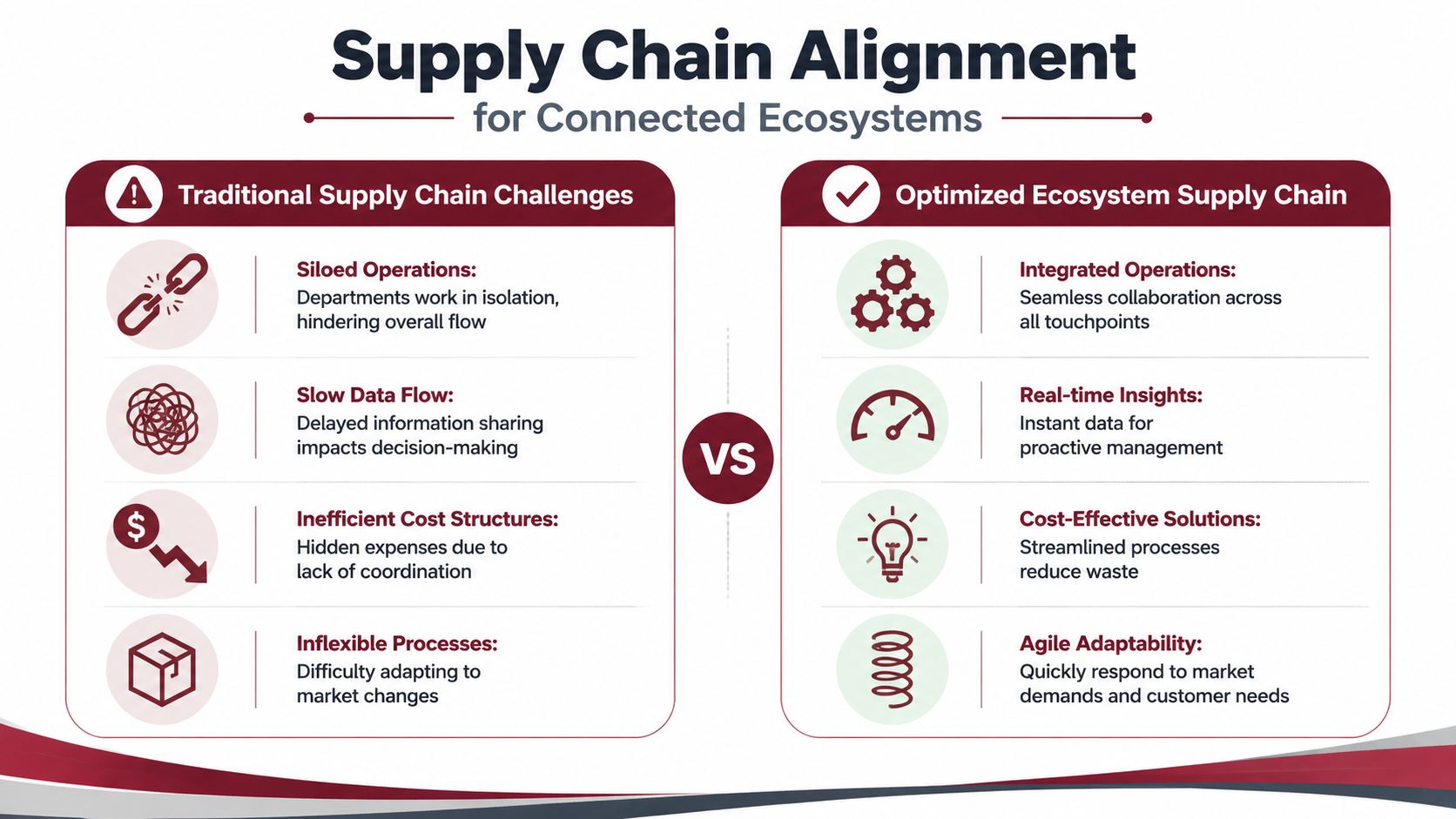
Amazon rewards availability, speed, and clean fulfilment. Connected products often require something more disciplined. Hardware versions need to align with firmware readiness. Accessories need to match regional compliance settings. Replacement parts and add-ons need to connect to the installed base coherently. That is not a standard catalogue problem. It is an ecosystem coordination problem.
When brands ignore that distinction, Amazon starts fragmenting the offer. The marketplace may still sell individual units, but the connected system loses cohesion.
Localisation changes algorithmic behaviour
This becomes even more visible during international expansion. In Amazon Australia, connected product ecosystems can see 25-30% lower cross-sell rates when bundles contain mixed-origin components, and non-optimised listings can see Buy Box win rates fall from 68% to 42%, according to this report on Amazon Australia’s international offering dynamics. That isn’t just a listing issue. It tells you the marketplace is penalising ecosystem structures that don’t look locally coherent.
For connected brands, that matters a lot. A bundle may be logical from the manufacturer’s perspective and still perform poorly if the marketplace reads it as operationally mismatched.
Stronger operators build modular coherence
The practical answer is rarely “list everything”. It is usually to redesign the catalogue for marketplace logic without weakening the underlying ecosystem.
That tends to involve choices like these:
- Regional core SKUs first: Launch the primary device in a market-ready format before expanding accessory depth.
- Localised bundle logic: Pair components that are operationally and regionally aligned, not merely convenient from a global inventory perspective.
- Version discipline: Keep hardware, firmware, and support documentation synchronised by market.
- Accessory sequencing: Introduce add-ons in a way that supports actual installed-base behaviour rather than forcing cross-sell through listing architecture alone.
A recent marketplace review revealed that brands with the strongest Amazon presence often look narrower at launch than they do in traditional retail. That is usually a sign of discipline, not weakness.
The marketplace prefers a product system that looks simple, available, and locally coherent. The operator’s job is to create that simplicity without breaking the ecosystem behind it.
Fulfilment decisions shape customer confidence
Fulfilment is not just a logistics function for connected products. It shapes trust. If a customer receives the wrong regional configuration, an incomplete bundle, or an accessory that creates setup friction, the brand has already lost time and confidence before the device is even activated.
That is why fulfilment planning needs to sit alongside catalogue design and support design. This broader view of fulfilment as a brand and growth function matters more for connected products than for simpler categories, because every operational inconsistency can ripple into service load and customer perception.
A useful internal test is simple. If your supply chain team, firmware team, marketplace team, and support team are all making channel decisions separately, the ecosystem will eventually fragment on Amazon. The strongest brands force those decisions back into one coordinated operating model.
A Framework for Sustainable International Expansion
Most connected product problems on Amazon don’t start with the listing. They start earlier, when the brand chooses a marketplace strategy that treats the product like ordinary inventory.

The strongest connected ecosystem operators usually solve four problems early.
Start with ecosystem audit and channel intelligence
Before entering a new marketplace, brands need to examine more than category demand. They need to assess how the product ecosystem will be interpreted by that market’s search logic, fulfilment norms, accessory behaviour, and customer expectations.
That means asking practical questions. Which product should introduce the ecosystem? Which items should remain off-marketplace initially? Where will compatibility confusion arise? Which region-specific requirements will distort bundle performance?
Build a commercial model that can absorb marketplace pressure
Connected brands need enough gross margin to fund what happens after the sale. If the marketplace model strips out that capacity, the ecosystem degrades even if top-line revenue grows.
A sound commercial model usually includes:
- Clear role for Amazon within the wider channel mix.
- Protected premium architecture so the connected product isn’t framed like a commodity.
- Margin thresholds that stop the business chasing unhealthy volume.
Many expansion plans fail at this stage. They enter a new market with a sales objective but without a margin defence.
Integrate supply chain, fulfilment, and release control
Connected product ecosystems create supply chain constraints that conflict with Amazon’s expectation of fast, flexible “batch of one” responsiveness. The need for coordinated firmware versioning, hardware compatibility, and predictive maintenance support creates a tension between fast supply and controlled supply, as outlined in this discussion of the Amazon effect and industrial operations.
That tension doesn’t disappear with expansion. It intensifies.
A workable model usually includes release discipline across regions, controlled SKU logic, and operational visibility across marketplace and non-marketplace channels. Without that, international growth amplifies fragmentation rather than scale.
Create a hybrid customer relationship strategy
Amazon can be a powerful acquisition layer. It should not be the entire relationship layer for a connected brand.
That means brands need a deliberate system for moving customers from transaction into ecosystem participation. Registration, activation, education, warranty pathways, app onboarding, support continuity, and accessory planning all need to be designed with marketplace constraints in mind.
The healthiest international marketplace expansions treat Amazon as an important commercial layer, not as the place where the whole customer relationship should live.
This is the shift many founders eventually make. Marketplace expansion isn’t a listing project. It’s an ecosystem transition. This broader view of Amazon expansion becomes far more useful once a brand accepts that point.
The connected product brands most likely to strengthen on Amazon over the next several years will probably not be the brands chasing the most aggressive short-term marketplace growth.
They will more likely be the brands that preserve ecosystem coherence while scaling internationally across increasingly fragmented marketplaces.
Because once ecosystem trust weakens, rebuilding it becomes significantly harder than generating the original transaction.
TPR Brands works with established product companies navigating exactly that transition across Amazon and international marketplaces.