Most founders answer the title question incorrectly.
They assume that if they created the product, own the trademark, paid for the photos, and built the listing, they own the Amazon listing. They don’t. That misunderstanding causes expensive mistakes when a brand expands into new regions, starts using distributors, or lets marketplace operations drift to whoever got there first.
Who owns your Amazon listing isn’t a legal trivia question. It’s a control question. If you get it wrong, you can lose consistency, pricing discipline, content quality, and seller control while still technically “owning” the brand.
That’s why brands run into chaos when multiple sellers appear, distributors start editing content, or a new market launches with the wrong account structure. If you’ve seen that happen, multiple sellers on your Amazon listing often signal a control problem, not just a seller problem.
The Strategic Blind Spot Most Founders Have About Amazon
The blind spot is simple. Founders confuse brand ownership with listing control.
On your website, you own the domain, the product page, the content stack, and the checkout path. On Amazon, you don’t own the shelf. You participate on a platform that sets the rules, controls the catalogue, and decides how product detail pages function.
That distinction matters more as soon as you move beyond one market.
An Australian brand might be well organized at home, with tidy trademark records and a strong direct retail strategy. Then it enters the US or Canada through a marketplace-first push and assumes the same logic applies. It doesn’t. Amazon’s operational structure creates a gap between what you own legally and what you can control day to day.
Your trademark protects your brand. It does not automatically protect how Amazon operationalizes that brand across every marketplace.
That’s the part many experienced product companies underestimate. They think the risk is counterfeiters or random hijackers. Those risks are real, but the deeper issue is structural. A listing can drift even when everyone involved is technically authorized. Different partners use different copy. Images get localized badly. Pricing loses discipline. Inventory allocation gets distorted. Reviews accumulate on pages you’re not actively managing.
The founders who manage Amazon well treat it as a governance system before they treat it as a revenue channel.
Why Amazon Legally Owns the Digital Shelf Space
Amazon built its marketplace around a catalogue model, not a private property model. That means the product detail page belongs to the platform’s catalogue architecture, not to the seller who first uploaded it or the brand that manufactured the item.
Think of a physical retailer. The retailer owns the shelf space. Your product may sit on that shelf, your packaging may be recognizable, and your sales team may negotiate placement, but the shelf still belongs to the retailer. Amazon works the same way, just with digital infrastructure instead of aisles.

The shelf is Amazon’s. Your leverage comes from rights and permissions
The key legal reality is blunt. By default, Amazon retains ownership of all product listings on its platform. Enrolling in Brand Registry does not transfer ownership of the listing. It establishes the brand’s legal right to control content, pricing, and seller access, and that status depends on maintaining an active trademark, as explained in One Egg’s breakdown of Amazon listing control and Brand Registry.
That means you are not buying title to a digital asset. You are securing a stronger operating position inside Amazon’s system.
For founders, this changes the strategic question from “How do I own my listing?” to “How do I build durable control over a listing I can never own?”
That’s a much better question, because it reflects how Amazon operates.
Why Amazon designed it this way
Amazon wants a unified catalogue. It doesn’t want five separate detail pages for the same product created by five different sellers, each claiming exclusive control. The platform aggregates offers around a shared page because that improves catalogue efficiency for Amazon and supports its marketplace model.
That structure serves Amazon. It doesn’t necessarily serve your brand.
When the page is a shared platform asset, Amazon can prioritize consistency at catalogue level while leaving brands to fight over operational control inside that structure. That’s why seller disputes, content conflicts, unauthorized offer activity, and regional inconsistencies happen so often.
A founder should read this correctly.
Amazon is not a neutral platform. It operates according to its own commercial incentives.
The platform incentive is not your brand incentive
Amazon’s marketplace rules don’t exist to preserve your premium positioning. They exist to support Amazon’s system economics and governance model.
If you’re building a serious consumer brand, the implication is obvious:
- Your listing is exposed to platform logic: Content, offer structure, and seller participation happen within Amazon’s rules.
- Your brand standards are not the default setting: You have to enforce them.
- Your legal rights matter only if they’re operationalized: Trademark ownership without active management doesn’t buy much protection.
Practical rule: Treat every Amazon detail page as rented shelf space inside someone else’s store. Then build the controls that stop that rented space from damaging your brand.
Founders who ignore this usually become reactive. They wait until a distributor changes the copy, another seller appears, pricing drops, or a market launches with the wrong structure. By then, they’re trying to repair control after Amazon’s system has already accepted a version of reality they didn’t intend.
The better move is to accept the legal position early. Once you stop pretending the listing is yours, you can focus on what actually matters: trademark coverage, role design, partner structure, monitoring, and enforcement.
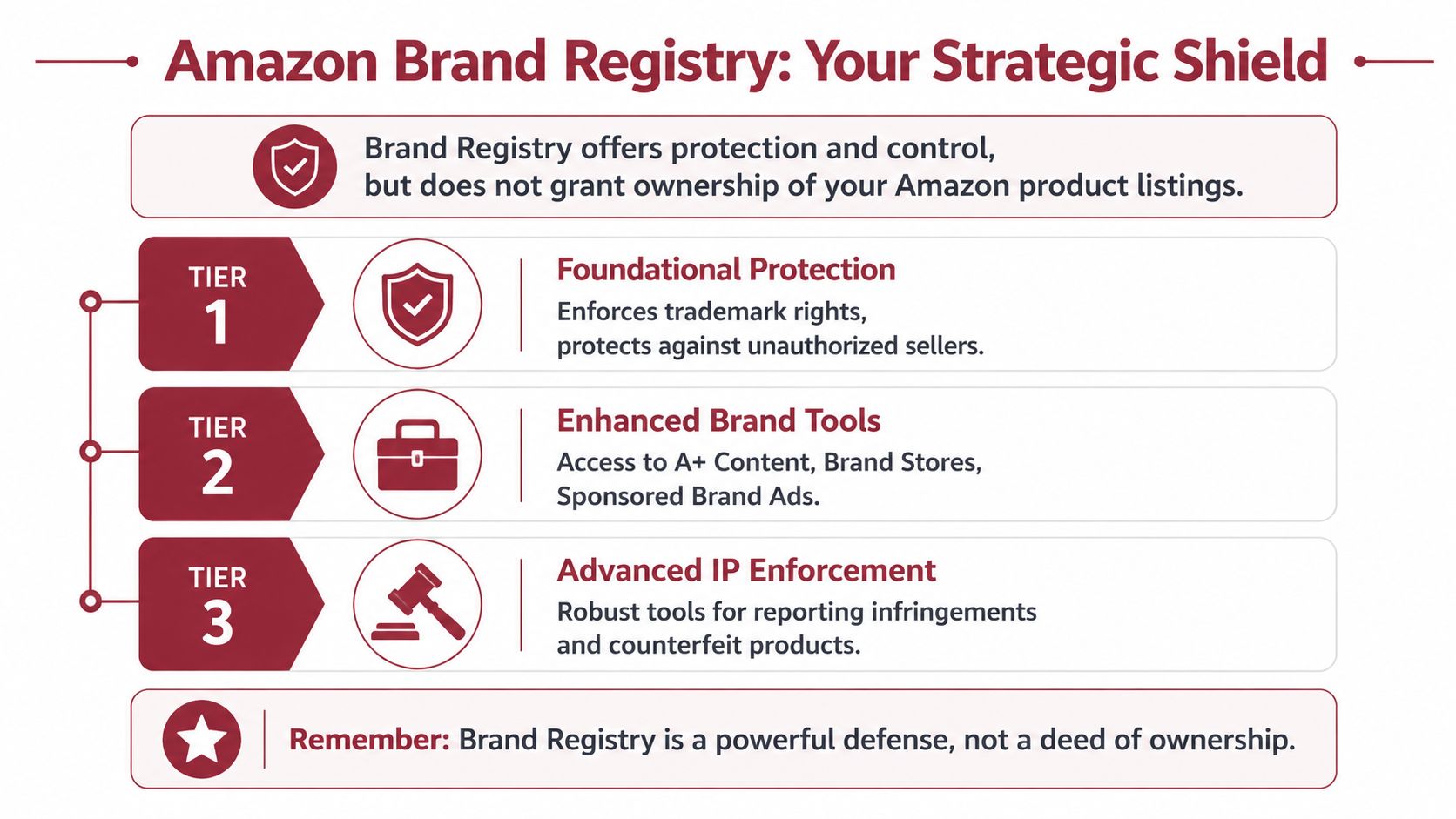
Brand Registry Your Shield Not Your Title Deed
Who controls your Amazon listing once Brand Registry is in place?
The founder with the trademark often assumes the answer is obvious. It isn’t. Brand Registry gives trademark owners stronger enforcement rights and operational control tools inside Amazon’s system.
It does not give you ownership of the listing, and it does not remove the operational risk created by agencies, distributors, or regional partners touching the account.
That distinction matters because brands usually lose control through permissions, not through trademark filings.
The three roles that decide who can do what
Amazon Brand Registry runs on three role types: Rights Owner, Reseller, and Registered Agent. Those labels are not admin details. They define who can act, what they can see, and where control stops.
Here’s the practical version:
| Role | What it does | What it means strategically |
|---|---|---|
| Rights Owner | Full access | The brand keeps decision authority and enforcement control |
| Reseller | Restricted functionality | Can sell the product, but does not operate as the brand owner |
| Registered Agent | Reporting only | Useful for IP enforcement, not day-to-day marketplace control |
Founders miss the consequence. If the wrong entity sits in the wrong role, your operating model breaks even if your trademark position is clean.
Reseller access is deliberately limited
A Reseller cannot see or do what the brand owner can. One example is Brand Analytics access. That matters because Brand Analytics shapes search strategy, competitor tracking, product positioning, and content decisions.
For a brand expanding through distributors or third-party operators, that limitation creates a clear fork in the road. You either keep Rights Owner control and centralize the strategic layer, or you let local operators push the business with partial visibility and uneven authority.
The second model creates drift fast.
A partner starts selling in the US. Another handles Canada. An agency supports the UK. Each party has enough access to influence performance, but not enough authority to govern the brand properly. That is how content diverges, seller approvals get messy, and nobody can tell who should escalate what.
Role confusion creates operational conflict
The common failure pattern is predictable:
- The founder treats “authorized seller” as if it also means brand governance
- The distributor assumes selling rights include input on copy, images, and offer structure
- The agent assumes enforcement access includes operational authority
- Nobody documents who approves listings, content edits, seller access, or pricing interventions
Then the problems start. Titles change without approval. Images are replaced. A+ content stalls. The wrong party opens cases with Amazon. Everyone believes they have standing, and Amazon usually responds to the account structure in front of it, not the assumptions behind it.
The fix is straightforward.
- The trademark owner holds Rights Owner status
- Commercial partners get the narrowest role that fits their job
- IP specialists sit under Registered Agent access only if they need it
- Decision rights live in written agreements, account permissions, and escalation rules
If you need the mechanics, this guide to Amazon Brand Registry for brand owners and operators covers the setup in more detail.
Brand Registry only works if governance sits behind it
Brand Registry helps you police misuse. It does not replace governance. If your brand is selling across regions or through partners, you need a control system behind the registry itself.
Set the approval chain. Define who can change copy. Define who can add sellers. Define who handles infringement, listing disputes, and catalogue changes. Audit permissions before problems appear.
That is how founders keep practical control. Without that layer, Brand Registry becomes a badge on the account while other people shape the listing.
The Multi-Region Control Gap When Scaling from Australia
What happens when your brand is tightly managed in Australia, but your US, UK, and Canadian listings start drifting in different directions?
That is the control gap. Founders assume international expansion means repeating the same brand system in more countries. Amazon does not work that way. Each regional marketplace runs as its own operating environment, with its own seller accounts, catalogue behaviour, support workflows, and local decision-makers. One brand can end up expressed four different ways.
One brand can end up with several versions of itself
On paper, the trademark is the same. In practice, the listing control points are scattered.
Amazon’s regional listing pages operate independently, each technically owned by Amazon and often influenced by different authorized sellers or operators, which makes unified standards harder to enforce across Australia, the US, Canada, and the UK, as described in this Seller Forums discussion on multi-region control gaps.
What usually happens next is fairly consistent. An Australian brand enters the US through one partner and the UK through another. The US listing uses aggressive copy and discount-first positioning. The UK listing uses different imagery and a flatter title. Australia keeps the original premium presentation. Same product. Same trademark. Different market identities.
The issue is usually operational fragmentation, not outright misuse.
Where operational drift shows up first
Drift rarely starts with a major dispute. It starts with small local decisions nobody escalates.
Content drift
One region rewrites the copy for conversion. Another region localizes badly and strips out the brand voice. A third changes image order to suit a reseller’s sales strategy. Over time, your catalogue stops behaving like a brand system and starts behaving like separate regional assets.
Seller drift
A partner begins as the approved seller of record, then adds sub-distributors or allows inventory to move into channels you did not authorize. More sellers appear on the offer stack. More people gain influence over the listing. The founder notices after the page has already changed.
Pricing drift
Regional operators respond to their own targets, not your global positioning, unless you set firm rules. That is how one market trains customers to wait for discounts while another tries to hold a premium price. The damage is commercial, not cosmetic.
Many Amazon brand problems come from authorized operators working without tight controls.
The reverse is true as well. A US or UK brand expanding into Australia can lose local control if the Australian market is launched without a defined approval structure. That is why selling on Amazon Australia from overseas requires a clear market entry control model.
The problem gets worse when partners hold the operating keys
Trust does not remove the need for structure. It increases the stakes.
A distributor can be excellent at sales and still be the wrong party to control listing architecture, catalogue language, variation structure, pricing posture, or case escalation with Amazon. Those decisions shape how the brand is perceived and how hard it is to clean up later. If a partner controls the account layer and the day-to-day listing actions, they often control outcomes long before a founder realizes it.
This short discussion captures the broader issue well:
A founder-level view of the risk
This affects expansion quality, margin protection, and exit value.
Consider what happens when:
- The US partner writes conversion-heavy copy that pulls in the wrong customer expectations
- The Canadian account uses different packaging photos and creates confusion around product specs
- The UK partner allows inconsistent offer activity that weakens premium positioning
- Support and warranty language diverge by region and create a trust problem that spills back to the brand
Those are not minor marketplace tasks. They define what the customer thinks the brand is.
Founders who scale well across Amazon regions decide three things early. Which elements stay globally consistent. Which elements can be adapted locally. Who has final approval when regional execution conflicts with brand rules. If you do not set that structure up front, Amazon will expose the gap fast.
Choosing Your Expansion Model Direct vs Partnership Strategy
Should you keep every Amazon market in-house, or let regional partners run the local operation?
That is not a distribution question. It is a control design question.
Founders in Australia often get this wrong when they expand into the US, Canada, or the UK. They assume the actual choice is speed versus control. It is not. The critical decision is where authority sits when listing standards, compliance pressure, and commercial incentives start pulling in different directions.
Direct gives you authority close to the source
If you run each market directly, your business controls the seller account, the catalogue decisions, the support logic, and the escalation path with Amazon. That matters because the team closest to the account usually sets the pace for everything else.
Direct expansion gives you cleaner governance. It also gives you more operational weight to carry.
Your team has to handle tax and compliance requirements by region, account health, marketplace support, stock flow, content updates, and issue resolution across time zones. If you do not already have internal marketplace operators who can manage that load, direct expansion becomes a slow-motion bottleneck. You still have control, but you do not have enough execution capacity to use it well.
This model works best when the brand wants one global operating standard and has the internal capability to enforce it.
Partnership gives you speed, but only if control is drafted properly
A distributor, local operator, or hybrid partner can help you enter a market faster and avoid building a full regional team on day one. For many Australian brands, that is a sensible move.
It becomes dangerous when the partner owns the operational layer and the founder assumes brand ownership will be enough to keep the listing aligned.
Amazon’s own ecosystem creates that gap. Amazon Brand Registry guidance discussed in the Seller Forums states that resellers, distributors, and other agents are not considered brand owners, which creates a real challenge for brands expanding through third-party partners, as discussed in Amazon’s Seller Forums on distributor and brand owner classification.
That is the point founders need to grasp. A partner can be commercially valuable and still be structurally misaligned with your brand goals. If they control the account operations in-market, they can shape titles, images, review responses, pricing posture, and case escalation before head office even sees the problem.
Compare the models by failure mode
| Expansion model | Main advantage | Main risk |
|---|---|---|
| Direct in each market | Clear authority, cleaner data access, tighter approval control | Internal team gets stretched and regional execution slips |
| Partnership-led entry | Faster launch, local knowledge, in-market operating coverage | Listing control fragments when partner incentives override brand rules |
Neither model protects you by default.
A direct model fails when the central team cannot keep up. A partner model fails when local execution rights are granted without hard approval boundaries.
Decide these points before you choose
Make the decision based on governance, not optimism.
- Who has final approval over listing content, images, and variation structure? Put that in the operating agreement, not in a kickoff call.
- Who controls the seller account or vendor relationship in each region? Account access determines practical power.
- Who handles Amazon case escalation and policy disputes? The party speaking to Amazon day to day often shapes the final outcome.
- Who owns the performance data? If regional sales data sits with a partner, your market visibility is weaker than you think.
- What can be adapted locally, and what stays fixed globally? Product claims, premium positioning, warranty language, and image standards should not be open to interpretation.
The strongest partnership models separate market execution from brand authority. Let the partner run local logistics, retail relationships, or regional media if that is their strength. Keep brand rules, listing approvals, and account governance under founder control or under a central team you appoint.
That is the standard to use. Choose direct if you have the internal bench to run multiple regions well. Choose partnership if it expands reach without handing away the operating levers that define your brand.
A Framework for Maintaining Global Brand Control on Amazon
How do you keep control of your brand on Amazon when the platform owns the shelf, local operators run day-to-day execution, and each new region adds another point of failure?
You do it with structure. Not trust. Not access alone. Not a vague belief that Brand Registry will sort it out.
Amazon is built to protect Amazon first. Public market pressure reinforces that. Institutional investors control approximately 65.91% of Amazon’s ownership, with Vanguard Group the largest shareholder, as outlined in WallStreetZen’s summary of Amazon ownership. That means founders should expect tighter policy enforcement, harder margin pressure, and less tolerance for messy account setups. If your control model depends on flexibility from Amazon, it is weak from the start.
Start with trademark timing, not launch timing
Founders expanding from Australia into the US, Canada, or the UK often rush the marketplace launch and leave rights protection for later. That is backward.
File trademarks in each target market before rollout. Do it early enough that legal ownership can support account setup, Brand Registry access, partner agreements, and enforcement if a distributor, agency, or reseller starts shaping the listing in ways you did not approve.
This is market-entry sequencing. Get the rights in place first. Then build the marketplace.
Build one global source of truth
Global brand control breaks down when each region works from its own version of the brand.
Create one controlled operating document or system that defines:
- Approved titles, bullets, and core claims
- Image order, packaging presentation, and visual rules
- A+ content standards
- Pricing logic by market
- Warranty, support, and compliance wording
- Approval rules for any local deviation
Keep it current. Version it properly. Assign one owner.
If your US partner has one set of claims, your UK agency has another, and your Australian team approves changes in email threads, you do not have a brand system. You have regional improvisation.
Put authority into contracts
A partner can run local execution without controlling your brand. But only if the agreement says so clearly.
Your contracts should state:
- Who holds Rights Owner authority
- Who can submit listing edits
- Who approves creative and copy changes
- Who can add or approve sellers
- Who handles infringement reporting
- What happens if a partner breaches brand standards
- What access, data, and assets must be returned if the relationship ends
Many cross-border expansions frequently fail. The trademark sits with the brand owner, but day-to-day control rests with the local operator because approval rights, escalation rights, or exit terms were not documented tightly enough.
Legal ownership without operating authority is a weak position.
Monitor by region, not just by account
A global Amazon business needs more than account access and a monthly report. It needs active oversight by marketplace.
Review each region on a set cadence:
- Content consistency
- Seller activity and offer changes
- Price movement
- Inventory position and Buy Box exposure
- Review patterns and support issues that suggest listing confusion
- Variation structure changes
- Suppressed listings, compliance flags, or unauthorized edits
This matters more in a partner-led model. A local operator can make a change that helps short-term conversion in one market and damages brand consistency everywhere else.
Control weakens when nobody is watching.
Define what can change locally
International growth does require local adaptation. But adaptation needs boundaries.
Set global rules for the parts of the brand that shape recognition and trust. Allow local flexibility only where the market or regulator demands it.
Use a framework like this:
| Control area | Global standard | Local flexibility |
|---|---|---|
| Trademark and rights | Centralized | None |
| Core brand positioning | Centralized | Limited adaptation |
| Compliance wording | Controlled baseline | Market-specific adjustments |
| Seller permissions | Central policy | Local execution within policy |
For Australian brands expanding overseas, this is the control gap that causes the most damage. The founder assumes the overseas partner is adapting the offer. In practice, the partner is often rewriting the brand.
Build the escalation path before there is a problem
When a listing gets changed, a reseller appears, or a regional operator pushes a claim you would never approve, speed decides the outcome.
Set the chain of command in advance:
- Who investigates first
- Who contacts Amazon
- Who approves emergency listing changes
- Who can overrule a local operator
- Who decides whether a seller remains authorized
- Who makes the final call when short-term revenue conflicts with long-term brand control
Do not leave this to whoever notices the problem first. The party already active on the listing usually has the advantage. Your structure has to close that gap.
Strong brands treat Amazon management as an operating system, not a marketplace task. That is how you protect the brand while still giving regional teams or partners enough room to execute.
Conclusion Turning a Rented Space into a Brand Fortress
You are not trying to own the Amazon listing. You are trying to control what happens around it.
That is the strategic shift founders need to make. Amazon owns the shelf. Your brand has to secure the rights, structure, and operating discipline that keep that shelf from being used against you.
The brands that get this right don’t obsess over account access alone. They build layered control. Trademark protection in every target market. Correct Brand Registry role design. Clear partner agreements. Tight standards for content, sellers, and pricing. Ongoing monitoring across regions. Fast enforcement when drift starts.
That matters even more once you scale internationally. One weak regional setup can distort how the brand appears everywhere else. One poorly structured distributor relationship can reduce your authority where you assumed you had it. One lazy marketplace rollout can turn a good product into a fragmented brand.
Strong products don’t automatically become strong international brands. On Amazon, they become strong only when founders treat platform control as a strategic discipline, not an admin task. And for many established brands, especially those entering new regions through carefully chosen operators, strategic partnerships are often the most effective way to scale deliberately while protecting long-term brand value.
TPR Brands helps established product brands expand into Amazon across Australia, the US, Canada, and the UK while protecting pricing, seller control, and long-term brand value.