
For established brand founders, international expansion often feels like a choice between saturated, hyper-competitive markets. The US and UK attract most of the attention, but this predictable move is frequently a strategic error. This article will help you understand how to sell on Amazon Australia from overseas.
The smartest growth isn’t about fighting for incrementally smaller shares of the biggest markets. It’s about identifying and dominating high-growth regions where a great product can become a definitive brand. If you are assessing your next strategic move, you must seriously analyze how to sell on Amazon Australia from overseas. It’s a market defined by significant opportunity but underserved by sophisticated international brands.
Why Australia Is A Strategic Market, Not Just Another Channel
Many founders fall into the pattern of chasing volume in saturated marketplaces. They mistake activity for progress, ignoring the fundamental economics of supply and demand. The superior strategy is to enter a market where a proven product can establish a strong, defensible position without a capital-intensive battle for visibility.
For founders assessing international expansion, understanding how to sell on Amazon Australia successfully is a critical part of building a global marketplace strategy.
https://tprbrandsau.com/how-to-sell-on-amazon-australia/
Australia represents that strategic opening. It is a wealthy, digitally mature country where consumers are actively seeking quality international products. However, its primary e-commerce destination, Amazon.com.au, remains relatively uncontested. This is a market dynamic that rarely lasts.
The Strategic Advantage of Low Competitive Density
Market data reveals a clear structural advantage. While Amazon globally hosts approximately 1.9 million active sellers, Amazon Australia has just 24,227 as of early 2026.
That represents a mere 0.82% of the worldwide seller population. This is not a signal of market weakness; it is a clear indicator for brands seeking first-mover advantage. While competitors are engaged in escalating advertising costs in the US or Europe, a clear path exists to build a dominant position in the Australian market.
This dynamic is best understood through a direct comparison.
Amazon Australia Market Opportunity Analysis
| Metric | Amazon Australia | Amazon US | Strategic Implication for Founders |
|---|---|---|---|
| Active Sellers | ~24,227 | ~1.1 Million+ | Radically lower competitive density allows for a higher share of voice and a more efficient path to market leadership. |
| Prime Penetration | ~45% of households | ~67% of households | A strong, established logistics network supports a rapidly growing base of high-value consumers conditioned to buy. |
| Market Maturity | Growth Phase | Mature Phase | Entry occurs during a steep growth trajectory, not after market saturation and commoditization. |
The takeaway for brand founders is clear: Australia offers a rare combination of a developed, affluent consumer base with a marketplace that is far from saturated. This is the ideal environment for profitable brand expansion.
This low seller density translates into tangible strategic benefits:
- Greater Share of Voice: Your products have a structurally higher probability of being discovered.
- More Efficient Ad Spend: With fewer brands competing for the same keywords, customer acquisition costs are often significantly lower.
- Faster Path to Category Leadership: Achieving high search rankings for key terms is far more attainable.
Success is not defined by entering the largest market; it’s defined by entering the right market at the right time. Australia’s current dynamic creates a window for controlled, profitable growth before the market inevitably saturates.
A Market Primed for Quality International Brands
Australian consumers value quality and actively seek it from international brands. Increasingly, they are turning to Amazon as their primary platform for discovery and purchase.
With Amazon Prime membership reaching 4.5 million subscribers—approximately 45% of all households—the infrastructure for rapid, reliable fulfilment is already in place and scaling.
This creates an ideal environment for founders with proven products. You have:
- An Engaged Audience: Australian consumers are actively searching for new, high-quality products.
- An Uncrowded Marketplace: The platform is not yet flooded with competitors driving down prices and inflating advertising costs.
- World-Class Logistics: The Amazon FBA network provides an immediate, scalable fulfilment solution, enabling you to compete on service from day one.
For a founder who has already validated a product, the Australian marketplace is not just another sales channel. It is a strategic opportunity to capture significant market share before the competitive landscape intensifies. It’s about leveraging existing success to own a new, high-growth market.
Working with brands through TPR Brands, we often see companies underestimate the opportunity in markets like Australia. Recently we began working with a multi-million-dollar cosmetics company entering a category where one dominant player controls most of the market and competition is surprisingly limited. With the strength of their product and the strategic positioning we are building for them inside Amazon marketplaces, the goal is not simply to enter the category but to capture a significant share of the market over time. Situations like this are exactly why founders begin exploring how to sell on Amazon Australia from overseas strategically rather than treating it as a small side channel.
The Market Entry Framework: A Foundational Strategic Decision
Before any discussion of listings or logistics, a foundational decision must be made. How you structure your market entry will have lasting implications on brand control, tax efficiency, and your ultimate ability to scale.
For founders planning to sell on Amazon Australia from overseas, this first choice is the bedrock of the entire expansion strategy.
Essentially, two paths exist: utilizing Amazon’s Global Selling program or establishing a dedicated Australian seller account. Let’s analyze the strategic implications of each.
Amazon Global Selling: The Unified Approach
On the surface, Amazon Global Selling appears to be the most efficient option. It allows you to link an existing Seller Central account—for instance, your US account—to the Australian marketplace and manage operations from a single dashboard.
However, this convenience can come with strategic trade-offs. You are operating as a foreign entity, which can create friction in customer perception and operational reality. You are navigating Australian customs and tax from a distance, which can signal a lack of long-term commitment.
We observe this pattern repeatedly. For founders serious about building a durable brand presence, demonstrating market commitment is critical. A linked global account can signal to Australian consumers and potential partners that you are merely testing the waters, not building for the long term.
The Dedicated Australian Seller Account: A Stronger Foundation
For brands with significant ambition in Australia, this is the superior strategic choice. It involves registering a new, separate Amazon seller account specifically for the AU marketplace.
While this requires more initial administrative work, the strategic advantages are substantial. It immediately positions your brand as a serious, committed player in the market. More importantly, it provides a clean operational structure for managing Australian inventory, finances, and performance metrics, insulated from the complexities of your home market.
This decision tree helps frame the strategic choice for founders considering the Australian market.
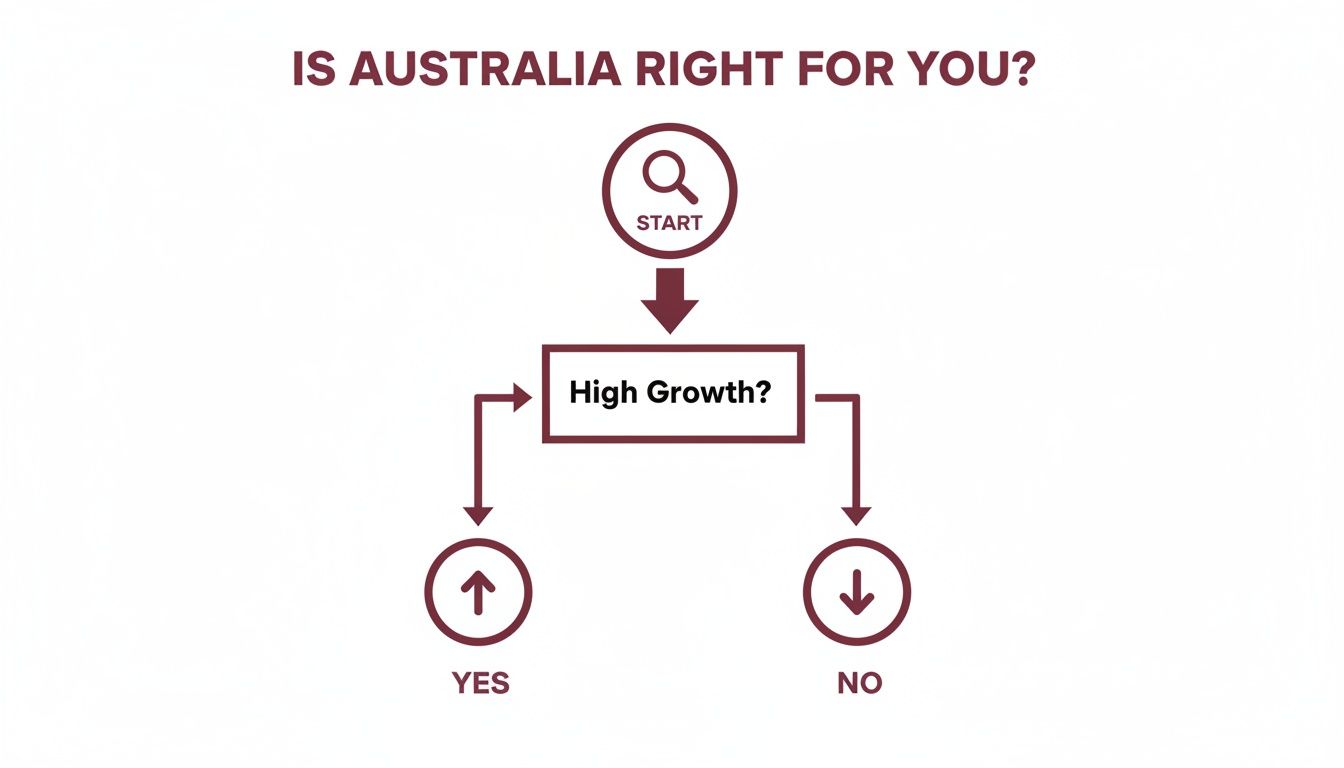
The flowchart forces an honest assessment of whether your brand is structured to capitalize on a high-growth opportunity.
Executing Registration with Precision
Regardless of the chosen path, Amazon’s verification process is notoriously stringent. Errors can delay a launch by weeks or even months. All documentation must be perfectly aligned.
Verification Checklist:
- Proof of Identity: A valid passport or national ID for the account principal.
- Business Information: Official business registration documents (e.g., LLC or Ltd. certificate) displaying the exact legal business name and address.
- Financials: A recent bank account statement and a valid credit card. The name and address on the bank statement must match the ID and business documents precisely.
Even a minor discrepancy—a missing middle initial or a slight address variation—will trigger a rejection. Meticulous verification of all documents is non-negotiable.
For brands committed to the Australian market, we strongly recommend obtaining an Australian Business Number (ABN) and registering for Goods and Services Tax (GST) from the outset. While not always mandatory on day one, it signals serious intent and dramatically simplifies customs, tax, and financial operations. We explore this further in our articles on global brand expansion.
Ultimately, a dedicated account establishes a stronger, more scalable presence, demonstrating to the market and to Amazon that your brand is positioned for long-term success.
Building a Resilient Australian Supply Chain
A proven product and established brand traction are necessary prerequisites for expansion, but they are not sufficient. The true test for many overseas brands entering Australia comes down to supply chain execution. Countless brands stumble here, underestimating the operational complexity of moving products from a port to a customer’s doorstep efficiently and profitably.
Logistics is not a tactical choice between Fulfilment by Amazon (FBA) and Fulfilled by Merchant (FBM); it is a core strategic decision that directly shapes brand perception, customer trust, and profit margins. For founders looking to sell on Amazon Australia from overseas, an intelligent fulfilment strategy is what allows a foreign brand to compete on equal footing with local incumbents.
The Strategic Power of FBA in the Australian Market
For the majority of established brands we work with, leveraging FBA is the only viable path for a successful Australian launch. It is the most direct way to neutralize the inherent disadvantage of being an international seller: slow, expensive shipping.
By positioning inventory in Amazon’s local fulfilment centers, you gain two decisive advantages:
- Prime Eligibility: Your products immediately qualify for free, rapid shipping to millions of Australian Prime members. The Prime badge is a powerful conversion driver and a primary filter for discerning shoppers.
- Competitive Speed: In the consumer’s mind, you are no longer an “overseas” seller. You are offering the same 1-2 day delivery promise as a Sydney-based company, eliminating a major point of friction in the purchase decision.
This is not about convenience; it is about meeting a non-negotiable market expectation. Third-party seller revenue on Amazon Australia recently grew to $316.9 million, a 74% year-over-year increase. This growth is fueled by the platform’s 75.2 million monthly visits and its appeal to a premium demographic, with 80% of households earning over $200k shopping on the platform. To compete for this audience, flawless delivery is table stakes. Discover more about Australia’s booming e-commerce trends and their implications for your brand.
Beyond FBA: A Hybrid Model for Margin Protection
While FBA is the engine for a successful launch, it is not a universal solution for every product. The most sophisticated founders analyze their cost structures to identify where alternative models are more profitable. A blind reliance on FBA can quietly erode margins.
A rigid supply chain is a fragile one. The objective is not to select a single fulfilment method but to build a flexible, hybrid system that matches the most efficient logistics model to the right product.
Consider scenarios where a different approach is strategically superior:
Fulfilled by Merchant (FBM)
Shipping directly from an international warehouse is rarely viable for core products due to high costs and long delivery times. However, it has a strategic place for:
- Made-to-Order Items: Products with customization options that cannot be pre-stocked.
- High-Value, Low-Velocity Goods: Bespoke or luxury items where the buyer is less sensitive to delivery time.
Third-Party Logistics (3PL)
Partnering with a local Australian 3PL provider enables a powerful hybrid strategy. A 3PL can store and ship products that are not economically viable for FBA, such as:
- Oversized or Heavy Items: FBA fees for bulky products can destroy margins. A local 3PL often provides more competitive rates.
- Slow-Moving Inventory: Avoid punitive FBA long-term storage fees by holding slower-moving SKUs at a 3PL and replenishing FBA inventory as needed.
- Multi-Channel Fulfilment: A 3PL can manage inventory across Amazon, a DTC site, and other channels from a single stock pool, providing operational synergy.
A resilient supply chain is a blended one. Use FBA as your primary engine to win the Prime customer with core, fast-moving products. Then, strategically deploy FBM or a 3PL to handle the exceptions. This ensures every product line remains profitable while delivering a world-class customer experience.
Positioning Your Brand for the Australian Consumer
Product-market fit in one country does not guarantee global success. Many strong brands fail when expanding because they assume a winning formula is universally applicable. This is a critical miscalculation, particularly in the Australian market.
To successfully sell on Amazon Australia from overseas, you must do more than simply list your products. You must strategically re-position them for a new consumer mindset. This involves adapting your brand narrative, sharpening your value proposition, and aligning your visual identity with the nuances of Australian culture.
Conducting Strategic Market Analysis
Before a single unit is shipped, a deep analysis of the local competitive landscape is essential. This goes far beyond superficial keyword searches. It is a strategic intelligence-gathering exercise to determine exactly where your brand can win.
Begin by dissecting the top-performing brands in your category on Amazon.com.au. Analyze their brand voice, the angles emphasized in their A+ Content, and the sentiment within their customer reviews. What market gaps exist?
- Pricing Architecture: Are competitors positioned as budget, mid-tier, or premium? Australians will invest in quality but are adept at identifying perceived price gouging.
- Customer Pain Points: What are the most common complaints in competitor reviews? Every negative review highlights an unmet need—a potential opening for your brand.
- Brand Promises: What core benefits are competitors communicating? Look for a unique value proposition that has been overlooked.
Simply translating marketing copy is a formula for failure. The objective is to translate your brand’s core value, which requires understanding the cultural drivers of purchasing decisions in Australia.
Translating Brand Value, Not Just Language
A brand story that resonates in North America can easily fall flat in Australia. Australians generally respond to a more direct, down-to-earth tone. Exaggerated claims and marketing hype are often met with skepticism.
For example, aggressive “best-in-the-world” messaging can be perceived as arrogant. A more effective approach often focuses on durability, practicality, and how the product genuinely enhances the Australian lifestyle. This is a subtle but critical shift from “what our brand is” to “what our product does for you.”
Consider how your brand aligns with local values:
- Lifestyle Congruence: Does your product fit the outdoor, coastal, and active lifestyles prevalent in Australia?
- Practicality and Durability: Australians respect products that are well-made, functional, and built to last.
- Authenticity: A straightforward, honest brand voice builds trust more effectively than slick marketing slogans.
A strong brand requires more than transactions; it requires loyalty. Learn more about the specific strategies for building brand loyalty in our dedicated article.
Optimizing Listings for the Australian Shopper
Once your brand positioning is defined, it must be executed flawlessly on your Amazon listings.
Australian Keyword Research
Never assume your US or UK keywords will translate. Australian English has its own distinct slang and terminology. A “cooler” in America is an “esky” in Australia. A “stroller” is a “pram.” Use robust keyword tools to identify the exact search terms Australian shoppers use.
Compelling A+ Content
Your A+ Content is the primary canvas for telling your adapted brand story. Use high-quality lifestyle imagery that feels authentically Australian. Show your products in context—at a backyard barbecue, a day at the beach, or on a weekend camping trip. This visual relevance is far more powerful than generic stock photography. According to Amazon, even basic A+ Content can increase sales by up to 8% by building the trust that drives conversion and repeat purchases.
This deliberate adaptation is what separates brands that thrive in Australia from those that merely survive. It demonstrates a commitment to the market that Australian consumers will recognize and reward.
The Partnership Model: A Framework for Intelligent Scale

The ambition to sell on Amazon Australia from overseas is often tempered by the daunting prospect of building an entire international operation from scratch.
This is a common failure point for many brands. Founders are typically presented with two unattractive options: attempt to manage everything from a distance (the “Go-It-Alone” model) or cede control to a traditional distributor who may not prioritize brand equity.
A superior path exists. A strategic partnership provides immediate access to on-the-ground infrastructure and market expertise, enabling deliberate growth without the associated risk and complexity. This is about gaining an operational advantage, not relinquishing brand control.
The Hidden Costs of the Go-It-Alone Model
Attempting to build an Australian operation from the ground up is a significant drain on founder time and capital. The operational friction involved in seemingly simple tasks is consistently underestimated.
This operational drag manifests in several key areas:
- Logistical Complexity: This is not just about shipping. It involves managing international freight, navigating Australian customs regulations, and solving for last-mile delivery. A single error can result in inventory being held at the border for weeks.
- Compliance Risk: Australia has its own stringent product safety standards, labelling laws, and electronics certifications (RCM). Ignorance of these regulations does not prevent penalties.
- Cultural Disconnect: Marketing strategies that are effective in one market can fail completely in Australia. Without local insight, advertising spend is often wasted.
These challenges consume time and capital—resources that should be allocated to product innovation and brand building. The founder becomes a logistics manager by necessity, not by choice.
Many great products fail internationally not due to a lack of demand, but because the operational weight of expansion becomes unsustainable. The smartest brands do not do everything themselves; they partner to accelerate growth and mitigate risk.
How a Strategic Expansion Partner Changes the Equation
Engaging an expansion partner is not about outsourcing your brand. It is about plugging your brand into a pre-built operational system that is already integrated into the local market.
A true partner acts as an extension of your team, focused on protecting your brand while navigating the complexities of the market on your behalf. Instead of spending months on setup, you can launch with the confidence that all critical operational functions are already in place and optimized.
The Strategic Advantages of Partnership
A partnership model transforms complexity into a strategic advantage. It allows your brand to operate with the speed, knowledge, and efficiency of a local entity from day one.
The benefits are clear:
- Immediate Market Access: You gain instant access to established FBA networks and local fulfilment systems, ensuring Prime eligibility and meeting consumer expectations for fast shipping.
- Reduced Operational Overhead: You bypass the significant cost and complexity of establishing an Australian business entity, hiring local staff, and managing payroll and compliance.
- Mitigated Risk: An experienced partner understands Australian customs, GST, and product regulations, preventing costly errors that can damage your brand and finances.
- A Localized Go-to-Market Strategy: You benefit from real-world, data-driven insights on consumer behavior, pricing strategy, and brand positioning.
This is not a shortcut; it is a strategic decision. It allows you to focus your resources where they generate the most value—on your brand and products—while your partner manages the on-the-ground execution. For an established brand, this is the most secure and efficient path to transforming a successful product into a global brand.
For Established Brands Considering Amazon Expansion
At TPR Brands we work with established consumer product brands that are ready to expand into international Amazon marketplaces. Our focus is not on launching beginner sellers.
Instead, we partner with brands that already have:
• proven products
• strong manufacturing capability
• the ambition to scale globally
We help these brands enter high-potential Amazon marketplaces including Australia, the United States and Canada while building long-term category leadership. Our team handles the operational and marketplace strategy required for international expansion so founders can stay focused on growing their brand.
If your product is already performing and you are exploring international marketplace expansion, you can start a brand expansion conversation with TPR Brands.
Common Questions From Founders Expanding Into Australia
Entering a new market like Australia inevitably raises strategic questions around compliance, pricing, and operations. For founders looking to sell on Amazon Australia from overseas, the same concerns arise repeatedly.
Addressing these issues correctly from the outset is the difference between a smooth launch and a series of costly errors. Here are the founder-focused answers to the most critical questions we encounter.
Do I Need an Australian Business Number to Sell on Amazon?
The tactical answer is no, not immediately. The strategic answer is yes, absolutely.
You can technically register your Amazon.com.au account and begin selling as a foreign business without an Australian Business Number (ABN).
However, this approach is not scalable. The moment your annual turnover from Australian sales is projected to reach AUD $75,000, you are legally required to obtain an ABN and register for the Goods and Services Tax (GST).
An ABN is more than a tax identifier; it is a signal of market commitment. It simplifies customs clearance, streamlines tax obligations, and builds a foundation of trust with local partners and with Amazon itself. View it not as a bureaucratic hurdle, but as a critical piece of infrastructure for building a legitimate, scalable business in Australia.
How Should I Price My Products for the Australian Market?
This is a common point of failure. A simple currency conversion of your US or EU price is a flawed methodology that will either destroy your margins or render your product uncompetitive.
You must construct your Australian pricing from the ground up, based on a full-cost model.
Your final retail price must account for several local factors:
- Landed Costs: This includes international freight, import duties (typically 5% of the customs value), and the mandatory 10% GST levied on the value of the imported goods.
- Amazon Fees: These include referral fees, which vary by category, and any professional seller account fees.
- Fulfilment Costs: FBA fees in Australia are unique. You must calculate the specific fulfilment and storage costs for the .com.au marketplace for each ASIN.
- Marketing and Returns: Factor in a budget for advertising and the cost of managing local customer returns.
Before finalizing any price, conduct a thorough analysis of your direct competitors on Amazon.com.au. The objective is to identify the price point that communicates your brand’s value while remaining compelling enough to drive initial sales velocity and market adoption.
Underpricing can permanently devalue your brand in the consumer’s mind. Overpricing will kill sales velocity and prevent you from gaining traction. The goal is to find the equilibrium that protects both your brand equity and your profit margin.
What Are the Biggest Compliance Mistakes Overseas Sellers Make?
The most damaging and frequent errors relate to product compliance and incorrect labeling. Australia maintains its own strict safety standards, with rigorous enforcement in categories like electronics, children’s toys, cosmetics, and food-contact items.
The classic mistake is assuming that compliance in one region (e.g., UL certification in the US or CE marking in Europe) guarantees compliance in Australia. This assumption is incorrect and can lead to severe consequences:
- Seizure and destruction of entire shipments by the Australian Border Force.
- Immediate suspension of your Amazon seller account.
- Significant financial penalties and potential legal action.
For example, nearly all electronics sold in Australia require the Regulatory Compliance Mark (RCM), which certifies that the product meets local safety and electromagnetic compatibility standards. Skincare and cosmetic products have specific ingredient and volume labeling requirements. You must complete due diligence on all relevant Australian regulations before your first shipment leaves its point of origin. This is an area where engaging expert guidance provides a significant return on investment by mitigating substantial risk.
Is FBA the Only Viable Fulfilment Option for Australia?
Fulfilment by Amazon (FBA) is the most powerful tool for launching in Australia. It provides the Prime badge and ensures the fast, reliable delivery that consumers demand. However, it is not the only option, and for certain products, it is not the most profitable one.
FBA storage fees, particularly long-term storage fees, can severely impact the profitability of certain types of inventory. Consider these scenarios:
- High-Value, Slow-Moving Items: Storing an expensive product that sells infrequently in an FBA warehouse can become prohibitively expensive.
- Oversized or Heavy Products: FBA fees for large and heavy items are substantial and can make it impossible to price a product competitively.
In these cases, a hybrid model utilizing a local Third-Party Logistics (3PL) provider is often the more intelligent strategy. A reputable 3PL can manage warehousing and fulfilment for your “problem” SKUs, often at a fraction of the cost of FBA for those specific items.
This allows you to leverage FBA for your core, fast-moving products to capture Prime sales, while using a 3PL to profitably manage the items that do not fit the FBA fee structure. A blended fulfilment strategy is a hallmark of a sophisticated and profitable international operation.
At TPR Brands, we work with established product brands to navigate these challenges, helping them expand into international Amazon marketplaces with a clear, strategic growth plan.
If your product is proven and you are ready to build a deliberate strategy for entering the Australian market, let’s Start a Brand Expansion Conversation.
Pingback: Selling on Amazon USA from Australia: A Founder's Guide to Market Entry