
Selling on Amazon Australia requires a Professional Seller account, GST compliance, product validation and a fulfilment strategy such as Amazon FBA. Many established consumer brands work with an Amazon expansion partner to handle marketplace setup, international logistics and compliance across Australia, the United States and Canada. This article explains how established brands can sell on Amazon Australia and expand into international marketplaces.
Many great products struggle internationally, not because demand is weak, but because the expansion strategy is flawed. Selling on Amazon Australia is a strategic play, not just another box to tick on your global checklist. It’s about genuinely adapting your brand to a new market, understanding local consumer psychology, and navigating a unique operational landscape. Success here requires a different playbook than the one that worked in the US or Europe.
An Amazon expansion partner is a company that helps established product brands expand into international Amazon marketplaces by managing logistics, compliance, fulfilment strategy and marketplace positioning.
Why Many Great Products Fail to Become Great Brands on Amazon Australia
I’ve seen it time and again: successful founders assume they can replicate their home-turf success and watch the sales roll in. This is easily the most expensive mistake a brand can make when entering Australia. On the surface, the market looks familiar, but the distribution dynamics and consumer trust signals are completely different. You’re dealing with a savvy retail culture, massive geographical spread, and very specific consumer expectations.
This isn’t a beginner’s guide on how to open an account. It’s a strategic playbook for established brand leaders on launching successfully on Amazon Australia and dodging the common pitfalls that stall even the biggest players.
The Myth of a ‘Copy-Paste’ Expansion Strategy
A product that’s a bestseller in North America can absolutely fall flat down under. It’s rarely about the product itself, but almost always about a flawed market entry strategy. Many brands underestimate the Aussie consumer, who is often loyal to high-quality local brands and has firm expectations around service and delivery speed. A great product does not automatically become a great brand in a new market.
The opportunity, however, is significant. Projections show Amazon Australia is on a path to reach 60% of Australian shoppers by 2026—a huge jump from 52% in 2023. And with 93% of Australian consumers having bought from a marketplace in the last year, the demand is clearly there. You can dig into more data about Australian online sales to see the full potential.
For founders, the key takeaway is this: Marketplace success requires strategic positioning. Your product’s existing reputation doesn’t automatically translate to brand adoption in a new country. You have to earn consumer trust from scratch.
Real-World Patterns: The Hidden Risks for International Brands
To truly succeed, you must do more than just list products. It requires deep market adaptation. Without it, even strong brands hit the same predictable roadblocks that lead to stalled growth:
- Underestimating Compliance: Australia has strict Australian Consumer Law (ACL) and Goods and Services Tax (GST) rules for overseas businesses. A misstep here can freeze operations and lead to significant financial penalties.
- Misjudging Distribution Dynamics: Australia is vast. A shipping strategy that works in a dense European country is completely unworkable for reaching customers from Perth to Sydney. This blows out costs, delivery times, and ultimately, erodes brand trust.
- Ignoring Cultural Nuances: Your marketing messages, branding, and even product names might not land as intended. A failure to localise can make your brand feel alien and untrustworthy to Australian shoppers, sabotaging your efforts before they begin.
The strategic lesson is to shift from a tactical ‘how-to’ mindset to a strategic ‘how to win’ approach. The following sections lay out a playbook for established brands to properly assess their readiness, build a scalable operation, and launch intelligently. At TPR Brands we work with founders navigating these challenges as they expand into international markets.
Market Insight: Can Your Brand Successfully Sell on Amazon Australia?
Before shipping a single unit of inventory, you must conduct rigorous market validation. This is the step that separates a smart, profitable Australian launch from a cash-burning disaster that harms your brand’s global reputation.
What works wonders in your home market might fall completely flat here. A product only becomes a brand once it proves its value to local shoppers. For founders, that means swapping assumptions for hard, analytical data.

Think of this early validation as market intelligence. It’s about de-risking your expansion and confirming your products have a real shot at winning over Australian customers.
Mapping the Competitive Landscape
First, you need to understand the marketplace economics on Amazon.com.au. It’s not enough to check if your usual US or UK rivals are present. Often, your biggest challenge will come from established local brands who have been building consumer trust with Australians for years.
Analyze what these players are doing:
- Pricing and Positioning: Are they competing on price, or have they carved out a premium niche? This reveals the market’s perception of value.
- Listing Quality: How strong is their brand positioning? Examine their A+ Content, Brand Store, and customer reviews to gauge their level of sophistication.
- Fulfilment Method: Are they leveraging FBA for the Prime badge, or handling shipping themselves (FBM)? This indicates their operational strength and commitment to the market.
This deep dive reveals where the strategic gaps lie. If the market is a race to the bottom on price, it could be the perfect opening for a high-quality, premium brand. Conversely, if it’s crowded with strong brands, you’ll need a significant marketing budget and a superior value proposition to gain a foothold.
Gauging Genuine Local Demand
Next, you must confirm that Australians are actively searching for the type of products you plan to sell on Amazon Australia. Your sales data from other countries is irrelevant here. You must dig into local search behavior.
A classic mistake is a mismatch in language. An American ‘cooler’ is an Australian ‘esky’. Using localized keyword research tools not only provides the right terms but also reveals search volume—your best proxy for actual demand. Your mission is to find high-volume, commercial keywords that you can realistically compete for.
Many brands launch to silence because they target keywords that are popular in their home market but have zero search traffic in Australia. It’s a simple mistake that can render an entire launch invisible.
Beyond keywords, look at trend data. Is your product category growing, shrinking, or highly seasonal? For a summer product, launch timing is everything. Launching as demand dips can kill your momentum. Seeing how these pieces fit together is crucial for understanding brand loyalty on Amazon.
Navigating Australian Compliance
This is not the glamorous part of brand expansion, but it is non-negotiable. Getting compliance wrong is a surefire way to have listings shut down or face legal trouble. It is not an afterthought—it is a mandatory gate you must pass through.
Ensure these key areas are addressed:
- Goods and Services Tax (GST): If your business has a global turnover of more than A$75,000, you are required to register for, collect, and pay GST in Australia.
- Australian Consumer Law (ACL): This law provides consumers with automatic guarantees on products. You must understand your obligations around refunds, replacements, and repairs.
- Product-Specific Certifications: Depending on your category, you may need special approvals. Electronics need SAA (Standards Australia) certification, and many health products are regulated by the Therapeutic Goods Administration (TGA).
Attempting to launch without the right certifications is a recipe for failure. It poses a huge risk to your brand and can permanently burn your reputation. Ticking these boxes means building your Australian business on a solid and compliant foundation.
Building the Infrastructure to Sell on Amazon Australia
You’ve validated the Australian market. Now it’s time to build the operational engine that will drive your brand on Amazon.com.au. This isn’t just about activating an account; these are the foundational decisions that determine long-term success or lead to months of operational chaos.
Let’s walk through how to build a scalable and defensible operation from the ground up.
First, dismiss the Individual seller plan. For any serious brand, a Professional seller account is the only viable option. The monthly fee of around A$49.95 is insignificant compared to the powerful analytics, advertising tools, and reporting it unlocks. Consider it your non-negotiable ticket to the game.
Laying the Regulatory Groundwork
With your account live, the next immediate job is to get your regulatory house in order. Getting these wrong from the start can create massive headaches down the line.
- Get an Australian Business Number (ABN): While not always a strict requirement for non-residents, an ABN signals a serious commitment to the market. It simplifies dealings with local 3PLs, marketing agencies, and is crucial for some B2B sales.
- Handle Your GST: As mentioned, if your global turnover exceeds A$75,000, you must register for and collect the Goods and Services Tax (GST). Ensure your seller account is configured to handle this from day one. You do not want to be on the wrong side of the Australian Taxation Office (ATO).
- Enrol in Amazon Brand Registry: This is your brand’s shield and sword. To enrol, you’ll need a registered trademark in Australia. Brand Registry is the single best tool for removing counterfeiters, locking down your listings, and unlocking premium marketing features like A+ Content and your Brand Store.
For founders, securing Brand Registry is not just a defensive move; it’s an offensive one. It allows you to control your brand’s narrative on the platform, building a moat of trust and authenticity that competitors without registered IP simply cannot replicate.
The Critical Fulfilment Decision: FBA vs. FBM
Once the administrative tasks are sorted, you face your most important operational choice: fulfilment. The method you choose to get products to customers across Australia’s huge landmass will directly impact your customer experience, costs, and ability to scale.
Australia is a logistics puzzle. A customer in Perth is over 3,000 kilometres from a warehouse in Sydney. Meeting the modern Aussie shopper’s expectation for fast, reliable delivery is paramount.
Worldwide, third-party sellers are the lifeblood of Amazon, accounting for 61% of all paid units. Here in Australia, with over 24,000 registered sellers, the most successful brands—those pulling in over $250,000 annually—are almost always using a Professional account and a smart FBA strategy. You can get a better sense of the competitive landscape from data on Amazon’s Australian market share.
Deciding between Fulfilment by Amazon (FBA) and Fulfilment by Merchant (FBM) isn’t a simple tactical choice; it’s a strategic one.
Fulfilment Model Comparison for the Australian Market
This table cuts through the noise and compares FBA and FBM on the factors that truly matter for brands in Australia: brand control, customer experience, and operational workload.
| Factor | Fulfilment by Amazon (FBA) | Fulfilment by Merchant (FBM) |
|---|---|---|
| Prime Eligibility | Automatic. Your products get the Prime badge, a huge conversion driver. | Not available. You miss out on the trust and visibility of Prime. |
| Shipping Speed | Fast & Reliable. Leverages Amazon’s vast logistics network across Australia. | Variable & Complex. You’re responsible for meeting delivery promises nationwide, which is tough. |
| Customer Service | Handled by Amazon. Amazon manages all shipping-related inquiries and returns. | Your Responsibility. You or your 3PL must handle all customer service and returns. |
| Operational Overhead | Low. You ship in bulk to Amazon; they handle the rest (pick, pack, ship). | High. Requires managing your own warehouse or a 3PL partner for individual orders. |
| Brand Control | Limited. Standard Amazon packaging. Less control over the unboxing experience. | Full Control. You control your own packaging, inserts, and unboxing experience. |
| Cost Structure | Predictable. Fees for storage and fulfilment are clear, but can add up. | Complex. Costs include warehousing, staff, packaging, and variable shipping rates. |
For most international brands launching in Australia, the choice is clear.
Fulfilment by Amazon (FBA) is the standard model for success. Sending your stock to Amazon’s fulfilment centres gives you instant access to their nationwide network and, most importantly, makes your products Prime-eligible. This offloads the immense logistical challenge of warehousing, picking, packing, and customer support for a market as geographically dispersed as Australia.
Fulfilment by Merchant (FBM), where you handle your own shipping or use a third-party logistics (3PL) partner, offers more control. This can be vital if you have a highly customised unboxing experience. But trying to match FBA’s shipping speed and cost-effectiveness across the country is incredibly difficult and expensive. You also sacrifice the powerful Prime badge, which is a major competitive disadvantage.
The strategic lesson is that FBA provides the speed, credibility, and operational freedom to launch effectively. It lets you focus on marketing and brand building while Amazon handles the complexities of Australian logistics.
Optimising Your Listings to Build a Brand, Not Just Sell a Product
Your logistics are sorted, but getting your products live on Amazon.com.au is just the starting line. The real work is convincing savvy Australian shoppers to choose your brand over local favorites. Your listing optimization strategy is how you turn casual browsers into loyal customers.
One of the biggest mistakes international brands make is a simple copy-paste of their US or UK listings. This approach ignores the cultural nuances of how Australians search and buy. To truly connect, your listings must speak their language.
Crafting Content That Connects and Converts
Think of your product title as your most important piece of digital real estate. It must be loaded with relevant, high-volume keywords, but it also needs to be readable and compelling. Put yourself in an Australian shopper’s shoes. Are you selling a gadget for a ‘backyard BBQ’ or for ‘outdoor entertaining’? That small tweak can make a world of difference in showing up in the right search results.
Your bullet points and product description are where you seal the deal. This isn’t just a space to list features; it’s your chance to translate those features into real-world benefits that solve a problem for your Australian customer.
- Lean into local scenarios: If you’re selling kitchenware, talk about its utility for a Sunday roast or a summer pavlova. If it’s outdoor gear, mention its durability for a weekend camping trip.
- Use Aussie vernacular sparingly: Dropping in words like ‘arvo’ (afternoon) or ‘brekkie’ (breakfast) where it feels natural shows you’re not another faceless international company. It signals you understand the local market.
- Be clear and direct: Australians generally appreciate straight-up, no-nonsense communication. Ditch the marketing fluff and get to the point about what makes your product a better choice.
Elevating Your Brand With A+ Content
If you’re brand-registered, A+ Content is a game-changer. It lets you replace the plain text description with a magazine-style layout featuring rich images, custom text, and comparison charts. This is where you stop selling a product and start building a brand.
A+ Content is your best opportunity to build trust and justify a premium price. It gives you the canvas to tell your brand’s story, showcase quality, and explain what truly sets your product apart from cheaper alternatives.
Use this space to show your product in action, dive into your brand’s mission, and answer common questions before a customer even thinks to ask them. A well-designed A+ Content page can significantly boost conversion rates by giving shoppers the confidence to click “Add to Cart.”
The whole process, from discovery to purchase, is a connected journey.
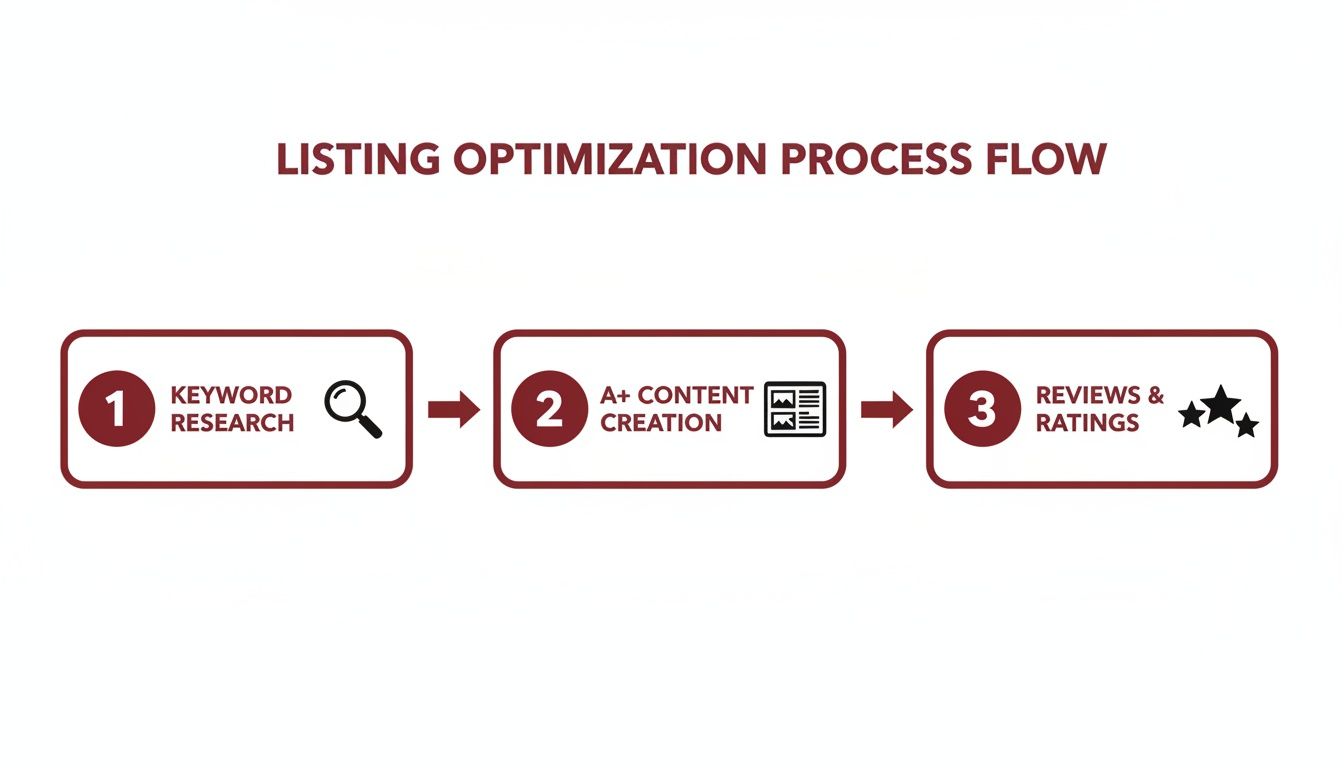
As you can see, it all works together. You pull customers in with smart keywords, convince them with compelling content, and lock in the sale with social proof.
Pricing, Margins, and Gaining Reviews
Your pricing must be deliberate. You can’t just match a competitor’s price and hope for the best; you have to protect your margins. That means carefully factoring in all Australia-specific costs.
- Goods and Services Tax (GST): Build the 10% GST into your final displayed price.
- Import Duties: Depending on your product, you could face duties between 5-10%.
- FBA Fees: Amazon’s fulfilment and storage fees in Australia can be higher, reflecting the country’s vast geography and higher operational costs.
Getting these numbers wrong is a fast track to turning a promising product into a money-loser. For more on spotting value, our guide on shopping tips for Amazon deals offers insights you can apply to your own competitive pricing.
Finally, you need reviews. A product page with zero reviews is a major red flag. Generating those first few reviews is critical for building momentum. Enrolling products in the Amazon Vine program is an excellent way to get the ball rolling, as it puts your product in the hands of trusted reviewers. Those initial, credible reviews create the social proof needed to kickstart sales and build your reputation.
Launching and Scaling Your Brand Intelligently
Getting your products live on Amazon Australia is the easy part. A successful launch, however, isn’t about just flipping a switch. I’ve seen too many brands treat their launch like an afterthought, and it’s a surefire way to get lost in the noise.
To gain traction, you need a deliberate campaign designed to build momentum from day one. It’s about creating a powerful launch plan and having a clear blueprint for what comes next.
The first few weeks are crucial. Your immediate goal is to send strong signals to Amazon’s A10 algorithm that your product is relevant and desirable. This is where a smartly structured Amazon Advertising (PPC) campaign becomes your most valuable asset.
Architecting a Profitable Launch with PPC
Forget vanity metrics like clicks and impressions. When you launch, the only thing that matters is driving profitable sales from high-intent shoppers. This means maintaining a laser focus on your Advertising Cost of Sales (ACoS) and building campaigns that capture customers ready to buy.
A winning launch campaign has three key pillars:
- Broad Match Discovery Campaigns: These are your reconnaissance missions. They help you uncover how real Australian customers search, often revealing valuable, local long-tail keywords you would never have guessed.
- Exact Match Performance Campaigns: Once you’ve identified high-converting search terms, you move them here. In these campaigns, you can bid more aggressively to own the top of search for the keywords that generate the most profit.
- Product Targeting (PAT) Campaigns: Don’t just target keywords—target your competitors. This tactic places your ad directly on their product detail pages, catching shoppers at the moment of decision.
The strategic lesson is that a launch campaign should kickstart a ‘flywheel’ effect. Sales from ads boost your organic ranking. Higher organic rank leads to more organic sales, which, over time, reduces your dependency on paid advertising.
Look Beyond the Consumer Market: The Amazon Business Opportunity
Once your consumer sales stabilize, another massive growth channel that international brands often miss is Amazon Business.
The launch of Amazon Business opened up a $76 billion B2B e-commerce market. It’s a dedicated storefront for targeting Australian small and medium-sized businesses (SMEs) with features like bulk pricing and GST-compliant tax invoices. This perfectly complements the consumer marketplace, which already attracts over 60 million monthly visits. You can read more on Amazon’s dominance in the Australian market on valueaddedresource.net.
For brands in sectors like office supplies, hardware, or anything sold in bulk, this dual-channel approach is a game-changer. You’re effectively capturing two different customer bases with the same inventory pool.
Managing Growth and Protecting Your Margins
Scaling intelligently isn’t just about selling more; it’s about growing without losing control or profitability. As you gain momentum, two things demand constant attention: inventory management and strategic planning.
Inventory Across a Continent
Australia’s geography creates unique logistical hurdles. Running out of stock is one of the quickest ways to kill your sales velocity and tank your organic rankings.
- Plan for Realistic Lead Times: Factor in the full journey—shipping from your factory, customs clearance, and the final delivery to Amazon’s fulfilment centres.
- Live in Seller Central: Keep a close watch on sales velocity and use Amazon’s forecasting tools to map out replenishment cycles.
- Prepare for Major Sales Events: Don’t get caught out. Major retail holidays like Boxing Day, Black Friday, and Prime Day cause huge traffic spikes. Stock needs to be in place weeks ahead of time.
Data-Driven Decision Making
Your Seller Central account is a goldmine of strategic insight. Regularly analyze reports like Brand Analytics and your Business Reports. They’ll reveal who your customers are, what search terms they use, and how often they repurchase. These insights are invaluable for refining your marketing, spotting new product opportunities, and making informed strategic decisions.
Ultimately, learning how to sell on Amazon Australia successfully is a continuous cycle of launching, analysing and optimising. It requires a founder’s mindset—one focused on building a defensible market position and expanding with precision. For many brands, navigating this complexity is where a strategic partner makes all the difference. You can see how we put these principles into practice by checking out some of our recent brand expansion case studies.
Founder Strategy: When to Partner for Global Expansion
Scaling your brand on a marketplace like Amazon feels like hitting the jackpot. It’s a massive growth engine. But for founders, that rapid growth—especially into a new market like Australia—can be a double-edged sword.
Before you know it, you’re tangled in brutal price wars, your brand gets diluted, and you’re suddenly facing channel conflict that puts hard-won retail relationships at risk. The very success you’re chasing can create hidden risks that erode your brand’s long-term value. This brings every founder to a critical crossroads: when do you partner instead of expanding alone?
The DIY route for global expansion is a huge undertaking. You’re essentially building an entire international division from scratch. This means hiring local experts, navigating unfamiliar tax laws, and piecing together a logistics network that can service a continent. It’s a slow, expensive path filled with operational landmines. For many great products, this is where the global dream dies.
A strategic partner isn’t just a shortcut; they’re a force multiplier. It allows your brand to skip the steepest part of the learning curve and plug directly into established, on-the-ground expertise.
So, when does a partnership become the smart move? It’s when the sheer complexity of market entry starts to overwhelm your team’s capacity.
Consider these common scenarios:
- Complex Distribution Dynamics: Australia’s geography is vast. A successful fulfilment strategy here requires much more than just signing up for basic FBA.
- Regulatory Hurdles: On-the-ground expertise in local compliance, from GST to specific product certifications, is non-negotiable for de-risking your launch.
- Speed to Market: Plugging into an established distribution network lets you launch faster, capturing market share before your competitors even know you’re there.
At TPR Brands, we work with founders navigating these exact challenges. We provide the strategic framework and operational muscle needed to turn a strong product into a successful global brand, helping you expand into international markets intelligently and with total control.
Answering Your Big Questions on Selling in Australia
When brand founders look at the Australian market, the same strategic questions always pop up. Let’s get straight to the answers you need, moving past the basic setup steps to tackle the real challenges of launching successfully.
Do I Need an Australian Business to Sell on Amazon AU?
No, you don’t have to set up a local company. This is a common misconception.
However, you absolutely must pay attention to tax. If your global turnover hits A$75,000 or more, you’re required to register for Australian GST. While Amazon can handle remitting the tax, getting your tax structure right from day one is critical. Getting this wrong can lead to serious compliance headaches later. I always recommend consulting a tax professional who understands international e-commerce before you start. It’s a smart investment.
Is FBA the Only Real Choice for Fulfilment in Australia?
For the vast majority of brands, yes, Fulfilment by Amazon (FBA) is the way to go. Australia is a huge country, and using Amazon’s logistics network is the quickest path to offering that Prime-level experience shoppers expect. That Prime badge is a massive driver for conversions.
But it’s not a one-size-fits-all solution. If you’re selling oversized, heavy, or highly specialised products, a dedicated third-party logistics (3PL) partner with warehouses across the country might actually save you money. The key is to run the numbers. You need to model the costs for both options and weigh them against the powerful brand boost you get from being Prime-eligible.
I’ve seen brands underestimate the power of the Prime badge, and it’s a big mistake. In a market where fast, reliable shipping is everything, FBA is often the fastest way to build trust and get ahead of the competition.
What’s the Real Cost to Launch on Amazon Australia?
You should think of this as a strategic investment, not just another expense on a spreadsheet. A poorly funded launch is a classic mistake that kills momentum before you even get started.
Your main budget items will be:
- Professional Seller fees, which are around A$49.95 per month.
- Your first batch of inventory and the import duties, which often run between 5-10%.
- Brand setup costs, like getting high-quality photos, videos, and trademarking so you can use Brand Registry.
- A solid launch advertising budget. This is non-negotiable for driving those crucial first sales.
Expanding into a new market like Australia brings a unique set of operational and strategic hurdles. For established brands wanting to scale smartly without the painful learning curve, TPR Brands offers the on-the-ground expertise and distribution you need for a successful launch. Find out more about a partnership at https://tprbrandsau.com.
About the Author
Maini Homer is the founder of TPR Brands, an Amazon expansion partner helping established consumer product brands scale into international marketplaces including Amazon Australia, the United States and Canada.
Through strategic marketplace positioning, international fulfilment networks and global distribution partnerships, TPR Brands helps brands expand beyond local markets while protecting brand value and long-term growth.
Frequently Asked Questions
Do product brands need help expanding onto Amazon internationally?
Many established product brands choose to work with an Amazon expansion partner because international marketplaces involve logistics, compliance requirements, fulfilment networks and marketplace strategy that can be complex to manage internally.
What does an Amazon expansion partner actually do?
An Amazon expansion partner helps consumer product brands expand into global marketplaces such as Amazon Australia, Amazon USA and Amazon Canada. This typically includes marketplace setup, product positioning, compliance guidance, fulfilment strategy and international distribution planning.
Is Amazon expansion suitable for every product brand?
No. Amazon expansion works best for established consumer product brands that already have proven demand, reliable manufacturing and consistent product quality. Early-stage products or untested concepts usually struggle in international marketplaces.
Can Australian brands sell their products in the United States and Canada through Amazon?
Yes. Many Australian brands expand internationally by using Amazon’s fulfilment network, including FBA warehouses in the United States and Canada, allowing products to be distributed locally to customers.
How do brands start an Amazon expansion conversation with TPR Brands?
Established consumer product brands interested in expanding internationally can start a brand expansion conversation with TPR Brands here:
https://tprbrandsau.com
Pingback: How Home Goods Brands Can Sell on Amazon Australia Successfully - TPR Brands
Pingback: Fashion Brands Dominating Amazon - TPR Brands
Pingback: Best Sellers in Consumer Electronics - TPR Brands
Pingback: Understanding Brand Loyalty on Amazon - TPR Brands
Pingback: Beauty and Skincare Brands Expanding Through Amazon Marketplaces
Pingback: How Supplement Brands Expand Through Amazon Marketplaces
Pingback: How to Sell on Amazon Australia From Overseas: A Founder's Playbook
Pingback: Selling on Amazon USA from Australia: A Founder's Guide to Market Entry
Pingback: Selling on Amazon USA from Australia: A Founder's Guide to Market Entry