
Many great products struggle internationally, not because demand is weak, but because the expansion strategy is flawed. You have solid demand, proven quality, and a loyal customer base in your home market. The next logical step is to take the brand global, but this is exactly where so many successful founders get stuck.
This is where an Amazon expansion partner comes in. Think of them not as a service provider, but as a strategic and operational part of your own team. They handle the immense complexity of international logistics, market-specific compliance, and brand positioning, letting you scale globally without having to build an entire international operation from the ground up.
Why Your Next Big Move Is a Strategic Partnership

Making the leap from a successful domestic product to a global brand is a far bigger challenge than just listing your items on a few international Amazon marketplaces. Founders often realize—too late—that a "go-it-alone" approach to expansion is riddled with risk, complexity, and unexpected costs.
The real challenge isn’t just getting your product seen overseas; it’s getting it there, fully compliant, and positioned to win in a completely foreign market. This requires a depth of operational expertise that most brand teams simply don't have in-house.
Beyond Simple Amazon Listings
Just selling on Amazon overseas is a tactic, not a brand strategy. It almost always leads to a fragmented brand presence, inconsistent pricing, and a logistical nightmare of customs, taxes, and fulfilment headaches. This is where the difference between a simple service provider and a true partner becomes incredibly clear.
A dedicated Amazon expansion partner isn't just executing tasks; they are an operational extension of your business, designed to protect brand value while unlocking new revenue streams. They turn your proven product into a scalable global asset.
A genuine strategic partner understands that your brand's reputation, which you've spent years building, is your single most valuable asset. Their main job is to protect that asset while navigating the messy details of new markets. For a deeper look at entering one of the world's most lucrative markets, you can learn more about how to sell on Amazon USA from Australia in our detailed guide.
The Shift to Partner-Led Growth
Many founders get bogged down trying to handle global expansion alone. It’s a steep and incredibly expensive learning curve. Instead of focusing on product innovation and brand vision, they're stuck in the weeds of operational details they were never meant to manage.
This table gives you a founder's-eye view of how the two approaches typically play out.
Solo Expansion vs Partner-Led Growth: A Founder's View
| Challenge Area | Typical Solo Approach (High Risk) | Strategic Partner Approach (Controlled Growth) |
|---|---|---|
| Market Selection | Guesswork based on market size, often leading to wasted effort in saturated or low-potential regions. | Data-driven analysis to pinpoint markets with the highest ROI and best product-market fit. |
| Logistics & Fulfilment | Patchwork of expensive 3PLs, freight forwarders, and customs brokers. Frequent delays and stockouts. | Leverages established, cost-effective warehousing and fulfilment networks for smooth distribution. |
| Compliance & Legal | Reactive problem-solving. Products get held at customs over unforeseen labelling or certification issues. | Proactive navigation of international customs, product regulations, and tax obligations from day one. |
| Brand Positioning | Brand story gets "lost in translation." Inconsistent messaging and pricing erode brand value. | Localised strategy to ensure brand messaging resonates with cultural nuances and consumer behaviour. |
| Founder Focus | Tied up in operational fires, customs forms, and supply chain management instead of brand growth. | Free to focus on high-level strategy, product development, and building the core business. |
As you can see, the partner-led model completely changes the dynamic by providing an established, proven framework. It’s about being smart, not just being ambitious.
A partner brings structure to key areas:
- Market Entry Strategy: Identifying which markets (e.g., USA, Canada, UK) offer the best opportunity and tailoring the launch strategy for each one.
- Operational Infrastructure: Using existing warehousing, fulfilment networks (like FBA), and logistical relationships for smooth, cost-effective distribution.
- Compliance and Regulation: Navigating the maze of international customs, product certifications, and labelling laws that differ from one country to the next.
- Brand Positioning: Making sure your brand story, messaging, and value proposition connect with local consumer behaviour and cultural nuances.
This strategic alignment is what prevents common pitfalls like brand dilution, channel conflict, or the logistical gridlock that can kill an international launch before it even gets going. When you engage an Amazon expansion partner, you aren't just outsourcing a task; you are insourcing a level of expertise that makes intelligent global growth truly possible. It’s the right move for founders who are serious about building a durable, worldwide brand.
Understanding the Different Types of Expansion Partners
If you’re a founder looking to grow your brand globally, you’ve probably been flooded with offers from people claiming they can help you scale on Amazon. The term “Amazon partner” gets thrown around a lot, but it can mean anything from a part-time task-doer to a genuine strategic operator.
Choosing the wrong type of help is one of the fastest ways to burn through your expansion budget and damage the brand you've worked so hard to build. It’s not about comparing hourly rates; it’s about matching your goals with a partner who actually has the right capabilities.
Freelance Virtual Assistants (VAs)
A freelance VA is an executor, not a strategist. They are hired to handle specific, well-defined administrative tasks and take direction from your team. They’re a tactical resource for when you just need more hands on deck.
Their role is to follow your instructions on repetitive work, such as:
- Uploading product listings you've already prepared.
- Answering basic customer service messages with a script.
- Monitoring inventory levels based on your directions.
- Pulling simple reports you’ve asked for.
VAs are a fit for brands that have a detailed, in-house expansion plan and just need an affordable way to manage the administrative load. They aren’t equipped to build your market entry strategy, handle the complexities of international logistics, or make high-level decisions. They’re a solution for capacity, not growth strategy.
Niche Agencies
Niche agencies specialise in one specific part of the Amazon puzzle, like PPC advertising, listing optimisation, or A+ Content design. They bring deep, focused expertise and can be incredibly effective at pulling a single lever to improve performance. A top-tier PPC agency, for instance, can absolutely transform your ad spend.
But their focus is, by design, narrow. A PPC agency is measured on ad spend efficiency, not your brand’s overall health or logistical costs. They won’t be helping you with customs clearance, finding a 3PL partner in Canada, or making sure your product labelling meets UK compliance standards.
A niche agency can help you sell more effectively in a market you're already in. A true Amazon expansion partner helps you enter and operate in that new market from the ground up.
Their business model is often a monthly retainer plus a percentage of ad spend, which aligns their incentives with increasing your marketing budget. This isn't necessarily a bad thing, but it highlights their focus on advertising metrics rather than your total brand profitability in a new country.
Full-Service Agencies
Full-service digital marketing agencies offer a wider range of services, often covering everything from Amazon and Google Ads to your social media and email campaigns. Their pitch is convenience—a single point of contact for all your digital marketing. While this sounds good, their expertise is often a mile wide and an inch deep when it comes to the operational side of global expansion.
Many full-service agencies are excellent marketers, but they have little to no real-world experience in the messy backend of international trade. They can create beautiful listings and run effective ad campaigns, but their involvement usually stops where the real complexity begins:
- International freight and customs brokerage.
- Cross-border tax and compliance issues.
- Multi-country warehousing and fulfilment strategy.
These agencies are often light on operational logistics because their core business is marketing, not supply chain management. They’re a solid choice for brands needing broad marketing support in their home market, but a poor fit for founders who need an end-to-end partner for market entry.
Strategic Expansion Partners
A strategic Amazon expansion partner operates on a completely different level. These are typically teams led by operators who focus on the entire value chain of international growth, from initial market selection right through to sales execution. Their role is to act as an extension of your own leadership team, managing the end-to-end process of entering and scaling in new countries.
Unlike agencies that focus on marketing KPIs, a strategic partner is measured on your overall success in a new market. They are deeply involved in the entire process:
- Strategic Planning: Identifying the right markets and building a full-stack entry plan.
- Operational Execution: Managing all logistics, compliance, and multi-channel fulfilment.
- Brand Protection: Ensuring your pricing, messaging, and brand experience are consistent across borders.
- Commercial Growth: Driving sustainable sales while protecting your profit margins.
This is a true partnership model built on shared risk and aligned incentives. They don’t just run your ads; they manage your international P&L. For established brands with proven products, this is the only model that truly addresses the full scope of challenges that come with becoming a global brand.
The Framework for Vetting Your Potential Partner
Choosing an Amazon expansion partner is one of the biggest decisions you’ll make for your brand. The right partner can unlock growth you didn't think was possible, while the wrong one can burn through cash and seriously damage your brand's reputation. You have to look past the slick sales pitch and understand their operational muscle.
A partner's real value isn't in what they promise, but in what they've already done. Their history tells you everything you need to know about their approach.
Demand Specific Case Studies
The first thing you need to do is get past the hypotheticals and ask for hard proof. Don't let them show you simple revenue charts. Many of those are just the result of throwing a massive ad budget at a listing for a few months. That’s not sustainable growth.
You need to see detailed case studies that show controlled, strategic brand building.
Ask them to break down a previous project, showing you:
- The Initial Situation: What problems was the brand facing before they started? What was the competitive landscape in the target market?
- The Strategy: What was their exact plan for market entry? How did they position the brand against local competitors already on the ground?
- The Execution: What specific logistical, compliance, and marketing steps did they take? How did they actually set up the supply chain?
- The Outcome: This is critical. Look for metrics beyond top-line revenue. Ask for data on profit margins, changes in brand search volume, the speed of customer reviews, and market share growth.
If a potential partner gets evasive or can't provide this level of detail, it’s a huge red flag. It likely means their experience is more theoretical than practical.
Assess Their Operational Infrastructure
A polished presentation means nothing if the operational backbone is weak. The real work of an Amazon expansion partner happens in the unglamorous world of logistics, compliance, and warehousing. This is where you need to focus your due diligence.
Any agency can talk about "global scale." A true partner can show you the warehouses, the customs brokerage relationships, and the compliance frameworks that make it possible.
Your goal is to make sure they have a real, functioning infrastructure already in place. Ask them direct questions about their setup for each market you’re targeting, whether it’s the USA, Canada, or Australia. Can they walk you through their step-by-step process for clearing customs, managing FBA inventory, and handling returns in another country?
This infographic shows how a true partnership is far more integrated than what a typical agency or VA provides.
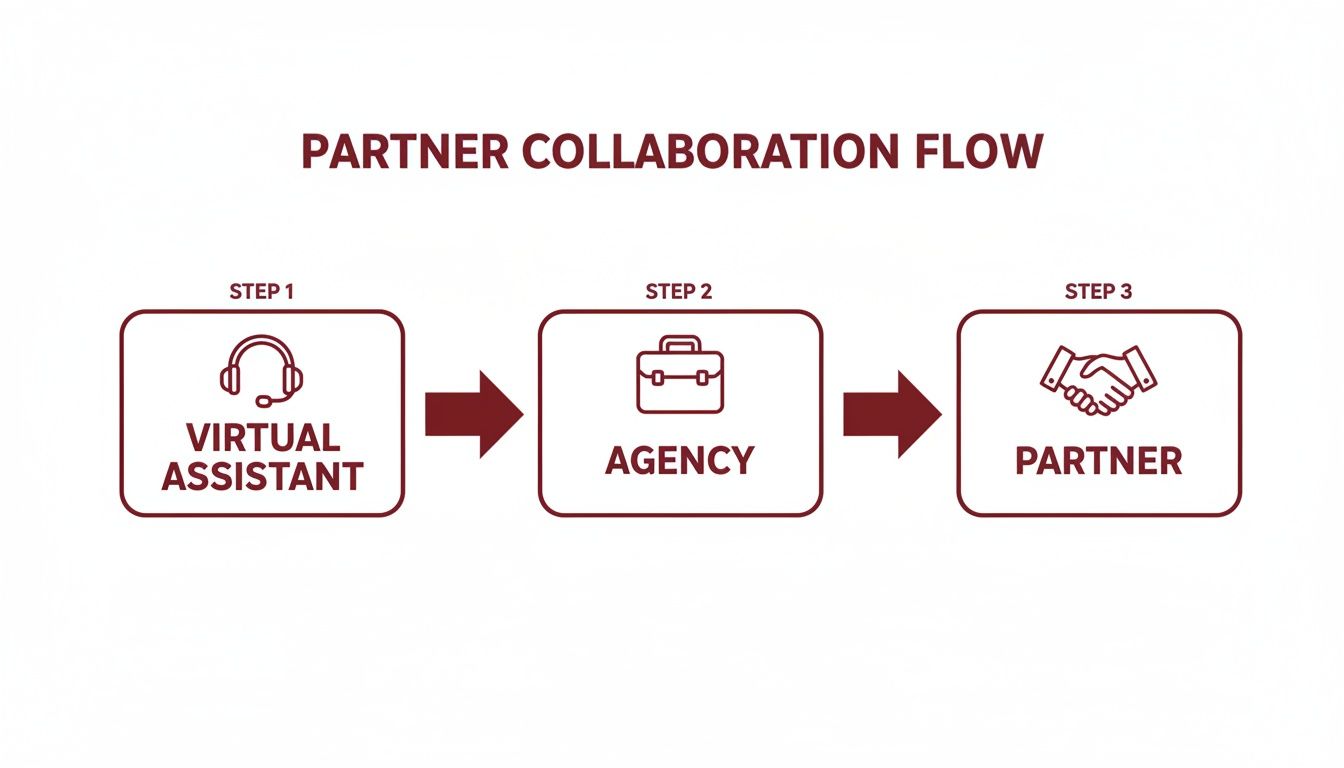
As you can see, a genuine partner relationship is built on deep integration of both strategy and execution, moving far beyond simple task management.
Ask the Tough Questions
Challenging, scenario-based questions will tell you far more about a potential partner’s mindset than any sales deck ever will. Their answers will quickly reveal whether you’re talking to operators who solve problems or marketers who just sell services.
Here are a few 'red flag' questions to ask to test their operational depth:
-
"How do you protect a brand from channel conflict and price erosion when entering a new marketplace?"
A strong partner will immediately talk about disciplined pricing, MAP (Minimum Advertised Price) policy enforcement, and controlling unauthorised third-party sellers. A weak answer will pivot back to just driving sales volume. -
"Describe a time a market entry failed or stalled. What went wrong, and how did you pivot?"
Every experienced operator has faced failure. A transparent partner will be open about what went wrong and share the lessons they learned, showing you they're resilient. Evasion or blaming others is a clear sign of inexperience. -
"Walk me through your process for handling a product compliance issue at the border."
This question directly tests their real-world knowledge of customs, duties, and international regulations. A partner with genuine expertise will describe a clear, structured process involving their customs brokers and regulatory specialists.
A savvy partner will also be proactive about new opportunities. For instance, the recent launch of Amazon Business in Australia has opened a massive door into the A$76 billion B2B e-commerce sector. A strategic partner should be advising their hardware and consumer product brands on how to tap into this channel, which is rapidly replacing old-school procurement.
This vetting process isn’t about finding a perfect partner—it's about finding one with genuine operational expertise and a founder-first mindset.
How to Structure the Partnership for Long-Term Success
Once you’ve found a partner you trust, the work of structuring the relationship for long-term, mutual success begins. A handshake and a vague promise to “grow sales” simply won't cut it on a global platform like Amazon.
Your agreement isn't just a legal formality; it's the operational blueprint for how you and your Amazon expansion partner will function as a single, cohesive team.
Defining a Clear Scope of Work
The foundation of any strong partnership is a precise Scope of Work (SOW). This document needs to go far beyond generic statements like “manage the Amazon account.” Ambiguity is the enemy of accountability, and a vague SOW is where partnerships often begin to fail.
Your SOW should clearly detail who is responsible for every moving part. For example:
- Market Entry Execution: This covers everything from listing creation and translation to the initial keyword research for each new market.
- Logistics and Fulfilment: Who is managing the freight forwarding, customs clearance, and FBA inventory levels in the USA, Canada, or Australia? This must be explicit.
- Marketing and Advertising: Define who runs the PPC campaigns, manages the promotional calendar, and is tasked with optimising your products for organic rank.
- Brand Protection: Lay out the responsibilities for monitoring unauthorised sellers, enforcing MAP policies, and handling customer service enquiries in different time zones.
A well-defined SOW removes guesswork. It creates a clear framework for measuring performance and ensures both sides know exactly what’s expected, preventing disputes down the road.
Choosing the Right Financial Model
The financial structure you choose will directly influence your partner's behaviour. It’s absolutely crucial to pick a model that aligns their incentives with the long-term health of your brand, not just short-term revenue spikes.
The goal isn't to find the cheapest option; it's to find the structure that creates a true win-win scenario, where your partner profits only when your brand genuinely succeeds and grows sustainably.
From a founder’s perspective, here’s how the common models typically play out:
- Pure Retainer: You pay a fixed monthly fee. While this offers predictable costs, it can lead to complacency. The partner gets paid regardless of the results, which is why this model is usually better for short-term, project-based work, not a growth partnership.
- Revenue Share: The partner takes a percentage of sales. This strongly incentivises sales growth, but it can also encourage a "growth at all costs" mindset, leading to aggressive discounting that erodes margins and damages brand value.
- Hybrid Model (Retainer + Revenue Share): This is often the most balanced approach. A modest base retainer covers the partner’s operational costs, while the revenue-share component incentivises real performance. It ensures they are invested in driving results but also have the stability to focus on long-term brand health.
For a true Amazon expansion partnership, a hybrid model almost always provides the best balance of security and motivation.
Setting KPIs That Matter
Finally, your agreement needs to establish Key Performance Indicators (KPIs) that go far beyond top-line revenue. Sales figures are important, but they don't tell the whole story of your brand's health and market position.
Smart brands insist on tracking metrics that reflect sustainable growth. Consider including KPIs like:
- Landed Profit Margin: This tracks true profitability after all costs are factored in—COGS, shipping, duties, Amazon fees, and partner fees.
- Brand Search Volume: Is the number of people searching for your brand name in the new market actually growing? This indicates rising brand awareness.
- Market Share Growth: This measures your product's rank and visibility for key, non-branded keywords against your competitors.
- Review Velocity and Rating: Monitoring the rate and quality of customer reviews is a powerful way to gauge product-market fit and customer satisfaction.
This strategic approach is vital, especially in dominant marketplaces. For instance, with Amazon's projected reach of 60% of Australian shoppers by 2026, simply being on the platform is not enough. As you can discover in this marketplace report, this shift makes a skilled Amazon expansion partner essential. Structuring the partnership around these deeper KPIs ensures your partner is focused on building a durable, profitable brand asset, not just chasing fleeting sales figures.
Navigating Global Logistics and Compliance With a Partner

A great strategy is one thing, but execution is what separates successful global brands from the ones that get stuck. This is where a true Amazon expansion partner proves its worth, turning the overwhelming mess of global logistics and compliance into a competitive edge.
For most founders, this part of international growth causes the most anxiety. It’s a complex world of customs brokers, freight forwarders, international tax law, and product-specific regulations that can quickly derail your focus and drain your capital.
A partner with established infrastructure takes this entire risk off the table. They provide the operational spine that allows your brand to enter markets like the US, Canada, or Australia without the huge overheads and painful learning curve of building an international logistics team from scratch.
Turning Customs and Duties Into a Predictable Process
Every founder’s nightmare is getting a call that thousands of dollars of inventory is stuck at customs because of a documentation error or an unexpected tariff. A genuine expansion partner has deep, hands-on experience navigating the specific customs requirements for each market you’re targeting.
For example, the process of shipping a container from Asia to the US involves a completely different set of HS codes, duties, and import regulations than shipping the same goods to Canada. An experienced partner doesn't guess; they have a proven system.
This system always includes:
- Pre-shipment Audits: Checking that all product classifications and documents are 100% correct before the goods ever leave the factory. This simple step prevents the vast majority of customs delays.
- Landed Cost Calculation: Giving you a clear, all-in cost per unit that covers manufacturing, freight, insurance, duties, and tariffs. This protects your margins and eliminates nasty financial surprises.
- Broker Relationships: Using their long-standing relationships with customs brokers in each country to quickly solve any issues that pop up.
Without this operational expertise, you're gambling with every shipment. A partner turns that gamble into a predictable, repeatable part of your supply chain.
Ensuring Product Compliance Across Borders
What sells perfectly in one country might be illegal to sell in another without major changes. Product compliance is a minefield of local standards that can completely destroy an expansion plan if it isn't managed proactively.
Consider these real-world scenarios:
- Electronics: A consumer electronic device sold in Australia needs different electrical certifications (RCM mark) than one sold in the US (FCC mark) or Europe (CE mark).
- Packaging: Labelling laws are notoriously strict. Canada’s bilingual packaging requirements mean English-only packaging gets rejected at the border. The EU has its own specific rules about material declarations and symbols.
- Health Products: Supplements and wellness products face intense scrutiny from bodies like the TGA in Australia or the FDA in the US, each with unique rules for ingredients and marketing claims.
A partner’s job is to identify these compliance hurdles months in advance, not discover them when your container is being held at the port. They make sure your product is legally ready for sale before a single dollar is spent on shipping.
This proactive compliance work is a non-negotiable part of de-risking your global expansion. If you're looking at the Australian market, our guide on how to sell on Amazon Australia from overseas dives deeper into these local complexities.
Building a Resilient Fulfilment Strategy
An expansion partner doesn’t just get your product into a country; they get it to your customers quickly and efficiently. The best way to do this is by building a resilient fulfilment strategy that primarily uses Amazon's world-class Fulfilment by Amazon (FBA) network.
This isn’t just about sending all your stock to a single FBA warehouse. A sophisticated partner designs a multi-layered strategy, managing inventory across different regions to cut shipping times and costs. This is what keeps your products Prime-eligible—a critical factor for success on the platform.
Amazon’s landmark AU$20 billion investment in Australian data centres from 2026 to 2029 highlights just how much demand there is for robust cloud and logistics capabilities. This creates a perfect environment for partners to help brands scale effectively.
By managing your FBA inventory, handling replenishment, and dealing with returns in the local market, your partner takes care of the entire operational backend. This frees you, the founder, to stay focused on what you do best: building a great product and a powerful brand.
Common Questions About Working with an Expansion Partner
As a founder, bringing on a partner is a huge decision. You’re weighing the risks, the rewards, and what it all means for the brand you’ve built from the ground up. These are the questions that really matter.
What’s the Real Difference Between a Partner and a Distributor?
This is the most important question to get clear on. A distributor simply buys your product and resells it. Their main game is protecting their own margins, and once your stock is in their hands, you lose almost all control over how your brand is priced or presented. This is a fast track to price erosion and a messy brand image.
An Amazon expansion partner, on the other hand, operates as an extension of your own team. We don’t just buy and flip your product; we manage your brand's entire presence in a new country. Our success is tied directly to yours, meaning our incentives are aligned with the long-term health of your brand. Our focus is on protecting your brand equity, keeping your message consistent, and driving growth that is both sustainable and profitable.
How Much Control Do I Keep Over My Brand?
This is a non-negotiable for most founders, and the answer should always be: you keep full strategic control. A genuine partnership is a collaboration, not an abdication of your brand. While your partner handles the daily operational grind—the logistics, compliance, and marketplace management—the big strategic calls are always yours.
You’re still the one setting the brand vision, approving the market entry plan, and defining the pricing guardrails. A partner’s job is to execute that strategy flawlessly, bringing the on-the-ground expertise to make it happen without you getting lost in the operational weeds.
Any good partnership agreement will spell this out clearly, ensuring you never lose control of your brand’s destiny.
What Are the Typical Costs and ROI?
The financial models can vary, but they should always be structured to align everyone’s interests. A true partnership model usually combines a base operational fee with a performance-based element, like a share of revenue.
The base fee covers the essential work like logistics, compliance, and account management. The performance piece is what ensures your partner is just as motivated as you are to grow your sales and profit.
As for Return on Investment (ROI), it’s a mistake to measure it in sales alone. The real value comes from:
- Speed to Market: Launching in a new country in months, not the years it could take to go it alone.
- Risk Mitigation: Avoiding the expensive compliance errors and customs nightmares that can cripple a solo launch.
- Capital Efficiency: You’re using the partner’s existing infrastructure, not burning cash to build your own international team and logistics from scratch.
- Founder Focus: It frees you up to work on product innovation and brand building—the things that only you can do.
How Long Does It Take to See Results in a New Market?
International expansion is a marathon, not a sprint. While we can get you up and selling in a new market surprisingly fast—often within 3-6 months—building a real brand presence takes patience and a strategic approach.
A realistic timeline usually looks something like this:
- Months 1-3 (Setup & Launch): This is all about the groundwork—logistical setup, product compliance checks, creating listings, and getting your first shipment into FBA warehouses.
- Months 4-9 (Traction & Optimisation): Initial sales start to come in. The focus shifts to gathering data, generating those crucial early reviews, and fine-tuning your advertising campaigns. This is where you establish a foothold.
- Months 10-18 (Scaling & Growth): With a solid foundation in place, this is where things get exciting. You start to see significant momentum in sales velocity, organic search rank, and brand awareness.
Any partner promising you explosive, overnight results is probably using short-term tactics that will only hurt your brand in the long run. The right partner will set realistic expectations and focus on building a durable, profitable position in the market.
At TPR Brands, we work with founders navigating these challenges as they expand into international markets. If you’re ready to scale your proven product into a global brand, let's start a brand expansion conversation.