Most advice about how to sell on Amazon focuses on speed. Open the account, upload the catalogue, run ads, and scale quickly.
That approach can generate sales activity, but it often creates operational and strategic problems underneath the surface.
For established brands, Amazon is not just another ecommerce channel. It is a marketplace environment with its own pricing pressure, customer behaviour, fulfilment expectations, and competitive structure. Entering without a clear strategy can weaken margin control, create channel conflict, and reduce a premium product into a price comparison exercise.
The strongest brands approach Amazon differently. They treat it as a structured market-entry system rather than a simple listing destination. That means making deliberate decisions around SKU selection, positioning, pricing architecture, operational readiness, and long-term channel strategy before scaling aggressively.
This guide explains how established brands successfully sell on Amazon while protecting brand value, operational stability, and commercial control.
Why Strong Products Often Fail on Amazon
A strong product in retail or DTC often underperforms on Amazon for one reason: the brand enters with the wrong assumption. Success elsewhere proves there is product-market fit. It does not prove there is marketplace-market fit.
Amazon compresses decision-making. Buyers don’t move through your homepage, your founder story, or your trade presentation. They search, compare, scan images, read reviews, check delivery speed, and decide whether your offer feels safer than the next one. If your product needs context to justify its value, Amazon can strip that context away unless you rebuild it for the platform.
Amazon Rewards Clarity, Not Reputation
Established brands often believe their existing reputation will carry over. On Amazon, reputation has to become visible in a few seconds. Packaging, certification cues, listing structure, image sequence, and review profile matter more than the internal confidence your team already has in the product.
That’s where many premium brands stumble. They publish listings that sound like brochures and look like trade sheets. The product may be good, but the page doesn’t reduce risk for the buyer.
Your product isn’t competing only against direct substitutes. It’s competing against every listing that makes the buying decision feel easier.
A marketplace buyer also behaves differently from a retail buyer. The same customer who happily pays a premium in-store may hesitate online if the listing doesn’t make the difference obvious. That creates pressure to discount, bundle awkwardly, or chase ad spend before the fundamentals are fixed.
The Hidden Cost of a Weak Launch
A poor Amazon launch doesn’t just create slow sales. It can reposition your product in a way that is hard to reverse.
Common patterns look like this:
- Price-first competition means the listing wins only when it’s discounted.
- Brand dilution happens when premium cues disappear and the product looks interchangeable.
- Review drag starts when early buyers arrive with the wrong expectations because the listing framed the offer badly.
- Channel friction begins when retail or distributor partners see Amazon undercutting their shelf price.
Founders usually notice the financial symptoms first. The strategic damage comes slightly later. Internal teams then start asking whether Amazon “works” for the brand, when the better question is whether the brand entered Amazon with a marketplace strategy at all.
Strong Products Also Fail for Operational Reasons
Even before scale, Amazon exposes weak planning. Catalogue sprawl, poor SKU discipline, inconsistent supply, and unclear ownership across marketing, operations, and finance all show up quickly.
Practical rule: Don’t treat Amazon as a listing exercise. Treat it as a controlled market launch with brand, margin, and compliance implications.
Brands that do well on Amazon usually make one decision early. They stop asking how to copy their existing channel strategy onto the platform and start asking how the platform changes the rules.
Your First Strategic Filter Market Assessment
Amazon rewards fit long before it rewards effort. Established brands get into trouble when they treat market entry as an execution problem, then discover the offer was wrong for the channel in the first place.

The first filter is simple. Decide whether a marketplace deserves the product, not whether the product can technically be listed there.
That distinction matters more for established brands than for first-time sellers. A founder can absorb a failed test on a minor SKU. It is harder to unwind price compression, weak reviews, and channel tension once Amazon becomes the reference price in the market.
Start with the sub-niche, not the category
Category-level demand is too blunt to guide a launch. “Home improvement” does not tell you whether buyers will pay for your version of the product. “Garden tools” is only slightly better. The strategic question is narrower. Which use case gives your product a right to exist on Amazon without forcing it into commodity behavior?
On Amazon AU, that usually means looking for sub-niches where buyer intent is specific, review depth is still manageable, and the page is not filled with near-identical imports. In hardware-related pockets, for example, operators often find demand concentrated around practical constraints such as fire resistance, durability, or sustainability. Those are better entry points for an established brand because the premium can be explained quickly, and defended.
The opportunity is not “Australia is less crowded.” That is too simplistic. Instead, the advantage is that some AU sub-categories still let a brand enter around a clear problem-solution fit instead of pure price comparison.
A useful go or no-go framework
Run the assessment through four filters.
-
Search intent fit
Check whether Amazon shoppers already use the language that matches the problem your product solves. If the value proposition needs a long educational sequence, conversion will be harder and ad costs will rise faster than expected. -
Competitive density
Count offers, then examine who owns the page. Ten credible brands with strong review history can be harder to displace than fifty weak sellers. The reverse is also true. A page full of generic offers may look attractive until price erosion starts. -
Margin tolerance
Model the economics after fees, ad spend, returns, and any channel protections you need to preserve elsewhere. If the SKU only works when everything goes right, it is not launch-ready. -
Brand coherence
Ask whether the product still feels like your brand inside Amazon’s constraints. Some SKUs carry premium positioning well. Others lose too much context and end up looking interchangeable.
A serious market review should end with portfolio decisions. Which SKUs can enter without harming pricing discipline? Which ones should stay out until packaging, claims, or bundle structure are reworked? Which products belong in retail or DTC only?
What to inspect in practice
Use Amazon-specific tools such as Jungle Scout AU or Helium 10 to validate movement at the sub-category level. A useful early screen in Australia is straightforward: enough monthly sales activity to prove demand, a competitor set small enough to leave room for entry, and category rank patterns that suggest consistent turnover rather than one-off spikes.
Those thresholds are filters, not forecasts. Their value is practical. They stop teams from building a launch plan in a segment where the economics already depend on aggressive discounting or unusually high ad efficiency.
A simple working table keeps the review grounded.
| Assessment area | Good sign | Warning sign |
|---|---|---|
| Search demand | Buyers already search for the use case your product solves | Demand is broad but generic |
| Competitor offers | Few credible FBA competitors in a focused sub-niche | Pages dominated by lookalike offers |
| Pricing posture | Premium can be justified quickly | Price gap needs long explanation |
| Strategic role | Amazon supports expansion or discovery | Amazon would cannibalise stronger channels |
After the initial scan, go past the keyword tools. Read review complaints on adjacent products. Check where incumbents are overselling, under-explaining, or ignoring a buyer objection you already solve. That is often where a strong brand finds its real opening.
A short overview of marketplace thinking can help frame this stage before the team commits further:
Why established brands should test narrowly
A broad launch feels ambitious. In practice, it often muddies the signal.
A narrower entry produces better information and limits downside. Start with one hero SKU that represents the brand clearly. Keep variants out if they create price confusion. Watch search terms, review language, and return reasons before expanding. Choose products that will not trigger avoidable channel conflict on day one.
Experienced operators separate curiosity from strategy. The question is not whether Amazon can carry the product. The question is whether this product should enter this marketplace, at this price point, under these operating conditions.
Adapting Brand Positioning for the Marketplace
A brand can be well positioned and still badly presented on Amazon. That’s common. Teams often copy DTC copy into a marketplace listing and wonder why the page feels flat.
Amazon doesn’t erase brand positioning. It forces compression. Your job is to translate the brand into a format that works when the buyer is comparing options side by side and making a decision in seconds.

Your DTC language is usually too slow
On your own site, you can lead with philosophy, origin, design ethos, or community. On Amazon, the buyer first wants certainty.
They want to know:
- what the product is
- why it’s better
- whether it fits their use case
- whether they can trust the claim
- whether the price feels justified
That means messaging has to become more direct without becoming generic. Premium brands often fear this step because they think simplification equals cheapening. It doesn’t. Poor translation is what cheapens a brand.
Rebuild the value proposition for search and comparison
A useful way to rework positioning is to break it into three layers.
Functional proof
Most categories are won or lost in the listing itself. The listing needs specific, scannable reasons to believe. Material quality, compatibility, durability, safety, and compliance cues belong here. If the product has a real differentiator, state it in the plainest useful language.
Outcome language
Features matter, but buyers convert on outcomes. “Designed for dry conditions” is weaker than language that clearly connects to the use case. A founder’s internal vocabulary often needs rewriting here because marketplace buyers don’t read like distributors.
Brand reinforcement
A+ content, secondary images, and a disciplined visual system matter. Brand doesn’t disappear on Amazon. It just moves down the decision stack. Once the buyer sees relevance and proof, the brand identity helps justify preference.
If your listing only says “premium”, Amazon will force you to compete with products that say the same thing for less.
What strong marketplace positioning looks like
Compare two versions of the same brand logic.
| Weak translation | Strong translation |
|---|---|
| “Innovative craftsmanship for modern living” | “Corrosion-resistant hardware designed for long-term outdoor use” |
| “Sustainably inspired design” | “Eco-sourced materials with clear compliance and care information” |
| “Built for discerning households” | “Fast to install, easy to maintain, and suited to repeated daily use” |
The second column isn’t less premium. It’s more usable in a search-led marketplace.
Visuals do more of the selling than many teams expect
Founders often over-focus on copy and under-invest in visual hierarchy. On Amazon, images have to answer objections before the buyer scrolls.
That usually means the image sequence should do distinct jobs:
- Main image earns the click with clarity
- Secondary images show scale, components, and practical use
- Comparison or explainer images reduce confusion
- Brand images reinforce quality and positioning once trust is established
The listing should feel organised, not decorative. Every image needs a role. If a visual doesn’t remove friction or strengthen belief, it’s taking up space.
Protect the brand by tightening the promise
Established brands often try to say too much because they’re proud of the full story. That can blur the core promise. On Amazon, restraint usually performs better.
The strongest marketplace brands don’t tell their whole story at once. They tell the part that earns the next click, the next scroll, and the next purchase.
This is also where many teams make the wrong premium move. They avoid direct comparison language because it feels inelegant. But buyers are already comparing. If your listing doesn’t help them do it, they’ll use price as the shortcut.
A strong Amazon page still feels like your brand. It speaks in marketplace logic first. That protects equity better than forcing your retail or DTC language into a context where buyers won’t process it the same way.
The Non-Negotiable Operational and Compliance Setup
Brands rarely lose on Amazon because the product is weak. They lose because the operating model was built for wholesale or DTC, then forced into a marketplace that demands tighter proof, cleaner data, and faster decisions.
That gap gets expensive fast. A listing can look polished and still fail if the account structure is wrong, product documents are incomplete, or replenishment logic breaks under Amazon’s stock expectations.
Compliance is a growth constraint
Established brands often assume their current packaging, testing, or trade paperwork will carry across to Amazon with minor edits. In practice, Amazon asks for product-level evidence in a format and timeframe many retail partners never required.
That pressure is sharper in regulated categories. For Australian hardware and household products, ACCC product safety rules, import documentation, and claim substantiation can determine whether a listing stays live at all. Amazon has also increased scrutiny on imported goods and category compliance in Australia, which raises the risk of suppressed listings, document requests, and account disruption if the setup is loose.
A suspension is not an admin problem. It interrupts inventory flow, stalls ad performance, creates cash drag, and often shakes internal confidence right when the channel needs disciplined follow-through.
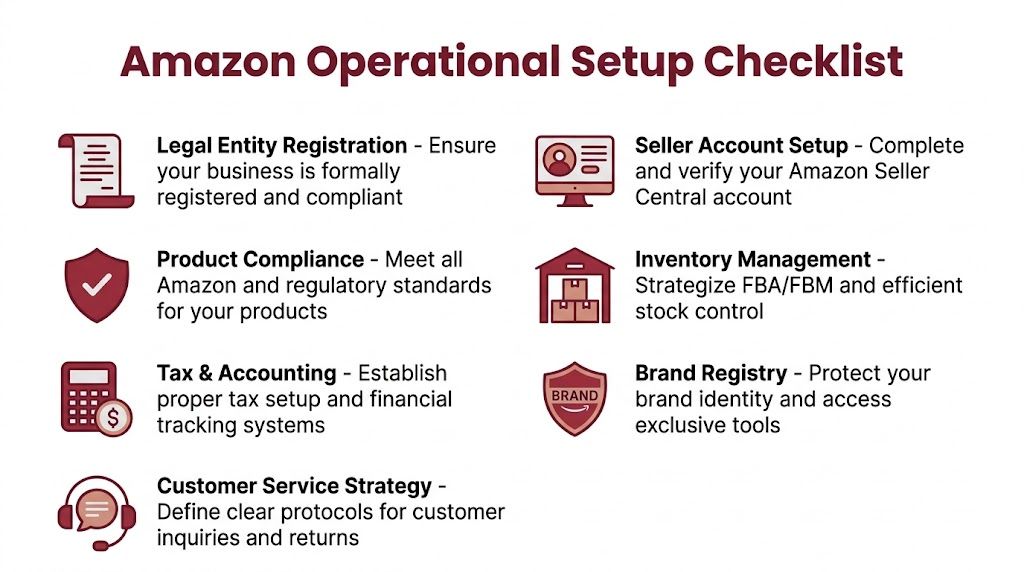
What an operationally ready brand checks first
A useful audit starts with the areas that create the most downstream friction.
-
Entity and account structure
Seller account ownership, legal entity details, banking, and tax settings need to match the commercial structure of the business. If they do not, verification delays and account risk follow. -
Product documentation
Gather certifications, test reports, safety data, manuals, and support for every product claim before listings go live. Waiting for an Amazon request is late. -
Catalogue discipline
Titles, pack counts, identifiers, dimensions, and attribute data should match across internal systems. Small catalogue inconsistencies create listing errors, receiving issues, and customer confusion. -
Fulfilment design
Decide which SKUs belong in FBA, which should stay merchant fulfilled, and which should be held back until the operation is simpler. Amazon rewards reliability more than ambition. -
Returns handling
Returns need clear rules for inspection, resale, disposal, and customer response times. DTC returns logic often breaks on Amazon because the volume, timing, and fault patterns are different. -
Brand protection
Brand Registry and listing monitoring matter because control of content, unauthorised sellers, and variation structures affects both brand perception and operating stability. -
Ownership inside the business
Amazon needs named decision-makers across compliance, stock, customer service, and content. Shared responsibility usually becomes delayed responsibility.
Setup should follow channel intent
If Amazon is a market-entry vehicle for selective growth, the operating model should reflect that. Launching fewer SKUs, limiting regions, and holding back complex products is often the right strategic choice for an established brand protecting margin and channel relationships.
Here is the practical version:
| Operational choice | Better when | Risk if ignored |
|---|---|---|
| Narrow initial SKU range | You need cleaner forecasting and faster issue resolution | Inventory gets fragmented across too many products |
| Documentation prepared upfront | The category has safety or compliance exposure | Listings are suppressed or suspended during launch |
| Clear replenishment logic | Lead times and inbound planning matter | Stockouts, storage issues, and higher fees follow |
| Defined account ownership | Several teams influence the channel | Problems sit unresolved between departments |
The trade-off is straightforward. A broader launch can create more early revenue opportunities, but it also multiplies compliance exposure, operational noise, and catalogue errors. For most established brands, control beats range in the first phase.
The supply chain question founders often miss
Amazon exposes supply chain weakness faster than almost any other channel. If replenishment is unstable, the damage shows up in rank volatility, inefficient ad spend, lower conversion, and a worse customer experience.
I have seen brands blame the marketplace when the underlying issue was inbound planning. Carton configuration was wrong. Lead times were too optimistic. Reorder triggers were built for wholesale cycles, not for a channel that reacts quickly to stock gaps.
That is why mature brands treat Amazon more like a new distribution environment than a simple listing exercise. Inbound shipment timing, carton planning, prep requirements, inventory buffers, and release logic should be set before launch, not fixed under pressure later.
Some teams build that capability internally. Others bring in specialist support for setup, fulfilment planning, and channel execution. For brands assessing that route, TPR Brands’ Amazon selling support shows the scope of work involved in structured marketplace expansion.
Compliance failure usually starts with a team assuming its current systems are close enough for Amazon.
Build the checklist before you build the forecast
Forecasting matters. Operational readiness comes first.
The better order is:
- lock the legal and account structure
- validate product compliance and category requirements
- standardise catalogue and operational data
- map fulfilment and replenishment logic
- assign internal owners
- then build the launch model
This sequence feels slower at the start. It usually shortens the path to stable growth because it removes the failure points that derail established brands once inventory lands and demand arrives.
Crafting Your Pricing and Margin Strategy
Amazon does not forgive lazy pricing.
Established brands rarely fail here because demand is absent. They fail because the unit economics were copied from DTC or wholesale, then forced into a marketplace with different fees, different customer expectations, and far less control over price visibility. The result is predictable. Sales come through, margin thins out, retail partners complain, and the team starts using discounts to cover a strategy problem.

Start with contribution margin, not top-line optimism
Amazon pricing has to be built from the bottom up. Referral fees, fulfilment fees, storage, returns exposure, advertising, promo mechanics, and GST all affect what a sale is worth. If finance signs off on a list price before those inputs are modelled, the brand is guessing.
For established businesses, the primary question is not whether a SKU can sell. It is whether that SKU can sell on Amazon without damaging portfolio profitability or forcing compromises in other channels.
That means every launch SKU needs a channel-specific margin view. Not a blended business margin. Not a hopeful first-order model. A real one.
Teams that need a clearer cost baseline often start with a breakdown of Amazon fees and margin inputs before they decide which products can carry the channel.
Give each SKU a job
A common mistake is treating Amazon like a digital shelf where every item should follow the same pricing logic. Strong brands do the opposite. They assign each SKU a role, then price according to what that role needs to achieve.
| SKU role | Pricing posture | Strategic aim |
|---|---|---|
| Discovery product | Competitive, with controlled downside | Win new-to-brand customers without resetting price expectations across the range |
| Margin anchor | Premium, defended with clear value cues | Protect contribution and signal brand strength |
| International test SKU | Priced around operational fit and manageable risk | Learn demand and compliance friction before expanding the assortment |
Channel conflict often starts inside the catalogue. If every product is priced to maximise short-term conversion, Amazon begins to dictate the brand’s price architecture instead of supporting it.
Discounting usually hides a weaker decision upstream
A lower price can lift conversion. It can also hide the actual problem.
In practice, poor conversion on Amazon often comes from weak positioning, unclear pack logic, low-trust imagery, or a product that does not fit marketplace demand as well as the team expected. Cutting price before checking those variables trains customers to wait for deals and gives away margin that is hard to recover later.
I usually treat heavy discount dependence as a warning sign. If the page cannot justify the price, or the SKU cannot hold its margin without constant promo support, the brand should fix the offer or reconsider the product selection.
If volume only appears after price cuts, the problem is rarely price alone.
Premium products can work on Amazon. They just need their premium to be obvious in the first three seconds. Main image, title clarity, pack count, claims hierarchy, and review profile all shape whether a higher price feels justified.
Test with enough stock to learn, not enough to create a problem
Small launch quantities are not a sign of caution. They are a sign that the business understands risk.
A measured first inbound lets the team test conversion, returns patterns, fee impact, content quality, and ad efficiency before larger commitments are made. That matters more for established brands than for early-stage sellers because the downside is larger. Excess stock ties up cash. Underperforming price points create internal pressure. A rushed correction can spill into retail or distributor conversations.
The goal of early pricing tests is simple. Find out whether the product can hold its price while still generating acceptable contribution after fees and media.
Protect the wider business while you use Amazon properly
The strongest Amazon pricing strategy is usually selective. It does not mirror the whole wholesale catalogue, and it does not try to win every comparison shopper.
Practical ways to reduce channel friction include:
- using channel-specific bundles or pack sizes
- holding back hero retail SKUs until Amazon proves its role
- choosing products with strong search demand and lower in-store dependency
- avoiding direct price collisions with key wholesale lines
- setting promo rules before the first launch, not after complaints arrive
Good brands do not ask how low they need to go. They decide which products deserve Amazon, what margin floor protects the business, and how price should support brand position rather than erode it.
That is the difference between selling on Amazon and entering Amazon with intent.
Common Mistakes Brands Make When Selling on Amazon
Many established brands struggle on Amazon for predictable reasons. The issue is rarely product quality. Most failures come from weak marketplace adaptation and poor operational structure.
One common mistake is launching too many SKUs at once. Large catalogues create inventory complexity, inconsistent positioning, and inefficient advertising spend before the business understands which products truly fit the marketplace.
Another issue is copying retail or DTC positioning directly into Amazon listings. Marketplace buyers behave differently. They compare quickly, scan visually, and expect immediate clarity around value, compatibility, and trust.
Pricing mistakes are also common. Brands often underestimate fees, returns exposure, storage costs, and advertising pressure. Revenue may grow while contribution margin quietly deteriorates underneath.
Operational readiness is another major weakness. Catalogue inconsistency, weak replenishment systems, unclear ownership, and incomplete compliance documentation can destabilise growth very quickly once inventory scales.
The strongest brands avoid these problems by treating Amazon as a controlled commercial system rather than a simple ecommerce channel.
The Strategic Path to Launch and Global Scale
Two brands can enter Amazon with equally strong products and get very different outcomes.
The first brand launches fast. It lists a broad catalogue, copies over existing copy, prices close to competitors, sends stock in, and starts advertising. Early sales come through, which feels encouraging. Then the friction begins. Some SKUs don’t convert cleanly. Internal teams argue about pricing. Inventory planning gets messy. Expansion into a second marketplace feels possible in theory but operationally heavy in practice.
The second brand moves slower at the start and faster later. It enters with a narrower range, a clear role for each SKU, a marketplace-adapted value proposition, cleaner operations, and a launch plan tied to specific learning goals. It doesn’t avoid every problem. It avoids the expensive ones.
What a disciplined launch actually looks like
A serious launch tends to follow a sequence, even if the exact timing varies.
First phase
The brand chooses a limited product set with strong fit for search demand, clear differentiation, and manageable fulfilment. Listings are built for marketplace behaviour, not copied from retail material.
Second phase
Inventory is introduced in a controlled way. The team monitors whether traffic quality, conversion behaviour, and customer questions match the original market thesis.
Third phase
Advertising supports discovery, but only after the page is ready to convert. The goal is not to buy artificial momentum. It is to generate enough signal to judge whether the offer deserves scale.
A healthy launch creates information. An unhealthy launch creates activity.
That distinction matters for founders because busy dashboards can hide weak strategy. Traffic, impressions, and ad spend may rise while the underlying economics remain fragile.
The wall most brands hit
Brands that build Amazon alone often reach the same plateau. The first marketplace becomes operationally manageable, but the next step into another region exposes everything that was loosely held together.
Common bottlenecks include:
- Country-specific compliance that was never built into product documentation
- Inventory complexity across multiple fulfilment networks
- Inconsistent positioning as listings get adapted by different people
- Slow decision-making because no one owns expansion end to end
Founders sometimes make the wrong conclusion. They assume the brand has “maxed out” Amazon, when the actual issue is that the operating model wasn’t built for international scale.
Global expansion changes the build versus partner decision
There is a point where doing everything in-house stops being the most strategic option. That point arrives sooner when the brand is entering new geographies, regulated categories, or operationally demanding marketplaces.
The decision to partner isn’t a sign that the team can’t do it. It’s a capital allocation choice. Build capability where it creates long-term advantage. Partner where specialised infrastructure, local knowledge, and channel execution reduce time, risk, or complexity.
For founders thinking beyond one marketplace, the more useful question is not “Can we do this ourselves?” It’s “Should our core team be the one building every moving part?”
A partner can make sense when you need:
- faster market adaptation without rebuilding internal teams
- local operational knowledge in new regions
- tighter control over compliance and fulfilment handoffs
- clearer separation between strategic oversight and daily marketplace execution
That’s especially relevant when Amazon is one piece of a broader international channel strategy rather than the entire growth plan. A branded Amazon Store approach can support that broader strategy, but only if the underlying operations and positioning are already aligned.
Final Thoughts on Selling on Amazon
The biggest mistake established brands make on Amazon is treating the marketplace like a simple extension of existing retail or ecommerce channels.
Amazon changes how products are compared, how pricing is evaluated, how fulfilment performs, and how quickly operational weaknesses become visible. Success usually comes from disciplined execution rather than aggressive expansion speed.
The brands that scale successfully tend to launch narrower, localise more carefully, protect pricing discipline, and build stronger operational systems before expanding aggressively across marketplaces or regions.
Amazon can become a highly effective growth channel when it strengthens broader commercial capability instead of weakening it. It can improve market visibility, sharpen operational discipline, validate international demand, and support wider expansion into retail, distribution, and direct-to-consumer channels.
At TPR Brands, we work with established product businesses navigating Amazon growth across complex marketplace and international environments. Our focus is helping brands improve positioning, marketplace readiness, operational structure, compliance, and scalable expansion planning before growth becomes unnecessarily expensive.
If your business is evaluating how to sell on Amazon more strategically, the strength of the operating model underneath the launch will usually matter far more than the speed of entry.