Most advice on Amazon expansion starts in the wrong place. It starts with listings, ads, keywords, and launch mechanics. For established brands, that's rarely where control is won or lost.
The core decision sits upstream. Amazon is not just another channel. It's an ecosystem with its own pricing gravity, catalogue logic, seller incentives, and fulfilment pressures. If you enter it casually, the platform will organise your brand for you. Usually in ways you won't like.
That's why the better question isn't how to expand your product to amazon without losing control. It's how to build a channel structure that can absorb Amazon's scale without letting it distort your wider business. Founders who get this right treat Amazon as a controlled operating environment. Founders who get it wrong often discover that marketplace growth can come with weaker margin discipline, catalogue sprawl, channel conflict, and avoidable strain across retail accounts.
The Amazon Paradox Controlling Growth on a Platform Built for Scale
Amazon does not protect premium positioning for you. It rewards the offer that is available, competitively priced, easy to ship, and easy to compare. That logic can grow revenue quickly while weakening the commercial controls that made the brand valuable in the first place.
That is the paradox.
Brands rarely lose control on Amazon because the product lacks demand. They lose it because the business treats Amazon as a sales opportunity before defining it as a governed channel. Price gets handled after launch. Catalogue decisions get made SKU by SKU. Inventory enters the market before anyone has set the rules on who can sell, who can bundle, and what happens when a second seller appears. If that risk is already on your radar, this guide on managing Amazon multiple sellers without losing brand control is worth reviewing early.

Why simple expansion advice creates complex problems
“Just get on Amazon” is usually advice from people who do not carry the downstream cost.
For an established brand, Amazon is not a simple add-on. It changes how price is seen, how product data is managed, how stock flows across channels, and how quickly small inconsistencies become public. A listing issue on your own site is a contained problem. A listing issue on Amazon can affect search visibility, conversion, reseller behaviour, and retail relationships at the same time.
The commercial risks show up fast:
- Pricing discipline weakens first. If nobody owns channel rules, Amazon becomes the place where the product is compared hardest and defended least.
- Assortment expands without a reason. Teams launch too many SKUs, packs, or variations before they know which range deserves marketplace distribution.
- Operational friction spreads. Returns, support expectations, replenishment cycles, and content changes start running on a different cadence from the rest of the business.
- Channel conflict stops being theoretical. Wholesale accounts and distributors react quickly when Amazon carries stock, pricing, or bundles that change the economics of the wider account base.
A founder should read early marketplace traction with caution. Sales can rise while control is falling.
Control starts before the first ASIN goes live
The strongest Amazon entries usually look slower at the start. They are not slower. They are better structured.
In Australia, that still matters. Amazon.com.au remains less mature than older Amazon markets, which gives disciplined operators more room to establish clean foundations before bad habits harden into channel problems. The advantage is not timing alone. It is the ability to set rules before the catalogue fragments, before discounting becomes routine, and before internal teams start treating Amazon exceptions as normal operating practice.
The brands that keep control make a few decisions earlier than everyone else. They define Amazon's role in the channel mix. They choose which products belong there and which do not. They assign clear authority over listings, pricing, inventory, and seller access. They treat launch as a channel architecture decision with legal and operational consequences, not a race to push ASINs live.
That approach can feel restrictive. In practice, it preserves margin, protects other channels, and gives the business room to grow on Amazon without letting Amazon reorganise the business around itself.
Defining Your Channel Architecture and Contractual Guardrails
Control on Amazon is largely determined before a customer ever sees the listing. It's built into your channel architecture, meaning who sells, who holds inventory, who controls presentation, and who can change price or assortment without asking permission.
Founders often frame the decision as a platform choice. It's closer to a governance choice.
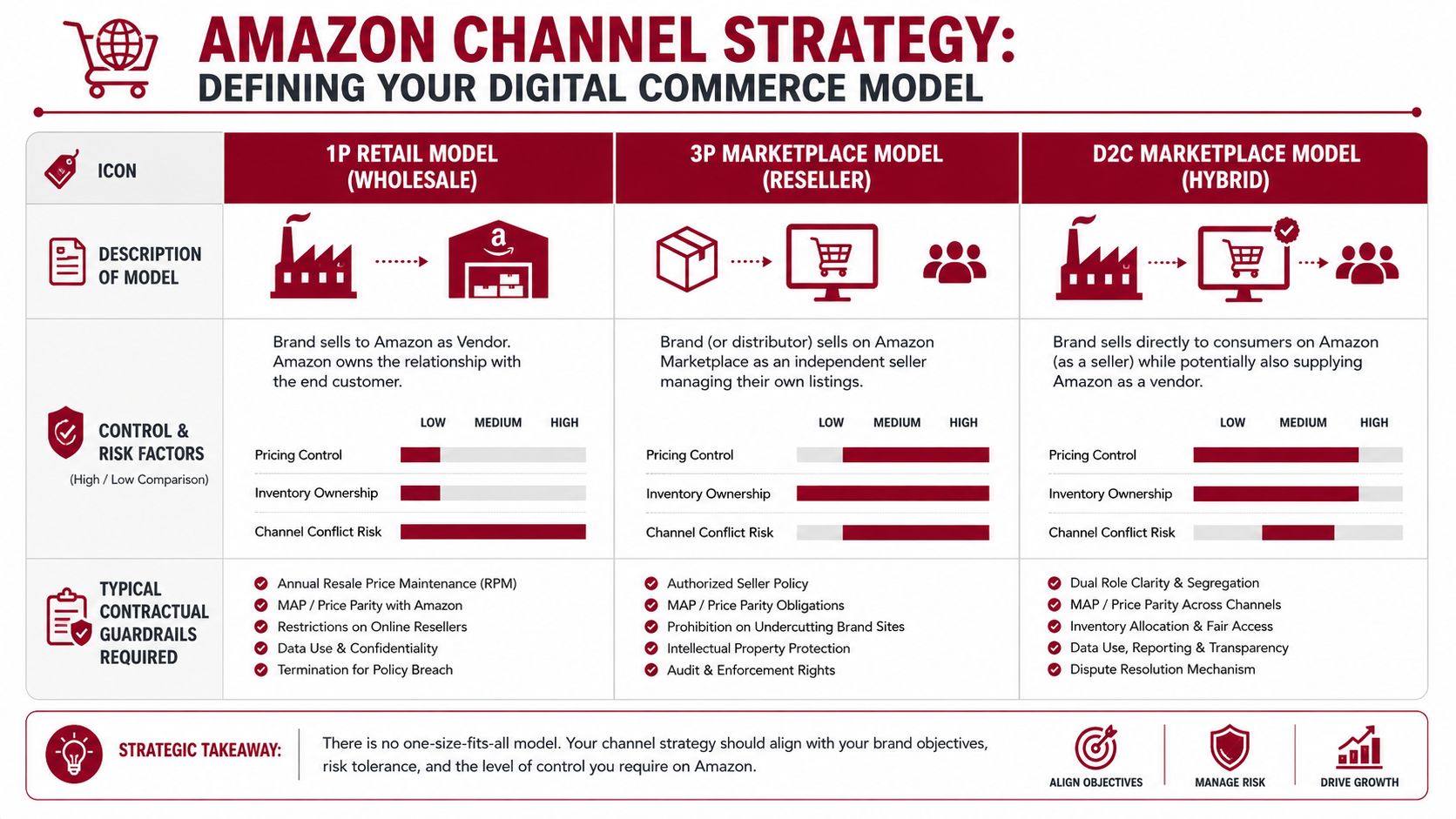
The control trade off across 1P 3P and hybrid
A founder deciding between Vendor Central, Seller Central, or a hybrid model shouldn't ask which one is most popular. The better question is which structure leaves the business with enough negotiating power when things go wrong.
| Model | What it usually gives you | What it usually takes away |
|---|---|---|
| 1P retail | Simpler wholesale-style relationship and operational familiarity for some teams | Less pricing control, less direct control over retail execution, and reduced leverage once Amazon becomes the retailer |
| 3P marketplace | Greater control over listings, assortment, and channel pacing | More operational responsibility, more governance work, and more need for internal discipline |
| Hybrid | Flexibility to split roles across products or markets | More complexity, more risk of internal confusion, and more need for very clear channel rules |
The common mistake is assuming 1P is safer because it feels familiar. It can be simpler administratively, but simplicity and control aren't the same thing. If Amazon is buying inventory as the retailer, you've handed over a meaningful share of your downstream control at the exact point your brand becomes most visible.
A 3P structure often gives established brands the cleaner control model, especially when the business already cares about margin architecture, presentation, and selective distribution. But 3P only works when the operator is disciplined. If no one owns standards, 3P becomes a different route to the same disorder.
For brands dealing with overlapping seller activity, the risks become clearer when you look at how multiple Amazon sellers can affect brand control.
Contracts need to do more than appoint a seller
A dedicated marketplace partner can work well. An undisciplined reseller arrangement usually doesn't. If a brand uses an exclusive 3P operator, the contract needs to protect governance, not just volume.
The strongest agreements usually define things like:
- Price conduct expectations. If your wider business relies on price integrity, the agreement should reflect that instead of hoping marketplace behaviour will stay aligned.
- Content control rights. Listings, images, brand copy, bundles, and variation strategy shouldn't be changed casually.
- Audit access. You need the right to inspect performance, compliance, and execution standards.
- Inventory rules. The seller shouldn't be free to chase volume by loading in assortment that creates downstream instability.
- Termination conditions. If the partner breaks channel rules, the exit path must be clear enough to enforce.
Poor Amazon structures usually don't fail because the initial launch was weak. They fail because no one defined what the operator was allowed to optimise, and what had to remain protected.
Choose leverage over convenience
Founders often prefer the route that gets them live fastest. That instinct is understandable, but speed creates fragility when the wrong party controls price, content, and stock decisions. The launch phase should preserve optionality. You want the ability to tighten, pause, narrow, or redirect the channel without untangling a loose network of sellers and conflicting incentives.
That's what good architecture does. It doesn't chase reach. It preserves control.
Building Your Digital Moat with Brand Registry and IP Protection
Control on Amazon is established twice. First in your channel model, then inside Amazon's own systems. Brands that miss the second step often discover that legal ownership of a trademark and practical control of a catalogue are not the same thing.
On Amazon, authority has to be operationalised. If it is not, other sellers, weak listing edits, and poor content hygiene can reshape how the brand appears to customers long before anyone internally treats it as a serious problem.

Brand Registry changes your position, not just your tooling
Brand Registry matters because it gives the brand a recognised standing in Amazon's ecosystem. That affects who can influence listing content, how quickly issues can be challenged, and how much confidence the business can have that the catalogue will still reflect its actual proposition six months from now.
The immediate benefit is practical. Better control over product detail pages, branded content, and infringement reporting reduces the chance that the offer gets rewritten by sellers whose incentives are short term. The longer-term benefit is strategic. It is easier to protect pricing logic, premium positioning, and portfolio structure when the brand has formal platform status rather than relying on informal workarounds.
Founders who want to understand the operational implications of Amazon Brand Registry for brand control and protection should treat it as part of channel governance, not a marketing add-on.
Small catalogue changes create larger commercial problems
Amazon listings rarely degrade in one obvious event. The pattern is usually incremental. A title is rewritten for clicks rather than clarity. Images lose consistency. Variations are attached loosely. An unauthorised seller joins an ASIN and the page starts serving whoever is trying to win the Buy Box fastest.
Those changes affect more than presentation. They can weaken conversion quality, blur product differentiation, create avoidable customer confusion, and push a brand into price-led competition. Premium brands feel this first because they depend on message discipline. Mass brands feel it later, usually when catalogue clean-up becomes expensive and politically messy.
Protection needs a managed system
IP protection works when ownership, workflow, and accountability are tied together. Trademark coverage should match how the brand will appear on Amazon. Content standards should be documented. Escalation rules should be clear before a seller dispute or infringement claim appears.
A workable operating structure usually includes:
- Brand Registry set up correctly so Amazon recognises the brand owner's authority
- Trademark alignment between legal registrations, packaging, and listing presentation
- Central control of A+ Content, images, and copy so the catalogue reflects the brand rather than seller improvisation
- A defined response path for hijacks, inaccurate edits, and infringement issues so problems are handled quickly and consistently
- Regular review of seller activity and listing changes so the team catches drift early
A short visual explainer can help clarify how Amazon frames some of these tools in practice.
The moat is legal, operational, and economic
IP protection is often framed too narrowly. Counterfeits matter, but so does commoditisation. Once the product page becomes inconsistent or contested, the offer starts to lose the signals that justify its margin. At that point, Amazon does what it is designed to do. It rewards availability, price competitiveness, and conversion efficiency.
That is why strong brands build a moat from several layers at once. Formal IP rights establish ownership. Brand Registry gives that ownership platform expression. Internal governance keeps content, seller access, and enforcement decisions consistent. Together, those layers do not remove risk. They reduce the number of ways control can leak out of the business.
Ensuring Catalogue Integrity with a Cohesive GTIN Strategy
Marketplace fragmentation often starts inside the catalogue long before it shows up in reported performance. A brand thinks it has a sales problem, an ad problem, or a conversion problem. Often it has a structure problem. The catalogue has been allowed to multiply in ways that make the business harder to manage and easier to dilute.
Proper GTIN discipline matters at this stage. GS1 Australia notes that GTINs are the standard identifiers for distinguishing product variants, and that becomes critically important once a brand begins expanding its assortment across retail and online channels, as reflected in this analysis of Amazon multi-product strategy.
The catalogue usually breaks before the brand realises it
One issue we repeatedly observe is quiet SKU sprawl. A team adds near-duplicate products, inconsistent packs, or poorly distinguished variants because each addition feels commercially harmless on its own. Over time, that creates overlapping offers that compete with one another.
The technical failure is straightforward. SKU proliferation without a portfolio structure leads sellers to create overlapping products that can cannibalise search rank and ad performance, while operations teams lose visibility. That isn't just a listing clean-up issue. It affects forecasting, replenishment, margin interpretation, and internal reporting.
A weak catalogue usually creates these symptoms:
- Variant confusion where colour, size, or pack-count relationships are set up inconsistently.
- Duplicate value propositions where multiple ASINs answer the same customer need with no real portfolio logic.
- Split commercial signals where reviews, traffic, and demand history scatter across listings that should have been consolidated.
- Fulfilment complexity where operations teams carry too many low-clarity lines that are hard to forecast confidently.
Use portfolio logic before product logic
The strongest operators don't ask, “Can we launch this SKU?” first. They ask where it sits inside the portfolio, what it protects, and whether it strengthens the existing demand structure. That's a more useful question because Amazon magnifies weak catalogue logic very quickly.
A practical way to think about it is this:
| Catalogue choice | Likely effect |
|---|---|
| Add tightly related variations | Supports clarity, keeps customer choice organised, and can preserve demand concentration |
| Create bundles with a clear use case | Can lift basket value while staying close to existing fulfilment and demand patterns |
| Launch unrelated products under the same momentum | Usually introduces noise, operational drift, and weaker positioning |
That last point matters. A strong benchmark is to use product bundles and tightly related add-ons rather than unrelated launches because they help protect margin and reduce operational drift. That principle sounds conservative. On Amazon, it is usually what keeps the catalogue scalable.
The deeper issue is ecosystem cohesion. If your assortment doesn't behave like a portfolio, the marketplace will still index it, advertise it, and distribute demand across it. You'll just be doing that with less control. This is one reason the difference between a product catalogue and a marketplace ecosystem becomes so important once the business starts adding products at pace.
Clean catalogue architecture doesn't make a brand look organised. It makes the business governable.
GTIN strategy is really an ownership strategy
Using a coherent GTIN structure isn't admin hygiene. It's how you establish a single source of product truth across Amazon and the rest of the channel mix. That matters even more for brands in hardware, home improvement, and consumer products where variant depth can expand quickly and where one sloppy listing decision can create downstream confusion everywhere else.
If a founder wants control, the catalogue can't be treated as a marketing asset only. It has to be treated as commercial infrastructure.
Establishing Workflows for Enforcement and Governance
A launch plan creates initial control. Governance is what keeps it.
Weaker Amazon operations usually become obvious at this stage. The strategy sounds sensible, the listings look polished, and the first orders come through. Then the business stops governing. Price exceptions go unchallenged. New bundles appear without portfolio review. Listing edits get made informally. Internal teams assume someone else is watching seller behaviour. Nobody is, and control starts leaking through routine neglect.

Governance needs cadence not heroics
Professional operators don't rely on occasional checks. They build repeatable workflows around a few areas that matter disproportionately.
Price monitoring
If your channel depends on price discipline, someone needs to review who is selling, at what price, and whether that activity aligns with your authorised model.Listing integrity reviews
Titles, images, variation links, and bundles should be reviewed on a schedule. Small changes compound.Seller and partner audits
If a distributor, reseller, or marketplace operator is involved, audit rights need to become actual audits.New product gatekeeping
New ASINs, packs, and bundles shouldn't appear because a sales opportunity looked attractive for a week.
The point isn't bureaucracy. It's control through rhythm.
Expand through proven demand not catalogue ambition
There's also a governance issue inside your own expansion decisions. Brands often assume control means policing third parties. It also means policing yourself. Controlled product expansion works best when brands use existing demand to reduce risk. The safest pattern is to validate one hero product, then add variations like size or colour before broadening into new categories, a pattern supported in this Amazon scaling analysis.
That sequence matters because it preserves fulfilment accuracy and keeps forecasting simpler. It also stops the team from mistaking marketplace access for permission to multiply products.
A sensible internal review process usually asks:
- Is this variation attached to proven demand, or are we forcing a new use case?
- Does it improve average order value through a bundle or add-on, or just add another forecasting burden?
- Will it create clearer customer choice, or clutter the catalogue?
- Can the operations team support it without introducing new exceptions?
For brands tightening governance around their product pages, listing control on Amazon is rarely about a prettier page. It's about reducing unauthorised change and preserving the rules behind the page.
Governance fails when the business treats Amazon as a campaign. It works when the business treats Amazon as an operating environment that needs rules, owners, and regular review.
Enforcement is part of brand positioning
Founders sometimes worry that strong enforcement will slow growth. In practice, the opposite is more often true. Unenforced channels create noise, and noise makes every growth decision harder to interpret. Once price, assortment, and seller quality become inconsistent, the business stops knowing which demand signals are real.
Good enforcement doesn't just protect the brand from bad actors. It protects management from bad information.
Navigating the Australian Inventory Equation for Multichannel Stability
The most expensive Amazon mistakes in Australia often don't begin on Amazon. They begin in the wider channel mix.
A founder adds Amazon AU, demand starts moving, and the business reacts by feeding stock into the marketplace faster than the rest of the operating model can tolerate. On paper, it looks like momentum. In reality, it can weaken service levels in the accounts that built the business long before Amazon became relevant.
The local risk most brands underweight
For Australian brands, one of the least discussed issues is how to grow on Amazon without disrupting replenishment across core retail accounts. Overcommitting stock to Amazon can create hidden service-level risks, especially if the business also supplies retail or wholesale channels where reliability matters commercially, as noted in Amazon's new product success guidance.
That problem is sharper in categories like hardware and home improvement, where buyers care intensely about availability and where channel trust is built over time. If Amazon receives stock while a major retail partner faces gaps, the damage isn't limited to one purchase order. The retailer may start questioning your planning discipline, your channel priorities, or your future reliability.
Ring fence inventory before the marketplace demands it
The practical question is simple and uncomfortable. What inventory reserve should be ring-fenced for Amazon AU so expansion doesn't trigger stockouts in core wholesale accounts like Bunnings or Mitre 10? There isn't a universal answer, and businesses get into trouble when they pretend there is.
What becomes visible during expansion is that stock allocation is a control mechanism. Teams need channel-by-channel allocation rules, forecast bias checks, and reorder triggers that reflect the commercial importance of each channel rather than treating all demand as equal.
A more stable approach usually includes:
- Protected inventory logic for core wholesale accounts that cannot be raided every time Amazon demand spikes.
- Amazon-specific launch quantities based on validated demand, not optimism.
- Reorder thresholds by channel so one marketplace promotion doesn't distort the whole replenishment plan.
- A margin-aware escalation path when stock tightens, because the highest-volume channel isn't always the one you most need to protect.
In Australia, inventory discipline is often the difference between healthy marketplace expansion and a retailer relationship that starts quietly deteriorating.
Multichannel stability is a brand asset
Founders sometimes think of inventory planning as a supply chain topic and Amazon control as a marketplace topic. In practice, they are the same topic. If stock allocation undermines retail confidence, Amazon expansion has already become a brand problem.
The better operators understand that Amazon AU should earn inventory through proven performance and controlled forecasting, not receive it by default because the platform promises reach. That's especially true in a market where Amazon is important but doesn't exist in isolation from established retail ecosystems.
If you're thinking seriously about marketplace expansion and need a partner who understands how channel architecture, catalogue control, localisation, and multichannel stability fit together, TPR Brands works with established product brands to scale into new marketplaces and regions without undermining the business that already works.