The most common Amazon advice is wrong at the point where it matters most. It tells founders to treat discounting as a growth lever, a visibility lever, or the necessary price of competing on the platform.
That thinking is too shallow.
On Amazon, repeated discounting usually isn't proof that your strategy is working. It's evidence that your pricing, listing, and channel control are already starting to slip. By the time a founder feels they “need” promotions to hold rank, protect conversion, or win the Buy Box, the problem is rarely just price. It's that the brand no longer controls the conditions under which customers see, compare, and value the product.
That distinction matters. A temporary promotion can be strategic. A business that relies on discounting to stay visible is usually reacting to forces it no longer governs.
The Founder's Dilemma With Amazon Pricing
Founders usually arrive at the same crossroads. Sales start moving. Amazon looks efficient. Velocity improves when price comes down. Then the team starts asking a dangerous question: should we just run more deals?
The platform encourages that mindset because the short-term feedback is seductive. A lower price can lift clicks, shift the Buy Box, and create the impression that momentum is building. But the true test isn't whether a discount can generate transactions. Almost any product can do that. The test is whether the brand can hold price integrity, listing accuracy, and positioning once other sellers, bots, and marketplace rules begin shaping the offer.
For many brands, that's where control starts leaking out of the business.
In Amazon AU, 62% of consumer product listings experience unnoticed content changes, often driven by unauthorised sellers or repricing bots, and those changes can cause a 50 to 70% drop in search visibility according to TPR Brands' analysis of Amazon listing control in Australia. That should change how any founder interprets discounting. If the catalogue itself is unstable, lower pricing isn't a clean tactic. It becomes a patch over a deeper governance problem.
Discounting feels like action. Loss of control often starts as inaction. No one notices the listing changed, the price anchor moved, or the wrong seller took over key traffic.
The founder's dilemma is simple to describe and hard to solve under pressure. You can protect sales this month by becoming more promotional, or you can protect the brand by asking why the product now needs price support in the first place.
The second question is the one that leads to durable growth.
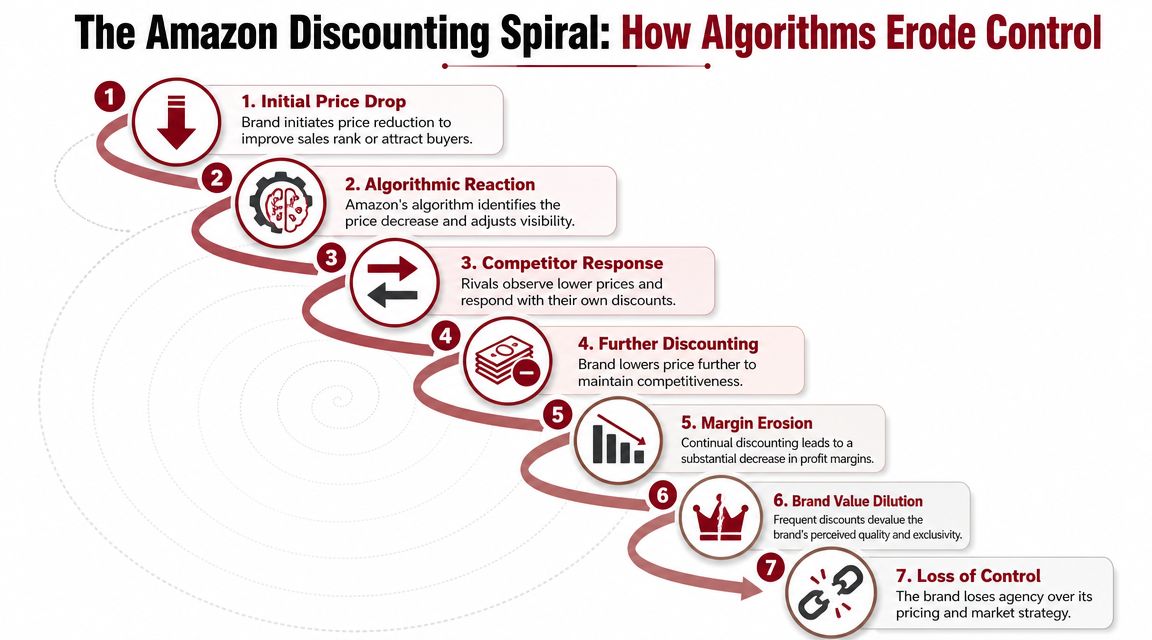
The Discounting Spiral How Amazon's Algorithm Erodes Control
The dangerous part of discounting on Amazon isn't just that margins shrink. It's that the platform remembers your behaviour and starts using it against your future pricing.
On Amazon AU, the Typical Price calculation was recalibrated in 2024 to include historical discounting data over 90 days, which means repeated promotions don't disappear when the sale ends. According to Cahoot's write-up of Amazon 1P pricing control issues, discounts above 15% offered more than three times in a quarter can lower the benchmark by 10 to 18%. The same source notes that brands discounting quarterly saw their Typical Price drop 22% on average, followed by a 31% fall in conversion rates post-promo.
Why the algorithm punishes repeated promotions
A founder often assumes a sale is temporary. The algorithm often treats it as a new reference point.
That changes the economics of every future campaign. Once the system has learned that your product is frequently available below list price, later promotions can lose impact. Deals may become less visible. Full-price periods look inflated to shoppers. The product starts needing price intervention just to maintain what used to happen naturally.
The trap is technical, not emotional. You're no longer deciding price in a clean market. You're negotiating with a marketplace memory system that has already reset buyer expectations.
How competitor behaviour turns one discount into a price war
Amazon doesn't operate in isolation. Your discount becomes a signal to other sellers, other brands, and automated repricers.
One seller cuts. Another seller's bot reacts. A third seller follows to stay eligible for the Buy Box. Soon the founder who thought they were running a tactical promotion is operating in a repricing loop. If there are multiple sellers on one Amazon listing, the brand can lose the ability to communicate a single market position because each seller is optimising for their own immediate outcome.
Here's what typically happens in practice:
- The brand drops price first: often to improve rank, move stock, or support a launch.
- The algorithm resets expectations: historical discounting starts shaping the Typical Price benchmark.
- Other sellers follow: manual discounting and repricing tools narrow the room to recover.
- The brand responds again: not because it wants to, but because the listing now struggles at its intended price.
- The category starts reading the product differently: what was premium now behaves like a commodity.
Practical rule: If you need repeated discounts to preserve velocity, the platform is no longer supporting your positioning. It's rewriting it.
What works and what doesn't
What doesn't work is trying to out-discount a system built to reward reaction speed. Founders often believe they can run one more campaign, hold rank, then restore price later. In reality, the “later” phase is where they discover the benchmark has moved.
What works is discipline before the spiral starts:
| Decision area | Weak response | Strong response |
|---|---|---|
| Promotions | Frequent deep discounts to chase spikes | Controlled, limited promotions with clear rules |
| Seller behaviour | Let multiple actors influence price | Tighten distribution and seller permissions |
| Visibility problems | Solve with lower price | Audit listing quality, content control, and ownership |
| Buy Box pressure | Match every move | Decide where price should hold and where volume can be sacrificed |
A founder who understands this early stops asking, “How do we discount better?” and starts asking, “Why are we letting Amazon train the customer to wait for a lower price?”
That's the more useful question.
Beyond Margin Erosion The Hidden Costs of a Discount-Led Strategy
Margin loss is the visible cost. Loss of control is the expensive one.
Once a brand starts using discounts as a regular operating tool on Amazon, the problem usually spreads beyond price. Teams begin with a simple goal. Keep units moving. What follows is less simple. Lower prices attract more attention from opportunistic sellers, increase pressure on customer support, and force the business to spend time protecting a listing that no longer behaves like a controlled brand asset.

The cost shows up in operating drag
Founders often look at discounting through a finance lens first. That is understandable, but incomplete.
The harder cost to reverse is the shift in how the product is managed day to day. A listing under constant price pressure tends to attract more interference. More sellers test the offer. More pricing tools react to every move. Internal teams get pulled into disputes over fulfilment quality, listing accuracy, review mismatches, and who is shaping the customer experience.
That work does not create growth. It burns management attention.
In practice, discounting often creates a second P&L inside the business. It sits in support tickets, agency hours, marketplace monitoring, and senior time spent resolving problems that should never have reached the founder.
Customers read instability faster than brands expect
Customers do not separate pricing behaviour from brand quality. They read the whole signal.
If the product is positioned as premium but appears to be on sale every other week, buyers stop treating the list price as real. If the Amazon presentation varies by seller or fulfilment source, they stop assuming the experience will be consistent. If your direct site holds one price while Amazon trains them to wait for another, the brand starts looking conflicted.
That is where discounting becomes a positioning problem, not a promotion problem.
A weaker pricing signal usually brings other costs with it:
- Support load increases: customers ask whether the product is genuine, current, or materially different from what they bought before.
- Retail conversations get harder: buyers and distributors question whether your recommended pricing has any real authority.
- Internal focus shifts: commercial teams spend time correcting marketplace noise instead of building the next channel properly.
- Recovery gets more expensive: restoring price integrity often requires tighter distribution, stricter seller controls, and accepting lower volume for a period.
Even the fee structure worsens the trade-off. Amazon does not become cheaper because the brand cuts price. Referral fees, fulfilment charges, storage costs, and promotional spend still sit in the model, which is why founders need a clear view of how Amazon fees stack up against margin before they treat discounting as an easy fix.
A premium product can survive a promotion. Repeated price instability teaches the customer that patience matters more than brand value.
Why founders miss the real bill
The warning signs rarely appear in one report.
Finance sees lower margin. Customer service sees more confusion. Sales sees channel tension. Operations sees more marketplace exceptions. The founder feels the drag but often does not connect it back to the original pricing decision quickly enough.
That delay is costly. By the time discounting has become routine, the business is usually dealing with a changed market position. The product no longer commands its intended price with confidence. It has been recoded by the marketplace as an offer to watch, compare, and buy only when the number drops.
That is the hidden cost of a discount-led strategy. It weakens the systems that protect brand value, then asks the business to spend more time and money compensating for the loss.
How a Single Marketplace Can Damage Your Global Brand
Founders often treat Amazon geography as strategy. Australia sits in one plan, the US in another, the UK somewhere else, and retail is handled separately.
The market does not make those distinctions.
A price collapse on one Amazon marketplace changes how your brand is interpreted in every other channel that can see it. That includes retail buyers, distributors, international partners, and customers comparing markets side by side. Once one public price starts contradicting your intended position, expansion stops being a distribution question and becomes a credibility problem.
Local discounting creates global credibility problems
This is why discounting on Amazon is rarely just a marketplace issue. It is evidence that the brand is no longer setting a consistent commercial story across channels.
In the Amazon Seller Forums conversation on discounting and international brand impact, sellers describe the practical effect in plain terms. One recurring complaint is that once Amazon begins pushing lower visible pricing through automated promotions or marketplace pressure, retail accounts and overseas partners start using that number as the reference point, regardless of the brand's intended wholesale structure. The forum discussion does not provide a clean percentage to cite, but the pattern matters. Public marketplace pricing gets treated as market truth.
That is the part many founders underestimate.
Distributors do not care whether the lower price came from a deliberate campaign, an automated Amazon program, or a short-term attempt to lift conversion. They care that the product was publicly available at that number. From that point on, every margin conversation starts with doubt about whether your stated pricing architecture is real or temporary.
Why retail buyers become harder to win
Retail buyers are trained to spot pricing instability fast.
If a major chain sees your product selling below its intended position on Amazon, your wholesale case gets weaker before the first serious meeting. The buyer does not need to debate Amazon mechanics. They need to protect their shelf economics, promotional calendar, and category pricing logic. If they believe your brand can be undercut in public at any time, they will ask for lower buy-in, heavier support, or they will pass.
That same concern shows up in international distribution.
A distributor taking your brand into a new market is not just buying inventory. They are buying confidence that local retailers will not be forced into price-matching conflicts with a global marketplace screenshot. If your Amazon history suggests unstable pricing, selective distribution becomes harder to defend.
The risk is not limited to one discounted listing. The risk is teaching every future partner that your public price is negotiable.
The hidden strategic cost
The real loss is strategic flexibility.
Discount-led behaviour on one marketplace can reduce your ability to:
| Strategic objective | What discounting does to it |
|---|---|
| Enter premium retail | It weakens your price position before the buyer reviews the product |
| Support distributors | It raises fears of channel conflict and future undercutting |
| Launch in new regions | It carries an unstable value signal into markets that have not met the brand yet |
| Hold DTC pricing | It makes your own site look inflated instead of deliberate |
I have seen founders read strong Amazon sales as proof that expansion is working, while the brand is becoming harder to place everywhere else. The numbers can look healthy inside Seller Central and still erode negotiating power outside it.
That is the control problem.
Repeated discounting tells the market that Amazon, not the brand, is shaping public value. Once buyers, distributors, and customers absorb that lesson, you do not just lose margin. You lose authority over what your product is worth.
The Strategic Alternative Building a Moat Around Your Brand
The alternative to discount-led growth isn't stubbornly refusing every promotion. It's building a business that doesn't need frequent price cuts to explain why the product deserves demand.
That requires a moat. Not a marketing slogan. A commercial moat made up of controlled distribution, clear positioning, disciplined channel roles, and traffic sources that you influence more directly.

Control starts outside Amazon
Many brands still treat Amazon as the primary engine of discovery. That's becoming a weaker assumption, especially in categories where products need education, context, or trust before purchase.
As noted in the YouTube discussion that argues Amazon is losing discovery and forcing sellers to own their own traffic, sellers increasingly need to build direct-to-consumer and wholesale partnerships earlier rather than relying on Amazon's search funnel. The same source argues that brands which deprioritise an Amazon-first strategy in favour of regional distribution partnerships often achieve faster profitability and stronger brand control.
That matters because a founder with diversified demand has more control. If traffic comes only from Amazon search, Amazon conditions the brand. If demand also comes from DTC, email, retail partners, distributors, and repeat customers, the brand can decide when Amazon matters and when it doesn't.
What a real moat looks like
A durable moat usually includes several layers working together:
- Selective distribution: not every reseller should have access to the product, especially in early market expansion.
- Clear channel roles: Amazon can be one buying path, but it shouldn't define the product's total market identity.
- Brand-led content: product pages, imagery, comparison assets, and usage education should do more than support conversion. They should defend perceived value.
- DTC signal strength: your own site should reinforce why the product is worth its intended price.
- Wholesale depth: strategic regional partnerships can stabilise reach without turning the brand into an open listing free-for-all.
Founders often ask which of these matters most. The answer depends on the product, but the order usually starts with channel discipline. A product placed everywhere ends up controlled nowhere.
Why channel diversification is defensive, not optional
This short breakdown is useful if your team has been relying heavily on Amazon for market entry:
The strategic shift is straightforward. You stop using price as the main mechanism for competitiveness and start using structure.
That means:
- choosing which channels are allowed to carry the brand
- deciding what each channel is supposed to do
- protecting the commercial conditions that keep one channel from poisoning the others
Brands that keep control rarely look “everywhere” early. They look deliberate. That restraint is often what preserves margin later.
A moat doesn't make Amazon irrelevant. It makes Amazon one part of the system rather than the system itself. Once a founder sees that clearly, discounting stops looking like a necessary tactic and starts looking like an expensive substitute for strategy.
When to Partner for Controlled Global Expansion
Founders usually wait too long to get strategic help. They bring in partners when the channel conflict is already visible, the pricing is already unstable, or the retail opportunity is already harder to land than it should be.
The better moment is earlier, when the product has traction but the expansion model is still flexible.

The signs you've outgrown a channel-only approach
A niche agency can manage ads, fix creatives, or improve marketplace operations. That can be useful. But it won't solve a business model problem if your brand is entering new regions without a coherent pricing and distribution architecture.
You're likely at the point of needing a broader strategic partner when several of these signs appear together:
Amazon performance is growing but confidence is falling
Revenue doesn't feel clean because the brand is relying on promotions, reacting to sellers, or explaining too many price inconsistencies.Retail conversations keep circling back to online price
Buyers hesitate because the public market signal doesn't support your intended positioning.International expansion feels fragmented
Each new region is treated as a separate launch instead of part of a coordinated brand system.Internal teams are spending time on channel friction
Senior commercial people are chasing listing issues, repricing problems, or market-by-market exceptions.
What the right kind of partner should actually do
A serious expansion partner should help with decisions that shape control, not just execution volume.
That includes questions like:
| Decision point | Weak support | Strategic support |
|---|---|---|
| New market entry | Open the marketplace quickly | Assess channel fit, pricing risk, and brand translation |
| Distribution | Add sellers for reach | Build selective relationships that protect value |
| Pricing | React to local pressure | Set rules that preserve global consistency |
| Brand positioning | Optimise listing copy | Clarify how the product should be perceived across markets |
The distinction matters. If the product is proven, the challenge usually isn't finding another channel. It's entering the right channel in the right order, with enough control that one market doesn't destabilise the next.
A useful decision test for founders
Ask three questions.
- Can we explain our pricing logic across Amazon, DTC, and wholesale without sounding defensive?
- Do we know which channel should lead in each market, and why?
- If one marketplace discounted the product aggressively tomorrow, would the rest of our channel strategy still hold?
If the answer to those questions is unclear, the issue isn't just marketplace management. It's brand governance.
At that point, the smartest move often isn't to push harder into Amazon. It's to build the structure that lets Amazon sit inside a controlled expansion plan rather than dictate it.
Frequently Asked Questions About Brand Control on Amazon
Founders usually don't need another abstract warning. They need to know what to do next, what to stop doing, and where promotions still fit.
Is discounting always a mistake on Amazon
No. A promotion can be useful when it is limited, intentional, and tied to a clear commercial objective.
The problem starts when discounting becomes your default answer to weak visibility, slowing conversion, Buy Box pressure, or seller conflict. That's when price stops acting like a tool and starts acting like a dependency. If the business needs regular discounts to stay competitive, the brand is probably compensating for weaker control elsewhere.
Short-term promotions can support strategy. Repeated promotions often replace strategy.
What is the first practical step to regain control
Start with the listing and the seller environment before you touch pricing again.
Audit who is selling the product, what content is currently live, whether images and titles reflect your intended positioning, and whether the offer looks consistent across your own channels. If the listing is unstable, any pricing fix will be temporary because the customer is still seeing a compromised version of the brand.
Should we prioritise Amazon or diversify earlier
For many established product brands, earlier diversification is the safer path.
Amazon can still be part of the mix, but it shouldn't be carrying the full burden of discovery, validation, and international entry on its own. If your traffic sources, customer relationships, and channel partners all sit outside your control, Amazon gains too much influence over how the market values the product.
How do we think about promotions without damaging the brand
Use a simple filter before approving any campaign:
- Reason for the discount: Is it tied to a defined launch, inventory event, or strategic test?
- Duration: Is there a clear endpoint, not a vague promise to “go back up later”?
- Channel effect: Will the discount create problems for DTC, wholesale, or future retail meetings?
- Behavioural risk: Are you training customers to wait for the next sale?
If the team can't answer those questions clearly, the promotion is probably a reaction.
What does regaining control look like in practice
It usually starts with a few disciplined moves, then compounds from there.
| Area of Control | Immediate Action | Long-Term Strategy |
|---|---|---|
| Listing integrity | Audit titles, images, backend content, and seller activity | Maintain ongoing monitoring and clear ownership rules |
| Pricing discipline | Pause habitual discounting and review recent promotion behaviour | Set channel-specific pricing guardrails that support brand position |
| Seller environment | Identify who is on the listing and why they're there | Build selective distribution and reduce unnecessary marketplace exposure |
| Traffic sources | Reduce dependence on Amazon search alone | Grow DTC, wholesale, and regional partner demand |
| Global expansion | Review whether one market's pricing is affecting another | Build a coordinated market-entry plan rather than expanding channel by channel |
Can a brand recover after losing control
Yes, but recovery is harder than prevention.
The reason is simple. Once customers, sellers, and channel partners have learned to treat the product as negotiable, you need more than a price increase to change the story. You need cleaner distribution, stronger presentation, better channel sequencing, and enough conviction to sacrifice some short-term volume while the market resets.
That's uncomfortable for founders focused on monthly numbers. It's also often necessary if the goal is to build a brand that can scale globally without being priced like a commodity.
If you've built a strong product and you're now facing pricing pressure, channel conflict, or messy international expansion, TPR Brands works with established companies that want controlled growth rather than uncontrolled reach. The focus is on protecting brand value while opening the right next channels across Australia, the US, Canada, and the UK.