Your Amazon dashboard says the product is working. Orders are coming through. The listing has traction. You've proved demand in Australia, and Canada looks like the next sensible move.
Then the numbers underneath the headline revenue start to tell a different story.
Profit is thinner than expected. Reorders feel riskier than they should. Advertising spend keeps climbing. Freight, duties, tax registration, packaging changes, and marketplace fees start stacking on top of each other. What looked like expansion begins to behave more like leakage.
This is the problem behind Why Your Product Sells on Amazon… But Makes Less Money. For established Australian brands, especially those with real traction and a reputation to protect, Amazon growth is only valuable if the economics still work after the product crosses a border.
That distinction matters even more in Canada. The market can be highly attractive for the right product, but it punishes brands that treat international expansion like a listing exercise instead of a business model decision. We're seeing this firsthand while working with a major Australian cosmetics brand entering the Canadian market. The demand side is only one part of the equation. The harder part is structuring the move so the brand keeps its margin, stays compliant, and builds long-term value rather than chasing short-term marketplace sales.
The Anatomy of Profit Erosion on Amazon
A lot of founders have the same reaction when they first look closely at Amazon profitability. “We're selling well, so why does the margin feel worse than direct-to-consumer or wholesale?”
Because Amazon doesn't take profit in one obvious place. It takes it in layers.

Revenue can grow while profit falls
The most common mistake is reading top-line sales as proof of commercial health. On Amazon, that's dangerous. Unmanaged advertising costs typically consume 12–15% of sales, while properly managed campaigns reduce this to 5–8%, according to this breakdown of Amazon seller economics. That same analysis notes that referral fees, fulfilment fees, and storage charges sit on top of advertising, and only 10–15% of products launched become top performers.
That matters because many brands build forecasts as if their launch will sit in the winning minority. Most won't.
If your product is priced too low, the pressure gets worse fast. The same source notes that a $20 product can become unprofitable despite high sales volume once the full Amazon cost stack is included. That is exactly why a founder can feel encouraged by unit movement while the finance team gets increasingly uneasy.
For brands that haven't mapped fee exposure in detail, a proper Amazon fee review usually changes the conversation very quickly.
Practical rule: Don't ask whether the product sells. Ask whether each additional sale leaves enough room for ads, fulfilment, returns, storage, and cross-border overhead.
The cost stack that founders often underestimate
Amazon margin erosion usually comes from several small decisions rather than one catastrophic error.
- Advertising drift. Campaigns start tightly managed, then broaden over time. Search terms get less disciplined, bids rise, and the account pays to defend positions that don't always translate into profitable sales.
- Fulfilment complexity. FBA simplifies delivery, but convenience doesn't mean low cost. Oversized packaging, awkward dimensions, and slower inventory turns all affect the economics.
- Storage penalties. Slow-moving variants don't just sit there. They tie up working capital and add carrying cost inside the Amazon system.
- Referral fees on every order. Founders often think in gross margin before marketplace deductions, which creates a false sense of security.
- Cross-border friction. Once you move into Canada, the base Amazon model is joined by import administration, customs documentation, tax handling, and local compliance work.
A healthy Amazon business has to absorb all of those without relying on optimistic assumptions.
Why low-price success is often misleading
A listing can perform well in search and still be the wrong product to scale internationally. This happens often with products that feel “easy to move” because the retail price seems accessible. Lower price points can drive volume, but they leave less room for error.
That's why founders need to separate marketplace traction from commercial viability. A fast-selling product with weak contribution margin is not your expansion vehicle. It is a warning.
Sales velocity hides bad unit economics for longer than most brands expect.
The founder who wins in Canada usually isn't the one with the cheapest item. It's the one who chooses a product with enough gross profit buffer to survive the full marketplace and cross-border cost structure.
Building Your Foundation for Canadian Expansion
Before inventory moves, your account structure has to match the way you want to operate. Established brands ought to approach this differently from smaller marketplace sellers. The question isn't just how to get live quickly. It's how to keep reporting clean, protect brand control, and avoid operational mess six months later.
Unified account or separate Canada setup
For many Australian brands, the first decision is whether to use a North America Unified Account or create a more isolated Amazon.ca structure.
A unified setup can make sense if you're building a broader North American strategy and want tighter coordination across marketplaces. It can simplify central oversight of catalogue, brand assets, and account management. It also reduces the risk of building siloed processes that become difficult to reconcile later.
A separate Canada-first structure can be useful when the business wants cleaner market-level reporting, tighter local operational control, or a staged entry approach. That can suit a brand that wants to validate Canadian economics on their own merits before expanding further across North America.
Neither option is automatically right. The wrong choice is the one made for speed alone.
The decision criteria that actually matter
Founders should test the account structure against practical questions, not abstract convenience.
- Who owns the market P&L. If Canada needs to stand on its own financially, a cleaner separation can help.
- How will inventory be managed. A shared North American approach can work well, but only if forecasting, replenishment, and customs workflows are already organised.
- Who controls listings and brand assets. Registry, content ownership, and user permissions need to reflect the long-term brand structure, not whoever happened to set up the first account.
- How will currency settlement be handled. Revenue visibility matters more once foreign exchange starts affecting margin.
- What happens if channel conflict appears. If you already sell through distributors or local partners, the account design should support that reality instead of undermining it.
Build for control, not just launch speed
A rushed setup usually creates one of two problems. Either the founder loses visibility because too many functions are bundled together, or the team creates unnecessary fragmentation and spends months fixing admin rather than growing the brand.
The better approach is to define the operating model first.
A solid Canadian foundation usually includes:
- A clear legal entity path for how the business will trade into Canada.
- A decision on importer responsibility before stock leaves Australia.
- Brand registry alignment so content, trademarks, and listing control aren't sitting in the wrong hands.
- Document readiness for banking, tax, customs, and account verification.
- Reporting design that shows contribution margin by market, not just sales by channel.
If the account structure makes monthly reporting harder, it will make strategic decisions worse.
This is one reason established brands often use an operating partner rather than treating the move like a simple marketplace launch. TPR Brands works with proven product companies on market-entry structure, channel strategy, and execution across markets where on-the-ground coordination matters.
Documentation is an operational issue, not a clerical one
Founders often delegate paperwork too late. That creates hold-ups when Amazon asks for business verification, when customs brokers need importer information, or when tax registration requires matching records across jurisdictions.
The stronger pattern is to gather and reconcile documents early. Business registration details, beneficial ownership information, trademark records, packaging files, and product specifications should all match across systems. Small inconsistencies create expensive delays once goods are in motion.
In practice, the best Canadian launches feel boring at this stage. That's a good sign. It means the backend is organised enough to support growth.
Navigating Canadian Compliance and Tax Obligations
Most Australian brands don't fail in Canada because the product is wrong. They get delayed, margin-compressed, or operationally exposed because compliance was treated as a finishing touch.
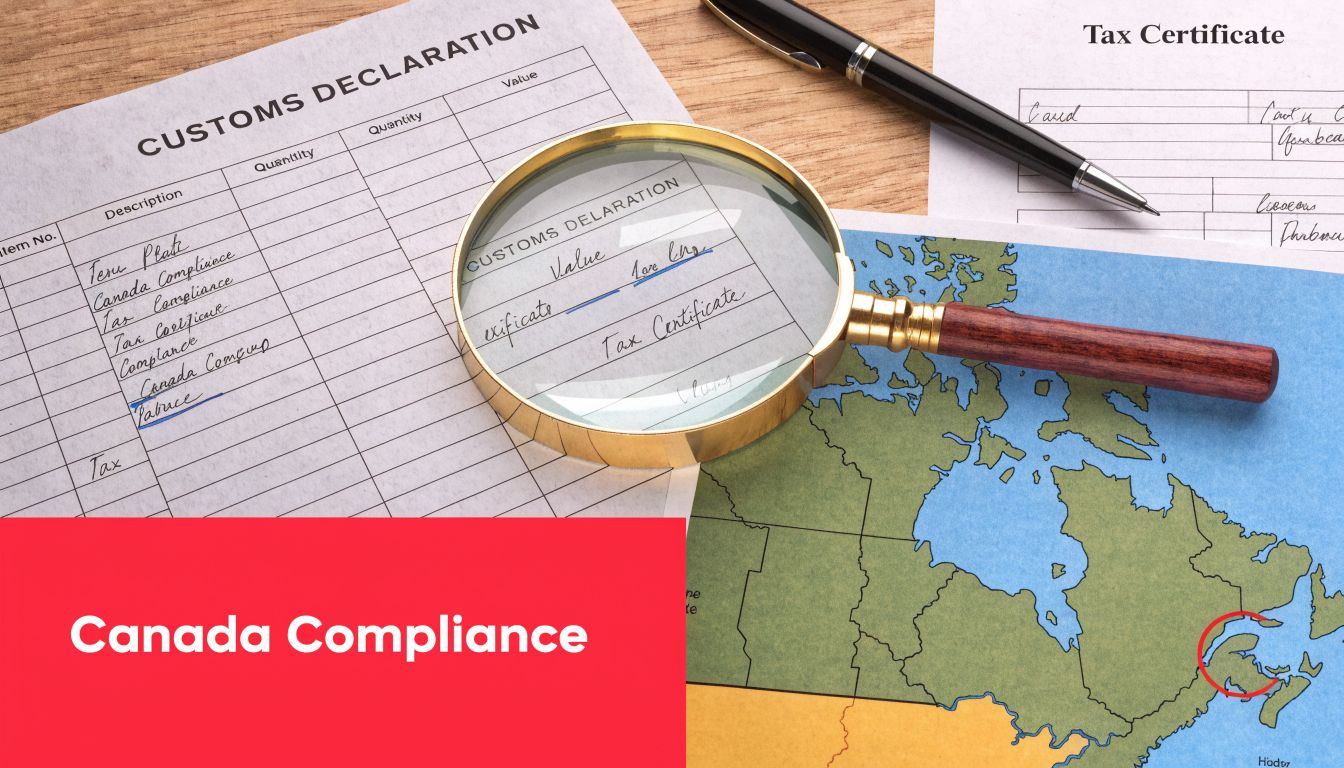
In Canada, compliance affects packaging, labelling, tax handling, customs clearance, and the way your inventory is allowed to move. If any of that is left unresolved, the product doesn't just become inconvenient to launch. It becomes risky to scale.
Tax registration needs an early decision
When an Australian company starts selling into Canada, one of the first practical questions is how it will handle GST and HST obligations as a non-resident business. This is not something to “sort out after launch”.
The right structure depends on how your goods enter the country, who acts as importer, where inventory is stored, and how the commercial flow is set up between your Australian entity and the Canadian customer. Those decisions affect tax registration, invoicing, landed cost treatment, and reporting.
Founders should work through these issues before inventory is shipped:
- Who is the importer of record
- Whether the business needs Canadian tax registration before launch
- How taxes will be collected and remitted
- How marketplace transactions reconcile with internal accounting
- How tax treatment interacts with customs and fulfilment decisions
A lot of Australian brands underestimate how quickly a tax issue becomes a cash flow issue. If the setup is wrong, margin gets distorted and reporting becomes unreliable.
For brands planning an Amazon-led entry, a more detailed view of the market setup is available in this Amazon Canada expansion guide.
Operator's view: Tax should be designed into the expansion model. If finance only sees it after the first shipment, you're already behind.
French language requirements are not optional
The second major trap is packaging and labelling. Canada is not a market where English-only packaging should be assumed to be fine.
French language requirements matter nationally in practical terms, and Quebec raises the stakes further. If your product, packaging, inserts, warnings, or claims aren't structured properly for bilingual compliance, you create avoidable exposure for the brand. This is especially important for cosmetics, household items, and consumer products where packaging carries functional, safety, and marketing information.
For established brands, this changes more than just the label. It can affect:
- Primary packaging layout
- Outer cartons and inserts
- Instruction materials
- Claims hierarchy and pack real estate
- Artwork approval timelines
- Inventory planning across bilingual and non-bilingual stock
A founder who wants speed will often ask whether bilingual packaging can wait until the product proves demand. In most cases, that's the wrong instinct. Packaging redesign is usually cheaper and cleaner before launch than after stock is already flowing.
Compliance has to be built into the launch timeline
The practical issue isn't just cost. It's sequencing.
A Canadian market entry usually needs legal, regulatory, packaging, tax, and logistics work to happen in the right order. If one piece slips, everything behind it slows down. Listings can be ready while inventory sits. Ads can be prepared while packaging is still under review. Forecasts can look solid while the importer setup remains unresolved.
That's why serious brands create a compliance workstream rather than burying the issue inside general operations.
This short video gives a useful visual explanation of the kind of compliance thinking founders should bring into cross-border launches:
A simple way to pressure-test your readiness
Use this before approving your first Canadian shipment.
| Compliance area | Founder question | Why it matters |
|---|---|---|
| Tax setup | Have we confirmed how GST/HST applies to our structure? | Prevents messy remediation and unclear margin reporting |
| Import pathway | Do we know who is legally responsible when goods enter Canada? | Affects customs, tax, and clearance risk |
| Packaging | Is every required consumer-facing element reviewed for bilingual use? | Reduces relabelling risk and launch delays |
| Product claims | Are pack claims and listing claims aligned? | Avoids regulatory and platform issues |
| Records | Can finance, ops, and Amazon documentation all match? | Stops verification and audit friction |
Compliance done early feels expensive. Compliance done late is usually more expensive and far more disruptive.
Designing a Profitable Cross-Border Logistics Strategy
Most margin problems in Canada don't start with ads. They start with the physical journey of the product.
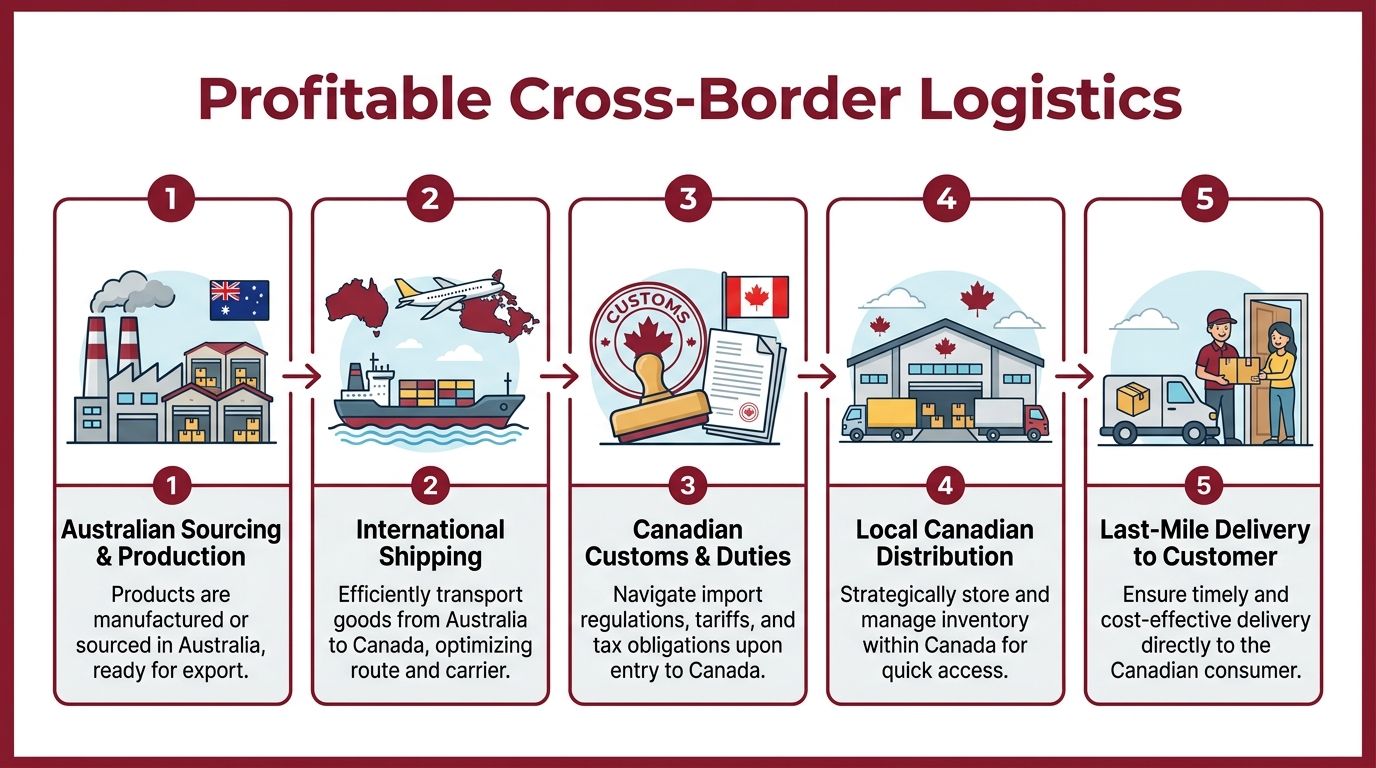
A founder approves a product for expansion because the Australian numbers look healthy. Then the product is exported, cleared, stored, transferred, fulfilled, and returned through a completely different cost environment. If logistics was treated as a shipping task rather than a commercial model, the margin starts shrinking before the first review appears on Amazon.ca.
Cheap products usually don't travel well
One of the most consistent patterns in cross-border expansion is that low-priced products struggle to absorb the added cost stack. A documented case discussed in this video on product economics showed that products priced around AUD $20 saw advertising and logistics costs consume margin faster than volume could compensate. The same source says products in the AUD $70–$300 range show “stronger unit economics” and provide “more room for ads”.
That idea matters in Canada because freight, customs handling, brokerage, local storage, and last-mile fulfilment don't care whether your item is strategically priced too low. They still take their share.
If the product has enough brand value and gross profit depth, you can carry those costs. If it doesn't, every operational step becomes a tax on growth.
Choose the right path before you choose the freight
There isn't one correct logistics model. There are trade-offs.
Direct shipping from Australia can work when demand is still being tested or product flow is modest. It limits upfront warehousing commitments, but it usually increases landed cost volatility and makes service levels harder to control.
A Canadian 3PL model gives better local inventory positioning and can support broader channel expansion beyond Amazon. It also creates more moving parts. Stock transfers, local receiving, and inventory reconciliation have to be managed well.
Amazon FBA as a non-resident seller can compress the customer experience nicely, but it doesn't remove the need to solve import structure, customs clearance, and upstream inventory planning. It only changes where some fulfilment responsibilities sit.
The strongest logistics strategy starts with a commercial decision: what level of customer experience, replenishment speed, and margin protection does the brand require?
Logistics is not a back-office function in cross-border ecommerce. It is one of the main drivers of profit or loss.
The landed cost model has to be visible
If founders only look at manufacturing cost and Amazon selling fees, they miss the full cost-to-serve. A practical landed cost model should include every category that affects delivered margin.
Here is a simple working format.
| Cost Component | Example Cost (CAD) | Notes |
|---|---|---|
| Product cost | Qualitative only | Base unit cost before export-related additions |
| International freight | Qualitative only | Varies by mode, timing, and shipment profile |
| Customs and brokerage | Qualitative only | Depends on classification and entry structure |
| Duties and import taxes | Qualitative only | Driven by product type and import setup |
| Canadian warehousing or FBA inbound | Qualitative only | Includes receiving and placement implications |
| Amazon referral and fulfilment fees | Qualitative only | Must be modelled against selling price |
| Advertising | Qualitative only | Should be estimated conservatively, not optimistically |
| Returns and damaged stock allowance | Qualitative only | Especially relevant for consumer categories |
| Packaging localisation and compliance handling | Qualitative only | Often omitted in early forecasts |
The table looks simple, but the discipline matters. When every cost line is visible, product selection improves. When half of them are hidden inside general overhead, bad expansion decisions survive for too long.
Classification and customs work change margin more than people expect
Two operational details deserve more founder attention than they usually get.
First, HS code classification. If the code is wrong, duty treatment and clearance risk can change. That doesn't just create admin pain. It changes landed economics and can disrupt inventory availability.
Second, customs broker selection. A good broker does more than file entries. They help keep documents consistent, reduce avoidable delays, and support the importer structure you've chosen. For established brands, that reliability matters as much as price.
Logistics and finance converge. Your freight method affects your inventory position. Your customs setup affects your tax handling. Your stock location affects fulfilment cost and service level. A proper cross-border logistics structure has to connect those decisions instead of managing them in isolation.
The real strategic choice
The practical question isn't “How do we ship to Canada?” It's “Which products deserve to carry cross-border infrastructure?”
For many brands, the answer is not the bestseller with the highest unit count. It's the product with the healthiest margin architecture, the clearest customer value, and enough pricing power to absorb the realities of international fulfilment.
That's the product that turns Canadian expansion into a brand-building move instead of an expensive experiment.
Localising Your Brand and Listings for Canadian Consumers
A lot of Australian founders assume Canada will be easy because the market feels familiar. English-speaking in many contexts. Similar digital buying behaviour. Strong Amazon adoption. Comparable product categories.
That assumption is expensive.
Canada doesn't reward brands that show up with lightly edited Australian listings. It rewards brands that feel local, credible, and deliberate. If your listing reads like it was copied from another market, shoppers may not articulate the problem, but conversion often reflects it.

Localisation changes trust before it changes conversion
Canadian buyers look for signs that a brand belongs in the market. Those signals sit inside language, imagery, claims, seasonality, and product framing.
A listing can be technically correct and still feel imported.
That usually happens when brands reuse:
- Australian usage language that doesn't match the way Canadian shoppers search
- Seasonal references that fit the Southern Hemisphere sales calendar rather than the Canadian retail year
- Visuals that ignore local household context, weather, or lifestyle cues
- Pricing logic that looks like a currency conversion instead of a market position
The strongest Canadian listings don't directly translate. They reinterpret.
A localised listing tells the shopper, “This product was brought here on purpose.”
Why Canada is not just a smaller version of the US
Some brands overcorrect and treat Canada as an extension of the United States. That creates a different set of problems.
The shopper language can overlap, but market nuances still matter. Regional preferences, bilingual expectations, climate use cases, and promotional timing all affect how products should be presented. Even straightforward household or beauty products can require different emphasis depending on where and how they are used.
For example, a pack message built around an Australian summer usage pattern may not be commercially useful if the Canadian purchase trigger is tied to indoor seasonal behaviour, cold-weather storage, or a different home-maintenance cycle.
That's why localisation should affect both listing copy and commercial planning.
The parts of the listing that deserve real adaptation
Founders often focus on the title and bullets first. Those matter, but localisation needs a wider lens.
Search language and keyword intent
You need Canadian search behaviour, not a recycled Australian keyword list. The strongest terms are often less about obvious product naming and more about context, application, and local buying habits. Sponsored campaigns should reflect that same reality. Otherwise, the account pays to learn lessons that market research could have clarified earlier.
A+ Content and imagery
Images should reflect Canadian environments and use cases where relevant. This doesn't mean covering everything in flags and clichés. It means using scenes, styling, and product framing that feel believable in-market.
Offer architecture
Bundles, pack sizes, and variation strategy should also be reviewed. Sometimes the right product for Canada is not the exact SKU mix that performed best in Australia. The market may prefer a different starter configuration, replenishment format, or gifting presentation.
Pricing in CAD
A straight currency conversion is not a pricing strategy. Canadian pricing has to protect margin while still preserving the product's perceived value. If the item looks too expensive relative to category expectation, conversion suffers. If it looks too cheap, you may win volume at the expense of brand position and contribution margin.
Market-entry advice: Set CAD pricing from a full landed-cost view and a deliberate brand position. Don't let exchange-rate math write your strategy.
Localisation is part of brand building
Founders with strong products sometimes resist localisation because they think it dilutes the original brand. In practice, the opposite is usually true.
A brand gets stronger when it translates well across markets without losing coherence. That requires selective adaptation. The core promise stays intact. The way you express it changes to match the customer in front of you.
That distinction is where a lot of international launches either stall or scale.
An actionable Expansion Checklist for Founders
A profitable Canadian launch rarely comes from one clever move. It comes from a chain of disciplined decisions made in the right order.
Use this checklist as a final founder-level filter before committing serious inventory and budget.
Commercial fit
- Choose the right product first. Don't default to the bestseller. Pick the SKU with enough margin room, clear differentiation, and pricing power to handle cross-border costs.
- Pressure-test contribution margin. Review the product after marketplace fees, freight, compliance work, tax handling, and launch advertising are included.
- Protect brand position. If the product only works by dropping price aggressively, it may not be the right entry vehicle.
Operational readiness
- Confirm the account structure. Your Amazon setup should support reporting, control, and future expansion, not just launch speed.
- Lock the importer and tax pathway. If this is vague, the launch is not ready.
- Review packaging and claims. Bilingual requirements and claim consistency should be resolved before stock moves.
- Map the logistics model. Decide how inventory will enter, clear, store, and fulfil inside Canada.
Market execution
- Localise the listing properly. Adapt copy, imagery, and keyword strategy for Canadian shoppers.
- Build a realistic launch forecast. Assume operational friction, not a perfect run.
- Create one owner for the Canadian P&L. If responsibility is fragmented, margin problems will hide.
Expansion works best when founders treat Canada as a strategic market entry, not a spare Amazon storefront.
The brands that scale cleanly are usually the ones that slow down early, make the hard structural decisions, and only then push for growth.
If you're an established brand assessing whether Canada is the right next move, TPR Brands works with founders and operators navigating cross-border expansion, channel structure, compliance, and market positioning so growth is built on margin discipline rather than marketplace momentum alone.